

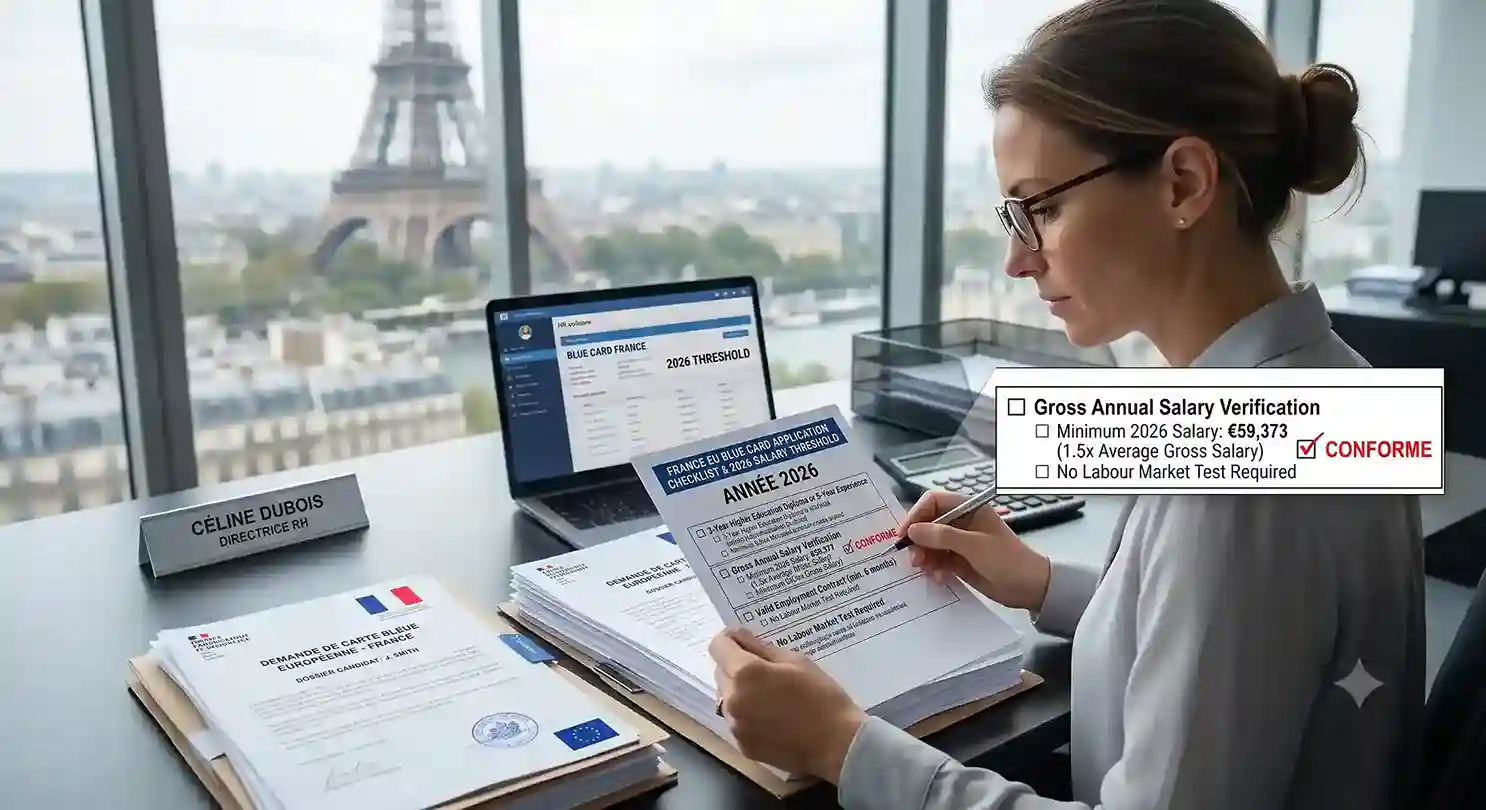
Key Takeaways: France EU Blue Card
- The 2026 salary threshold for the France EU Blue Card is €59,373 gross annually your employment contract must reflect this before you submit.
- No labour market test is required, making it one of the fastest routes to bring non-EU specialists into France.
- The full application runs in two stages: a long-stay visa from the French consulate, then a residence permit via the ANEF platform within 3 months of arrival.
- Total government fees are approximately €449: €99 for the consular visa and €350 for the residence permit (tax and stamp duty combined).
- Blue Card holders can move to another EU member state after 12 months, which matters if your company operates across borders.
- Jobbatical team handles France EU Blue Card applications, end-to-end in a compliant manner.
What Is the France EU Blue Card?
The blue card france is a combined work and residence permit for highly qualified non-EU, non-EEA, non-Swiss professionals. Officially issued as the carte bleue européenne passeport talent, it sits within France's broader immigration framework but carries one distinct advantage: intra-EU mobility.After 12 months of legal residence in France, your employee can transfer to another EU member state without starting the immigration process from scratch.
┈┈┈┈┈┈┈┈┈┈┈┈┈┈┈┈┈┈┈┈┈┈┈┈┈┈┈┈┈┈┈┈┈┈┈┈┈┈┈┈┈┈┈┈┈┈┈
What Are the France EU Blue Card Requirements in 2026?
Before submitting an application for the carte bleue européenne france, HR teams must ensure their candidate satisfies every mandatory eligibility criterion, including the 6-month minimum contract duration and the €59,373 gross annual minimum salary (carte bleue européenne salaire minimum).
Eligibility Criteria at a Glance: EU Blue Card France
Pro-Tip for HR Teams: While a reduced salary threshold for STEM/ICT shortage occupations exists on paper, the definitive ministerial list of eligible professions faces ongoing regional rollout delays. To ensure a seamless application and avoid processing backlogs, it is safest to meet the standard €59,373 threshold for all tech roles.
┈┈┈┈┈┈┈┈┈┈┈┈┈┈┈┈┈┈┈┈┈┈┈┈┈┈┈┈┈┈┈┈┈┈┈┈┈┈┈┈┈┈┈┈┈┈┈
Which Documents Do You Need for the France EU Blue Card Application?
To ensure a smooth filing for the EU Blue Card France, both employer and employee must prepare a complete, compliant documentation package. Most personal and academic records are gathered by the applicant, while the sponsoring company supplies the employment contract and corporate compliance filings required under the passeport talent carte bleue européenne framework.
Employee Documents for Blue Card France
- Valid passport (must remain valid throughout the permit period)
- Two recent passport-sized photographs
- Completed long-stay visa application form
- University degree certificate(s) recognised in France or the EU or proof of 5 years relevant experience
- Clean criminal record certificate
- Proof of health insurance coverage
- If changing status in France: proof of current valid residence permit
For a step-by-step overview of france work permit , see our France Passeport Talent Guide, which covers the key requirements and process employers need to understand.
Employer Documents for Blue Card France
- Signed employment contract stating role, salary (at or above €59,373), and contract duration (minimum 6 months)
- Employer declaration form (completed by the company, submitted alongside the visa application)
- Company registration documents (Kbis extract or equivalent)
- Confirmation that the company has no outstanding social security, tax, or labour law issues prefectures can now refuse applications on this basis
Translation errors between the employment contract and the qualification documents are one of the most common rejection triggers. Have a consistent job title and role description across every document before submission.
┈┈┈┈┈┈┈┈┈┈┈┈┈┈┈┈┈┈┈┈┈┈┈┈┈┈┈┈┈┈┈┈┈┈┈┈┈┈┈┈┈┈┈┈┈┈┈
How Do You Apply for the France EU Blue Card ?
The France EU Blue Card application process generally has two stages for employees applying from abroad: obtaining the appropriate long-stay visa before travelling to France and, where required, applying for the multi-year residence permit after arrival.
Stage 1: Long-Stay Visa for Employees Applying From Abroad
- Complete the France-Visas application: The employee applies for the appropriate long-stay visa through the French visa process in their country of residence. For an EU Blue Card applicant, the visa is issued under the "passeport talent carte bleue européenne" category.
- Submit the required documents: The employee provides the personal, professional and employer documentation required for the application. The employer must complete the relevant employment documentation, including the form required for the EU Blue Card application.
- Pay the visa fee: The standard long-stay visa fee is €99.
- Receive the visa and enter France: Once the visa is approved, the employee can travel to France.
- Validate a VLS-TS where applicable: If the employment arrangement is for less than 12 months, France-Visas states that a long-stay visa serving as a residence permit (VLS-TS) bearing the "passeport talent" designation is issued. This must be validated online within 3 months of arrival.
Stage 2: Residence Permit Application in France
For an EU Blue Card France arrangement requiring a multi-year residence permit, the employee must apply after arriving in France.
- Apply within 2 months of arrival: The employee submits the application for the multi-year Talent residence permit through the ANEF online platform. France-Visas specifies that EU Blue Card holders can apply for the multi-year residence permit within 2 months of arrival.
- Submit the supporting documents: The application includes the employee's identity and residence documents, employment documentation and evidence of the qualifications required for the EU Blue Card.
- Pay the residence permit tax: The current Service-Public guidance states that the Talent residence card costs €225, consisting of a €200 tax and €25 stamp duty.
- Receive the residence permit: The EU Blue Card is generally issued for the duration of the employment contract, subject to a maximum validity of 4 years.
Use our OFII validation after arrival checklist to understand the key post-arrival steps, deadlines, and compliance requirements for France.
Status Change (for employees already in France)
If your employee is already in France on a different permit, they apply for a change of status directly on the ANEF platform. Submit 4–2 months before the current permit expires. No visa application is needed for this route.
Jobbatical manages both stages end-to-end, eligibility assessments, document preparation, ANEF submissions, and real-time tracking across your entire employee pipeline. Book a demo to see how it works.
┈┈┈┈┈┈┈┈┈┈┈┈┈┈┈┈┈┈┈┈┈┈┈┈┈┈┈┈┈┈┈┈┈┈┈┈┈┈┈┈┈┈┈┈┈┈┈
How Much Does the France EU Blue Card Cost in 2026?
Sponsoring a specialist under the EU Blue Card france involves total official government fees of €449, combining the €99 consular long-stay visa with €350 in residence permit taxes and stamp duty.
Official Government Fee Breakdown : France EU Blue Card
These are state fees only. Professional immigration management, document translation, legalisation, and any OFII integration obligations are separate costs. Budget accordingly if you are managing multiple relocations.
┈┈┈┈┈┈┈┈┈┈┈┈┈┈┈┈┈┈┈┈┈┈┈┈┈┈┈┈┈┈┈┈┈┈┈┈┈┈┈┈┈┈┈┈┈┈┈
How Long Is the France EU Blue Card Valid and How Do You Renew It?
EU Blue Card France Permit Duration
- The Blue Card matches the length of your employment contract, up to 4 years.
- Short contracts get a small buffer: a contract under 2 years results in a card valid for the contract duration plus 3 months.
France EU Blue card Permit Renewal
- Renewal must be submitted via ANEF no earlier than 4 months and no later than 2 months before expiry.
- At renewal, the current salary threshold applies not the threshold at original application. If the figure has increased, the salary must be adjusted first.
- Companies with multiple Blue Card holders should run a compliance audit at least 6 months before the earliest renewal date.
- Keep in mind that under the current tax structure, the total fee due at renewal has risen to €250 (€200 renewal tax + €50 administrative stamp duty).
┈┈┈┈┈┈┈┈┈┈┈┈┈┈┈┈┈┈┈┈┈┈┈┈┈┈┈┈┈┈┈┈┈┈┈┈┈┈┈┈┈┈┈┈┈┈┈
What Are the Employer Compliance Obligations for the France EU Blue Card?
Sponsoring a specialist under the Talent – Carte Bleue Européenne requires strict operational compliance. Under current rules, Prefectures can refuse initial filings and renewals if an employer has outstanding social security, tax, or labor law discrepancies.
To safeguard your approval timelines, global mobility managers must manage five core pillars:
- The Personnel Register Mandate: Every foreign national’s work authorization must be logged immediately in your company’s registre unique du personnel with a copy attached. Mismatches in role titles, categories, or branch locations can trigger administrative fines between €4,000 and €8,000 per employee.
- Ongoing Salary Tracking: Compensation is monitored continuously. If a Blue Card holder’s salary drops below the mandatory €59,373 threshold for more than 3 consecutive months, upcoming renewals will be denied.
- Stricter Integration Requirements: Multi-year permit extensions are subject to strict integration criteria, including passing a standardized civic knowledge exam and hitting specific French language proficiency thresholds. HR teams must flag these testing windows early.
- Arrival Validation: Ensure the worker validates their long-stay visa online via the OFII portal within 3 months of entering France and completes registration with French social security (CPAM) within 90 days.
- Status Change Notifications: Any immediate changes to the employee's contract statussuch as termination, layoffs, or major role modifications, must be reported directly to the prefecture via the ANEF portal.
┈┈┈┈┈┈┈┈┈┈┈┈┈┈┈┈┈┈┈┈┈┈┈┈┈┈┈┈┈┈┈┈┈┈┈┈┈┈┈┈┈┈┈┈┈┈┈
What is the difference between France EU Blue Card vs.Talent Passport (carte bleue européenne vs passeport talent)?
A common point of confusion is treating these as two competing schemes, but the Blue Card sits directly inside the French framework as the Passeport Talent – Carte Bleue Européenne. The real decision is simply selecting the right sub-category for your specific hire.
- One framework, many categories: While the broader framework covers numerous national permits, the carte bleue européenne passeport talent is its single EU-harmonized category governed by dedicated European directives.
- Shared mechanics: Both routes bypass labor market tests to offer multi-year residence permits and grant immediate Talent – Famille work rights for accompanying family members.
- Breadth vs. the single EU category: National categories accommodate founders and lower-salary specialists, whereas the passeport talent carte bleue européenne is exclusively reserved for highly qualified salaried professionals earning at least €59,373.
- Key advantages: The primary passeport talent carte bleue européenne avantages include structured intra-EU mobility, 90-day cross-border work exemptions, and the ability to stack multi-country residency time toward long-term EU status.
- Best-fit summary: Choose a national category for France-bound hires or salaries under €59,373, but select the Passeport Talent –Carte Bleue Européenne for high-earning specialists needing European cross-border mobility.
For a deeper look at how cross-border moves work once the card is issued, see our guide to Intra-EU Mobility: Moving an EU Blue Card Holder to France.
┈┈┈┈┈┈┈┈┈┈┈┈┈┈┈┈┈┈┈┈┈┈┈┈┈┈┈┈┈┈┈┈┈┈┈┈┈┈┈┈┈┈┈┈┈┈┈
France EU Blue Card vs. Talent Salarié Qualifié : Which Route Fits Your Hire?
The EU Blue Card is not always the optimal permit for a France-based hire. The Talent Salarié Qualifié permit suits certain profiles better, and choosing correctly at the outset prevents costly refiling.
- Salary threshold difference: The Talent – Salarié Qualifié route uses the €39,582 reference salary, while the Blue Card requires 1.5× that figure at €59,373, so roles paying below €59,373 fit the Salarié Qualifié route instead.
- Qualification and role profile: The Talent – Salarié Qualifié covers qualified employees broadly, whereas the Blue Card is defined by a higher qualification-and-salary bar rather than a specific sector, which in practice suits senior technical and highly paid positions.
- Family reunification: Both routes grant families the simplified talent – famille residence card with full work rights and no standard reunification waiting period, so family access is broadly equivalent between the two permits.
- EU-wide portability: The Blue Card offers structured intra-EU mobility after 12 months and stacked residency time across member states, which the Talent – Salarié Qualifié does not provide for multi-country strategies.
- Best-fit summary: Choose the Talent – Salarié Qualifié for France-centric hires or salaries below €59,373; choose the Blue Card for higher-paid roles where intra-EU mobility and cross-border residency support a broader European expansion plan.
For end-to-end support selecting and filing the right skilled-worker route into France, explore our France Talent Passport service, Jobbatical's expert-managed permit solution for HR teams relocating talent to France.
┈┈┈┈┈┈┈┈┈┈┈┈┈┈┈┈┈┈┈┈┈┈┈┈┈┈┈┈┈┈┈┈┈┈┈┈┈┈┈┈┈┈┈┈┈┈┈
What is the France EU Blue Card Minimum Salary (Carte Bleue Européenne Salaire Minimum)?
The France EU Blue Card minimum salary is €59,373 gross annually for 2026. This figure is not arbitrary; it is anchored in a specific ministerial order that HR teams should understand when justifying compensation to internal stakeholders.
- The governing order: A ministerial order dated 29 August 2025, published in the Journal Officiel, sets the reference salary framework for both Talent and Blue Card permits.
- The reference salary: The order establishes a gross annual reference salary of €39,582, which functions as the 1× baseline for the Talent-Qualified Employee permit.
- The Blue Card multiplier: The €59,373 threshold is derived directly as 1.5 times that reference salary, under Articles R. 421-16 A and R. 421-21 A of CESEDA.
- EU Blue Card Minimum Salary Threshold( Carte bleue européenne salaire minimum): Meeting this mandatory €59,373 gross annual requirement is a strict compliance rule, meaning any employment contract offering below this minimum cannot be processed under the Blue Card route.
- Geographic scope: The thresholds apply to mainland France and extend to Saint Barthélemy and Saint Martin for the European Blue Card specifically.
- Repeal of prior rules: The order revokes the earlier 2016 thresholds, replacing the outdated €53,837 figure that governed applications until August 2025.
For hands-on help ensuring your employment contracts meet France's compliance thresholds, see our France EU Blue Card service, Jobbatical's fully managed route for sponsoring highly skilled talent in France.
┈┈┈┈┈┈┈┈┈┈┈┈┈┈┈┈┈┈┈┈┈┈┈┈┈┈┈┈┈┈┈┈┈┈┈┈┈┈┈┈┈┈┈┈┈┈┈
What Changed in the 2026 France EU Blue Card Reform ?
France's recent decrees introduced several structural relaxations that make the Blue Card more flexible than it was under the previous framework. Understanding what changed helps employers exploit newly available hiring options.
- Shorter contract minimum: The mandatory contract duration dropped from 12 months to 6 months, covering both fixed-term (CDD) and permanent (CDI) contracts.
- Experience-based qualification: Applicants may now substitute a degree with 5 years of relevant experience, or 3 years for specific in-demand sectors, subject to the ministerial occupational list.
- Visa-free intra-EU entry: Blue Card holders from another member state can enter France visa-free and file their French application within 30 days of arrival, rather than restarting the process.
- Adjusted validity buffers: Contracts under two years now yield a card valid for the contract duration plus a three-month buffer, capped at 24 months.
- Heightened compliance auditing: Authorities have intensified scrutiny of employer tax and labour records, including URSSAF standing, during the application process.
┈┈┈┈┈┈┈┈┈┈┈┈┈┈┈┈┈┈┈┈┈┈┈┈┈┈┈┈┈┈┈┈┈┈┈┈┈┈┈┈┈┈┈┈┈┈┈
What Happens If You Don't Comply With France EU Blue Card Rules?
Employing a foreign national without the correct, validated authorization or employing them outside their permitted profession or region,carries severe penalties:
- Administrative Fines: Up to €20,750 per worker for a first infraction, jumping to €62,250 for repeat offenses.
- Criminal Penalties: Fines have doubled up to €30,000 per worker.
Automating compliance tracking prevents last-minute renewal surprises and shifts your HR team from reactive crisis management to smooth talent mobility.
┈┈┈┈┈┈┈┈┈┈┈┈┈┈┈┈┈┈┈┈┈┈┈┈┈┈┈┈┈┈┈┈┈┈┈┈┈┈┈┈┈┈┈┈┈┈┈
How Does EU Mobility Work Under the France Blue Card?
The defining edge of the EU Blue Card (Talent – Carte Bleue Européenne) over standard qualified employee streams is its unparalleled regional flexibility. For multi-national corporations or businesses running regional projects across the continent, this permit cuts through localized red tape in two distinct ways:
1. Short-Term Project & Work Exemption (New for 2026)
Following recent immigration adjustments, holders of an EU Blue Card issued by another EU Member State can now enter France to perform actual paid, salaried work for up to 90 days within any 180-day period completely exempt from a French work permit. This makes it incredibly easy to deploy cross-border project teams or handle temporary internal transfers without getting bogged down in separate immigration filings.
2. Long-Term Intra-EU Relocation
After 12 months of legal residence in France, your employee can transfer permanently to another participating EU member state (like Germany, Spain, or the Netherlands) via a highly accelerated, simplified track without needing to start their original immigration process from scratch.
┈┈┈┈┈┈┈┈┈┈┈┈┈┈┈┈┈┈┈┈┈┈┈┈┈┈┈┈┈┈┈┈┈┈┈┈┈┈┈┈┈┈┈┈┈┈┈
How Does the France Blue Card Fast-Track Permanent Residency work?
If your company is onboarding a specialist who already holds an EU Blue Card from a different member state, there is an underrated structural bonus: their accumulated time spent living under that previous card counts toward France's 5-year long-term residency requirement. In practice, this means experienced international hires gain much faster access to permanent status, serving as a powerful lever for long-term talent retention.
Compliance Note: For a standard French Talent Passport, moving to a secondary EU country requires waiting out localized timelines or filing separate initial visas. If your business model relies on moving talent fluidly between European offices, the Blue Card is by far the superior long-term vehicle.
┈┈┈┈┈┈┈┈┈┈┈┈┈┈┈┈┈┈┈┈┈┈┈┈┈┈┈┈┈┈┈┈┈┈┈┈┈┈┈┈┈┈┈┈┈┈┈
Disclaimer: Immigration rules change quite frequently; please verify with official sources or contact us for the latest info before making any decisions.
Frequently Asked Questions -France EU Blue Card 2026

.svg)
.svg)