.svg)


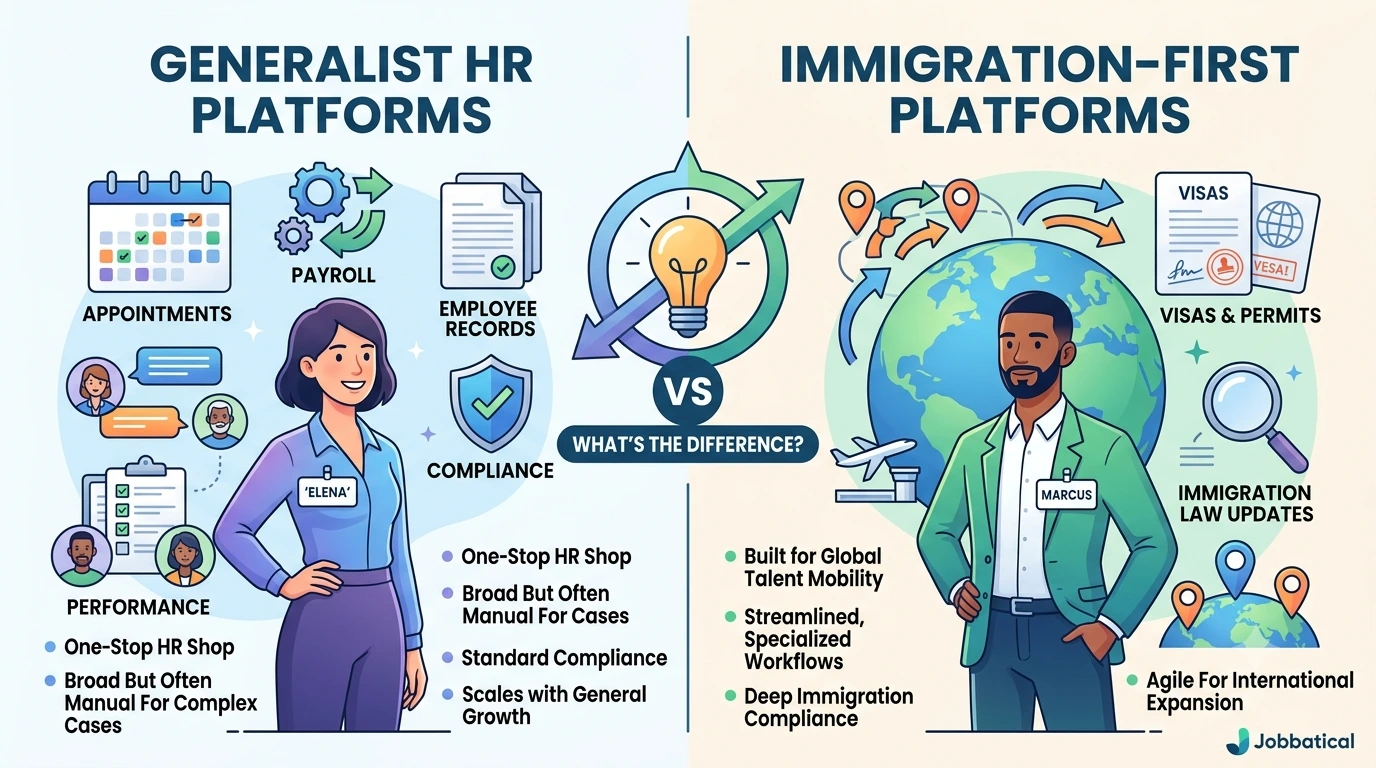
- Specialized Infrastructure Reduces Refusals: Immigration-first platforms handle complex visa rules, eligibility checks, and compliance requirements that general HR tools aren’t built to manage.
- Up to 40% Faster Processing: Direct ATS/HRIS integrations, automated document collection, and streamlined workflows reduce manual work and speed up visa processing.
- In-House Legal Expertise: Dedicated immigration specialists manage cases end-to-end, avoiding the delays and inconsistencies of outsourced legal partners.
- End-to-End Relocation Support: Beyond visas, specialized platforms help employees with housing, banking, tax registration, and other settlement services to improve the relocation experience and retention.
Global hiring has changed dramatically over the last few years. Companies are now hiring across borders earlier, faster, and in more markets than ever before. As a result, global mobility and immigration operations are no longer isolated HR functions. They have become operational infrastructure.
This shift has also created a new category question for growing companies. Should immigration be managed inside a broad global HR platform, or through a specialized immigration-focused system?
The answer depends on operational complexity, hiring velocity, and how immigration workflows are managed internally.
Why Generalist Global HR Platforms Emerged
As international hiring accelerated, companies began looking for consolidated systems that could simplify payroll, hiring, contractor management, and employer-of-record (EOR) operations under one platform.
This led to the rise of broad global employment platforms such as Deel, Remote, and Rippling. Their appeal is clear:
- One vendor relationship,
- Centralized workforce management,
- Integrated payroll and HR tooling,
- And simplified international onboarding.
For many companies, especially during early international expansion, this model reduces operational fragmentation and speeds up market entry.
Generalist platforms are designed to solve a broad set of global employment challenges across many functions simultaneously. However, immigration workflows introduce a different layer of operational complexity.
Why Immigration Workflows Operate Differently
Unlike standard HR workflows, immigration processes are highly dependency-driven. A single immigration case may involve:
- Employees
- Legal teams
- Internal HR
- External vendors
- Government authorities
- Relocation timelines
- Renewal deadlines across multiple jurisdictions
These workflows are not basic onboarding tasks but ongoing operational processes with legal, logistical, and time-sensitive dependencies. This creates challenges that generalist systems do not always prioritize deeply
As mobility programs scale, these workflows become increasingly operational rather than administrative.
The Difference Between Generalist and Immigration-First Platforms
At a high level, the distinction is not necessarily about which model is “better.” It is about what each system is optimized to handle.
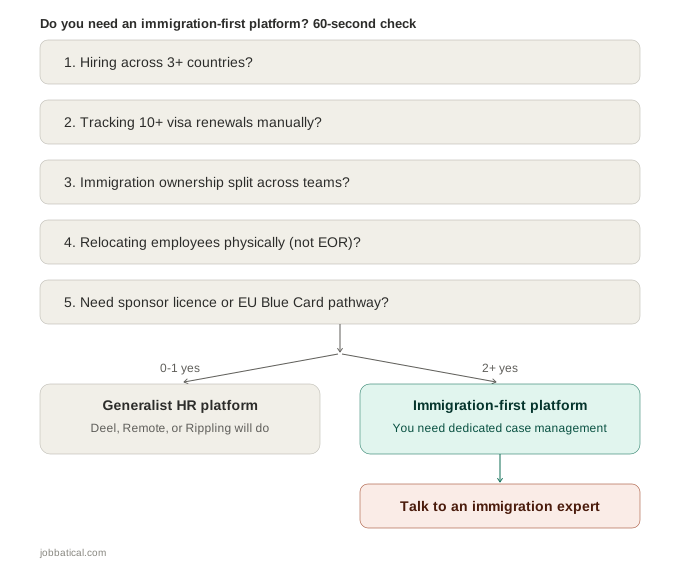
Generalist platforms typically optimize for breadth across the employment lifecycle. Immigration-first platforms on the other hand, optimize for depth within mobility and immigration operations themselves.
This distinction becomes more important with increase in hiring volume, Visa complexity, Relocation frequency or multi-country workforce coordination.
When Companies Begin Looking for Specialized Immigration Infrastructure
Many organizations initially manage immigration through broader HR or EOR systems successfully.
However, operational friction often increases when:
- hiring expands across multiple jurisdictions,
- renewal management becomes difficult to track,
- immigration ownership becomes fragmented,
- legal coordination slows down hiring,
- employees lack visibility into case progress.
At this stage, companies often begin evaluating whether immigration requires dedicated operational tooling rather than functioning as a secondary layer inside a broader HR platform.
This is one reason why immigration-first platforms have gained traction among companies with growing mobility programs.
Different Vendors, Different Operational Models
The global mobility ecosystem now includes several distinct operating models.
The Market Is Moving Toward Operational Immigration Infrastructure
As global hiring scales, immigration is increasingly being treated as an operational system rather than a purely legal or administrative function.
This shift is changing how companies evaluate platforms. Instead of only asking “Can this provider process immigration cases?” Teams are increasingly asking:
- Can this system support immigration operations at scale?
- Can stakeholders collaborate effectively?
- Can renewals and dependencies be managed proactively?
- Can mobility workflows integrate cleanly into hiring operations?
These questions are driving the rise of immigration-first operational platforms alongside broader global HR systems.
Compare Different Immigration Platform Approaches
If you are evaluating different mobility and immigration operating models, these comparisons may help:
The differences between vendors are often less about features alone and more about the operational philosophy each platform is built around.
The Verdict: Which is Best for Your Business?
If your global strategy focuses primarily on hiring remote workers in their home countries using an Employer of Record (EOR), a Generalist HR Platform will cover your core needs.
However, if your growth requires physically relocating top tier talent into your own entities, managing corporate sponsor licenses, or navigating complex visa pathways like the EU Blue Card, an Immigration-First Platform is a strategic necessity. It provides the deep technical specialization, speed, and bulletproof compliance required to scale a truly borderless workforce.
Frequently Asked Questions : HR Platforms vs. Immigration-First Platforms

.svg)
.svg)