

Key Take aways for Global Mobility Compliance
- Immigration case files contain some of the most sensitive personal data your company handles passports, visas, home addresses, and salary details.
- A single misconfigured server or uncontrolled third-party access can expose hundreds of employee records and trigger GDPR fines of up to €20 million.
- Role-based access controls and encrypted communication logs are non-negotiable for any platform handling cross-border relocation data.
- Jobbatical renewed its ISO 27001:2022 certification in 2026, confirming enterprise-grade information security management across all platform operations.
- Choosing an ISO-certified immigration platform is not just a security decision, it is a compliance obligation under GDPR.
The Data Risk Most HR Teams Overlook
Immigration case files contain highly sensitive information, moving frequently through unencrypted emails and unrestricted folders. While HR focuses heavily on visa approvals, the secure handling of this global mobility data is often dangerously overlooked. Ensuring GDPR-compliant onboarding for global hires is a critical step.
- Passport copies and national ID numbers are routinely shared via standard email.
- Salary details and medical certificates sit in unprotected local folders.
- Global mobility compliance must include rigorous data protection standards.
- Most HR teams lack proper encryption for external vendor communications.
Vulnerabilities in Global Mobility Workflows
Traditional relocation processes inherently scatter employee data across various unsecured touchpoints, making tracking nearly impossible. Relying on disparate systems prevents HR from maintaining a centralized, auditable trail of document access.
- Spreadsheets lack the security controls needed for sensitive immigration data.
- Local hard drives create dangerous silos of unencrypted personal files.
- Third-party agents often use their own untracked external servers.
Why Standard HR Systems Fall Short
General HR Information Systems (HRIS) are excellent for payroll and performance, but they are not built to handle the complex document exchange required for visas. Immigration processes require dynamic, multi-party access that standard HR software cannot securely accommodate.
- HRIS platforms lack specific immigration compliance tracking features.
- Providing external agents access to your HRIS exposes broader company data.
- Standard systems struggle with international data residency requirements.
Why Immigration Data Is Especially High-Risk
Unlike a leaked corporate email, exposed immigration data is uniquely identifying, difficult to change, and directly usable for severe identity fraud. Under GDPR, your company remains fully liable as the data controller even if a third-party processor causes the data breach.
- Breaches involving passport numbers cause irreparable identity fraud risks.
- Companies face GDPR fines up to €20 million or 4% of global annual turnover.
- Data controllers are legally responsible for third-party processor mistakes.
- Cross-border relocations expose you to multiple international supervisory authorities.
Severe Penalties and GDPR Compliance Risks
Data protection authorities actively target mismanaged employee data, leading to massive financial penalties and public regulatory scrutiny. Ignorance of complex cross-border data transfer laws is not a valid legal defense during a compliance audit.
- Non-compliance triggers mandatory investigations by regional data authorities.
- Publicized data breaches cause immediate and lasting reputational damage.
- Tight 72-hour breach reporting windows demand proactive incident planning.
The Threat of Long-Term Identity Fraud
When cybercriminals access immigration files, they acquire a complete profile of an individual, including biometric and financial markers. This comprehensive data allows for sophisticated, long-term identity theft that disrupts the employee's entire life.
- Stolen passports are highly valued assets on the dark web.
- Identity fraud deeply damages the trust between an employee and employer.
- Recovering from identity theft takes years of complex legal navigation.
How Jobbatical Manages Data Across the Relocation Lifecycle
Traditional immigration workflows scatter sensitive documents across fragmented emails and systems, multiplying potential exposure points. Jobbatical centralises all case communication and document management within a single, securely controlled platform, perfectly optimized for managing multi-country relocations .
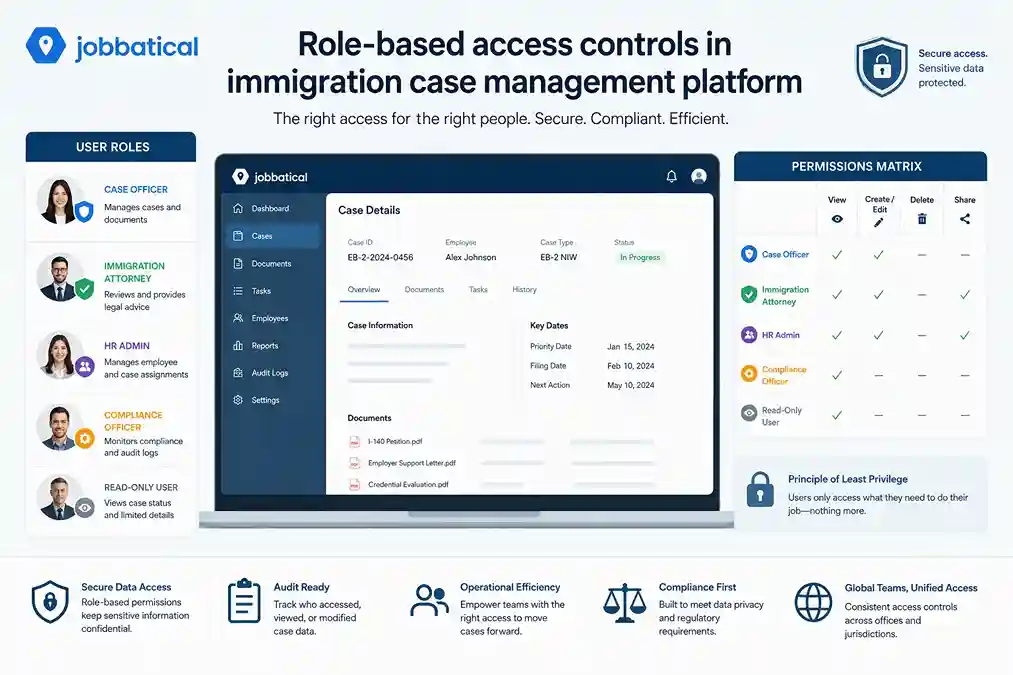
- Role-based access controls ensure users only see necessary case details.
- All platform messages are logged with strict timestamps and user attribution.
- Uploaded files are securely tied to specific case records, not shared inboxes.
- Clean audit trails provide immediate proof of compliance for data protection authorities.
Centralized Case Management vs. Email Chains
Replacing chaotic email threads with a unified portal drastically reduces the risk of human error, such as accidental cc’s or misaddressed attachments. Centralization ensures that the single source of truth for an immigration case is always secure and up-to-date.
- Platform messaging eliminates the risk of intercepted email attachments.
- Centralization prevents document loss due to employee turnover or absence.
- Unified portals streamline the overall candidate onboarding experience.
Role-Based Access Control and Strict Auditing
Not everyone involved in a relocation needs access to all documents; an agent needs the passport, but not the detailed salary contract. Jobbatical’s precise permissions ensure the principle of least privilege is rigorously applied across every single user.
- Granular permissions block unauthorized viewing of financial documents.
- Audit logs track exactly who viewed or downloaded specific files.
- Revoking access for departed stakeholders is immediate and absolute.
Key Areas of Data Protection in Global Mobility
Managing international relocations requires processing multiple categories of highly sensitive personal and financial data. Securing these touchpoints is critical to maintaining global mobility compliance and protecting employee privacy from end to end.
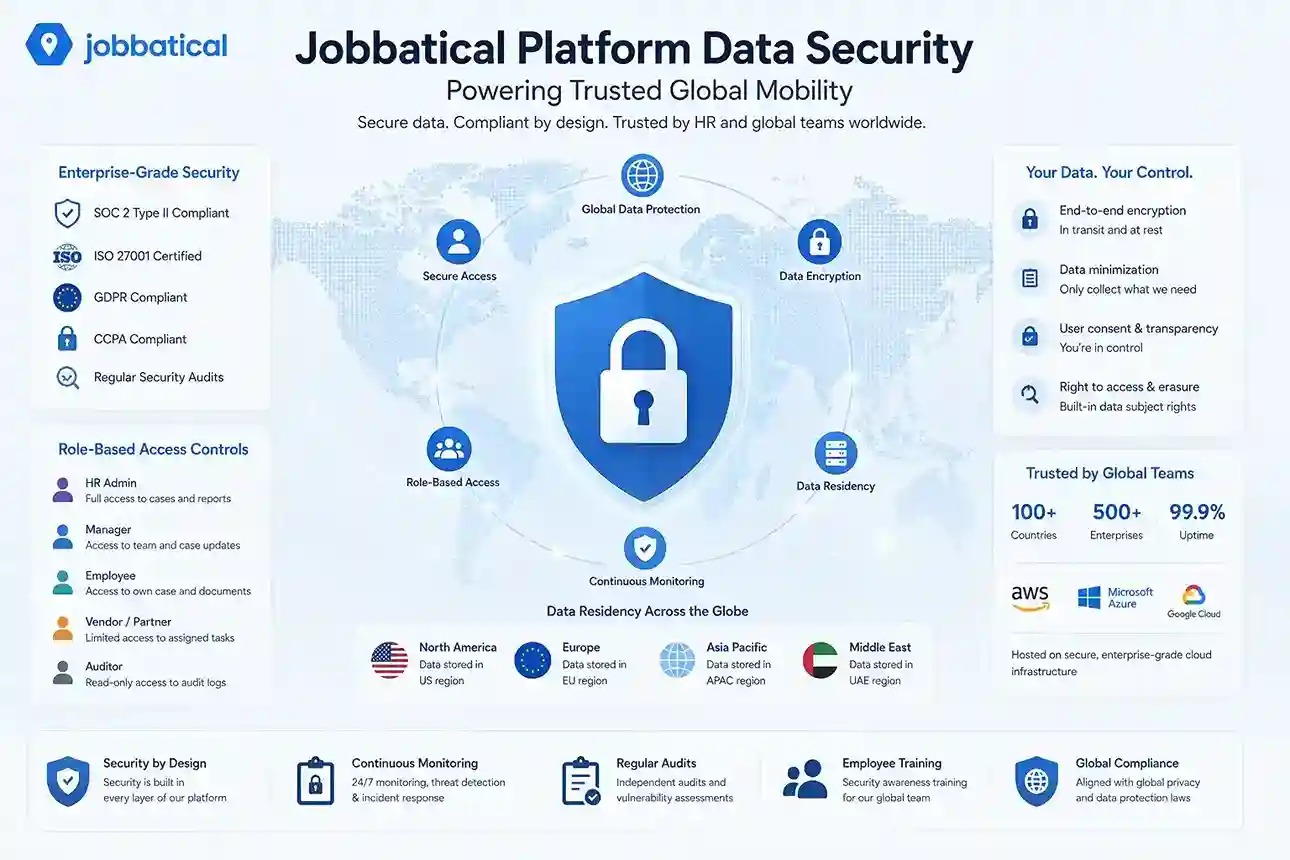
- Personal Data: Passports and national IDs must be protected against identity theft.
- Employment Data: Confidential salary details and contracts require encrypted storage.
- Documents: Medical certificates demand strict handling as special category data under GDPR.
- Communication: Forwarded email updates must be replaced by auditable platform messaging.
Jobbatical's ISO 27001:2022 Recertification in 2026
ISO 27001:2022 is the definitive international benchmark for rigorous information security management. Jobbatical's ISO 27001 certification validates our comprehensive information security practices.
- The 2022 edition replaces the outdated 2013 standard for modern threat mitigation.
- Certification demands independent audits and continuous security improvement.
- Using an independently verified processor strengthens your GDPR controller position.
- Annual surveillance audits ensure ongoing adherence to strict security protocols.
What to Look for in a Compliant Global Mobility Platform
Not all immigration software meets the rigorous security standards required for modern HR compliance and data protection. Procurement teams must conduct thorough due diligence on vendor data handling practices, often requiring a detailed global mobility software comparison before signing any agreements.
- Verify current ISO 27001:2022 certification, not expired older versions.
- Require comprehensive role-based access controls and detailed audit logs.
- Ensure Data Processing Agreements clearly outline GDPR obligations.
- Confirm EU data residency and strict restrictions on third-country transfers.
Conclusion
Data security in global mobility is no longer an optional IT concern; it is a fundamental pillar of modern HR compliance and corporate risk management. By treating immigration files with the exact same rigor as financial records, organizations can protect their employees and avoid catastrophic regulatory penalties.
📌 Not looking to talk to someone? Sign up for a self-serve FREE PLATFORM TRIAL
Disclaimer: Immigration rules change quite frequently; please verify with official sources or contact us for the latest info before making any decisions.
Frequently Asked Questions ,Global Mobility Data Compliance
What employee data is collected during an international relocation?
During relocation, companies collect passport copies, national ID numbers, salary details, home addresses, employment contracts, and family member information. This data is subject to GDPR when it involves EU-based employees or processing within the EU.
Does GDPR apply to immigration data for non-EU employees relocating to Europe?
Yes. GDPR applies when personal data is processed within the EU, regardless of the employee's nationality. If your company is managing a relocation to Germany or Spain, for example, all data handling falls under GDPR jurisdiction from the moment processing begins in the EU.
What is ISO 27001:2022 and why does it matter for HR teams?
ISO 27001:2022 is the international standard for information security management systems. For HR teams, it means the platform handling your employee immigration data has independently verified controls for data access, breach response, and risk management — reducing your liability as the data controller.
What security certifications should an immigration software provider have?
Look for providers with internationally recognized certifications such as ISO 27001 for information security management and GDPR-compliant data processing practices. These certifications demonstrate that the provider follows audited security controls, access management policies, and data protection procedures designed to safeguard sensitive employee immigration records.
How does Jobbatical protect immigration case data?
Jobbatical's platform uses role-based access controls so HR managers, immigration agents, and relocating employees each see only the data relevant to their role. All communications and documents are stored with audit logs, and the platform is ISO 27001:2022 certified — independently audited for information security controls.
Can I use email to share immigration documents with agents and employees?
Email is one of the highest-risk channels for immigration data. Passport scans and personal ID documents sent by email have no access audit trail, can be forwarded without control, and are rarely encrypted. Using a dedicated case management platform with permission-based document access eliminates this risk.

.svg)
.svg)