.svg)


_11zon.webp)
Key Take aways:
- Localyze is no longer independent : Acquired by Boundless Immigration in October 2025, it now operates as part of a US-headquartered global platform, shifting its focus well beyond European immigration.
- Acquisitions quietly change what you receive : Product roadmaps, support teams, and strategic priorities all shift to serve the acquirer's broader goals, often at the expense of the specialist depth you originally chose the provider for.
- Ask hard questions before renewing : Confirm whether your support team, SLAs, data residency, and pricing have changed. If answers are vague, that's a signal worth taking seriously.
- For European immigration, specialist focus beats global breadth : A provider whose entire product and team is built around European visas will consistently outperform a global platform trying to serve every geography at once.
In October 2025, Boundless Immigration acquired Localyze, one of the most recognised European global mobility platforms on the market. If you were a Localyze customer, or were evaluating them, that announcement probably raised a question: does this change anything for me?
The short answer is: yes, it likely does. Not immediately. But acquisitions change things in ways that aren't always obvious from the press release.
This piece is for HR leaders who manage European relocations and want to understand what to watch for when an immigration platform changes hands and what questions to ask before signing or renewing a contract.
Why Immigration Platforms Pursue Acquisitions
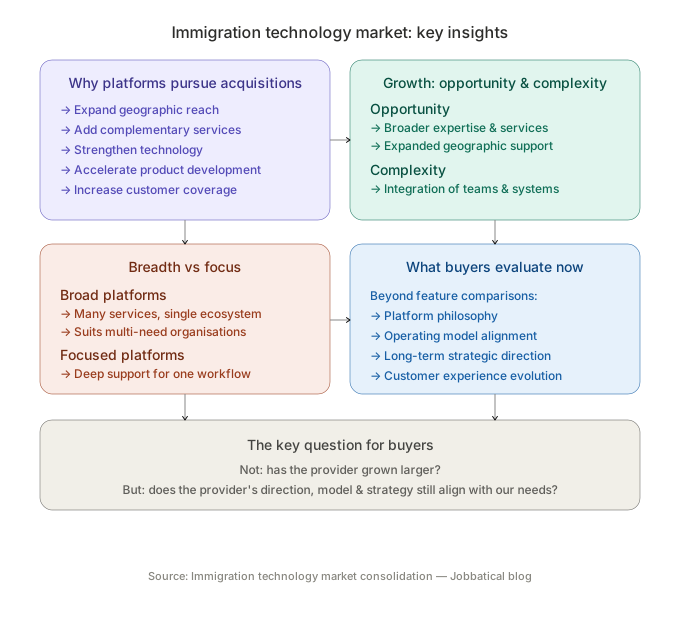
European immigration expertise from scratch, with in-country legal teams, government filing experience, and local knowledge across Germany, Spain, the UK, Portugal, and beyond takes years. Buying a company that already has it is faster.
For the acquiring company, the strategic logic is clear:
- Expand into a new geography quickly
- Add a customer base they didn't have
- Bundle services to compete with larger players
- Access technology or operational infrastructure
For example, Boundless is a US-focused immigration company, acquiring Localyze gave them a European foothold without building one from scratch. That's a rational business decision. But what does it mean for the companies that seek Localyze service specifically because of its European focus?
What Changes After an Acquisition
The first few months after an acquisition usually feel fine. Pricing stays the same. Your account manager is still there. The platform looks identical. The press release says "business as usual."
What actually shifts often quietly, over 12 to 24 months is, where the combined company's attention goes:
Product Roadmap
The platform's development priorities now have to serve two customer bases across multiple geographies. Features that mattered deeply to European-focused companies may move down the list in favour of US-market requirements or global integration work.
Support and Expertise
In-country immigration expertise is built over years and tied to specific people. Post-acquisition restructuring even well-intentioned restructuring can disrupt the teams that gave you the service quality you originally chose the provider for.
Strategic Focus
A European specialist becomes one division of a global platform. The energy that once went entirely into European visa depth now gets distributed across Americas, APAC, and whatever new markets the combined entity is chasing. That's not a criticism it's just the reality of how larger organisations work.
None of these changes are guaranteed to hurt you. Some companies come out of acquisitions with genuinely better products. But you shouldn't assume continuity without checking.
.svg)
The Questions HR Teams Should Ask
If your current provider has been acquired, or if you're evaluating a provider that recently went through a change of ownership here's what to ask before you commit:
Questions to Ask Your Provider
- Has your support team changed?
- Who will actually handle your cases day-to-day?
- Is the product roadmap still focused on European immigration?
- Or is development shifting toward the acquirer's primary market?
- Are your SLAs the same?
- Get confirmation in writing, not just in a call.
- Who owns your data?
- Data residency and GDPR compliance need to be confirmed under the new entity.
- What is the pricing model going forward?
- Acquisitions often lead to rebundling and repricing within 18 months.
If you don't get clear answers, that tells you something important.
Breadth vs. Focus: The Core Trade-Off
There's a genuine debate in this market between two models:
The All-in-One Global Platform
- One vendor handles everything - US visas, European permits, APAC compliance, relocation, expense management. The appeal is consolidation: fewer relationships, one contract, one dashboard.
- The risk is dilution. When a platform tries to serve every geography and use case at the same depth, it rarely leads every geography and use case.
The European Specialist
- A platform built specifically around European immigration with in-country legal teams, deep knowledge of German, Spanish, UK, and Portuguese visa processes, and a support structure designed for European HR workflows goes deep rather than wide.
- The trade-off is that you may need a separate vendor for other regions. But if Europe is where most of your international hiring happens, that specialist depth usually matters more than global breadth.
- In practice, most HR teams hiring into Europe need the second model. The complexity of European immigration country-by-country rules, language requirements, varying timelines, family reunification, permit renewals rewards specialisation.
What This Means If You're Evaluating Localyze vs Jobbatical
For a full side-by-side look at capabilities, pricing, and service models, see the Jobbatical vs Localyze comparison.
A Practical Framework for Evaluating Any Immigration Provider
Whether you're re-evaluating after an acquisition or doing a first-time vendor assessment, these four criteria matter more than any feature list:
Provider Evaluation Criteria
Conclusion
Acquisitions are a normal part of how technology markets mature. They're not inherently bad for customers. But they do change things and the HR teams that get caught out are the ones who assumed continuity without verifying it.
If your immigration provider has been acquired, treat it the same way you'd treat any major vendor change: review your contract, ask the hard questions, and make sure the service you're paying for still exists in the form you need it.
If you're starting fresh, look for a provider whose focus matches yours. For European immigration, that means someone whose entire product, team, and roadmap is built around exactly the problem you're trying to solve.
This is one reason comparisons such as Localyze vs Jobbatical are becoming more relevant. The discussion is often less about individual features and more about how different providers approach growth, specialization, customer experience, and operational execution. Understanding these differences helps organizations evaluate providers through the lens of their own priorities rather than market trends alone.
Frequently Asked Question : Immigration Platform Acquisition
Why are so many acquisitions happening in the immigration tech market?
The immigration technology market is entering a maturity phase. Providers are consolidating to accelerate growth, expand their geographic reach, strengthen market position, and add new services more quickly than building them internally. Acquisitions allow companies to scale faster and offer broader solutions to customers.
How do these acquisitions affect the day-to-day user experience?
Acquisitions create both opportunities and challenges. Customers may gain access to a wider range of services, stronger infrastructure, and larger support teams. At the same time, they may experience platform integrations, evolving product roadmaps, workflow changes, or adjustments to customer support processes as the businesses merge.
What is the difference between platform breadth and focus?
Platform breadth refers to an all-in-one ecosystem that covers a wide range of immigration, global mobility, compliance, and relocation services. Platform focus refers to a specialized solution designed to optimize a specific workflow or operational process in depth. Both approaches have advantages depending on your organisation’s priorities.
Should we choose a broad platform or a focused specialist?
The right choice depends on your primary business objective. A broad platform may be the better fit if you want to consolidate multiple vendors and manage immigration, relocation, and mobility services in one place. A focused specialist may be preferable if your priority is achieving maximum efficiency and expertise in a specific operational area.
Why are software feature checklists becoming less useful?
Most immigration and mobility platforms now offer similar core functionality, making feature checklists less effective as a decision-making tool. Buyers increasingly evaluate providers based on long-term strategy, service delivery model, customer support quality, innovation roadmap, and alignment with future business needs rather than individual features.
What do comparisons like Localyze vs Jobbatical actually represent?
Comparisons such as Localyze versus Jobbatical go beyond individual features. They often reflect different business philosophies, growth strategies, geographic strengths, service models, and approaches to customer support. Evaluating these differences can help organisations identify which provider aligns best with their operational priorities and long-term goals.

.svg)
.svg)