


KEY TAKEAWAYS
- The SOC code you assign decides eligibility, salary floor, discount access, and audit exposure all at once
- Match duties to the code, not the job title; "manager" alone maps to dozens of codes
- Use a five step process: write duties, search candidate codes, cross check Appendix Skilled Occupations, pick the majority duty match, keep the evidence
- For split roles, choose the code covering the majority of the working week and document why the alternative was rejected
- Rounding up to a higher code to justify an already agreed salary is the pattern most likely to trigger a compliance audit
A UKVI caseworker does not care what you called the role on the job advert. They care what the person does all day, and whether that matches the four digit code you put on the Certificate of Sponsorship. Get the match wrong and you are looking at a refusal, a wasted CoS fee, and possibly a compliance visit that puts your sponsor licence rating at risk.
Most SOC code guides hand you a list of 400 plus codes and tell you to search your job title. That is not the hard part. The hard part is choosing between two or three plausible codes when a role does not sit neatly in one box, and building a defensible reason for the one you pick. This is a framework for making that call.
What Does a UK SOC Code Actually Determine for a Skilled Worker Visa?
Once you assign a code to a Certificate of Sponsorship, it decides four things at once, not one.
- Eligibility. The role must sit in a table in Appendix Skilled Occupations at RQF Level 6 or above for new entry clearance, unless it qualifies under the Temporary Shortage List or Immigration Salary List.
- Sector rules can override the general position. For example, care worker roles (SOC 6135/6136) are closed to new overseas hires. See our full list of UK Health and Care Worker visa SOC codes for which health roles are open, closed, or in-country only.
- Salary floor. Each code carries its own going rate. Your sponsored worker must clear the higher of that going rate and the general threshold.
- Discount eligibility. Some codes unlock a reduced salary option for new entrants or shortage roles. Others do not.
- Audit exposure. UKVI compares the code against the actual job description during compliance visits. A mismatch here is one of the most common triggers for licence action.
In practice, the code is not paperwork. It is the load bearing wall of the whole application.
How Should Employers Choose the Right UK SOC Code for a Sponsored Worker?
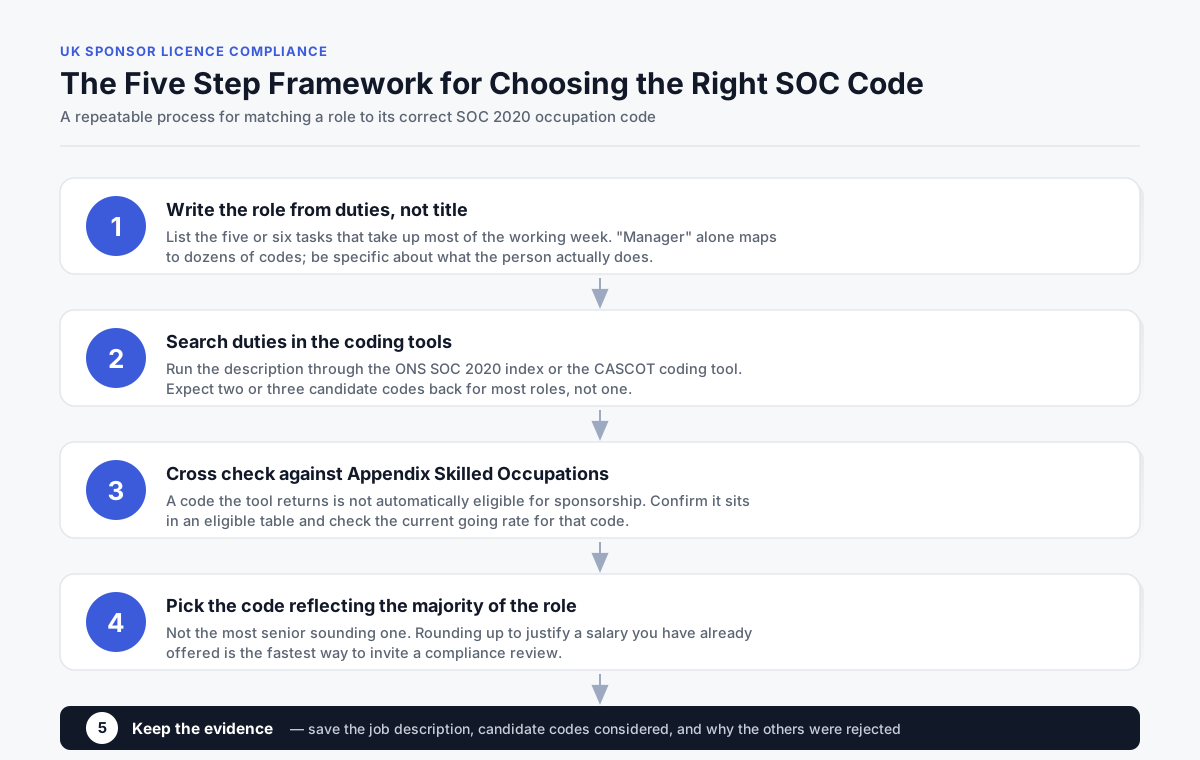
Skip the job title. Start with what the person will actually spend their week doing.
- Write the role from duties, not title.
- List the five or six tasks that take up most of the working week. "Manager" alone maps to dozens of codes; a restaurant manager and a construction site manager are not interchangeable.
- Search duties, not job title, in the coding tools.
- Run the description through the ONS SOC 2020 index or the CASCOT coding tool. Both return two or three candidate codes for most roles, not one.
- Cross check every candidate against Appendix Skilled Occupations.
- A code that CASCOT returns is not automatically eligible for sponsorship. Confirm it sits in an eligible table and check the current going rate for that code.
- Pick the code that reflects the majority of the role, not the most senior sounding one.
- Rounding up to a higher skilled code to hit a salary you have already offered is the fastest way to invite a compliance review.
- Keep the evidence.
- Save the job description, the candidate codes you considered, and the reason you rejected the others. If UKVI asks later, this file is your answer.
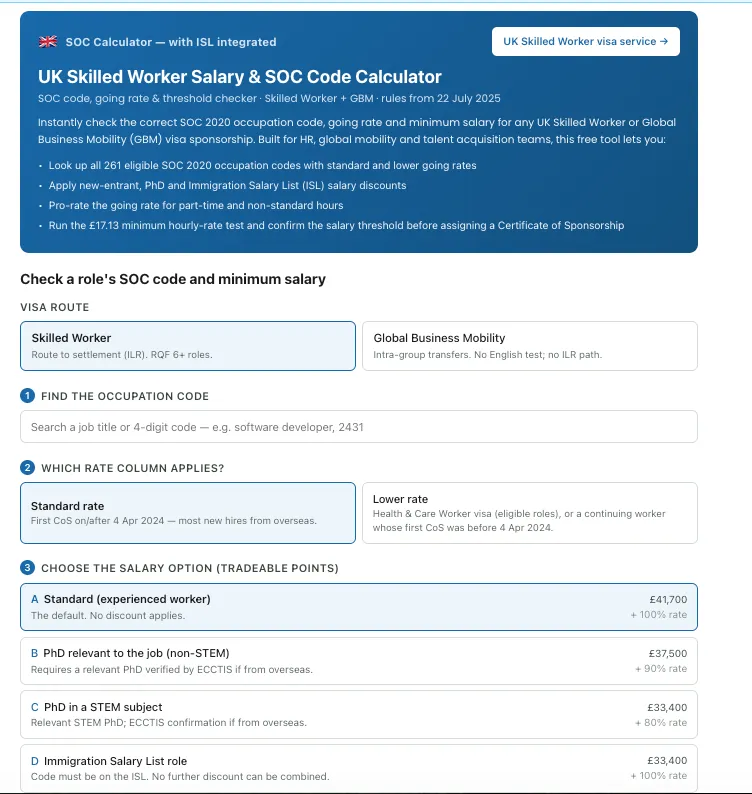
Which Salary Threshold Applies to Your Sponsored Employee’s SOC Code?
For the full breakdown of how these thresholds interact, see our 2026 salary threshold guide. This piece focuses on getting the code right first, since the wrong code makes the salary calculation meaningless anyway. Check your specific SOC code against the 2026 going rate and hourly floor with our SOC salary calculator.
Find Right SOC code and check if your role salary meets the 2026 UK Skilled Worker or GBM or Specialist Worker Threshold
How Should Employers Choose Between Two Similar UK SOC Codes?
This is where most SOC code guides stop being useful, because most roles are not textbook cases. A senior developer who also manages two juniors. A marketing lead who spends a third of their time on data analysis. Here is how to break the tie.
- Count time, not titles. Whichever set of duties takes up more than half the working week wins.
- Check seniority language in the job description against the unit group description for each candidate code, not against the job advert you already published.
- If duties are genuinely split close to even, choose the lower risk option: the code with the more conservative going rate and a stronger eligibility position under Appendix Skilled Occupations.
- Document why you rejected the other code, in one or two sentences, at the time you make the decision. Reconstructing this six months later during an audit is much harder.
What Are the Most Common UK SOC Code Mistakes That Trigger Sponsor Licence Audits?
These account for the bulk of SOC related refusals we see across sponsor accounts.
- Matching the job title instead of the duties. A title that sounds senior does not make the code correct. Caseworkers read the job description, not the letterhead.
- Using a SOC 2010 code. Every application must use SOC 2020. Old codes carried over from a previous CoS template are an automatic problem.
- Rounding up to justify a salary you have already agreed. If the going rate for the accurate code is lower than what you are paying, that is fine. Choosing a higher code purely to match the salary is the pattern UKVI compliance visits are designed to catch.
Rounding up does the most damage, because it rarely happens once. It tends to become the default for every similar role after that, and that pattern is exactly what a licence audit catches. A SOC code mismatch is one of the fastest ways to trigger a sponsor licence downgrade, see our guide to keeping an A-rating sponsor licence.
How Can HR Teams Standardise UK SOC Code Decisions Across the Business?
A framework only holds up if every hiring manager applies it the same way. If your team is switching an employee onto the Skilled Worker route or sponsoring for the first time, inconsistent SOC code decisions across departments are what turn one refusal into a pattern an auditor flags.
Disclaimer: Immigration rules change quite frequently; please verify with official sources or contact us for the latest info before making any decisions.
Frequently Asked Questions : UK SOC Codes for Sponsors
How do I find the right SOC code for a sponsored role?
Start by documenting the role’s actual duties and responsibilities. Use the ONS SOC 2020 Index or the CASCOT tool to identify potential occupation codes, then compare those codes against Appendix Skilled Occupations to confirm the correct SOC code, eligibility, and applicable going rate. Always match the code to the job duties rather than the job title.
What happens if I use the wrong SOC code on a Certificate of Sponsorship?
Using an incorrect SOC code is a common reason for Skilled Worker visa refusals. It may also trigger a Home Office compliance audit, and repeated coding errors can result in a sponsor licence being downgraded, suspended, or revoked.
Can a job title alone determine the correct SOC code?
No. The Home Office assesses the actual duties and responsibilities of the role against the SOC unit group description. Similar job titles can fall under different occupation codes with different salary thresholds and sponsorship requirements.
What if a role’s duties span two different SOC codes?
Choose the SOC code that best reflects the majority of the employee’s duties. If the responsibilities are evenly split, select the code that most accurately represents the primary purpose of the role and document the reasoning used to support the decision.
Which salary requirement applies: the general threshold or the SOC going rate?
Employers must pay whichever is higher: the general Skilled Worker salary threshold or the applicable SOC code going rate. Lower salary thresholds may apply only where specific immigration rules, such as the New Entrant provisions or eligible Immigration Salary List occupations, permit them.
Do I need to use SOC 2020 or SOC 2010 codes?
SOC 2020 codes must be used for all Skilled Worker sponsorship. Since 4 April 2024, applications submitted using the old SOC 2010 classification are not accepted, so employers should ensure all Certificate of Sponsorship templates have been updated.
Can I choose a higher-skilled SOC code to justify a salary I have already offered?
No. The selected SOC code must accurately reflect the genuine duties of the role. Assigning a higher-skilled occupation code simply to match a salary level is considered non-compliant and may be identified during a Home Office sponsor compliance audit.

.svg)
.svg)
