.svg)


KEY TAKEAWAYS: EOR Netherlands vs IND Recognised Sponsor
- Two legal routes hire non-EU talent in the Netherlands: a Netherlands Employer of Record that already holds IND recognition, or your own recognised sponsor status.
- An EOR needs no Dutch entity and starts hires in days to three weeks; direct recognition costs €5,080 (€2,539 reduced) plus €423 per permit and takes up to 90 days.
- You always keep Arbowet health and safety duties and daily management; the EOR carries payroll, tax, UWV, and IND sponsor reporting.
- From 1 January 2026, sponsors must prove salaries were paid into the employee's own account and keep records for five years; 2026 thresholds start at €5,942 gross for age 30+.
- Proposed rules would cap EOR-sponsored permits at two years with no renewal and require de facto employers to seek recognition, so treat long-term EOR reliance as a bridge.
There are two primary routes to legally hire non-EU talent in the Netherlands: acquiring IND Recognized Sponsor status for your own entity, or partnering with a Netherlands Employer of Record (EOR) that already holds it. This strategic decision dictates your time-to-hire, operational costs, and long-term compliance exposure.
Make the wrong choice, and you risk waiting months for an IND recognition you did not need, or locking into an EOR model just as strict 2026 regulatory changes tighten the rules around third-party staffing and salary compliance. This guide compares using an EOR in the Netherlands versus direct IND sponsorship across the critical factors that drive the decision: entity requirements, cost, operational control, and navigating the immediate regulatory shifts.
What Is the Core Difference Between a Netherlands Employer of Record and IND Recognised Sponsor Status?
Both options legally enable you to employ non-EU talent in the Netherlands. The main distinction centers on employment contract execution and risk allocation: one route gives you full operational control, while the other utilizes an established third-party infrastructure.
- Legal vs. De Facto Employer: Under a Netherlands Employer of Record (EOR), the provider acts as the legal employer that signs the Dutch employment contract and manages payroll, while your team directs day-to-day work. With direct IND sponsorship, your company serves as both the legal and de facto employer, bearing all statutory obligations.
- Local Entity Requirement: Direct sponsorship requires an official Dutch corporate presence, specifically a registered B.V. or branch office with a KVK number. An EOR in the Netherlands allows you to hire immediately without forming a local legal entity by leveraging the provider's existing company structure.
- IND Recognized Sponsor Status: Only an IND Recognized Sponsor (erkend referent) can sponsor a Highly Skilled Migrant visa application. An EOR provider already maintains this status. Pursuing direct sponsorship requires filing a separate application, paying required government fees, and waiting for official approval.
- Compliance Liability: The EOR handles all Dutch payroll taxes, UWV filings, sponsor compliance, and statutory record-keeping. Under direct sponsorship, your internal teams assume complete liability, including the legal duty to inform, duty to keep records, and duty of care.
- Speed to First Working Day: An EOR enables a non-EU candidate to start within days to a few weeks. Incorporating a Dutch entity and securing IND sponsor recognition first pushes your initial hire out by two to three months.
For a full breakdown of what recognition involves and how to qualify, see our guide to the Netherlands recognised sponsor process, the authority step every direct hire depends on.
Can a Foreign Company Hire Through an EOR Netherlands Without a Dutch Entity, and What Must It Provide?
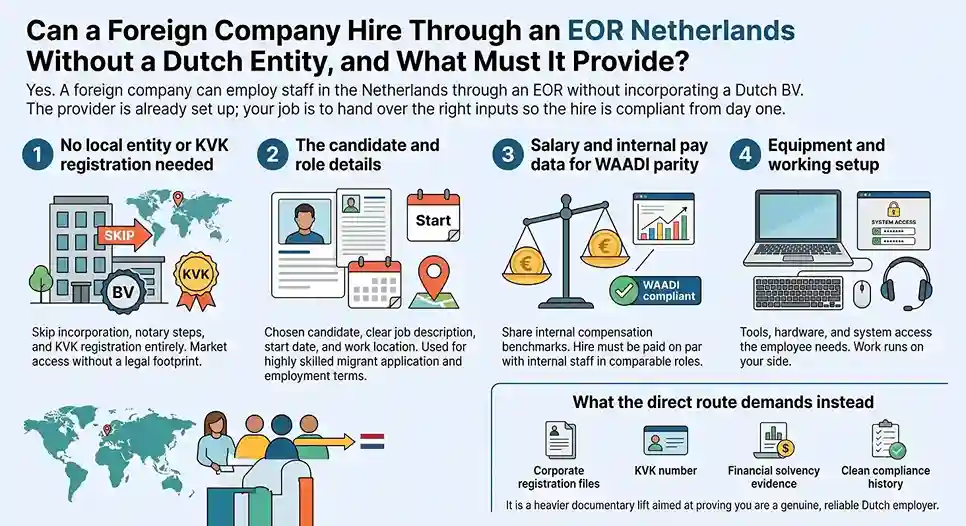
Yes, a foreign company can employ staff in the Netherlands through an EOR without establishing a local Dutch B.V. The provider supplies the corporate infrastructure, while you provide the necessary candidate and role details to ensure day-one compliance.
- No Local Entity or KVK Registration: The EOR serves as the legal employer via its established Dutch entity, eliminating notary fees, corporate incorporation, and Chamber of Commerce (KVK) registration to grant immediate market access.
- Candidate and Position Specifics: You supply the selected candidate details, job description, target start date, and work location. The EOR uses these inputs to file the Highly Skilled Migrant permit application and structure the employment agreement.
- Compensation Data and WAADI Parity: Under Dutch equal-treatment regulations (WAADI), non-EU hires must receive equal pay relative to internal peers in comparable roles. Sharing your compensation benchmarks allows the EOR to set a salary that satisfies both IND income thresholds and WAADI parity requirements.
- Equipment and Workspace Provision: Your company provides the hardware, software, and operational tools required for the job. Although the EOR acts as the legal employer on paper, day-to-day workflow management stays under your control.
- The Direct Sponsorship Alternative: Sponsoring employees directly requires submitting corporate registry documents, KVK filings, financial solvency evidence, and a clean tax history to the IND a heavier administrative burden designed to prove your standing as a reliable local employer.
See how an immigration-led partnership actually runs in practice in our employer of record immigration guide, which maps the division of work between provider and client.
How Do Responsibilities Split Between the Netherlands Employer of Record and Your Company?
Partnering with an Employer of Record (EOR) does not erase your company's obligations; it transfers legal duties to the provider while leaving daily operational responsibilities with you. Understanding this division is crucial, as Dutch labor inspectors can still hold your business accountable for workplace conditions on your floor.
- Legal Employer Responsibilities: The EOR manages Dutch payroll taxes, social security, UWV compliance, sick-leave management, and IND sponsor reporting. The provider also handles employee dismissals and statutory reintegration under strict, protective Dutch labor laws.
- Daily Operational Management: Your internal management team retains complete oversight, setting tasks, tracking performance, and directing daily work. The EOR does not supervise the employee's actual role or deliverables.
- Workplace Health and Safety (Arbowet): Under the Dutch Working Conditions Act (Arbowet), you are legally responsible for providing a safe, compliant work environment for both office-based and remote staff, regardless of who holds the employment contract.
- Payroll Funding and Invoicing: You pay a single monthly EOR invoice covering gross salary, statutory employer contributions, and service margins. Standard Dutch costs included within this invoice are the mandatory 8% holiday allowance (vakantiegeld) and any applicable sector pension contributions.
- Direct Sponsorship Exposure: Sponsoring employees directly requires your organization to assume all responsibilities internally IND sponsor duties, payroll, Arbowet health and safety, dismissals, and daily management leaving no intermediary to absorb Dutch labor law risks.
The sponsor duties an EOR takes on are the same ones you would carry alone; our highly skilled migrant permit guide sets out the inform, record, and care obligations in full
How Do Costs and Timelines Compare for EOR Netherlands vs Direct IND Recognised Sponsorship?
The money question flips with volume. An EOR is cheap to start and expensive to hold; direct sponsorship is expensive to start and cheap to run. Timelines follow the same logic.
How Do EOR Netherlands and IND Recognised Sponsorship Compare at a Glance?
- Recognition fees are one-time; permit fees repeat: Becoming a recognised sponsor costs €5,080 in 2026, or €2,539 for companies with 50 or fewer staff. Each highly skilled migrant or Blue Card permit then costs €423 per application, a recurring line finance teams often miss.
- Recognition takes up to 90 days: The IND has a statutory 90-day decision window for recognition, so a direct hire needed in the first quarter means applying the quarter before. There is no fast-track for the recognition step itself.
- EOR speed is the real argument: A recognised-sponsor EOR can file the individual permit immediately, and the IND aims to decide highly skilled migrant applications within two weeks. The first working day usually lands in two to three weeks.
- The crossover point: Below roughly five hires, the EOR margin rarely outweighs the cost and effort of recognition. Above it, direct sponsorship almost always wins on unit economics. Most companies wait too long to make the switch.
See how our Netherlands recognised sponsorship service manages the application end to end.
What 2026 Compliance Rules Affect the Netherlands Employer of Record and IND Sponsor Routes?
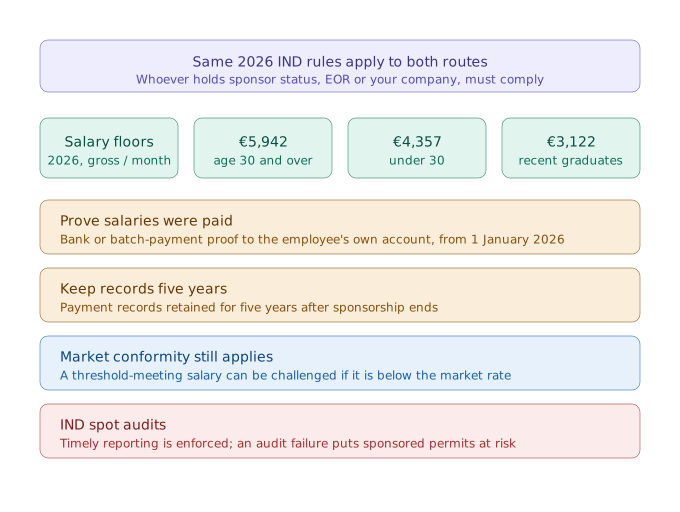
Both routes answer to the same IND rulebook, and 2026 tightened it. Whoever holds sponsor status, the EOR or your own company, has to meet these standards or risk the permit.
What Are the 2026 Highly Skilled Migrant Salary Thresholds?
- Salary thresholds rose again: The 2026 highly skilled migrant minimums increased by about 4.5 percent through annual indexation. The contract salary must meet the correct band at the moment of application, a frequent cause of refusals.
- Salaries must now be proven paid: From 1 January 2026, recognised sponsors must keep bank statements or batch-payment proof showing each salary reached an account in the employee's own name. Payslips alone no longer satisfy the IND.
- Records held for five years: Sponsors must retain these payment records for five years after sponsorship ends. Automated SEPA batch payments with full recipient details usually clear this bar with little extra work.
- Market conformity still applies: A salary that meets the threshold but sits below the market rate for the role can still be challenged. Threshold compliance is the floor, not the finish line.
- IND spot audits: The IND runs checks on recognised sponsors and enforces timely reporting. Whether the sponsor is your EOR or your own entity, an audit failure puts sponsored permits at risk.
The new salary-payment proof rule catches teams off guard; our Netherlands recognised sponsorship service builds the compliance and record-keeping procedures that keep your sponsor status audit-ready.
Why Do the Proposed 2026 EOR Netherlands Restrictions Change the Long-Term Decision?
Incoming regulatory shifts are reshaping Dutch employer strategy. Dutch authorities have proposed new immigration rules targeting Employer of Record usage for non-EU talent. While pending final legislative approval, these proposals signal a major compliance realignment worth planning for today.
- Two-Year Cap on EOR Permits: Proposed legislation limits EOR-sponsored Highly Skilled Migrant permits to a maximum of two years without renewals. Moving away from current five-year renewable permits, this change eliminates using an Employer of Record as an indefinite, long-term talent management solution.
- De Facto Sponsor Recognition Mandate: Under proposed rules, host companies directing daily operations must secure IND Recognized Sponsor status themselves to leverage EOR hiring. This mandatory requirement eliminates the primary strategic advantage of bypassing local corporate IND registration through third-party staffing providers.
- Stricter EOR Licensing via Wtta: The Wet toelating terbeschikkingstelling van arbeidskrachten (Wtta) establishes a mandatory authorization system for labor intermediaries. EOR providers must clear high legal and financial auditing standards to continue supplying international hires locally.
- Regulatory Direction and Strategy: Although pending final parliamentary approval, these regulatory updates reflect a clear legislative intent: holding true operational employers directly accountable. Businesses should view Employer of Record models in the Netherlands as an interim bridge solution rather than a permanent setup.
- Strategic Action Plan: If the Netherlands serves as a primary growth hub, budget for direct IND sponsorship recognition early. However, for initial market testing or isolated non-EU hires, an EOR remains a highly effective short-term solution within the proposed timeframe.
Track how the scheme is evolving in our and let our Netherlands Highly Skilled Migrant permit service handle the filings as the rules change.
Which Route Should Your Company Choose: EOR Netherlands or IND Recognised Sponsor Status?
There is no single correct choice only the route that aligns with your headcount targets, expansion timeline, and compliance strategy. Tailor your employment route to your business goals rather than forcing your strategy to fit a rigid hiring model.
- Choose EOR Netherlands for Speed and Low Volume: An Employer of Record is ideal for 1 to 5 hires, market testing, or immediate onboarding. It grants fast Dutch market entry without forming a local legal entity or waiting for sponsor recognition.
- Choose Direct Sponsorship for Scale and Longevity: When planning 5 or more hires or establishing a permanent Dutch hub, obtaining IND Recognized Sponsor status lowers cost-per-hire and yields total operational control over your talent pipeline.
- Evaluate 2026 Regulatory Risks: Given proposed two-year EOR permit limits, companies offering long-term roles should transition to direct recognition early rather than building a multi-year strategy around temporary third-party permit structures.
- Simplify Equity and Benefits Administration: Granting equity, stock options, or customized international benefit plans is far simpler through direct employment contracts than navigating complex third-party EOR restrictions.
- Adopt a Phased Transition Strategy: A proven strategy involves leveraging an EOR for initial Dutch hires, then securing direct IND sponsor status once hiring volume justifies the investment optimizing both early speed and long-term cost efficiency.
Comparing providers before you commit? Our overview of corporate work visa service providers in the Netherlands shows what to look for in an EOR or sponsorship partner.
The right call depends on numbers only you have: how many hires, how soon, how permanent. If you want a second read on where your Dutch plan sits between the two routes, book a demo and we will map the cost and timeline against your headcount.
Disclaimer: Immigration rules change quite frequently; please verify with official sources or contact us for the latest info before making any decisions.
Frequently Asked Questions - EOR Netherlands vs IND Recognised Sponsor

.svg)
.svg)