.svg)


KEY TAKEAWAYS - ICT Permit Expiry Netherlands
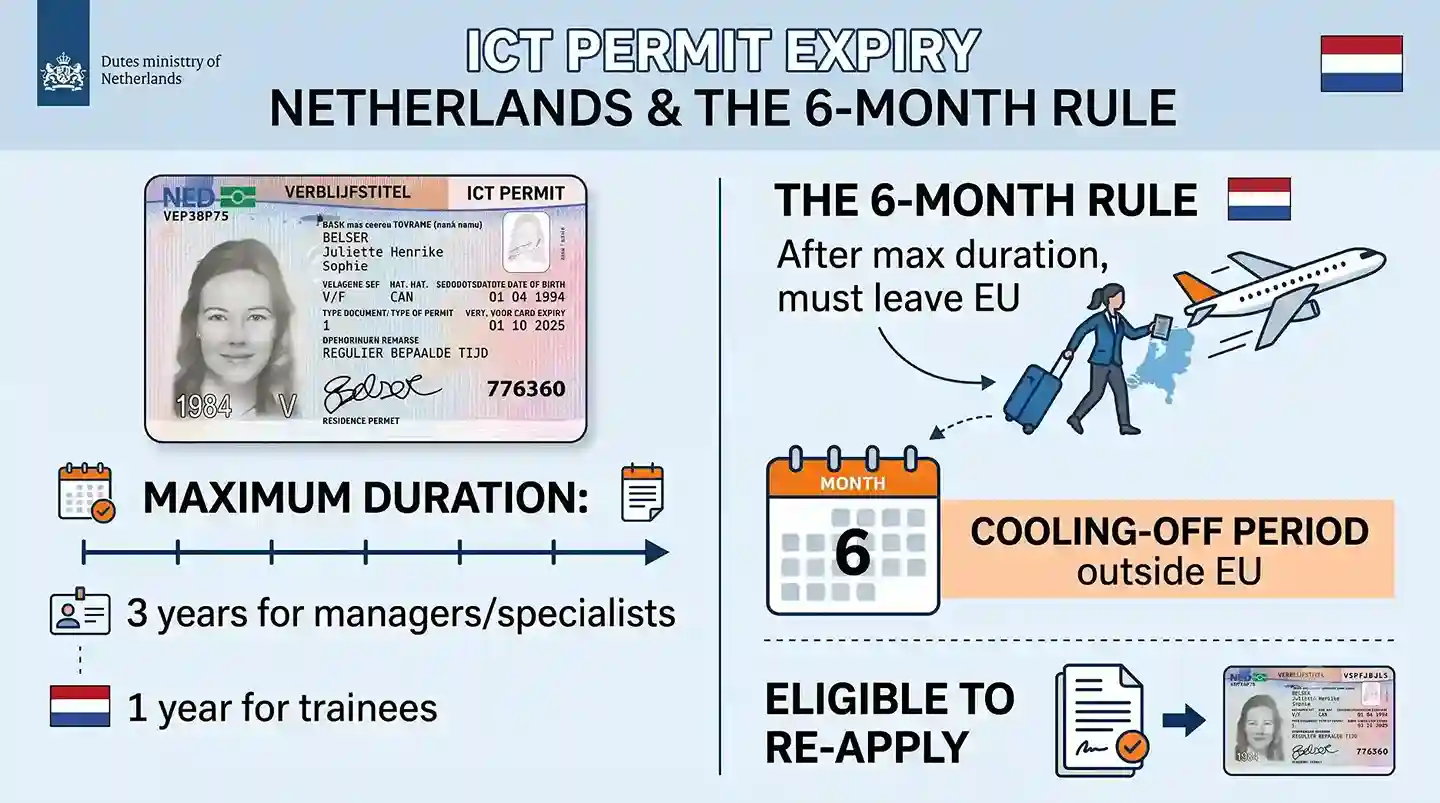
- ICT permits cap at three years for specialists and managers and one year for trainees, with no renewal once the cap is reached.
- A six-month cooling-off period outside the EU blocks back-to-back ICT permits.
- Start a switch three to four months before expiry, and always file before the current card lapses.
- Two switch routes retain talent: Highly Skilled Migrant (needs recognised sponsor status) and EU Blue Card (higher salary plus a diploma or five years of experience).
- Working on an expired permit triggers Wav fines up to €8,000 per worker and can cost you recognised sponsor status.
An ICT permit in the Netherlands carries a hard expiry date that cannot be pushed back indefinitely. Once your transferee approaches ICT Permit Expiry Netherlands at the three-year ceiling, there is no renewal button; there is only a switch, an exit, or a compliance problem. This guide sets out the timelines, the switch routes, and the exit steps you need to plan well before that date arrives.
What Drives ICT Permit Expiry Netherlands and the 6-Month Rule?
The EU Intra-Corporate Transferee (ICT) Directive sets rigid, non-negotiable validity ceilings for corporate transfers. Unlike standard Dutch work permits, the ICT permit was specifically designed for temporary mobility rather than long-term settlement, making proactive, long-term planning essential.
- Three-year statutory cap for managers and specialists. The maximum total duration for corporate managers and specialists under the ICT scheme is strictly capped at three years. Once an employee reaches this three-year ceiling, the Dutch Immigration and Naturalisation Service (IND) is legally prohibited from granting any further extensions under this permit category.
- One-year limit for trainee employees. Trainees face a significantly shorter timeframe, with their maximum stay capped at just one year. Because of this brief window, employers must evaluate whether to transition the employee or plan their departure almost immediately upon their arrival in the Netherlands.
- Mandatory six-month cooling-off period. Once an employee exhausts their maximum allowable stay under an ICT permit, they must reside outside the European Union for at least six consecutive months before becoming eligible for a new ICT transfer. This rule prevents companies from using back-to-back corporate assignments to maintain continuous residency within the EU.
- No renewals past the ceiling only a switch or exit. Because an ICT permit cannot be renewed once its legal cap is reached, employers face a binary choice: you must either repatriate the employee to their home entity or legally switch them to an alternative Dutch residence permit (such as the Highly Skilled Migrant scheme or European Blue Card) before the ICT permit expires.
- EU-wide assignment history counts toward the cap. The ICT Directive calculates total time on a continental level. Any period an employee has previously spent under an ICT permit in another EU member state counts directly toward their overall three-year or one-year ceiling. Employers must conduct a thorough audit of a transferee’s full EU assignment history before assuming they have runway remaining in the Netherlands.
Our Netherlands ICT permit service page sets out the eligibility rules, validity limits, and employer duties in one place: Netherlands Intra-Corporate Transfer (ICT) Permit.
When Should You Act on an Approaching ICT Permit Expiry Netherlands?
Most companies underestimate the timeline required to transition an employee off an Intra-Corporate Transferee (ICT) permit. Because an application to change a permit's purpose of stay must be submitted before the current card expires, your safety buffer should be measured in months, not weeks. Acting proactively is the difference between a seamless legal transition and an illegal gap in employment.
- Centralize expiration tracking. Maintain a single, reliable system of record for every transferee's permit expiry date. Relying on fragmented spreadsheets or informal reminders often leads to missed deadlines, which is the most common cause of entirely avoidable compliance breaches.
- Initiate the process three to four months in advance. Begin evaluating options and gathering the necessary documentation at least 90 to 120 days before the current permit expires. This generous buffer provides ample time to procure legalized documents and absorbs any unexpected processing delays at the IND.
- File before the current permit expires. To successfully change a candidate's purpose of stay without a disruption, the new application must be officially submitted while the ICT permit is still valid. If you file even one day late, the candidate loses their legal right of residence, and the direct transition route effectively closes.
- Secure a residence endorsement sticker during IND delays. If the IND is still processing the new application when the original ICT permit expires, the employee is not forced to stop working. They can visit the IND to obtain a temporary residence endorsement sticker (verblijfsaantekening), which explicitly grants them the right to continue living and working legally in the Netherlands while awaiting the final decision.
- Assign definitive project ownership. Establish exactly who is accountable for managing the permit switch whether it is local HR, a dedicated global mobility lead, or an external immigration provider. Ambiguity regarding who owns the process is the primary reason critical deadlines slip through the cracks.
Automated permit tracking removes the guesswork and flags deadlines across your whole workforce: Visa & Residence Permit Renewals.
What Are Your Switch Options Before ICT Permit Expiry Netherlands?
Two legal routes allow you to retain talent and entirely bypass the mandatory six-month cooling-off period. Both pathways require transitioning the employee to a local Dutch employment contract, and crucially, both applications must be initiated before the current ICT permit expires. The optimal route for your organization depends heavily on your corporate sponsorship status.
When evaluating your options, consider these key pathways and strategic factors:
- Option 1: Switch to a Highly Skilled Migrant (HSM) permit. This is the most common and streamlined route. To utilize it, the Dutch entity must act as the direct employer and hold official IND recognised sponsor status. The candidate must also meet the statutory HSM salary threshold. For 2026, the gross monthly requirements (excluding holiday allowance) are €5,942 for employees aged 30 and over, €4,357 for those under 30, and €3,122 for recent graduates.
See our Netherlands Highly Skilled Migrant Permit (Kennismigrant) service for the full pathway
- Option 2: Transition to a European Blue Card. This alternative is highly effective if your company is not an IND-recognised sponsor. However, it requires a different set of strict criteria: the applicant must possess a recognized higher education diploma (verified via a Nuffic evaluation) or demonstrate at least five years of equivalent professional experience. The base salary must also meet the standard 2026 threshold of €5,942 per month. Details sit on our Netherlands EU Blue Card page.
- Let your recognized sponsor status dictate the route. Your company's IND accreditation should drive your strategy. The HSM route is entirely dependent on holding recognised sponsor status. If your organization does not possess this standing, pursuing the European Blue Card is typically the fastest and most reliable path to retaining the employee.
- Weigh the degree requirement against corporate sponsorship. Because the 2026 salary thresholds for top-tier earners are now comparable across both routes, the deciding factor often boils down to logistical friction. You must weigh the administrative hurdle of the Blue Card’s formal degree evaluation against the corporate requirement of the HSM’s recognised sponsor status. Choose the path that best aligns with the evidence your company and candidate can readily produce.
- Initiate diploma evaluations immediately. If you select the Blue Card route, a formally recognized diploma assessment is mandatory. Because Nuffic evaluations often face processing backlogs, this step must be initiated at the very beginning of the transition process to ensure it does not become a costly bottleneck that delays the permit switch.
When the switch involves a move onto a local contract, our change of employer guidance covers the mechanics step by step: Netherlands Change of Employer.
What Should You Do After ICT Permit Expiry Netherlands Has Passed?
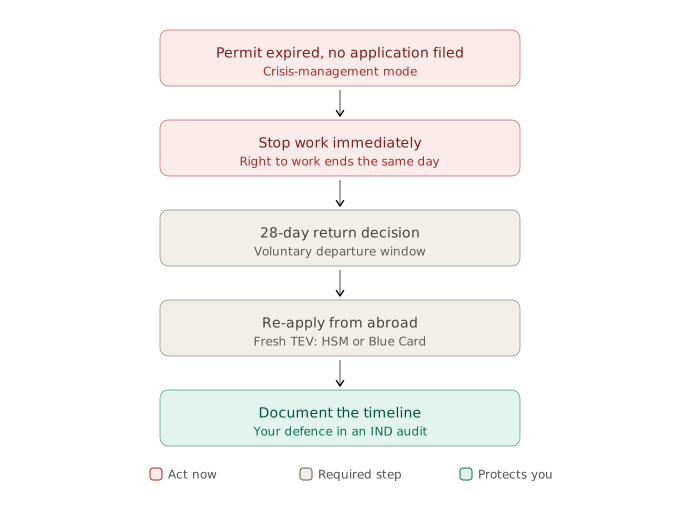
If a work permit expires before a renewal or transition application is formally submitted, your immigration strategy shifts immediately from routine planning into crisis management. The employee's legal right to reside and work in the Netherlands terminates the exact moment the card lapses, drastically narrowing your options. In this scenario, rapid action and meticulous documentation are critical.
- Halt all work immediately. The instant the current permit expires with no pending application on file, the employee entirely loses their legal right to perform work in the Netherlands. You must pull them from the active schedule that same day; allowing them to work even one day past expiration constitutes illegal employment.
- Prepare for a formal return decision (terugkeerbesluit). Once the permit lapses, the IND automatically treats the candidate's continued presence in the country as unlawful. Authorities will issue a formal return decision, which legally mandates that the employee voluntarily leave the Netherlands, typically within a strict 28-day window.
- Initiate a fresh application from abroad. An expired permit generally cannot be rectified from within the Netherlands. The employee must physically return to their home country or country of continuous residence. From there, your company must initiate a completely new Entry and Residence (Toegang en Verblijf or TEV) procedure to sponsor them for a Highly Skilled Migrant permit or a European Blue Card.
- Meticulously document the timeline. Keep a pristine, centralized record detailing the exact date the employee ceased working and the date they physically departed the Netherlands. Clean, highly accurate records are your primary defense if the IND or the Dutch Labour Inspectorate (Nederlandse Arbeidsinspectie) later audits the case for corporate compliance violations.
For end-to-end support restarting a case and relocating the employee back into the Netherlands, see: Relocate to Netherlands.
What Compliance Risks Follow ICT Permit Expiry Netherlands?
Allowing an employee to work on an expired permit even for a single day exposes your organization to severe legal and financial penalties under the Foreign Nationals Employment Act (Wet arbeid vreemdelingen). The risks extend far beyond monetary fines; a single violation can jeopardize your company's corporate sponsorship status and permanently damage your employee’s future career in Europe.
- Substantial Wav fines for the employer. Under the Foreign Nationals Employment Act (Wet arbeid vreemdelingen), employing an individual without valid authorization is a strict liability offense. The Netherlands Labour Authority (Nederlandse Arbeidsinspectie) can impose immediate fines of up to €8,000 per illegally employed worker, with penalties escalating even higher if aggravating factors or multiple offenses are present.
- EU-wide entry bans and SIS alerts for the employee. The consequences for the candidate are catastrophic. An employee who overstays an expired permit and ignores a formal return decision risks receiving an EU-wide entry ban. Furthermore, their details may be flagged in the Schengen Information System (SIS), effectively terminating their legal right to travel, reside, or work anywhere within the European Union.
- Revocation of recognised sponsor status. The Dutch Immigration and Naturalisation Service (IND) rigorously monitors corporate compliance. Employing individuals on expired permits constitutes a severe breach of your legal duty of care as an employer. In response, the IND has the authority to swiftly suspend or permanently revoke your company's highly valuable recognised sponsor status.
- Heightened reputational and audit exposure. A single documented compliance breach rarely stays isolated. It frequently triggers a comprehensive, company-wide audit of your immigration, payroll, and HR files by the Labour Authority. Uncovering one lapsed permit often prompts inspectors to dig deeper, potentially exposing other administrative gaps or labor law violations your organization would rather not have to defend.
See how we help compliance leads keep every case audit-ready and within policy: Solutions for Compliance Managers.
What Exit and Repatriation Steps Apply at ICT Permit Expiry Netherlands?
When transitioning an employee to a new permit is not an option, executing a structured, fully compliant offboarding process is essential. A clean, well-managed exit protects your company from regulatory penalties while safeguarding the employee's future immigration record in Europe.
To ensure no tax, payroll, or statutory reporting gaps remain, complete the following administrative steps in sequential order:
- Fulfill your legal IND notification duty. As an IND-recognised sponsor, you are statutorily required to notify the Immigration and Naturalisation Service within 28 days of the assignment ending. Submitting this formal notification through the online IND Business Portal officially records that the corporate transfer has concluded and the foreign national has departed the Netherlands.
- Deregister from the Municipal Personal Records Database (BRP). Ensure the departing employee formally deregisters from their local Dutch municipality (Gemeente) prior to departure. Official municipal deregistration is critical because it halts the continuous accrual of local tax liabilities, civic duties, and statutory obligations tied to physical residence in the Netherlands.
- Cancel mandatory Dutch health insurance. Terminate the employee's mandatory basic Dutch health insurance (zorgverzekering) effective on their departure date. Leaving policy coverage active unnecessarily generates ongoing premium charges, billing disputes, and administrative loose ends for both parties.
- Finalize shadow payroll and tax liabilities. Completely reconcile and close out the employee’s local shadow payroll, wage tax withholdings, and social security contributions. A thorough financial closeout prevents costly year-end tax surprises, filing complications, and audit friction for both the employer and the individual.
Protecting your recognised sponsor status through every exit is part of staying compliant; our team supports the full notification and duty-of-care process: Netherlands Recognised Sponsorship.
Planning Ahead of ICT Permit Expiry Netherlands
Proactive planning is the key to successfully managing Intra-Corporate Transferee (ICT) permits in the Netherlands. Because ICT permits carry strict statutory time limits, failing to prepare for their expiration can result in sudden work disruptions, compliance breaches, or forced departures.
To turn a looming legal cliff-edge into a routine, manageable mobility task, build these practices into your immigration workflow:
- Set decision deadlines from Day 1. Do not wait until the final quarter before a permit expires to decide the employee's future. The most effective strategy is to mark a formal "switch-or-exit" decision on your HR calendar the exact day the ICT permit is issued.
- Understand the strict maximum durations. The Netherlands enforces a hard cap on ICT permits: a maximum of three years for managers and specialists, and one year for trainees,. These permits are strictly non-renewable and cannot be extended beyond these limits under the ICT directive,.
- Evaluate transition pathways early. When the maximum duration is reached, the employee must either leave the EU for a mandatory cooling-off period or legally switch to a different residence status. Evaluate early whether the employee qualifies to transition to a Highly Skilled Migrant (Kennismigrant) permit or a European Blue Card to keep them legally employed and residing in the Netherlands,.
- Avoid the "legal cliff-edge." Last-minute scrambling frequently leads to incomplete files, payroll complications, and stalled projects. Front-loading this decision ensures your business has ample time to gather necessary documents, align corporate structures, and execute a smooth transition.
Put a switch-or-exit decision on the calendar the day each ICT permit is issued, not the quarter it expires. That single habit turns a legal cliff-edge into a routine mobility task your team can plan around. If you want a system that tracks these deadlines and manages the switch end to end, book a demo with our immigration experts.
Disclaimer: Immigration rules change quite frequently; please verify with official sources or contact us for the latest info before making any decisions.
Frequently Asked Questions - ICT Permit Expiry Netherlands

.svg)
.svg)