.svg)



KEY TAKEAWAYS: IND Sponsor Audits
- IND on-site inspections are now often unannounced, so recognised sponsors must stay audit-ready at all times, not just at application.
- Report relevant changes within four weeks; the address where you keep records must be reported within two weeks.
- Administrative fines reach up to €3,000 per violation for companies, charged per employee, and can be imposed up to five years after the breach.
- Keep each sponsored employee's records for five years after sponsorship ends, and from 2026 hold bank statements, not just payslips, as salary proof.
- If recognition is withdrawn, the IND can also withdraw your employees' residence permits, leaving them a short grace period to find a new sponsor.
Historically, the IND operated on a high-trust model with recognised sponsors, typically reviewing compliance documentation only after the fact. This regulatory approach has fundamentally changed.
For organizations sponsoring highly skilled migrants, an IND compliance inspection is no longer a remote possibility. Proactive regulatory adherence and audit readiness are now essential, mandatory conditions for maintaining your recognised sponsor status.
What Exactly Is an IND Compliance Inspection?
An IND compliance inspection is a formal check of whether your organisation still meets its recognised sponsor obligations after residence permits have been granted. Inspectors look at your records, your notifications, and how you handle your duty of care in daily practice, not only what your policy documents claim.
- The IND's shift to post-approval enforcement. The scheme runs on trust. In return for two-week processing and lighter document requirements, the IND expects you to police your own compliance. Its review found that enforcement after approval was too weak. Audits now protect the highly skilled migrant route from misuse and keep fast-track access credible.
- The three obligations under review. Every inspection tests the same three legal duties. The duty of care covers careful recruitment and informing your employee about their permit conditions. The duty of administration covers accurate, retrievable records. The duty to provide information covers timely reporting of changes. A gap in one usually signals gaps in the others.
- What inspectors actually examine. An inspection is not a paperwork formality. The IND can request details in writing, ask third parties for information, and check your records on location. It compares what you reported against what your files show. Any inconsistency between the two becomes a finding you have to explain.
- Where responsibility sits. The duty of care stays yours even when you outsource recruitment or use an agency. You cannot pass the risk to a vendor. If the paperwork behind a hire is thin, the IND holds your organisation accountable, not the third party that ran the process.
For a full picture of how these obligations are set before any audit begins, our Netherlands recognised sponsor guide breaks down each duty in plain terms.
What Triggers an IND Sponsor Audit in the Netherlands?
IND inspections are rarely arbitrary events. While the agency occasionally conducts randomized file audits, the on-site visits that typically blindside employers are almost always triggered by specific data discrepancies or missed administrative deadlines. Anticipating these institutional red flags empowers your organization to address vulnerabilities proactively, long before an inspector initiates an inquiry.
- Random versus targeted audits: While both occur, targeted investigations pose a significantly higher risk to employers. The IND actively cross-references corporate data with other regulatory agencies, including the tax authority and the UWV (Employee Insurance Agency). Any misalignment across these databases will often precipitate an on-site visit. Although the IND still conducts random, sector-wide thematic inspections, maintaining impeccably clean and consistent administrative records remains your most effective defense against both approaches.
- Common HR red flags: Specific human resources patterns are highly likely to draw immediate regulatory scrutiny. A sponsored employee's salary falling below the statutory threshold, a transition from full-time to part-time employment, complex corporate restructuring, or unusually high turnover among sponsored international staff will all raise concerns. Each of these scenarios suggests to the IND that the initial conditions of the residence permit may have been compromised.
- Strict notification deadlines: Sponsors are legally bound by a strict four-week window to report material changes, such as contract updates, employee address changes, or employment terminations. Missing this critical timeframe leaves a permanent mark on your compliance record. A pattern of repeated late filings flags your organization as negligent regarding its statutory duty to inform. Note one crucial exception: any change to the physical address where your compliance administration is housed must be reported within an even tighter two-week window.
- Inter-agency data sharing: The IND does not operate in a regulatory vacuum. Discrepancies in payroll tax filings, UWV employment records that contradict your active permit data, or external whistleblower complaints can all trigger an immediate inspection. Whenever two government entities possess conflicting data regarding the same sponsored employee, an investigation is virtually guaranteed.
- The risk of inactivity: As of September 2025, the IND implemented a strict review policy for dormant sponsors. If a recognized sponsor fails to file any new immigration applications for three consecutive years, their recognized status is subject to formal review and potential revocation. Maintaining a dormant status is no longer a safe harbor. Even during extended hiring freezes, it is imperative to keep your administrative files meticulously updated, as prolonged inactivity alone can now jeopardize your recognized sponsor credentials.
Salary thresholds are a frequent trigger, so keep them current with our Netherlands Highly Skilled Migrant permit service, which tracks the 2026 figures for every hire.
What Are the Penalties for Failing an IND Compliance Check?
The IND uses a graded response, not a single blunt penalty. A first minor slip is treated differently from a repeated or serious breach. Understanding the ladder helps you gauge your real exposure and act before it climbs.
- Formal warnings and their two-year shadow. A first, non-severe violation usually brings a warning rather than a fine. The IND records it in your file, and that warning stays valid for two years. Commit no further breach in that period and the record lapses. Repeat the same failure inside two years, and the next step is financial.
- Administrative fines. For a company, the administrative fine reaches up to €3,000 per violation; for an individual it is up to €1,500. It is charged per violation and per employee, so one systemic error across ten sponsored staff multiplies fast. The IND can fine you up to five years after the breach.
- Suspension and withdrawal of status. For serious or repeated failures, the IND can suspend your status for up to three months while it investigates, and extend that suspension in three-month blocks. Withdrawal is the final step. Once recognition is gone, you cannot sponsor new non-EU hires and you lose the two-week processing advantage until you requalify.
- The knock-on effect on your employees. The damage does not stop at your company. When recognition is withdrawn, the IND can also withdraw the residence permits of the employees you sponsor. Those workers then get a short grace period to secure a new recognised sponsor or risk losing their right to stay. One failure can put entire careers at risk.
- The operational and reputational cost. Beyond fines, a sanction stalls your hiring pipeline. A frozen non-EU intake, delayed start dates, and a public register that no longer lists you all signal risk to candidates and partners. The indirect cost of a damaged reputation often outweighs the fine itself.
What Are the IND Sanction Tiers for Sponsors?
Building the internal controls that keep you off this ladder is what our Netherlands recognised sponsorship service is designed to set up and monitor.
How Can Employers Successfully Survive an IND Audit?
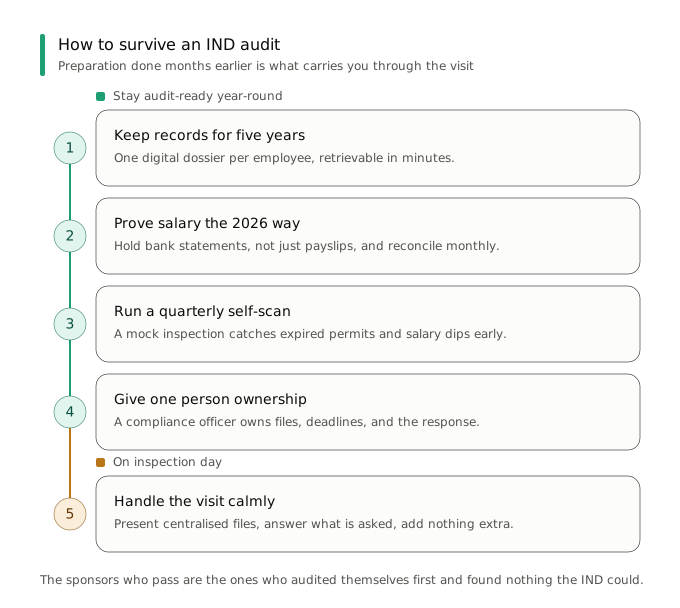
Passing an inspection is mostly about preparation done months earlier. The employers who sail through are the ones who treat their sponsor file as a living record, not a drawer they open when the IND calls. Here is what that looks like in practice.
- The five-year record retention rule. You must keep each sponsored employee's records for five years after you stop being their sponsor. A compliant dossier holds the signed contract, passport copies, permit and MVV details, proof of the duty of care, and salary evidence. Store it digitally, indexed by employee, so any file can be produced within minutes.
- The 2026 bank-statement salary proof rule. This is the change most teams miss. From 2026, payslips alone no longer satisfy an auditor. You must also hold bank statements showing the agreed salary was actually paid into the employee's account. Reconcile payslips against real transfers monthly, because a gap between the two is now a direct compliance finding.
- Running a pre-emptive compliance scan. The reality is that most problems are found by the sponsor, not the inspector, when someone bothers to look. Run a mock inspection each quarter. Check for expired permits, missing passport copies, salaries that have drifted below threshold, and unreported changes. Fixing these in advance is far cheaper than explaining them to the IND.
- Assigning clear internal ownership. Compliance fails when everyone assumes someone else is tracking it. Name one person who owns the sponsor file, the reporting deadlines, and the audit response. Give them a simple workflow and a calendar of renewal and threshold dates. Clear ownership turns scattered tasks into a single, accountable routine.
- Handling the inspection day itself. When the IND arrives, present your centralised digital files calmly and answer what is asked. Cooperate fully, but do not volunteer records or commentary beyond the question, since loose extras can open new lines of inquiry. Let your compliance owner lead the conversation and keep every response consistent with your files.
The record and salary-proof rules are set out in detail in our 2026 Highly Skilled Migrant sponsorship guide, which is worth a read before your next hire.
What Must Employers Keep Ready for an IND Audit Inspection?
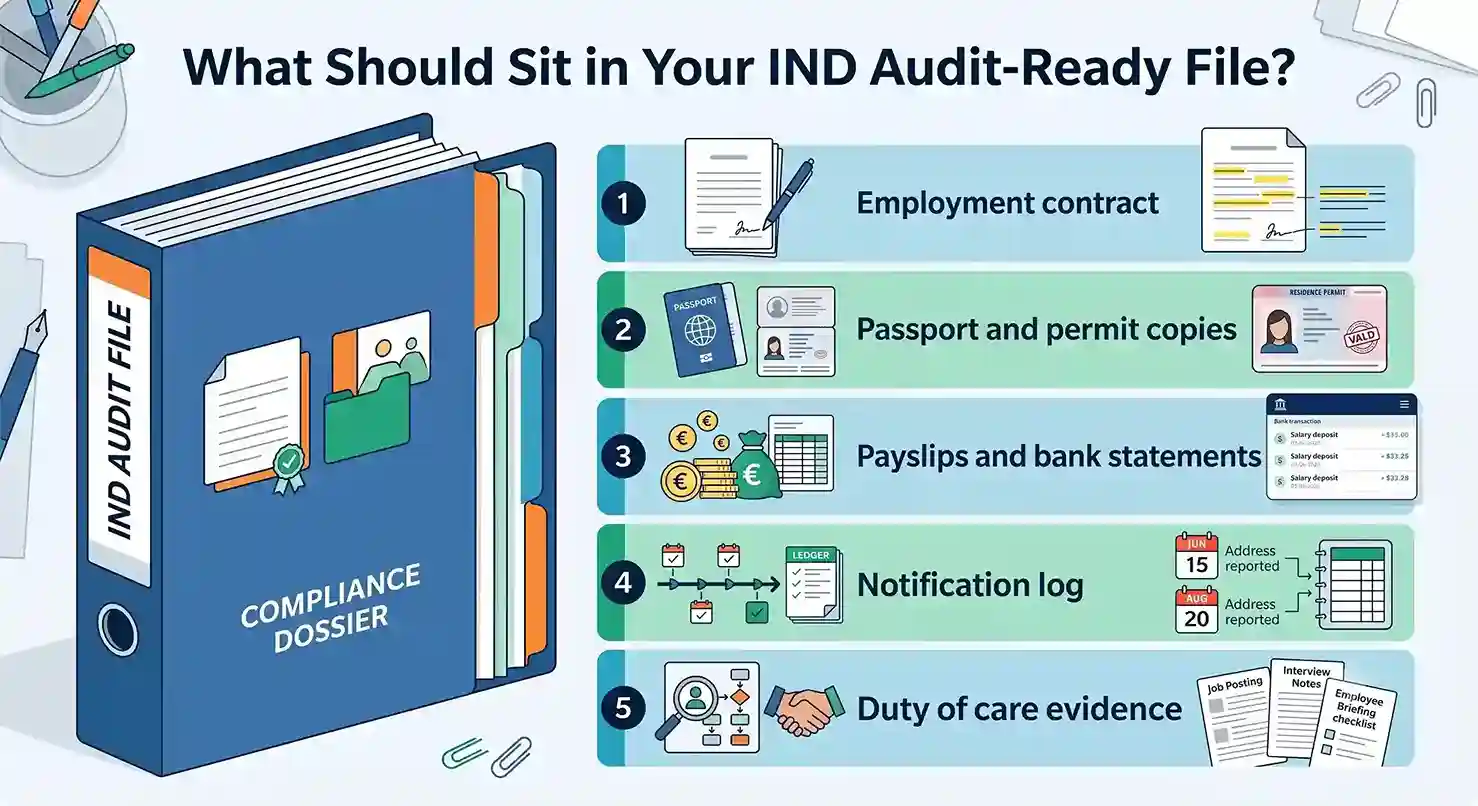
An inspector should never experience delays while your team searches for critical documentation. Every piece of evidence demonstrating a lawful, compliant hire must be consolidated in a single, secure location that is kept current and is immediately accessible. The checklist below outlines the essential components of a meticulously prepared, audit-ready sponsor file.
- Comprehensive individual employee dossiers: Maintain a distinct, centralized file for every sponsored worker rather than relying on a disorganized shared folder of loose scans. Each individual dossier must contain the finalized employment contract, legible copies of the employee's passport and residence permit, and the relevant MVV (provisional residence permit) records, if applicable. Missing or expired identification documents represent the most frequent audit findings, yet they are entirely preventable with systematic record-keeping.
- Verified salary disbursement evidence: Retaining basic payslips is insufficient; you must maintain robust proof of actual payment. Keep monthly payslips paired with corporate bank statements that verify the net salary successfully reached the employee's designated bank account. Furthermore, actively monitor the specific age-based salary thresholds applicable to each individual hire. Allowing compensation to inadvertently slip below these statutory requirements constitutes a severe compliance breach, meaning any potential shortfall must be flagged and corrected immediately.
- A comprehensive, chronological notification log: Maintain a detailed ledger of every update your organization has reported to the IND. This log must specify exactly what was reported and the exact date of submission, encompassing contract modifications, residential address changes, and employment terminations. This documentation serves as your primary proof that you adhered to the mandatory four-week reporting window. Without a verifiable ledger, proving your timely compliance during an inspection becomes significantly more difficult, even if you did file the updates correctly.
- Documented proof of your "duty of care": Sponsors carry a legal responsibility to support and inform their international hires, and you must maintain concrete evidence of this process. Retain documentation detailing your recruitment and selection methodology, alongside proof that you explicitly educated the employee on the specific legal conditions of their residence permit. Because demonstrating this duty of care is notoriously difficult to prove retroactively, it is crucial to document these steps comprehensively during the onboarding phase, rather than attempting to reconstruct the timeline months later during an audit.
What Should Sit in Your IND Audit-Ready File?
To build this file the right way from day one, our Netherlands Highly Skilled Migrant document checklist lists every document the IND expects to see.
When and How Does an IND Inspection Audit Happen?
IND compliance inspections rarely arrive with generous advance notice, and their execution formats can vary significantly. An audit may be conducted entirely via correspondence or involve an inspector arriving physically at your corporate premises. Understanding the procedural mechanics of these investigations eliminates unnecessary panic when the agency makes initial contact.
- How the IND initiates an inspection: The agency may commence an audit through a formal written request for information, an unsite review of your corporate records, or an investigation triggered by inter-agency data signals. The IND operates without a fixed auditing schedule and retains the authority to act at its sole discretion. Frequently, the very first indication of an inspection is an official administrative letter demanding the immediate handover of specific employee dossiers.
- Announced versus unannounced visits: On-site inspections are increasingly conducted without prior warning, underscoring the absolute necessity of maintaining constant audit readiness. While some visits offer brief advance notice, others provide none at all. Consequently, organizations must operate under the standard assumption that they could be required to produce a flawless, comprehensive sponsored-employee dossier on any given working day.
- The anatomy of the compliance check: During an inspection, the IND official will meticulously cross-reference your internal files against the updates you have officially reported, as well as against overarching data maintained by other government bodies. The inspector may request an interview with your designated compliance officer to understand the exact procedural steps taken during a specific international hire. Expect the audit to go far beyond simply verifying the existence of paperwork; inspectors will actively test whether your organization has genuinely fulfilled its statutory "duty of care."
- Post-inspection outcomes and consequences: If the IND verifies full compliance, the audit is officially closed with no further action. However, if administrative gaps or discrepancies are discovered, the consequences can escalate from formal warnings to direct financial penalties. In severe cases of non-compliance, the agency holds the authority to suspend your recognized sponsor status for up to three months pending further investigation. Maintaining a transparent, highly cooperative demeanor throughout the process is crucial for shortening the audit timeline and mitigating potential regulatory fallout.
For how IND checks and decisions work in practice, see our recognised sponsorship application FAQ, which answers the questions employers ask most.
What Do Employers Need From Employees During an IND Audit?
The integrity of your audit file is inherently tied to the accuracy of the information provided by your employees. Because inspectors scrutinize details that are directly managed by the individual worker, your compliance framework must actively and continuously capture this data, rather than treating it as a one-time onboarding administrative task.
- Maintaining valid identification and permits: You are required to hold current, legible copies of passports and residence permits for every sponsored professional. Because permits expire and passports are periodically renewed, it is crucial to establish a strict protocol requiring employees to submit updated documents the moment a change occurs. An expired document sitting in your corporate dossier is recorded as a definitive compliance violation by an inspector, even if the employee maintains valid legal status in practice.
- Verification of salary deposit accounts: Since the IND now heavily relies on bank statements to substantiate salary requirements, the destination account for payroll deposits must precisely match your internal administrative records. Instruct your international staff to proactively report any changes to their primary banking details to ensure your payroll evidence perfectly aligns with their actual financial deposits.
- Timely reporting of personal life events: Residential relocations, changes in marital or family status, and extended periods of unpaid leave can all directly impact an employee's residence permit conditions. Because international hires often underestimate the regulatory importance of these personal events, you must provide a straightforward, highly accessible internal channel for them to report updates immediately. This system is essential for ensuring you consistently meet your mandatory four-week reporting obligation to the IND on their behalf.
- Rapid cooperation during regulatory inquiries: If the IND identifies a potential discrepancy, employers are occasionally granted a brief two-week window to verify and correct the information in question. To meet these tight statutory deadlines, you require employees who will respond swiftly to urgent requests for supplementary documentation or necessary signatures. Establish this expectation of active cooperation early in the employment relationship, ensuring that a critical compliance audit never stalls due to an unanswered email.
Managing these records across every hire is exactly what our Netherlands immigration services team keeps audit-ready on your behalf.
Treat your next inspection as a matter of when, not if. The sponsors who stay calm are the ones who audited themselves first and found nothing the IND could. Decide today who owns your compliance file, then have your records reviewed by people who handle IND audits every week. Book a demo and turn compliance from a worry into a routine.
Disclaimer: Immigration rules change quite frequently; please verify with official sources or contact us for the latest info before making any decisions.
Frequently Asked Questions: IND Sponsor Audits

.svg)
.svg)