.svg)


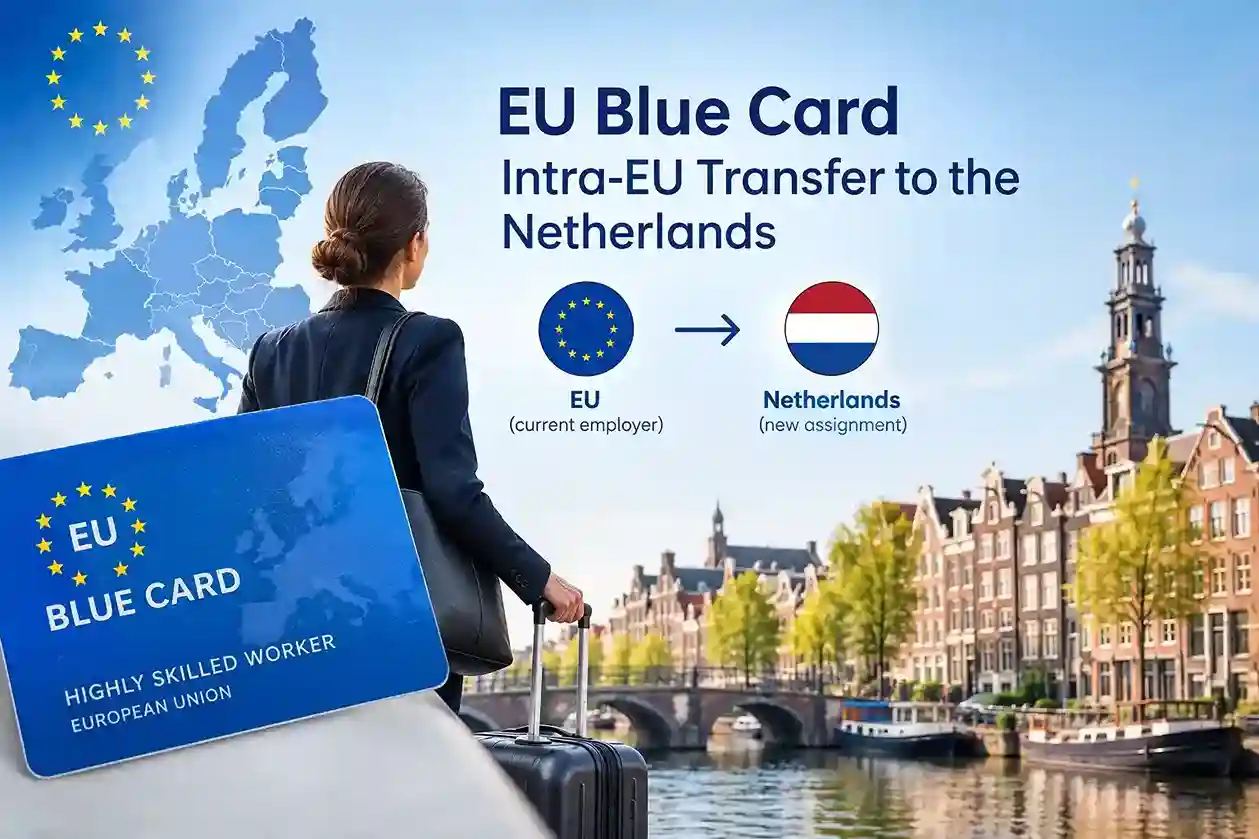
KEY TAKEAWAYS - Intra-EU Mobility Netherlands
- Intra-EU mobility lets an employee who already holds an EU Blue Card from another member state relocate to the Netherlands without starting a fresh recruitment process.
- After 12 consecutive months as a Blue Card holder in the first country, your employee can apply for a Dutch EU Blue Card without an MVV entry visa.
- The Netherlands salary threshold still applies: EUR 5,942 per month gross in 2026, or EUR 4,754 for recent graduates, both excluding the 8% holiday allowance.
- The IND decides within 30 days for recognised sponsors and up to 90 days otherwise; no recognised sponsor status is required for a Blue Card.
- Time held on a Blue Card in another EU state counts toward EU long-term resident status, giving you a stronger retention and mobility proposition.
One of your engineers has spent the last year in Germany on an EU Blue Card, and you now need them on a Dutch team. You do not have to run a fresh sponsorship process from zero. The EU Blue Card carries mobility rights across member states, and the Netherlands has a defined route for this exact situation.
This guide walks through how intra-EU mobility to the Netherlands works when your employee already holds a Blue Card, what the IND expects, and where the compliance risks sit.
What Does Intra-EU Mobility to the Netherlands Mean for EU Blue Card Holders?
Intra-EU mobility in the Netherlands refers to the legal right of an existing EU Blue Card holder to relocate from another Member State to the Netherlands for highly qualified employment. This framework exists because the EU Blue Card is a European-level credential, rather than a strictly national permit. Two distinct mobility routes apply, and understanding the difference is essential for effective workforce planning.
- An existing card, a new country: Your employee already possesses a valid EU Blue Card issued by an initial Member State, such as Germany or France. The Intra-EU mobility framework allows them to leverage that established legal status in the Netherlands, rather than starting the immigration process completely from scratch.
- Short-term mobility: A professional holding a valid EU Blue Card from another country is permitted to conduct business activities in the Netherlands for up to 90 days within any 180-day period. For this brief window, no separate Dutch work authorization is required, making it ideal for temporary projects or meetings.
- Long-term mobility: Once an employee has completed 12 months of residence in the first issuing country, they can officially relocate to the Netherlands and apply for a Dutch EU Blue Card. This is the required administrative route when an individual is transferring to a Dutch team on a permanent or extended basis.
- Continuity without a fresh start: The employee maintains the benefits of their established immigration status, and their immediate family can seamlessly relocate alongside them. For the employer, utilizing this route generally avoids the significant administrative delays and costs associated with applying for a new entry visa.
- The legal basis: The Intra-EU mobility framework is governed by EU Directive 2021/1883, which has been formally integrated into Dutch immigration law and is administered by the Immigration and Naturalisation Service (IND). This legal foundation ensures that crucial living and working rights travel across borders with the professional, rather than being confined to the original issuing country.
For the full employer process, eligibility checks and 2026 fees on the local route, see Jobbatical's dedicated Netherlands EU Blue Card service, which manages applications end to end for employers.
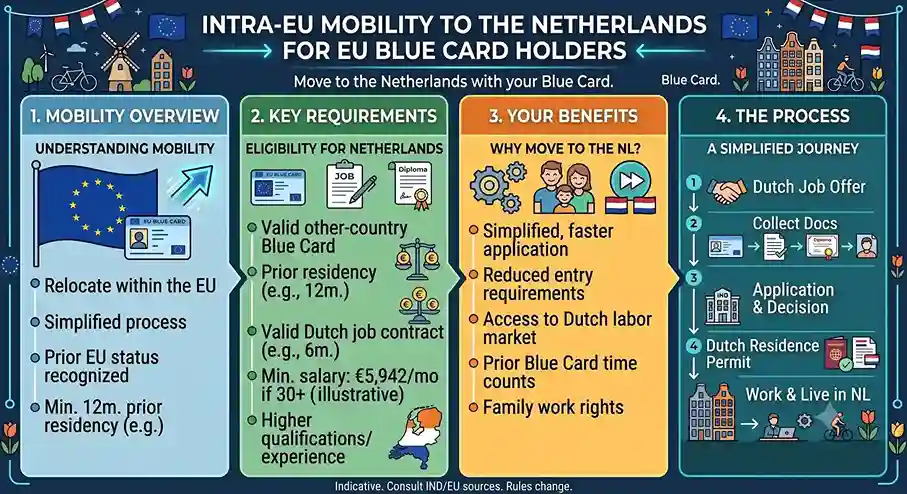
How Does Intra-EU Mobility Netherlands Work After 12 Months?
Reaching the 12-month milestone is the critical catalyst that unlocks long-term mobility rights. Prior to this point, an employee's options are restricted strictly to short-term business travel. Once this threshold is crossed, executing a full, permanent relocation becomes a highly streamlined process. Here is how these mechanics operate in practice:
- The 12-month rule: The employee must have accumulated 12 consecutive months of legal residence while holding an active EU Blue Card in the initial Member State. Crucially, this timeline begins on the issuance date of that specific country's card, rather than the date of their first arrival in the European Union.
- The MVV exemption: Upon satisfying the 12-month requirement, the employee is fully exempt from needing a provisional residence permit (MVV) to enter the Netherlands. This specific exemption is highly advantageous for employers, as it bypasses a typical two- to three-month administrative bottleneck at local embassies.
- Subsequent mobility after six months: If the professional has already exercised their Intra-EU mobility rights once before, the required residency period for any subsequent relocation decreases to just six months in the preceding Member State. This accelerated timeline is exceptionally beneficial for multinational organizations that frequently rotate talent across their European branches.
- A new Dutch permit is still required: It is important to note that the initial Member State's card does not automatically transfer or convert. The Netherlands will issue a distinct Dutch EU Blue Card, and the Immigration and Naturalisation Service (IND) will thoroughly evaluate the new application to ensure it meets all specific Dutch employment and salary conditions.
- Timing of the application: The new permit application must be submitted at the earliest opportunity, and strictly no later than one month following the employee’s arrival in the Netherlands. Missing this critical deadline can result in a problematic gap in their legal right to reside and work, which can cause significant compliance issues for your organization.
For a fuller breakdown of Dutch conditions, timelines and thresholds behind intra-EU mobility Netherlands, read Jobbatical's employer-focused Netherlands EU Blue Card 2026 guide, which sets out the IND route in detail.
What Are the Salary and Eligibility Rules for Intra-EU Mobility Netherlands?
The single biggest planning mistake is assuming the first country's salary threshold carries over. It does not. Each member state applies its own figure, so your Dutch offer must meet the Dutch minimum, regardless of what the employee earned before.
What Salary Thresholds Apply to Intra-EU Mobility Netherlands in 2026?
- The standard threshold: Your employee must earn at least EUR 5,942 gross per month in 2026 to qualify on the standard Blue Card route. Build this figure into the Dutch offer before you confirm the move.
- The reduced threshold: Recent graduates within three years of their qualifying degree may use the lower figure of EUR 4,754 per month. This helps you retain early-career talent moving between offices.
- Holiday allowance is excluded: Both thresholds exclude the standard 8% Dutch holiday allowance. Counting the allowance toward the minimum is a frequent error that leads to IND refusals.
- Degree or experience: Your employee needs a higher education qualification of at least three years, evaluated by Nuffic if it is foreign, or qualifying professional experience where accepted.
- Health cover and clean record: Dutch health insurance is mandatory, and the employee must not pose a public order or security risk. Both are checked at application and on arrival.
To see where offers most often fall short, read Jobbatical's guide to EU Blue Card refusals in the Netherlands, which breaks down the exact salary and diploma mistakes that trigger IND rejections.
How Do You Apply for Intra-EU Mobility Netherlands with the IND?
The application process is primarily driven by the employer, and administrative preparation is typically where most delays originate. A comprehensive, well-organized file ensures swift processing, whereas an incomplete submission often triggers requests for additional documentation. It is highly recommended to approach these steps in the following sequence:
- Confirm the qualifying period first: Prior to initiating the process, strictly verify that your employee has officially completed the required 12 months of legal residence under an EU Blue Card in the initial Member State, or six months if this is a subsequent relocation. Secure official documentary evidence of this timeline before submitting the application.
- Prepare the core file: Compile a robust application package that includes the finalized Dutch employment contract, the candidate's higher education diploma (along with a Nuffic credential evaluation, if applicable), verifiable proof of their previous Blue Card residence, and clear evidence that their proposed compensation meets the mandatory Dutch salary threshold.
- File within one month of arrival: The official EU Blue Card application must be submitted to the IND immediately upon the employee's arrival in the Netherlands, and strictly no later than one month post-entry. Adhering to this timeframe is essential to safeguard their lawful immigration and employment status.
- Plan around decision timelines: Statutory processing times dictate that the IND will issue a decision within 30 days for recognized sponsors, and up to 90 days for non-recognized entities. Because organizations frequently underestimate these administrative windows, it is a best practice to build a minimum buffer of six weeks into your onboarding schedule.
- No recognised sponsor status needed: Unlike the standard Highly Skilled Migrant program, the EU Blue Card framework does not legally require the employing company to hold recognized sponsor status with the IND. This key distinction makes the Blue Card an exceptionally accessible and strategic route for newer corporate entities, branch offices, and startups.
If you are still weighing routes, compare this against the Netherlands Highly Skilled Migrant permit, Jobbatical's fully managed service for the Kennismigrant alternative that many employers assess alongside the Blue Card.
What About Family Members Under Intra-EU Mobility Netherlands?
The success of an international relocation frequently depends on the smooth transition of the employee's family, and the EU Blue Card framework offers highly favorable conditions for dependents. Provided the family already resided with your employee in the initial Member State, the Dutch process is specifically designed to keep the household intact with minimal administrative friction.
- Family can accompany or join: A legally recognized spouse, registered partner, and dependent children under the age of 18 who cohabited with the employee in the first country are eligible to relocate to the Netherlands under the exact same mobility provisions.
- No MVV for the family either: Dependents who legally resided with the primary Blue Card holder abroad are equally exempt from the provisional residence permit (MVV) requirement. This crucial exemption eliminates a significant logistical and scheduling burden for the relocating household.
- Unrestricted spouse work rights: Upon approval, an accompanying spouse or registered partner is granted full, unrestricted access to the Dutch labor market from day one. Providing the certainty of a dual-income household is frequently a decisive factor for top-tier candidates considering a cross-border move.
- File within one month: To ensure continuous legal status, dependent applications must be submitted to the IND strictly within one month of the family's arrival in the Netherlands. It is highly recommended to file these simultaneously with the primary applicant's submission to synchronize the approval timelines.
- Children and schooling: Accompanying dependent children automatically gain access to the Dutch educational system, including eligibility for reduced statutory tuition rates at local universities. Employers should encourage candidates to finalize school placements early in the process, as this often dictates the family's optimal relocation date.
For the full set of dependant rules, income thresholds and spouse work rights, see Jobbatical's Netherlands family reunification visa service, which runs family applications alongside the main permit.
How Does Intra-EU Mobility Netherlands Support Long-Term Residence and Retention?
The most compelling advantage of the EU Blue Card extends far beyond the initial relocation, it lies in the long-term strategic value it generates. Every month an employee spends under the Blue Card framework, regardless of the issuing Member State, actively contributes to their eligibility for permanent residency within the European Union.
- Residence accumulates across states: The time an employee spends holding a valid EU Blue Card in various Member States can be aggregated to meet the five-year residency requirement for EU long-term resident status. Consequently, their accumulated progress is never forfeited when crossing borders for a new assignment.
- A faster Dutch route: The Netherlands offers an accelerated pathway: an employee can qualify for EU long-term resident status after just two consecutive years of residency in the country, provided they previously held an active EU Blue Card in another Member State for a minimum of 12 months.
- A genuine retention lever: Offering a transparent and expedited route to permanent residency, coupled with seamless cross-border mobility, significantly enhances your value proposition. This is an exceptionally powerful tool for attracting and retaining senior international talent who are evaluating opportunities across multiple global markets.
- Longer absence allowance: Once a former Blue Card holder successfully achieves EU long-term resident status, they are granted greater flexibility. They are legally permitted to remain outside the EU for up to 24 consecutive months double the standard 12-month allowance without risking the forfeiture of their permanent status.The most compelling advantage of the EU Blue Card extends far beyond the initial relocation it lies in the long-term strategic value it generates. Every month an employee spends working under the Blue Card framework, regardless of the issuing Member State, actively contributes to their eligibility for permanent residency within the European Union.
To turn accumulated residence into permanent status, explore Jobbatical's Netherlands EU Long-Term Resident permit service, built to secure indefinite settlement and EU-wide mobility.
What Are the Compliance Risks in Intra-EU Mobility Netherlands?
Most compliance issues encountered during an Intra-EU transfer are entirely avoidable, typically stemming from miscalculations regarding timing or compensation. While a cross-border relocation may appear straightforward on paper, any administrative oversight can inadvertently create a highly problematic gap in the employee's legal residence. Pay close attention to these five common risk factors to ensure a seamless and compliant transition.
- The one-month filing window: If the Dutch EU Blue Card application is submitted more than one month after the employee enters the Netherlands, they risk falling into unlawful immigration status. To prevent this critical compliance failure, ensure the submission deadline is firmly scheduled in your team's calendar the exact moment their travel is booked.
- Salary threshold drift: Compensation must meet specific Dutch statutory requirements, regardless of what was legally acceptable in the originating Member State. An employment offer that was fully compliant elsewhere may fall short in the Netherlands. Always cross-reference the proposed compensation against the current 2026 Dutch salary minimums before finalizing the transfer contract.
- Work-before-decision rules: It is a common misconception that an employee can automatically commence their duties immediately upon entering the country. Dutch immigration regulations may restrict active work until a formal positive decision is issued by the IND. Always verify and document the legally permitted employment start date in writing before proceeding with onboarding.
- Proof of prior residence: The IND requires definitive, verifiable evidence that the employee has fulfilled the mandatory 12-month residence period under an active Blue Card in the first Member State. Submitting incomplete, untranslated, or ambiguous documentation is a primary trigger for processing delays and supplementary information requests from the authorities.
- Payroll and start-date alignment: It is essential to meticulously synchronize the employee’s local payroll activation, their formal contractual start date, and the overarching permit application timeline. Any discrepancy between the dates on the employment contract and their actual authorized permit status exposes your organization to unnecessary regulatory and financial compliance risks.
When a move blends mobility with an internal transfer, Jobbatical's Netherlands change of employer service confirms the compliant pathway so no one works or resides without cover.
When Should Employers Consider Intra-EU Mobility Netherlands, and for Which Employees?
While the Intra-EU mobility framework is an exceptionally powerful tool, it is not a universal solution for every international hire. It is specifically designed to address a distinct set of circumstances and is only applicable to professionals who meet precise qualifying criteria. Consider the following strategic guidelines to determine whether the Intra-EU mobility route for the Netherlands is the optimal approach for your organization's specific needs.
- When the employee already holds an EU Blue Card: This specialized pathway is strictly contingent on the candidate currently possessing a valid, active EU Blue Card issued by another Member State. If you are hiring a non-EU national for the first time who does not hold this specific credential, you must utilize the standard Dutch immigration and sponsorship procedures instead.
- When you are relocating talent between European offices: For multinational organizations operating across various EU jurisdictions, this framework is invaluable. It enables you to seamlessly transfer a highly skilled professional to a Dutch subsidiary or branch without the administrative burden of initiating an entirely new, ground-up recruitment or corporate sponsorship cycle.
- When the employee has completed 12 months abroad: Executing a permanent or long-term relocation legally requires the employee to have accrued at least 12 consecutive months of residence under their initial Blue Card. If they have not yet reached this vital time threshold, their mobility rights are strictly limited to short-term business visits not exceeding 90 days.
- When embassy delays threaten your start date: By legally granting an exemption from the provisional residence permit (MVV), this route effectively bypasses a notorious two- to three-month administrative bottleneck at local embassies. It is the preferred strategic choice whenever external consular processing backlogs jeopardize a critical, fixed start date.
- For senior, hard-to-replace hires who value EU-wide options: This framework is particularly advantageous for highly qualified specialists and executive leadership. Because the Blue Card strategically accelerates their personal progression toward EU long-term resident status, it serves as a highly compelling retention tool for top-tier talent that your organization simply cannot afford to lose.
To weigh this route against the alternatives before you commit, compare the options in Jobbatical's breakdown of Netherlands work permits versus the EU Blue Card, written to help HR teams pick the right pathway.
What Is the Employer Action List for Intra-EU Mobility Netherlands?
Once you have determined that this mobility framework aligns with your hiring needs, successful execution relies on following a precise, chronological sequence. Overlooking a single step or missing a critical deadline can quickly transform a straightforward transfer into a problematic gap in legal residence. Carefully work through this mandatory action list in order, and refer to the infographic below as a streamlined reference guide for your global mobility team.
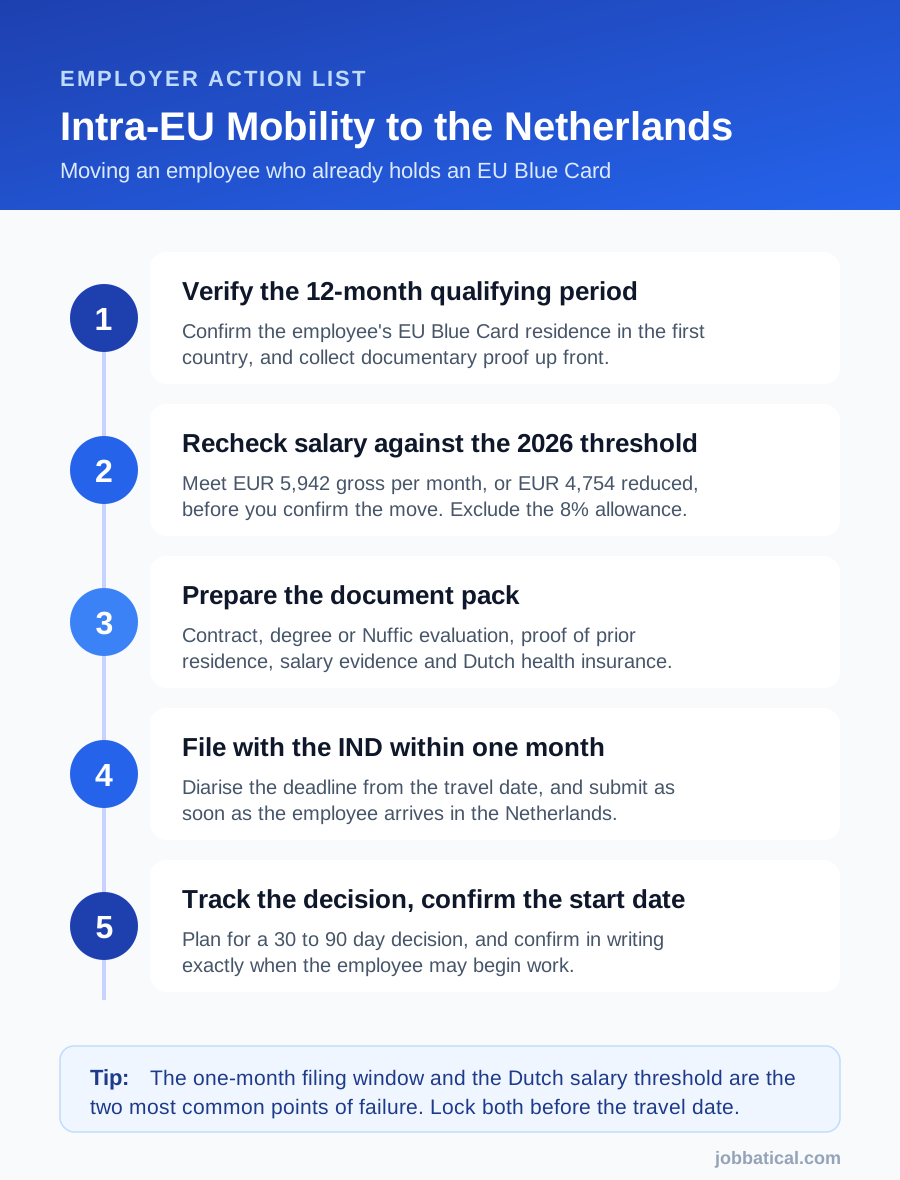
- Verify the 12-month qualifying period: Before initiating any further steps, definitively confirm that the employee has completed the required 12 months of legal residence under their initial EU Blue Card. Proactively collect formal documentary proof of this residency period upfront, as the IND will strictly require this evidence for their evaluation.
- Recheck salary against the 2026 Dutch threshold: Ensure the proposed compensation strictly complies with the updated 2026 Dutch statutory requirements. The employment offer must meet a minimum of EUR 5,942 gross per month (or EUR 4,754 for qualifying recent graduates). Importantly, you must explicitly exclude the mandatory 8% Dutch holiday allowance when calculating this base figure.
- Prepare the document pack: Systematically compile a comprehensive application file containing the finalized Dutch employment contract, the candidate’s higher education diploma (or the relevant Nuffic credential evaluation), verifiable proof of prior Blue Card residence, robust salary evidence, and proof of valid Dutch health insurance. Submitting a meticulously organized and complete file is the most effective way to ensure a swift processing timeline.
- File with the IND within one month of arrival: The formal application deadline must be firmly scheduled in your calendar the exact moment the employee's travel is booked. The file should be submitted to the IND immediately upon the employee's arrival in the Netherlands, and strictly no later than one month post-entry, as filing late severely jeopardizes their lawful immigration status.
- Track the decision and confirm the start date: Depending on your organization's recognized sponsor status, you must anticipate a statutory decision-making period ranging from 30 to 90 days. During this waiting window, closely monitor the application's progress and ensure you receive explicit, written confirmation regarding the exact date the employee is legally authorized to commence their duties
Ready to Move an EU Blue Card Holder to the Netherlands?
Intra-EU mobility rewards employers who plan the paperwork early and treat the 12-month rule, the Dutch salary threshold and the one-month filing window as fixed anchors. Get those right, and a cross-border move becomes one of the smoothest routes in European hiring.
If you have a transfer in the pipeline, map it before the travel dates lock in. Book a demo and we will walk your team through the exact IND steps for your case.
Disclaimer: Immigration rules change quite frequently; please verify with official sources or contact us for the latest info before making any decisions.
Frequently Asked Questions - Intra-EU Mobility to the Netherlands

.svg)
.svg)