.svg)



KEY TAKEAWAYS - EU Blue Card Refusals Netherlands
- Most EU Blue Card refusals in the Netherlands come from a salary figure that included the 8% holiday allowance, pushing the base pay below the 2026 threshold of €5,942/month gross.
- Foreign diplomas must clear a Nuffic evaluation before you apply; the backlog makes late starts a leading cause of incomplete, rejected files.
- The 2026 rules added employer-focused refusal grounds: tax, social security, and labour-law breaches (Wav, Waadi, WML) can block or withdraw the permit.
- You have four weeks (28 days) from the refusal date to file a formal objection (bezwaar); miss it and the case closes for good.
- Objections win only on administrative error or new evidence. A genuine salary shortfall or a recent Labour Inspectorate fine means reapplying or pivoting to the Highly Skilled Migrant route.
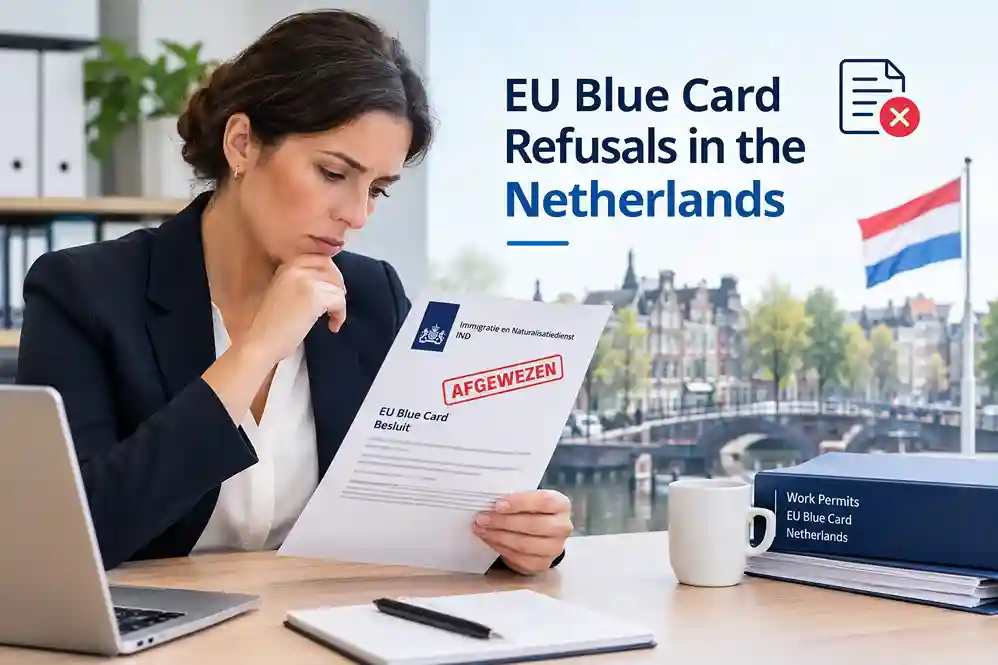
A rejected European Blue Card application rarely stems from a complex legal dispute. Instead, it is almost always the result of a minor administrative oversight such as a base salary falling just a few euros short of the statutory threshold, or a foreign diploma evaluation failing to clear Nuffic in time. These completely avoidable refusals cause significant friction for employers: they disrupt onboarding timelines, waste the €423 IND application fee, and stall critical hiring plans.
Why Do EU Blue Card Refusals in the Netherlands Keep Happening?
The Dutch Immigration and Naturalisation Service (IND) strictly enforces its 2026 criteria, meaning even minor oversights can result in a rejected work permit application. Most refusals stem from four recurring errors:
- Including allowances in the base salary. The 2026 minimum salary threshold is €5,942 gross per month, strictly excluding the standard 8% holiday allowance or performance bonuses. The required amount must be a fixed, guaranteed base wage paid directly to the employee.
- Misalignment between qualifications and the role. The IND requires a clear connection between the candidate's degree and their job duties. For example, hiring an art history graduate for a data science role will be rejected unless you provide compelling evidence to qualify for a professional experience exemption.
- Insufficient proof of work experience. A formal degree can be substituted with five years of relevant professional experience (or three years within the past seven for IT specialists). A standard CV is not enough to prove this; experience must be heavily documented with official records like signed contracts and formal reference letters.
- Employer compliance violations. The IND will deny an application if the sponsoring company has unpaid wage taxes or social security contributions. Additionally, any fines incurred within the last five years for breaching the Foreign Nationals Employment Act (Wav) will trigger a refusal.
Confirm your hire clears every criterion first. Our Netherlands EU Blue Card service runs the full IND eligibility check so gaps surface before you file, not after.
How Does the Nuffic Diploma Evaluation Cause EU Blue Card Refusals in the Netherlands?
Issues with educational credentials are a leading cause of application rejections. All non-Dutch degrees must be officially evaluated before you apply, and poor timing can easily jeopardize the process.
- Nuffic evaluation delays. Foreign diplomas require an official evaluation from Nuffic (formerly IDW) at the time of submission. Due to frequent processing backlogs, delaying this step often results in an incomplete file and an automatic refusal.
- Degree level downgrades. To qualify for a European Blue Card, a foreign degree must be evaluated as equivalent to a Dutch higher professional education (HBO) or university (WO) level. If Nuffic rates the diploma lower than expected, the candidate will no longer meet the criteria.
- Overlooking the IT specialist exemption. ICT managers and specialists can bypass the formal degree requirement entirely if they can prove three years of relevant work experience gained within the last seven years. Employers frequently miss this valuable alternative route.
- Dutch graduate exemptions. Candidates who obtained their degrees from a Dutch institution do not require a Nuffic evaluation. Identifying these hires early in the process streamlines the application and eliminates this layer of risk.
For the diploma, salary, and sponsor rules in one place, see our Netherlands EU Blue Card employer's guide
What New 2026 Grounds Are Driving EU Blue Card Refusals in the Netherlands?
The 2026 regulations have significantly expanded the grounds on which the IND can refuse or revoke a European Blue Card. Crucially, many of these updated policies shift the scrutiny directly onto the employer's corporate conduct and operational status, rather than just the applicant's credentials.
To protect your employees' visa status, employers must navigate the following compliance risks:
- Strict legal and labor compliance. The IND now rigorously evaluates whether the sponsoring employer fulfills all statutory obligations regarding social security contributions, taxation, and employee rights. Any documented breaches of labor laws specifically the Foreign Nationals Employment Act (Wav), the Placement of Personnel by Intermediaries Act (Waadi), or the Minimum Wage Act (WML) can lead to the immediate rejection of a new application or the withdrawal of an active permit.
- Failure to report employment changes. Recognised sponsors bear strict administrative responsibilities. If an employer fails to formally notify the IND that a Blue Card holder has changed roles, transferred to a new employer, or left the company, the IND retains the right to withdraw the current permit or deny future renewal applications.
- Corporate insolvency or lack of economic activity. The IND requires sponsoring entities to be financially viable, structurally sound, and actively trading. Applications will be automatically rejected if the sponsoring company is undergoing bankruptcy proceedings, is in the process of dissolution, or is deemed economically inactive by the Dutch Chamber of Commerce (KVK).
- Establishing "shell" companies for immigration access. To prevent abuse of the immigration system, the IND closely scrutinizes corporate structures and business motives. If an assessment suggests that a company was established primarily as a vehicle to facilitate foreign nationals' entry into the Netherlands rather than for legitimate commercial operations, the application will be firmly refused.
Employer compliance now sits at the centre of every decision. Our Netherlands recognised sponsorship support helps you meet IND obligations before they become refusal grounds.
What Should Employers Do After an EU Blue Card Refusal in the Netherlands?
Receiving a refusal from the IND does not necessarily mean the process is over. Your next steps depend on whether the rejection stems from a fundamental compliance issue or a fixable administrative oversight. However, because the IND enforces strict and short deadlines, you must act strategically and quickly.
If an application is rejected, follow these critical steps to determine your recovery strategy:
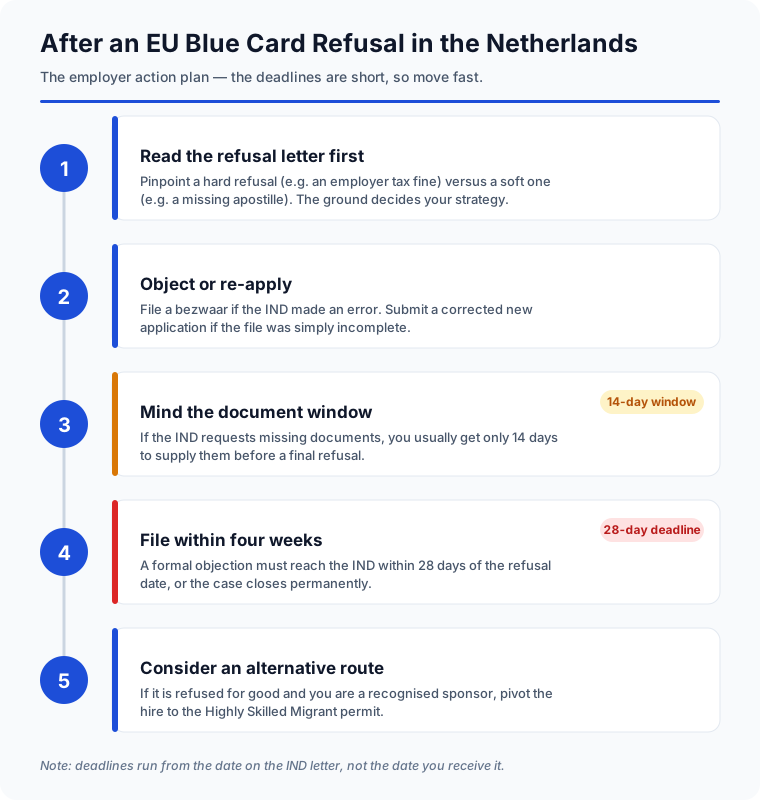
- Carefully analyze the rejection letter. Start by identifying the exact grounds for the denial. You must determine if it is a "hard" refusal (such as a severe employer tax violation or unmet salary threshold) or a "soft" refusal (such as a missing apostille or an unsigned document). Understanding the root cause will dictate your next move.
- Act immediately on requests for additional information. Before issuing a final refusal, the IND will sometimes pause the application process to request missing documentation. If you receive this notification, you typically have a strict, non-negotiable two-week window to supply the requested evidence before they officially deny the permit.
- Decide whether to object or re-apply. Your strategy here depends on who made the error. If you believe the IND misinterpreted the facts or made an administrative mistake, you should lodge a formal objection (bezwaar). Conversely, if the refusal was justified because your initial file was incomplete, it is often faster and more effective to submit a completely fresh, corrected application.
- Adhere to the four-week objection deadline. If you choose to file a formal objection (bezwaar), you must submit it within exactly four weeks (28 days) from the date printed on the refusal letter. If you miss this deadline, the decision becomes final and the case is permanently closed.
- Explore alternative immigration routes. If the European Blue Card is definitively refused for example, due to a specific diploma mismatch all is not lost. If your company is an IND-recognised sponsor, you can often pivot the candidate to the Highly Skilled Migrant (Kennismigrant) permit. This route has different educational and salary thresholds and serves as an excellent backup option.
When a pivot makes more sense than an appeal, our Netherlands Highly Skilled Migrant permit service gets your recognised-sponsor hire back on track.
What Are the Chances of Overturning EU Blue Card Refusals in the Netherlands?
Filing a formal objection (bezwaar) against an IND refusal is not an automatic fix. Your likelihood of success depends entirely on the nature of the error that triggered the rejection.
- Strong odds for administrative errors. Objections are highly effective when the IND has made a demonstrable mistake, or when you can supply irrefutable evidence to resolve an incomplete file. Supplying a newly legalized Nuffic evaluation or proving that a base salary was miscalculated are excellent grounds for a successful objection.
- Weak odds for genuine shortfalls. If your application genuinely failed to meet statutory criteria such as a base salary falling strictly below the 2026 threshold or the company receiving a recent Labour Inspectorate fine the IND will not bend the rules. In these scenarios, an objection will fail; submitting a fresh, fully compliant application is the only realistic path forward.
- Lengthy decision periods. The objection process is not a quick fix. Once filed, the IND typically takes up to 12 to 19 weeks to reach a decision on a regular permit, and this statutory timeframe can be legally extended. Employers must proactively manage hiring managers expectations, as candidate start dates will inevitably be delayed.
- Escalating to court (beroep). If your formal objection is rejected, your final recourse is appealing to a Dutch administrative court. However, courts strictly assess whether the IND followed the law and applied policies correctly; they do not re-evaluate the factual merits of your application. Without clear evidence of a procedural or legal error by the IND, success in court is very rare.
Not sure whether your company qualifies to make that switch? Our Netherlands recognised sponsor guide walks through the IND requirements and how to secure erkend referent status before you need it.
Which EU Blue Card Refusals in the Netherlands Have the Clearest Fixes?
Some refusals are worth fighting, and some are not. The table below maps the four most common grounds to the right response, so you can tell at a glance whether to object, reapply, or pivot to another route.
How Can You Prevent EU Blue Card Refusals in the Netherlands in 2026?
Prevention is always more cost-effective and efficient than fighting a refusal. Because most rejections are triggered by oversights made long before the application is even submitted, the best strategy is proactive preparation.
To safeguard your hiring pipeline, embed these four critical checks into your standard recruitment workflow:
- Lock in a compliant base salary. Ensure the candidate's guaranteed gross base salary meets or exceeds the 2026 threshold of €5,942 per month. Crucially, this baseline figure must strictly exclude the standard 8% holiday allowance, performance bonuses, or any other variable pay.
- Initiate Nuffic evaluations immediately. The Nuffic credential evaluation backlog is one of the leading causes of incomplete applications and subsequent refusals. Trigger this evaluation process the exact same week the employment offer is signed so the documentation is ready well before you file.
- Audit your corporate compliance record. The IND will heavily scrutinize your company's operational history. Before filing, verify that your payroll taxes are up to date and that you have not incurred any fines related to the Wav, Waadi, or minimum wage laws (WML) within the past five years. A corporate compliance violation will immediately block an application, regardless of how highly qualified the candidate is.
- Treat the application as a strict compliance project. Submitting a successful work permit application requires far more than just filling out a web form. Assign a dedicated project owner to manage the file, work backward from the candidate's target start date, and meticulously verify that every required document is properly legalized, translated, and complete before submission.
If a start date is on the line, do not wait for a rejection to find the gap. Book a demo and we will pressure-test the file before the IND sees it.
Disclaimer: Immigration rules change quite frequently; please verify with official sources or contact us for the latest info before making any decisions.
Frequently Asked Questions - EU Blue Card Refusals in the Netherlands

.svg)
.svg)