.svg)


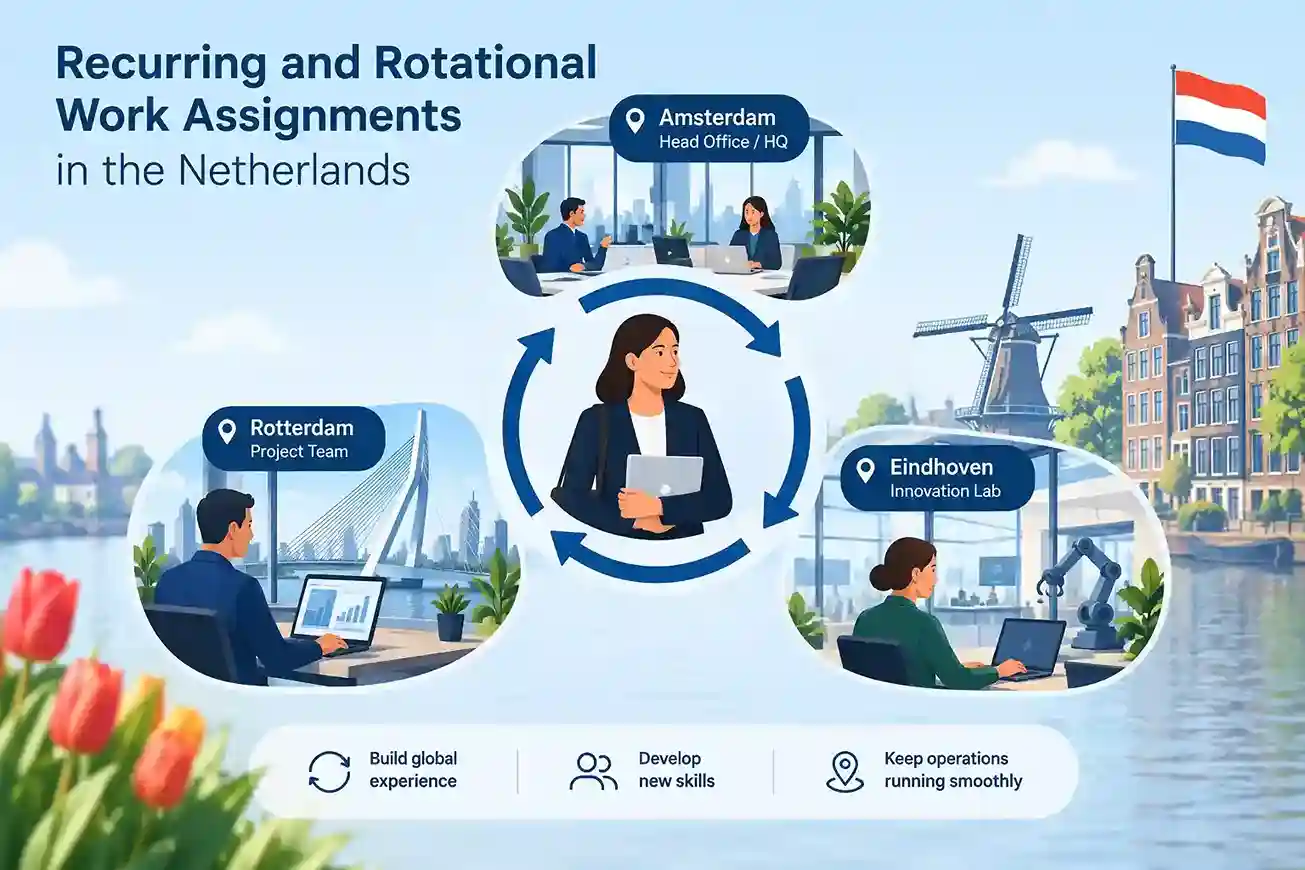
KEY TAKEAWAYS: Short-Term Work Assignments in the Netherlands
- A Netherlands short-term work permit (TWV) covers non-EU work of up to 90 days in any 180-day period, or 24 weeks seasonal, and each rotation usually needs a new five-week labour market test plus a new UWV filing.
- The 90/180 rule is a shared, rolling ceiling; a full 90-day allowance only returns after 90 continuous days outside the Schengen area, not after a short break.
- Visa-required nationals need a Type C multiple-entry visa for Netherlands work, because a TWV alone does not authorise repeated entry and exit.
- EU posted workers usually get a Wav exemption and need no TWV, but you must file the posted worker notification and hold a valid A1 certificate.
- The EES has tracked every short-stay crossing since April 2026; pivot rotational employees to a GVVA or Highly Skilled Migrant permit before work passes 90 days in 180.
Managing recurring short-term work assignments in the Netherlands requires careful navigation of Dutch labor laws and strict Schengen border limits. Review these essential takeaways to ensure your rotational workforce remains compliant, avoids unexpected entry bans, and transitions to long-term permits when necessary.
Why are Corporate recurring and rotational work assignments in the Netherlands so complex?
A single Netherlands short-term assignment follows a straightforward path. However, when managing rotational or back-to-back work assignments, three regulatory frameworks collide: work authorization, the Schengen 90/180-day limit, and Dutch tax rules.
- Three rulebooks, one employee: A TWV (Tewerkstellingsvergunning) grants the legal right to work, but it does not account for the Schengen day count or Dutch tax residency. Every rotation is evaluated against all three systems simultaneously.
- Every trip can reset the clock: Back-to-back work assignments rarely qualify as a single continuous permit. Each new assignment typically triggers a fresh labour market test and a full TWV application.
- The gaps matter as much as the days: Successful rotational schedules depend heavily on time spent outside the Schengen zone. Short breaks between trips rarely replenish enough allowable days for the next assignment.
- Compliance risk sits with the employer: As the Dutch employer, you are responsible for filing the work permit and facing severe fines for illegal work. A long-term rotational program extends this liability over many months.
If you only need a single standalone permit, our complete employer guide to the Netherlands TWV walks through the full one-off process.
Which Netherlands short-term work permit do your employees need for each scenario?
Selecting the correct immigration route depends on where the employee is hired, their scope of work, and the total length of the assignment. Defining this category before the initial trip is essential, as switching permit types mid-assignment creates severe compliance gaps and forces HR teams to restart the application process.
Which route fits each short-term assignment scenario?
- Selecting the standard TWV route: A non-EU national working under a Dutch contract requires a Netherlands short-term work permit (TWV) for stays up to 90 days, or up to 24 weeks for seasonal roles.
- Utilizing the Wav exemption for posted workers: An employee already working in another EU country who is sent to the Netherlands under a temporary service contract typically does not need a TWV. This Wav exemption in the Netherlands relies on filing an EU posted worker notification and securing a valid A1 certificate instead.
- Distinguishing business visits from productive work: Attending client meetings or internal training qualifies as a business visit and does not require a TWV. However, performing productive work that generates direct value for the Dutch entity makes a TWV mandatory.
- Knowing when to pivot to long-term options: If an employee's total work duration will exceed 90 days within any 180-day window, relying on a short-term TWV is no longer legally viable.
When an assignment outgrows 90 days, our Netherlands GVVA service files the combined permit through the IND.
How does the 90/180-day rule apply to work assignments in Netherlands?
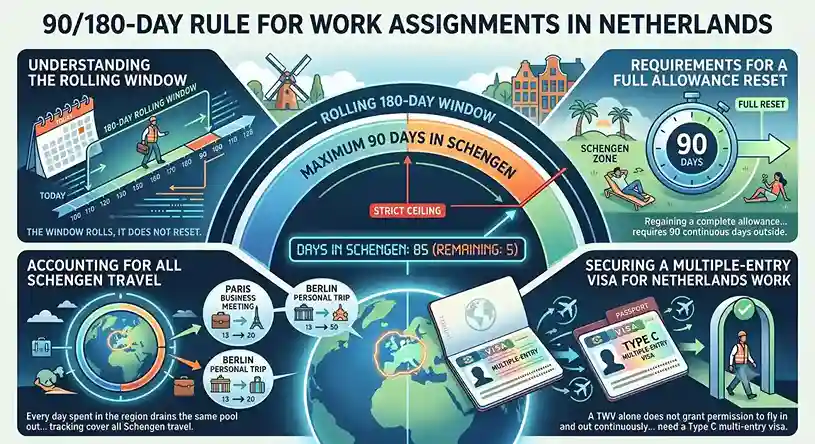
The 90/180-day rule serves as the strict ceiling behind every rotational assignment. A non-EU employee is permitted a maximum of 90 days within the Schengen area during any rolling 180-day window, and that allowance is shared across all 29 member countries.
- Understanding the rolling window: The 180-day period counts backward from today, every single day. An employee cannot complete 90 days of work, leave for a weekend, and return with a clean slate.
- Requirements for a full allowance reset: Regaining a complete 90-day allowance requires the employee to stay outside the Schengen zone for 90 continuous days.
- Accounting for all Schengen travel: Every day spent in the region drains the exact same allowance. A business meeting in Paris or a personal weekend trip to Berlin counts against the same 90 days, meaning compliance tracking must cover all Schengen travel rather than just Dutch trips.
- Securing a multiple-entry visa for Netherlands work: A TWV alone does not grant permission to fly in and out continuously. Visa-required nationals also need a Type C multiple-entry visa to avoid booking an embassy appointment before every rotation.
Count rolling days accurately with our free Schengen 90/180 compliance calculator, built for employers tracking staff across the Schengen area.
What are the Employer compliance risks of short-term work assignments in the Netherlands?
Rotational programmes often fail quietly. A permit lapses, a day count slips, or a tax line is crossed, and the breach typically surfaces only at the border or during a compliance audit. The resulting penalties fall heavily on both the employee and your company.
- Automatic overstay detection through EES: The EU Entry/Exit System is fully operational since April 2026, officially replacing manual passport stamps. It calculates the 90/180-day count automatically and retains overstay records for five years.
- Overstays trigger entry bans: Exceeding the limit by just one day can result in a multi-year entry ban across all 29 Schengen countries.
- Illegal employment fines under the Wav: If a work permit expires on Friday and the employee works on Monday, it constitutes illegal employment. Wav fines start in the thousands of euros per worker and escalate significantly for repeat breaches.
- Accidental Dutch tax residency: Stacking too many short-term assignments can push an employee across the 183-day tax threshold or create a permanent establishment risk.
- Missing A1 certificates: Posted and rotational workers must carry a valid A1 certificate to confirm which country's social security system applies.
Our Netherlands 30% ruling guide explains the payroll and tax exposure to plan for.
How do Employers plan Netherlands work permits for rotational employees?
Rotational planning is fundamentally a scheduling challenge before it becomes a legal one. Because immigration lead times are fixed and lengthy, HR teams must build their calendar backward starting from the exact day the employee is required to work.
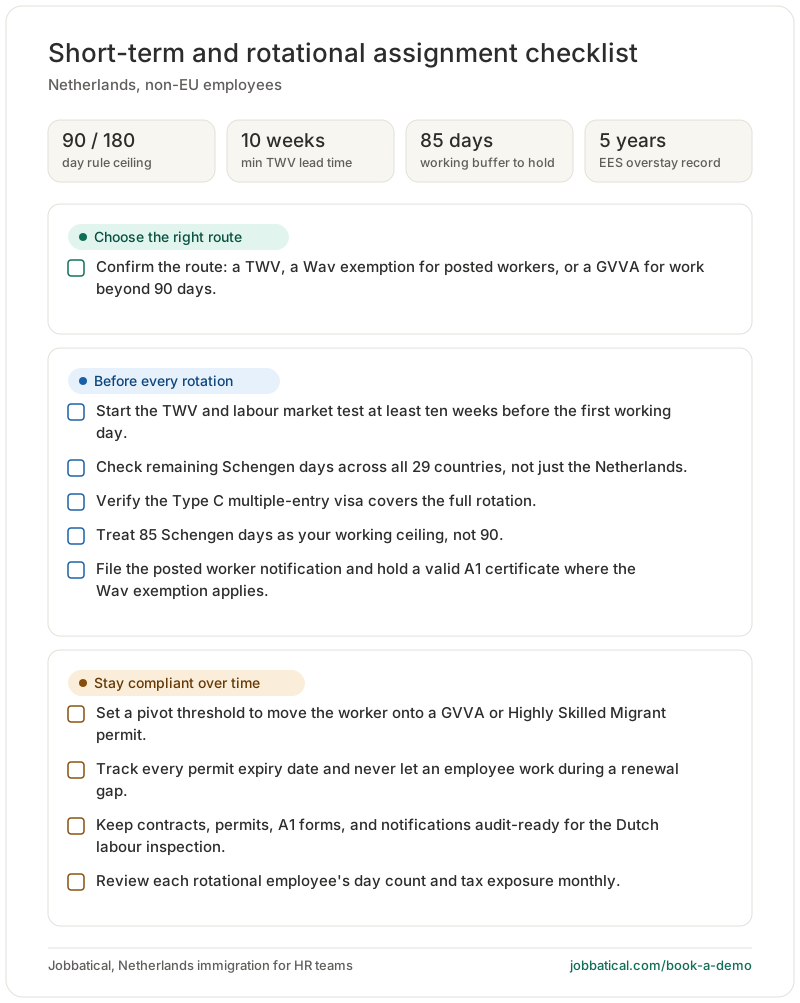
- Stacking applications early: The UWV labour market test takes five weeks, and the processing phase can add up to five more. You must initiate the next TWV application as soon as the current stint begins to prevent the gap between assignments from stretching.
- Building a buffer instead of a deadline: Treat the 90 Schengen days as an absolute ceiling and aim to use around 85 days.
- Tracking the entire Schengen footprint centrally: Using a Schengen rolling 180-day calculator for employers ensures every trip, including personal travel and visits to other EU offices, remains visible in one centralized view.
- Deciding the pivot point in advance: Establish a clear threshold such as when 70 days have been used to proactively transition a worker onto a GVVA or a Highly Skilled Migrant permit.
When rotations become permanent, our Netherlands Highly Skilled Migrant guide covers the route past the 90-day ceiling.
How should employers manage short-term and rotational assignments in the Netherlands?
Managing recurring work assignments in the Netherlands is a process problem, not a one-off task. The employers who avoid breaches treat it as a standing programme with clear ownership, fixed rules, and a single source of truth for every trip.
- Give one owner the day count. Assign a single person or team to track Schengen days and permit expiry for each rotational employee. Shared responsibility is how days slip and permits lapse.
- Set the rules before the first trip. Agree the permit route, the day-count buffer, and the pivot threshold up front. A written policy stops each assignment being decided from scratch.
- Run a pre-trip check every time. Confirm the permit is valid, days remain, and any multiple-entry visa is current before each departure. Treat it as a gate, not a formality.
- Keep documents audit-ready. Store contracts, A1 certificates, posted worker notifications, and permits in one place. The Dutch labour inspection can ask for them without notice.
- Bring in specialist support at scale. Beyond a handful of rotating workers, spreadsheets stop coping. A managed platform or immigration partner keeps filings, day counts, and renewals aligned.
Our Netherlands TWV service coordinates short-stay visas and permit cycles across repeat trips.
The teams that manage recurring work assignments in the Netherlands well pick the permit route and the day buffer before the first flight is booked. If you are juggling several rotational employees across Europe, book a demo to see how Jobbatical tracks rolling 180-day Schengen counts and stacked permits in one place.
Disclaimer: Immigration rules change quite frequently; please verify with official sources or contact us for the latest info before making any decisions.
Frequently Asked Questions - Recurring and Rotational Work Assignments in the Netherlands

.svg)
.svg)