

KEY TAKEAWAYS: UK Skilled Worker Sponsorship 2026
- 68–70-Day Average Sponsorship Timeline: Sponsored UK hires took an average of 68–70 days to arrive, with 48% of cases completed within 60 days and 90% within 120 days.
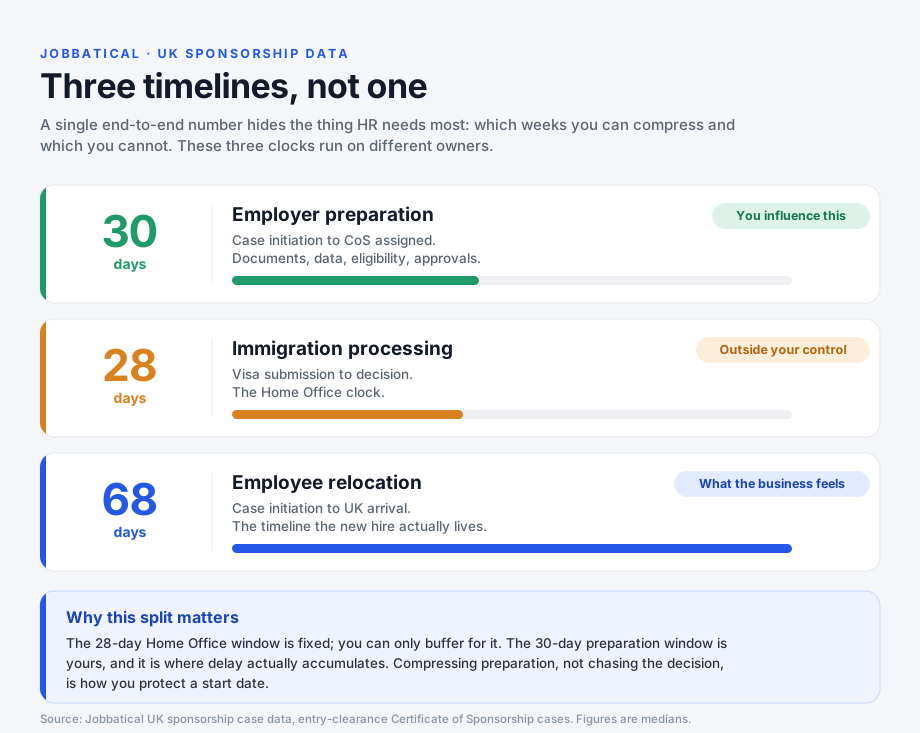
- Three Distinct Sponsorship Timelines: Application preparation accounted for 30 days, Home Office processing took a fixed 28 days, and the end-to-end journey averaged 68 days. Separating these stages helps HR teams identify where delays can be controlled.
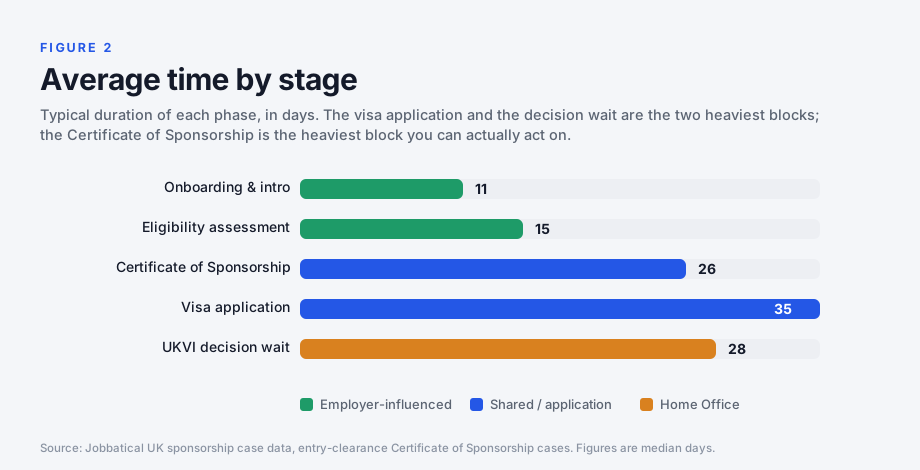
- 26-Day Average DCoS Processing Time: The Defined Certificate of Sponsorship (DCoS) stage took an average of 26 days, making it the most significant bottleneck employers can actively work to reduce.
- 56% of Cases Faced Employer Sign-Off Delays: Internal approvals and employer sign-offs delayed more than half of sponsorship cases, highlighting the importance of preparing documents and securing approvals early.
- 8–12 Weeks of Advance Sponsorship Planning: HR teams should initiate sponsorship 8–12 weeks before the target start date to accommodate the fixed 28-day Home Office processing period and long-tail delays affecting the 10% of cases taking more than 120 days.
UK Skilled Worker Sponsorship: 5 Critical Metrics for Faster International Hiring
Derived from Jobbatical casework for out-of-country UK Skilled Worker applications, these workforce metrics provide People leaders with an operational baseline for forecasting international hiring pipelines and time-to-productivity in 2027.
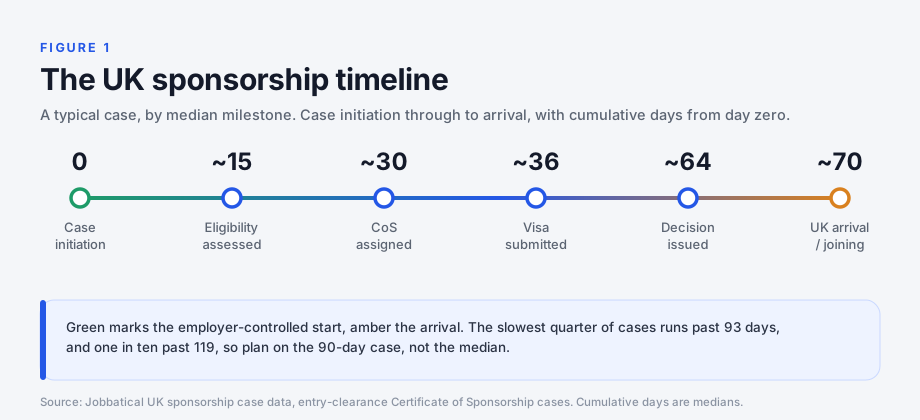
- Forecast a 10-Week Onboarding Window: Median cases require 63 days from initiation to completion, reaching 68 to 70 days until arrival in the UK.
- Predictable Milestone Completion Bands: Overall, 48% of cases finalize within 60 days, 69% within 90 days, and 90% within 120 days.
- Two Core Stages Drive Case Duration: The Defined Certificate of Sponsorship (DCoS) phase averages 26 days, while Home Office adjudication takes 28 days.
- Internal Employer Approvals Gate Momentum: Although People teams directly handle only 8% of procedural actions, 56% of filings stall awaiting internal sign-offs, making timely employer reviews the key to velocity.
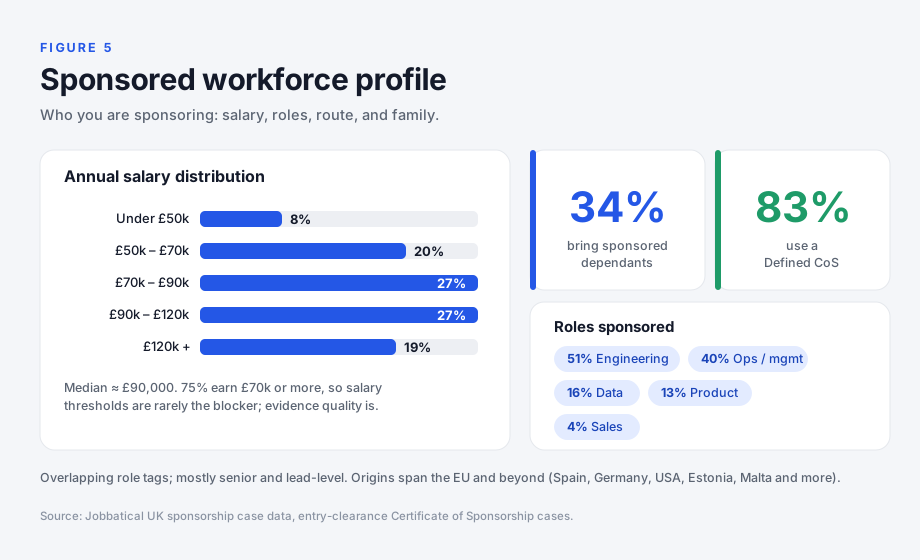
- Senior Compensation and Family Demographics: Relocating talent remains highly specialized, recording a median salary of £90,000 (with 75% earning £70,000+). Furthermore, 34% relocate with dependants, requiring parallel family relocation and visa budgeting.
For a full breakdown of eligibility, salary thresholds and employer duties, see Jobbatical's guide to the UK Skilled Worker visa.
How Long Does the UK Skilled Worker Visa Process Take from Prep to Arrival?
A single headline metric masks three distinct operational clocks and your internal HR workflows directly control only one.
Which 3 UK Sponsorship Timelines Should HR Teams Track?
| Timeline | Start | End | Typical duration |
|---|---|---|---|
| Employer preparation | Case initiation | CoS assigned | About 30 days, which you can influence |
| Immigration processing | Visa submission | Visa decision | About 28 days, set by the Home Office |
| Employee relocation | Case initiation | UK arrival or joining | About 68 days end to end |
Average Processing Times and Completion Windows for UK Skilled Worker Visas
| Completion window | Share of cases |
|---|---|
| Within 60 days | 48% |
| Within 90 days | 69% |
| Within 120 days | 90% |
- End-to-end UK visa sponsorship averages nine to ten weeks. Cases record a median duration of 63 days (mean: 69 days), with the 75% reaching 93 days and the 90% reaching 119 days.
- Internal Employer Preparation (30 Days): Managing vetting, paperwork, and sign-offs before assigning the Certificate of Sponsorship (CoS) is your primary lever to eliminate onboarding delay.
- Home Office Adjudication (28 Days): UKVI processing operates independently of employer action, requiring People teams to buffer for statutory review rather than relying on casework follow-ups.
- Post-Approval Arrival (7 Days): Sponsored talent typically enters the UK within a week of grant, making the visa decision—not travel logistics—the true start-date gating item.
- Strategic 8-to-12 Week Runway: Mobility teams should initiate sponsorship 8 to 12 weeks before target start dates to absorb tail variance and support family relocations.
How to Optimize Workflows to Hit Target Visa Onboarding Dates
- We own visa workload: Jobbatical handles the majority of procedural actions at same-day median turnaround, leaving HR with only the ~8% of gating tasks that genuinely require a licensed signatory.
- We chase employee and employer inputs before they stall the case. Since 56% of cases slip waiting on internal sign-offs, we flag approaching Level 1 SMS actions and document gaps early, enforcing 24-to-48-hour SLAs so filings keep momentum.
- We build the 8-to-12-week runway into your pipeline. By initiating sponsorship against target start dates and running dependant filings concurrently, we absorb the fixed 28-day Home Office wait and keep the 34% of family relocations aligned.
To compare the Skilled Worker route against other UK options before you commit, read Jobbatical's overview of UK visa options and requirements.
How Long Does a Certificate of Sponsorship (CoS) Take and What Causes Delays?
The Certificate of Sponsorship converts a job offer into a visa application, and it is the heaviest block of time you can act on. Understanding where it slows down lets you shorten it.
Key Data Insights: Defined vs. Undefined Certificate of Sponsorship (CoS) Timelines
| Metric | Value |
|---|---|
| Defined CoS share of cases | 83% |
| Undefined CoS share of cases | About 3% |
| Typical CoS stage duration | About 26 days |
| Case initiation to CoS assigned | About 30 days |
| Cases discussing CoS, allocation or SMS in notes | 84% |
Jobbatical manages the Certificate of Sponsorship stage end to end from owning the allocation, drafting, and chasing work so the 26-day block stays on track and your team only steps in where a licensed signatory legally must.
- Defined CoS routing handled from day one: Since 83% of out-of-country Skilled Worker applications require a Defined Certificate of Sponsorship (DCoS), Jobbatical confirms the right route upfront so no time is lost to misfiled allocations.
- The CoS stage held to its four-week benchmark: Jobbatical manages securing and assigning the DCoS to its 26-day average, keeping case initiation to final assignment on track against the roughly 30-day window.
- Employer inputs pre-empted before they slow velocity: With over 84% of case records referencing CoS allocations or Sponsor Management System (SMS) actions and 56% stalling on employer input, Jobbatical flags and chases these early.
- The sponsor-gated approval bottleneck worked around: Because 64% of employer approval tasks rest solely with licensed Level 1 SMS users and cannot be delegated or outsourced, Jobbatical drafts and queues assignments so your signatory only needs to approve, not prepare.
- SMS friction removed through allocation audits: Jobbatical runs regular allocation audits and proactive assignment drafting to resolve the recurring friction points that otherwise stall CoS assignment.
For step by step support on assigning and managing certificates, see Jobbatical's UK Certificate of Sponsorship service.
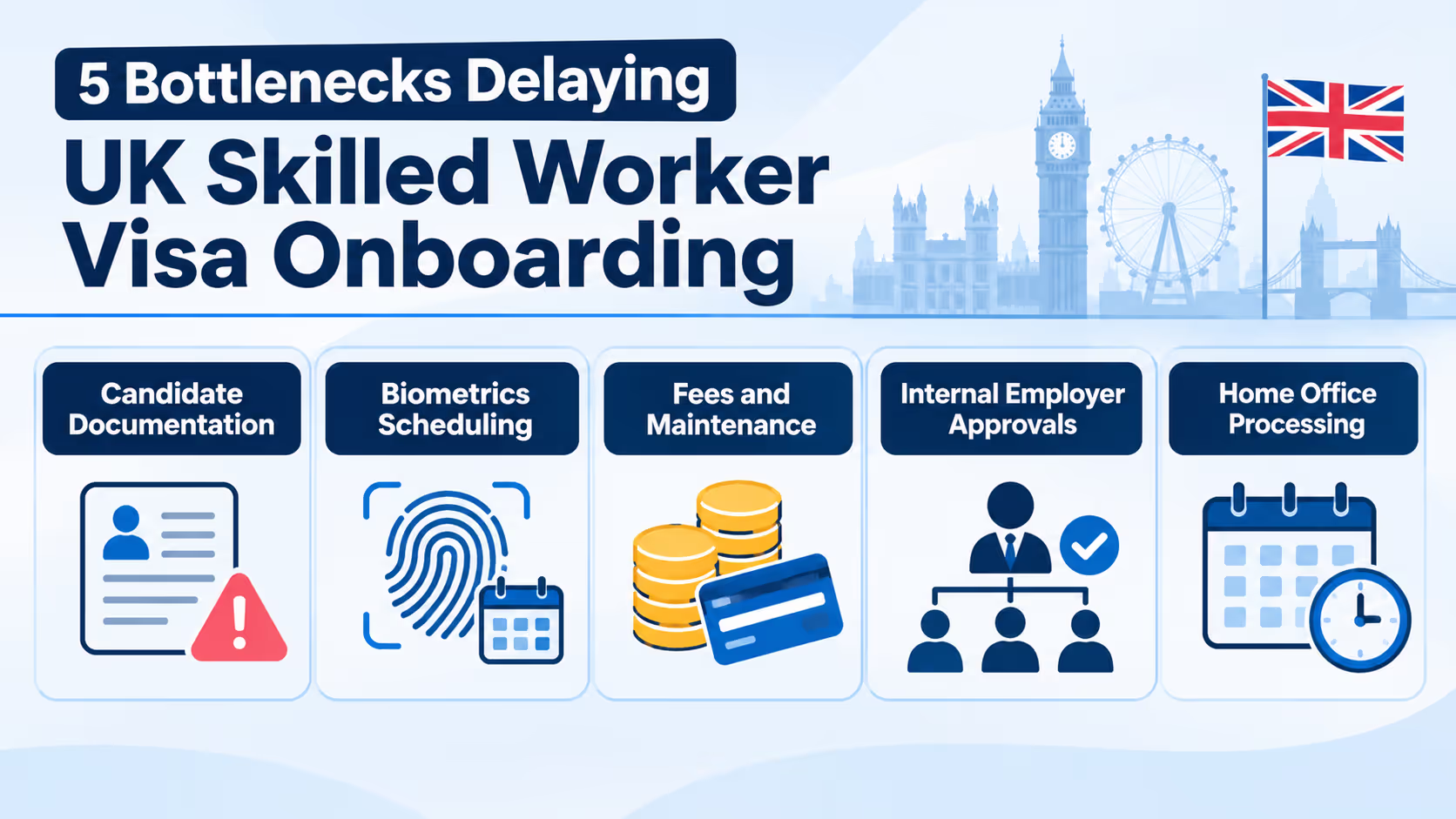
What Are the Top 5 Bottlenecks Delaying UK Skilled Worker Visas?
UK Skilled Worker sponsorship involves more than Home Office processing. Casework data highlights five operational bottlenecks that can extend onboarding timelines and delay international hires.
- Candidate Documentation: Missing or incomplete employee documents affect 72% of tasks and 83% of cases. Start document collection during offer acceptance and use digital checklists to identify gaps before application submission.
- Biometrics Scheduling: Biometrics-related delays affect 64% of cases. Check passport validity early and plan visa application centre appointments immediately after filing to avoid unnecessary onboarding delays.
- Fees and Maintenance: Financial requirements and payment issues delay up to 29% of filings. Confirm maintenance certification eligibility under your A-rated sponsor licence and pre-authorise corporate payments for visa fees and the Immigration Health Surcharge (IHS).
- Internal Employer Approvals: Internal approval delays affect 59% of cases and create bottlenecks in 56% of files. Set 24–48-hour approval SLAs and assign backup Level 1 users to prevent sponsorship applications from waiting on internal sign-offs.
- Home Office Processing: Home Office decisions take an average of 28 days across the analysed cases. Build a 4–6-week buffer into employee start dates or consider Priority processing where available to minimise disruption to hiring plans.
Where Do Most Delays Occur in the UK Visa Sponsorship Process?
| Source of delay | Cases affected | Typical impact |
|---|---|---|
| Employee tasks (documents, data, appointments) | 83% have a late employee task | Tasks slip 72% of the time, a few days each |
| Employer tasks (approvals, information) | 59% have a late employer task | Tasks slip 64% of the time, a few days each |
| UKVI processing (submission to decision) | Every case waits | 28 days median |
Practical Strategies for HR Teams to Eliminate Visa Sponsorship Friction
- Proactive Employee Document Management: With 83% of cases involving late employee tasks and 72% experiencing document delays, Jobbatical uses digital checklists and early biometrics planning to ensure submission readiness.
- Streamlined Employer Approvals: With 59% of cases involving late employer tasks and 56% delayed by internal sign-offs, Jobbatical prepares CoS assignments for efficient review and approval by Level 1 users.
- Proactive UKVI Processing Management: With UKVI processing taking a median of 28 days and up to 47 days for 75% cases, Jobbatical plans a 4–6-week buffer and uses Priority services where available to help protect employee start dates.
For a managed process that chases employee and employer inputs for you, see Jobbatical's UK Certificate of Sponsorship guide.
What Are the Most Common Roles and Demographics for UK Skilled Worker Visas?
Understanding the demographic profile of sponsored international hires enables People teams to anticipate salary baselines, evidential requirements, and family relocation logistics well ahead of submission. Casework patterns highlight an experienced, technical cohort frequently relocating with dependants.
- Engineering and Leadership Dominate: Engineering accounts for 51% of filings, followed by operations (40%), data (16%), and product (13%), with most roles carrying Senior or Lead titles.
- Defined Skilled Worker Visas Lead: Out-of-country Defined Certificates of Sponsorship (DCoS) represent the primary route.
- 34% Relocate With Family: Roughly 34% of cases include dependants, each requiring separate applications, evidence, and biometrics. Confirming family plans at offer stage keeps dependent tracks aligned.
- Diverse Global Sourcing: Talent relocates from diverse corridors including the US, Germany, Spain, Estonia, and Malta highlighting broad global recruitment over single-corridor reliance.
To match each hire to the right route and plan family relocation, read Jobbatical's guide to UK family visa service.
5 HR Actions to Reduce Sponsorship Delays and Protect Target Joining Dates
While UKVI adjudication remains fixed, People teams directly control the pre-submission phase where nearly all recoverable onboarding time is gained.
Key HR Actions and Supporting Benchmarks for UK Visa Processing
| HR action | Supporting metric | Why it expedites |
|---|---|---|
| Start eight to twelve weeks before the joining date | 90 percent of cases finish within 120 days | Absorbs the fixed 28-day Home Office wait |
| Approve and assign within one day | Employer tasks clear in 2 days median, but slip 64 percent of the time | Removes the sponsor-only bottleneck |
| Front-load employee documents | Employee tasks slip 72 percent; documents pending in 19 percent | Cuts the biggest controllable source of delay |
| Confirm salary, SOC code and going rate up front | 75 percent already clear £70,000, so evidence is the real risk | Prevents rework during the CoS stage |
| Book biometrics as soon as the application opens | Appointments appear in 64 percent of cases and always run to the wire | Keeps a critical-path step off the end date |
- Pre-Offer Eligibility Vetting: Conduct SOC code and salary checks before extending formal offers so Certificate of Sponsorship (CoS) applications launch the day contracts are signed.
- Dedicated 24-Hour Sign-Off Ownership: Designate a named SMS signatory with a strict one-day approval SLA to prevent internal task delays, which currently occur in 64% of cases.
- Single-Stage Document Intake: Issue a consolidated, digital paperwork request at offer acceptance to eliminate the multi-round submissions that routinely stall candidate pipelines.
- Early Financial Clearance: Pre-approve corporate payment methods and confirm sponsor maintenance certification upfront to resolve Immigration Health Surcharge (IHS) and financial requirements that affect 29% of cases.
For a managed process that keeps all of this on track, see Jobbatical's UK Skilled Worker visa guide.
Can Home Office Priority Service Fast-Track UK Skilled Worker Visas?
Beyond preparation, a few specific levers consistently compress the timeline. The data shows how often each is already in play.
- Expedited Priority Services: Fast-track critical start dates by leveraging UKVI Priority or Super Priority processing, a proven expediting lever actively utilized in 50% of casework.
- Concurrent Family Filings: Initiate dependant applications concurrently at offer stage to prevent secondary timeline resets for the 34% of international hires relocating with family.
- Unified Milestone Visibility: Track biometrics, caseworker decisions, and joining dates within a shared dashboard to catch appointment slippage early across the 64% of cases where bookings sit on the critical path.
- Pre-Approved Fee Workflows: Pre-authorize corporate payment methods for statutory filing costs and the Immigration Health Surcharge (IHS) upfront to remove administrative holds that stall 29% of cases.
- Prep-Phase Escalations: Concentrate internal escalation efforts entirely on compressing the controllable 30-day preparation window rather than chasing the fixed 28-day Home Office adjudication clock.
To put these levers into a managed, trackable process, book a demo with Jobbatical's immigration experts.
Disclaimer: Immigration rules change quite frequently; please verify with official sources or contact us for the latest info before making any decisions.
Frequently Asked Questions: UK Skilled Worker Visa Sponsorship 2026
How Early Should Employers Start Visa Planning Before an Employee's Start Date?
Start eight to twelve weeks before the intended joining date. The median case takes about 63 days to complete and 68 to 70 days until arrival, and the slowest tenth runs beyond 119 days. Family cases and priority roles need the longer end of that range.
How Long Does the Home Office Take to Decide on a UK Skilled Worker Visa?
Processing from submission to decision takes about 28 days on average, reaching 47 days at the 75th percentile. This is the fixed Home Office window, so plan your joining dates with a buffer rather than trying to speed it up.
How Much Lead Time Is Needed to Assign a Certificate of Sponsorship (CoS)?
Allow about four weeks. The Certificate of Sponsorship stage runs around 26 days, and reaching assignment from case initiation takes about 30 days. Preparing employer information in advance is the most reliable way to shorten it.
Which UK Sponsorship Delays Can Employers Prevent Internally?
Most are preventable. Employee tasks finish late 72 percent of the time and employer tasks 64 percent, both driven by documents and approvals you control. Only the 28-day Home Office decision sits outside your influence, so front-load documents and approve fast.
How Much of the UK Visa Sponsorship Workload Falls on Internal HR Teams?
Only about 8 percent of tasks, roughly two per case, with Jobbatical handling 63 percent and the employee 28 percent. The catch is that 56 percent of cases wait on employer approval, so naming one approver with a one day turnaround protects the whole timeline.
What Is the Most Effective Way to Fast-Track a UK Sponsored Hire?
Focus on the 30-day preparation window, since the decision window is fixed. Approve within a day, collect employee documents in one request, confirm salary and occupation code early, and use priority service, which already appears in about 50 percent of cases.