.svg)


KEY TAKEAWAYS - Netherlands Change of Employer
- A change of employer resets the salary position; the 2026 threshold on the new start date applies, not the old permit figure
- HSM and Blue Card (after 12 months) changes run as IND notifications within 4 weeks; GVVA and out-of-group ICT need full new applications
- 2026 HSM thresholds: €5,942 (age 30+), €4,357 (under 30), €3,122 reduced; Blue Card standard €5,942, reduced €4,754, all excluding holiday allowance
- From 2026 the IND can demand bank statements and batch payment proof; payslips alone no longer satisfy inspections
- The 30% ruling transfers if the job gap stays under 3 months and the new role still meets the income norm
What is a Netherlands change of employer, and who does it affect?
Facilitating a change of employer in the Netherlands involves transferring a foreign worker's existing residence permit to a new sponsor while maintaining their legal residency status. Because the specific rules and procedures depend entirely on the individual's current permit type, the critical first step in the hiring process is to accurately identify the candidate's immigration status.
Below is a breakdown of how to handle transfers based on the most common permit categories:
- Highly Skilled Migrant (HSM) Permit: To hire an HSM, your company must be an IND-recognised sponsor. The transition is processed as a simple notification through the IND Business Portal rather than a new application, making this the most efficient and streamlined route for onboarding.
- EU Blue Card: If the candidate has been with their initial employer for over 12 months, the change is processed as a standard notification. However, if they have been employed for less than 12 months, a completely new application is required. Notably, your company does not need to hold recognised sponsor status to hire an EU Blue Card holder.
- GVVA (Single Permit): Changing employers on a GVVA almost always necessitates a full new application. This often includes a mandatory labour market test conducted through the UWV. For administrative and timeline purposes, you should treat this scenario as a brand-new hire rather than a permit transfer.
- Intra-Corporate Transfer (ICT) Permit: These permits are strictly tied to a specific corporate group. If a candidate is moving to an employer outside of that corporate structure, they will require an entirely different residence permit. Employers must plan accordingly for a full new application process.
- Permanent or EU Long-Term Residents: Individuals holding these statuses have unrestricted access to the Dutch labour market. They can change jobs freely without requiring sponsor notifications or meeting specific salary thresholds, resulting in a minimal immigration compliance burden for your company.
Not sure which permit your candidate holds? Our Netherlands Highly Skilled Migrant permit service maps each permit type to the exact transfer route, so you know your obligations before the contract is signed.
What are the eligibility requirements to change employers?
Eligibility for a permit transfer is evaluated based on both the candidate's current immigration status and your company's capacity to act as a legal sponsor. Even if a candidate appears perfectly qualified on paper, a transfer can be denied if your organization or the offered role does not meet strict statutory requirements.
To ensure a successful transfer, the following criteria must be met:
- Valid Current Residence Permit: At the time of the transfer, the candidate must possess a valid, work-based residence permit. Furthermore, they must have a clean compliance record with the IND (Immigration and Naturalisation Service), with no outstanding violations or issues.
- IND-Recognised Sponsor Status (HSM): To directly hire a Highly Skilled Migrant, your organization must already hold recognised sponsor status with the IND. If your company does not have this accreditation, you must utilize an Employer of Record (EOR) or payroll company that does.
- Qualifying Role and Salary Thresholds: The new position must meet or exceed the specific statutory salary threshold designated for the candidate's permit type. This compensation must be structured as a fixed, guaranteed gross monthly salary, excluding discretionary bonuses or variable pay.
- Maintenance of Continuous Residence: The candidate must have maintained continuous, lawful stay in the Netherlands. If an HSM or EU Blue Card holder recently lost their previous job, they are granted a strict three-month "search period" to secure a new qualifying position before their residency rights are jeopardized.
- Educational and Contractual Alignment (EU Blue Card): For EU Blue Card holders, the responsibilities of the new role must genuinely align with and utilize the employee's higher education qualifications. Additionally, the employment contract must satisfy the statutory minimum duration required for the Blue Card.
For candidates you want to bring in on a fresh permit rather than a transfer, our Netherlands EU Blue Card service covers the full eligibility and filing process end to end.
What salary thresholds apply when changing employers in 2026?
Eligibility for a permit transfer is evaluated based on both the candidate's current immigration status and your company's capacity to act as a legal sponsor. Even if a candidate appears perfectly qualified on paper, a transfer can be denied if your organization or the offered role does not meet strict statutory requirements.
To ensure a successful transfer, the following criteria must be met:
- Valid Current Residence Permit: At the time of the transfer, the candidate must possess a valid, work-based residence permit. Furthermore, they must have a clean compliance record with the IND (Immigration and Naturalisation Service), with no outstanding violations or issues.
- IND-Recognised Sponsor Status (HSM): To directly hire a Highly Skilled Migrant, your organization must already hold recognised sponsor status with the IND. If your company does not have this accreditation, you must utilize an Employer of Record (EOR) or payroll company that does.
- Qualifying Role and Salary Thresholds: The new position must meet or exceed the specific statutory salary threshold designated for the candidate's permit type. This compensation must be structured as a fixed, guaranteed gross monthly salary, excluding discretionary bonuses or variable pay.
- Maintenance of Continuous Residence: The candidate must have maintained continuous, lawful stay in the Netherlands. If an HSM or EU Blue Card holder recently lost their previous job, they are granted a strict three-month "search period" to secure a new qualifying position before their residency rights are jeopardized.
- Educational and Contractual Alignment (EU Blue Card): For EU Blue Card holders, the responsibilities of the new role must genuinely align with and utilize the employee's higher education qualifications. Additionally, the employment contract must satisfy the statutory minimum duration required for the Blue Card.
Netherlands 2026 change of employer salary thresholds
Benchmarking an offer before it goes out saves a rejected notification later. Our Netherlands 30% ruling support service helps structure salary so the worker clears the threshold and protects their tax benefit through the move.
What documents are needed for a change of employer?
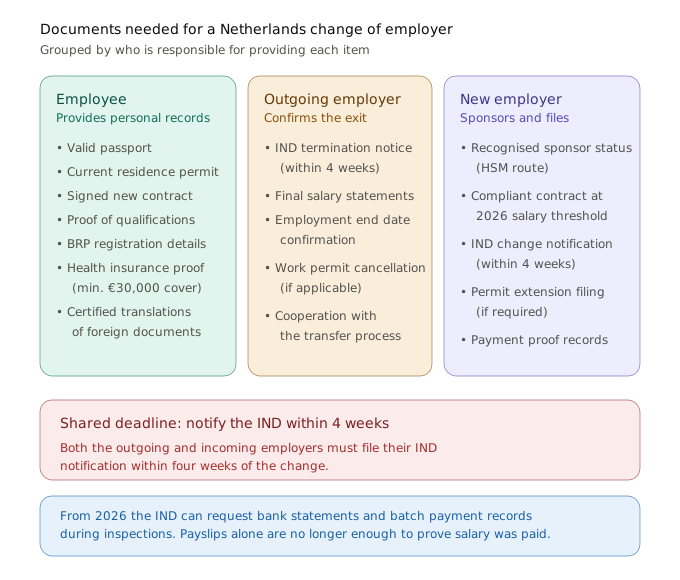
Managing the required documentation involves close coordination between three key parties: the employee, the outgoing employer, and your organization as the incoming sponsor. Because a single missing document from any party can significantly delay the entire transfer process, it is crucial to compile a complete and accurate file before submitting your notification to the IND.
Ensure you have collected and verified the following requirements:
- Employee Documents: You will need a copy of the candidate's valid passport, scans of both sides of their current residence permit, verified proof of educational qualifications, and an up-to-date extract from the Personal Records Database (BRP) confirming their municipal registration in the Netherlands.
- Health Insurance Verification: The candidate must provide comprehensive proof of Dutch statutory health insurance. If using alternative coverage, the policy must provide an equivalent of at least €30,000 in medical coverage, which is a strict prerequisite for any permit modification or new application.
- New Employment Contract: The signed contract must clearly define the job title, stipulate the guaranteed fixed gross monthly salary, and explicitly demonstrate that the compensation meets both the statutory permit threshold and general market-conformity standards.
- Outgoing Employer Records: Essential records from the previous employer include the candidate's final salary slips, formal confirmation of the employment end date, and assurance that the outgoing sponsor submitted their mandatory termination notification to the IND within four weeks of the contract's conclusion.
- Translations and Legalisation: Any official documents issued outside the Netherlands must be translated into Dutch or English by a sworn translator. Furthermore, certain foreign documents may require formal legalisation (such as an Apostille stamp) before the IND will officially recognize and accept them.
If the worker is moving from an intra-corporate transfer arrangement, our Netherlands ICT permit service clarifies which documents carry over and which must be reissued for the new role.
What is the application process for a Netherlands change of employer?
The mechanics differ by permit, but the sequence is broadly consistent. Run these steps in order, and resolve any salary or sponsor gap before the worker starts.
For workers whose permits are close to expiry during the move, our Netherlands recognised sponsorship service coordinates notifications and any renewal so lawful stay never lapses.
How long does a change of employer take, and what does it cost?
Processing timelines and associated costs vary significantly depending on whether the transfer qualifies as a straightforward notification or necessitates a completely new application. A common pitfall for employers is allowing an anticipated start date to dictate the immigration timeline; instead, the legal process must strictly govern the candidate's onboarding schedule.
Below is an overview of expected timelines and financial obligations to incorporate into your hiring plan:
- Notification Route Timelines: For transfers involving Highly Skilled Migrants and EU Blue Card holders (after 12 months with their initial employer), the notification process typically clears within two to four weeks. In these scenarios, the employee can usually commence work as soon as the IND notification is submitted and their legal residency is confirmed.
- New Application Route Timelines: Modifications requiring a full application such as GVVA permits, early-stage Blue Card changes, and out-of-group ICT transfers can legally take up to the statutory maximum of 90 days. However, IND-recognised sponsors frequently experience expedited processing times ranging from two to six weeks.
- IND Government Fees: As of 2026, the standard application fee for an EU Blue Card or a Highly Skilled Migrant permit is €423. Conversely, straightforward sponsor-transfer notifications do not incur an administrative fee from the IND.
- Professional Support Costs: Engaging an immigration consultancy to manage a change of employer generally incurs fees ranging between €500 and €2,000. This cost fluctuates based on the complexity of the case, the specific permit category, and the administrative burden involved in the transition.
- Additional Financial Considerations: Employers should allocate budget for ancillary expenses such as sworn document translations, formal legalisation procedures, and BRP municipal registration updates. Notably, transferring an existing 30% tax ruling to a new employer does not require a separate government application fee.
Processing time and cost by route
Want to know exactly what a specific transfer will cost and how long it will take? Our Netherlands change of employer service maps your case to the right route and timeline before you commit.
What are the compliance obligations for employers?
The reality is that most compliance risk in a change of employer falls squarely on your organization as the incoming sponsor, rather than the employee. Regulatory oversight is continuously strengthening, and simply issuing payslips is no longer sufficient to satisfy the Immigration and Naturalisation Service (IND) during an audit.
To protect your recognised sponsor status and ensure your new hire's legal residency remains intact, strict adherence to the following obligations is mandatory:
- Four-Week Notification Deadline: Both the outgoing and incoming employers are legally obligated to formally notify the IND within four weeks of the employment change. Failing to meet this critical deadline can disrupt the employee's continuous residence status and jeopardize their current permit.
- Proof of Actual Payment (2026 Update): As of 2026, the IND explicitly requires recognised sponsors to prove that salaries were successfully deposited into the employee's personal bank account. Payslips alone are no longer acceptable evidence; you must retain business bank statements or batch payment overviews that clearly trace the funds to the individual.
- Continuous Salary Compliance: Meeting the statutory salary threshold is an ongoing obligation, not merely a one-time requirement at the start of employment. Any drop in salary below the designated thresholdexcluding statutory sick leaven immediately trigger a permit review or revocation by the IND.
- Stringent Record Retention: Employers must maintain comprehensive files for each sponsored worker, including employment contracts, residence permit copies, payslips, and the newly mandated proof of actual payment. These records must be securely retained and readily available for IND audits for at least five years after the sponsorship formally ends.
- Market-Conform Pay Standards: In addition to clearing the fixed statutory permit threshold, the compensation offered must align with general market-conform rates. The IND requires the salary to accurately reflect what comparable roles command within the broader Dutch labour market to prevent wage suppression.
Ongoing tracking is where most in-house teams get stretched. Our visa and permit renewals compliance module automates deadline alerts and payment tracking so a missed notification never puts a permit at risk.
What happens if a worker loses their job before finding a new one?
Job loss does not automatically invalidate a foreign worker's residence permit, but it does initiate a strict regulatory timeline. Temporary permit holders are granted a limited window to secure a new qualifying position. The outcome of this transition phase significantly impacts both the worker's immediate legal status and their future eligibility for permanent residency.
- Six-Month Search Period (2026 Update): It is important to note that the rules recently changed. As of May 2026, the IND extended the statutory job-search period. Highly Skilled Migrants, EU Blue Card holders, and GVVA permit holders are now generally granted a maximum of six months up from the previous three months to find a new qualifying position and have their new sponsor formally notify the IND.
- Timely Notification Requirements: To keep the employee's continuous residence status intact, the incoming employer must submit the change-of-employer notification to the IND within four weeks of the employee's official start date.
- Risk of Permit Revocation: If a candidate fails to secure a qualifying role and complete the sponsorship transfer within their six-month search period, the IND is likely to revoke their permit, resulting in an immediate loss of lawful stay in the Netherlands.
- Status of Family Dependents: Permits for dependent family members typically remain valid, provided the new role meets the statutory family income requirements. However, these dependent permits may require an administrative update in conjunction with the primary applicant's permit transfer.
- Unrestricted Permanent Residents: Candidates who hold permanent residency or EU long-term residence are entirely exempt from search-period restrictions. They can navigate periods of unemployment and transition between employers freely without jeopardizing their immigration status or requiring IND sponsorship notifications.
When a permit is nearing expiry during a job change, our Netherlands EU Long-Term Resident Permit service helps eligible workers move onto a stable long-term status that removes future sponsor dependency.
How does a change of employer affect permanent residency and the 30% ruling?
A well-timed employer change safeguards two critical assets for your international employee: their trajectory toward permanent residency and their continued eligibility for the 30% tax ruling. Both of these benefits are strictly contingent upon administrative continuity, and a poorly managed transition gap can permanently jeopardize these advantages.
To protect your employee's status and benefits, ensure strict adherence to the following parameters:
- Continuous Residence Clock: To maintain a continuous lawful stay which is fundamentally required to keep the five-year clock toward permanent residency running the incoming employer must formally notify the IND within four weeks of the employee's start date.
- 30% Ruling Continuity (The 3-Month Rule): The 30% tax facility does not transfer automatically to a new employer. To retain it, the gap between the final day of the previous contract and the first day of the new contract cannot exceed exactly three months (90 days). Exceeding this tight window permanently breaks the employee's required "recruited from abroad" status. Additionally, you and the employee must submit a new joint application to the Belastingdienst within four months of the start date to ensure the ruling applies retroactively.
- Salary Thresholds and the Ruling: The new compensation package must independently satisfy the Belastingdienst's strict taxable income requirements, which are entirely separate from the IND's residence permit thresholds. If the new salary dips below the tax authority's specific norm, the employee will lose the tax benefit, even if their residence permit remains perfectly valid.
- Consequences of Lapses in Residency: Extended gaps in lawful stay that violate the IND's statutory search period can completely reset the continuous residency clock. This reset will erase previous accrued time and significantly delay or complicate a future application for Dutch citizenship or EU long-term residency.
- Strategic Timing Alignment: HR and recruitment teams must meticulously coordinate the transition timeline. It is essential to perfectly align the previous contract's end date, the IND notification deadline, and the new contract's start date to ensure there is absolutely no lapse in either lawful residence or tax ruling eligibility.
Protecting the tax benefit through a move takes careful sequencing. Our Netherlands 30% ruling support handles the timing and documentation so your employee keeps the benefit they relocated for.
Change employers in the Netherlands without a status gap
Start the immigration process the moment a candidate accepts, not the week before they begin. Identify the permit, confirm the 2026 salary threshold on the intended start date, and file the notification or application early. If any single piece is unclear, get it checked before the contract is signed rather than after.
Book a demo to see how Jobbatical coordinates every party and deadline in a Netherlands change of employer, so your new hire starts on time and stays compliant.
Disclaimer: Immigration rules change quite frequently; please verify with official sources or contact us for the latest info before making any decisions.
Frequently Asked Questions - Netherlands Change of Employer

.svg)
.svg)