

KEY TAKEAWAYS: Netherlands Business Visa
- A Netherlands business visa is a short-stay Schengen (Type C) visa for meetings, conferences and negotiations; it does not authorise paid work in a Dutch company.
- The standard Schengen visa fee is EUR 90 for adults and EUR 45 for children aged 6 to 11, set by the Netherlands Ministry of Foreign Affairs.
- Average decision time is 15 calendar days and can extend to 45 days, so start at least 4 to 6 weeks before travel to cover appointment waits.
- The 90/180-day rule caps stays at 90 days in any rolling 180-day period across the whole Schengen Area, even on a multiple-entry visa.
- If your employee will perform actual work, a business visa is not enough; a TWV, GVVA, Highly Skilled Migrant or EU Blue Card route applies instead.
What Is a Netherlands Business Visa?
A Netherlands business visa is a short-stay Schengen (Type C) visa designed for commercial activities lasting up to 90 days. While it allows employees to conduct business in the Netherlands, it strictly prohibits paid employment with a Dutch company, making early compliance crucial to avoid costly penalties.
- Short-stay Schengen visa: As a Type C visa valid across the wider Schengen Area, it permits short-term visits governed by Schengen-wide regulations rather than purely Dutch laws.
- Defined business purpose: The approved visa must strictly align with the employee's actual on-the-ground activities, such as attending meetings, negotiations, or conferences.
- No local employment: Because this visa prohibits productive work or receiving a salary from a Dutch employer, any paid roles require a separate work authorization route.
- Time-limited stay: The total permitted stay is strictly capped by the 90/180-day rule across the entire Schengen Area, regardless of how many separate trips are taken.
- Entry document, not residence: This document exclusively grants temporary entry and cannot serve as a pathway to a permanent Dutch residence permit.
For end-to-end help securing this visa for your travellers, Jobbatical's Netherlands Schengen and business visa service sets out exactly what the application covers and how expert support speeds it up.
Who Needs a Business Visa for the Netherlands?
Determining whether an employee requires a Netherlands business visa depends entirely on their nationality and country of legal residence, making early verification essential for seamless corporate travel.
- Visa-required nationals: Many non-EU and non-EEA passport holders must secure an approved Schengen business visa prior to their departure.
- Visa-exempt nationals: Citizens of specific non-EU countries can conduct business visa-free, provided they strictly adhere to the 90/180-day Schengen stay limit.
- EU, EEA, and Swiss citizens: Benefiting from freedom of movement, these nationals can freely conduct business in the Netherlands without any prior authorization.
- Application jurisdiction: Visa-required travelers must typically apply through the embassy or consulate in their current country of legal residence, rather than their country of citizenship.
- Upcoming ETIAS requirements: Once the system launches, all currently visa-exempt travelers will need to secure an approved ETIAS travel authorization before entering the Schengen Area.
To see which visa or permit each member of a mixed-nationality team actually needs, Jobbatical's guide to Netherlands visas for international employees maps every route in one place for HR teams.
Who Can Travel to the Netherlands on Business Visa?
The traveller's employment relationship changes the paperwork and the risk level. The reality is that a contractor delivering a service looks very different to an immigration officer than an employee attending a meeting.
- Employees: Travel is backed by an employer letter confirming role, salary continuity and the business purpose.
- Contractors: Independent contractors face closer scrutiny, because paid services can cross into work territory.
- Self-employed travellers: They must show their own business registration and evidence of the trip's purpose.
- Posted workers: Providing services under a contract can trigger posted-worker notification duties, separate from the visa.
- Purpose over job title: What the person actually does in the Netherlands decides whether a business visa fits.
What Are the Key Dutch and Schengen Immigration Rules for Netherlands Business Visa?
Understanding the specific roles of the authorities managing the Netherlands business visa process can prevent delays and streamline your corporate travel planning.
- IND (Immigration and Naturalisation Service): While they manage long-term residence and work authorizations, the IND is not involved in processing short-stay business visas.
- Ministry of Foreign Affairs (BZ): This governing body establishes the overarching Schengen visa policies, regulations, and fee structures that all business travelers must follow.
- Dutch Embassies and Consulates: Acting as the final decision-makers, these diplomatic missions evaluate individual applications and officially issue the business visa stickers.
- External Visa Application Centers (e.g., VFS Global): These administrative centers manage applicant logistics by collecting forms, supporting documents, and biometrics on behalf of the embassies, though they do not make visa decisions.
- Royal Netherlands Marechaussee: Because a valid visa does not guarantee automatic entry, these border control officers make the final admission decision when travelers arrive at the Dutch border.
For a fuller picture of how Dutch immigration law and IND compliance affect your workforce, Jobbatical's Netherlands immigration services explain the rules, policy, and employer obligations in detail.
Which Schengen Rules Apply to Netherlands Business Travellers?
Understanding the critical difference between a Schengen visa's validity period and its permitted duration of stay is essential for employers to maintain corporate travel compliance.
- Maximum stay limit: The business visa strictly caps travel at 90 days within any rolling 180-day period across all combined Schengen member states.
- Validity vs. duration: Employees must adhere to the specific "duration of stay" field on their visa rather than assuming they can remain for the entire validity window.
- Area-wide day counting: Because the 90-day allowance applies universally, time spent in any other Schengen country will directly deduct from the total days available for the Netherlands.
- Entry types: The granted entry type single, double, or multiple dictates exactly how many times an employee can cross into the Schengen Area during the visa's overall timeframe.
- Main destination rule: To prevent application refusals, employees must always apply through the embassy of their primary business destination or their initial point of entry.
When a role requires a qualified non-EU hire rather than a short business visit, Jobbatical's Netherlands Highly Skilled Migrant permit service explains the eligibility criteria, salary thresholds, and recognised-sponsor requirements in full.
What Are the Eligibility Requirements for a Netherlands Business Visa?
Securing a Netherlands business visa goes beyond mere administrative checklists; it requires comprehensively convincing a consular officer that the corporate trip is completely genuine and that the employee possesses strong ties to return home.
- Valid passport and travel document: Applicants must submit an undamaged passport issued within the last ten years that contains at least two blank pages and remains valid for a minimum of three months beyond their intended Schengen departure date.
- Genuine business purpose: Employees must avoid vague claims by providing concrete, verifiable documentation such as official corporate invitation letters, employer declarations, and detailed daily agendas that clearly justifies their exact commercial activities.
- Sufficient financial means: The visa application must include comprehensive financial evidence, either via personal bank statements or a formal corporate sponsorship letter, proving the traveler has adequate funding for every single day of the planned stay.
- Travel medical insurance: Travelers are legally required to hold a comprehensive, Schengen-valid health insurance policy providing at least €30,000 in coverage for emergency medical treatment, hospitalization, and potential repatriation throughout the entire trip.
- Intention to leave: Providing a confirmed return flight, proof of an ongoing local employment role, and a strong corporate endorsement letter is vital to credibly demonstrate the applicant's concrete intent to exit the Schengen Area before the visa expires.
For skilled professionals who need EU-wide mobility alongside Dutch work rights, Jobbatical's Netherlands EU Blue Card service covers the salary criteria, eligibility, and application route from start to finish.
How Long Does a Netherlands Business Visa Take to Process?
Accurate processing time estimates are critical planning metrics for global mobility teams, as a delayed visa application often results in a missed corporate trip. While the legal decision framework is predictable, highly variable appointment availability requires strategic planning to ensure seamless travel execution.
- Standard processing time: Mobility teams should utilize a baseline standard processing time of 15 calendar days from the moment a fully complete application is officially submitted.
- Extended processing: Travelers with complex profiles or prior immigration issues should anticipate extended processing timelines ranging from 30 up to a strict maximum of 45 calendar days.
- When the clock starts: The official processing period strictly commences upon the submission of a comprehensive application, meaning any missing documentation will immediately reset your timeline and cause delays.
- Appointment availability: Because securing application slots during peak spring and summer seasons can take weeks, this unpredictable waiting period must be factored in separately from the legal decision timeframe.
- Recommended planning buffer: To safeguard against delays, initiate the application process four to six weeks early, keeping in mind that submissions are accepted between six months and 15 days prior to departure.
Walk through the employer-led single-permit process in Jobbatical's Netherlands GVVA employer guide.
Which Documents Are Required for a Netherlands Business Visa?
A complete and well-organised document set is the fastest route to approval. Consular officers tend to decide quickly when the evidence lines up and slowly when it does not. The documents below form the standard requirement for a business visa application.
Which Employer-Specific Documents Are Needed for a Netherlands Business Visa?
The sending company's documentation is pivotal to the success of any Netherlands business visa application, as it formally validates the trip's legitimacy, financial backing, and corporate responsibility.
- Employer cover letter: Issued on official company letterhead, this foundational document confirms the employee's role, exact travel dates, and business purpose to provide consular officers with immediate context.
- Corporate cost undertaking: A formal declaration that the company will cover all travel expenses significantly strengthens the application by removing the financial burden from the individual applicant.
- Proof of active employment: Providing a current contract or recent payslips confirms the traveler's ongoing corporate role, acting as crucial evidence of their concrete intention to return home after the trip.
- Company registration details: Submitting official business registration documents endorsed by a verifiable signatory adds essential credibility by proving the sending organization is a genuine, legally operating entity.
- Coordination with the Dutch host: The employer must ensure their corporate cover letter perfectly aligns with the Dutch host's official invitation regarding dates, purpose, and contact details to prevent avoidable consular scrutiny.
Learn how to secure IND recognised sponsor status in Jobbatical's Netherlands recognised sponsor guide.
What Are the Steps to Apply for a Netherlands Business Visa?
Understanding the step-by-step Netherlands business visa application process is key to preventing unnecessary delays and ensuring a seamless submission. Because gathering documentation and securing appointment slots often take longer than the actual consular decision, following a structured timeline keeps corporate travel on track.
- Confirm visa requirement: Verify the traveler's nationality and legal residence status against Dutch immigration rules to determine if a Schengen business visa is required before booking travel.
- Prepare application and documents: Accurately complete the official Schengen short-stay application form and compile all mandatory employer, host, financial, and medical insurance documents according to the official checklist.
- Book and attend biometric appointment: Secure an appointment early at the designated embassy or external visa center to submit physical documents, digital fingerprints, and facial biometrics.
- Track application status: Monitor the application online using the provided tracking reference number to immediately address any requests for supplemental information from consular officers.
- Collect and verify visa sticker: Upon receiving the passport, carefully review the visa sticker details including permitted validity dates, duration of stay, and entry allowance to ensure complete alignment with the intended travel itinerary.
See how to sponsor a skilled non-EU hire in Jobbatical's Netherlands Highly Skilled Migrant sponsorship guide.
How Much Does a Netherlands Business Visa Cost?
While the official government fee for a Netherlands business visa is fixed, employers often underestimate total travel costs by focusing solely on administrative charges. Establishing an accurate per-traveler budget requires accounting for necessary third-party processing, compliance, and ancillary expenses alongside the core visa fee.
- Schengen visa application fee: Set by the Ministry of Foreign Affairs, the standard adult fee is €90, with a reduced €45 fee for children aged 6–11 and full exemptions for children under 6 and specific Schengen-designated categories.
- Visa application center service fees: External service providers such as VFS Global charge additional mandatory processing fees, with optional add-ons like courier delivery, SMS updates, or premium appointment slots adding to the total cost.
- Travel medical insurance: Every applicant must hold mandatory medical insurance providing at least €30,000 in coverage across all Schengen states, with premiums varying by traveler age and coverage duration.
- Document preparation and translation: Internal administrative overhead for gathering corporate evidence and obtaining certified document translations represents a significant, often overlooked operational expense.
- Travel, accommodation, and management expenses: Beyond core flight and hotel costs, investing in outsourced immigration handling or legal support helps safeguard frequent corporate travel against costly visa refusals.
What Is the Netherlands Business Visa Cost Breakdown?
Government fees are current for 2026 per the Netherlands Ministry of Foreign Affairs and VFS Global. Service fees vary by country, so confirm the exact amount at the relevant application centre.
Jobbatical manages your short-term work permit end to end via the Netherlands TWV service.
What Is Permitted on a Netherlands Business Visa?
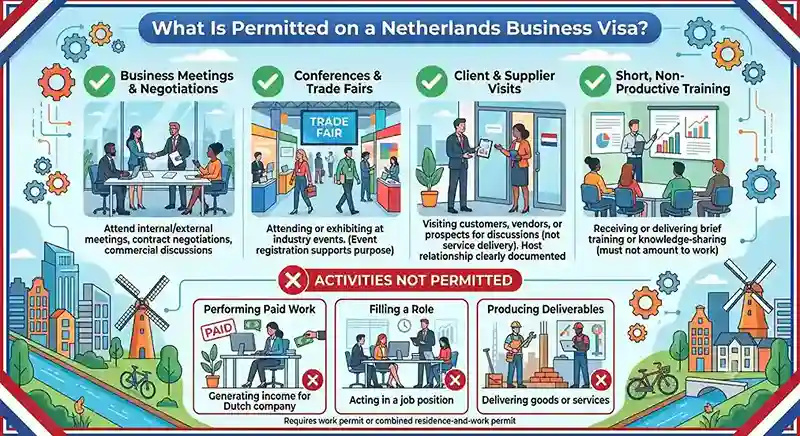
In immigration terms, "business" carries a strict definition that is far narrower than many employers anticipate. Permitted activities must strictly support your organization's commercial interests without crossing into the Dutch labor market or engaging in local productive work.
- Business meetings and negotiations: Employees can legally participate in internal corporate meetings, external client discussions, and commercial contract negotiations.
- Conferences and trade fairs: Attending, speaking at, or exhibiting at industry events is fully permitted with official event registration or exhibitor confirmation.
- Client and supplier visits: Conducting strategic discussions with prospects, vendors, or customers is allowed, provided the visit excludes direct service delivery.
- Short, non-productive training: Receiving or delivering brief, theoretical knowledge-sharing sessions is permitted, as long as it avoids hands-on, output-producing activities.
- Prohibited activities: Performing paid labor, filling an operational role, or producing deliverables for a Dutch entity strictly requires a separate work permit or combined residence-and-work authorization.
When an employee's planned activity edges toward actual work, Jobbatical's comparison of Netherlands work permits and the EU Blue Card shows which authorised route applies and how the thresholds differ.
What Is the Difference Between a Single-Entry and Multiple-Entry Netherlands Business Visa?
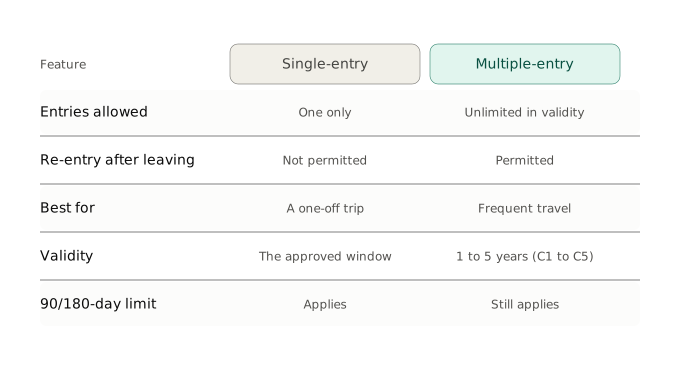
Selecting the appropriate entry type during the Netherlands business visa application process is critical for frequent corporate travelers. Choosing a multiple-entry visa eliminates repeat application administrative burdens, saving mobility teams valuable time and preventing costly appointment delays.
- Recurring meetings: A single visa approval covers ongoing visits to Dutch clients or corporate offices, eliminating the need for individual applications for every trip.
- Project-based travel: Multiple-entry visas provide necessary operational flexibility for employees who must make several short visits throughout a project lifecycle.
- Proven travel history: Applicants with a clean immigration record and demonstrated compliance are significantly more likely to secure multi-entry permissions.
- Reduced administrative burden: Consolidating multiple trips under one authorization lowers recurring processing costs and administrative overhead for mobility teams.
Validity Duration and Schengen Stay Limits Multiple-Entry Netherlands Business Visa:
- Validity classes: Multiple-entry visas are issued in distinct duration tiers ranging from C1 (up to one year) to C5 (up to five years), depending on individual traveler circumstances.
- Unchanged stay allowance: Regardless of whether a visa is valid for one year or five, the physical stay remains strictly capped at 90 days within any rolling 180-day period.
- Merit-based issuance: Consular officers grant longer validity windows to applicants with consistent, compliant Schengen travel histories, while first-time travelers usually receive shorter initial terms.
What Are the Most Common Netherlands Business Visa Mistakes to Avoid?
Common corporate travel mistakes during the Netherlands business visa process can turn routine trips into major compliance issues or costly delays. Performing a proactive pre-travel assessment is the most effective way to safeguard your organization against avoidable visa application errors.
- Choosing the wrong visa type: Employers must thoroughly evaluate an employee's actual daily tasks before applying, as defaulting to a business visa for activities that constitute productive work violates immigration regulations.
- Providing weak business documentation: Submitting vague host invitations or generic employer letters triggers consular scrutiny, whereas detailed, consistent documentation ensures smooth approvals.
- Ignoring the 90/180-day rule: Because frequent short trips quietly accumulate, mobility teams must actively track cumulative Schengen days to prevent accidental overstays.
- Applying too close to the travel date: Initiating applications weeks in advance provides a necessary buffer against tight appointment availability and extended processing times.
- Assuming a visa guarantees entry: Travelers must carry physical copies of their supporting corporate documents upon arrival, as border officers retain the ultimate authority to permit entry.
Because the most serious mistake is using a business visa where work authorisation is required, Jobbatical's Netherlands GVVA single permit service explains exactly when a combined work-and-residence permit becomes necessary.
What Happens If a Netherlands Business Visa Is Refused?
Receiving a Netherlands business visa refusal is not a final outcome, but resolving it requires a strategic response rather than an immediate, unchanged resubmission. Analyzing the official refusal grounds enables corporate mobility teams to effectively address application deficiencies and safeguard future travel plans.
- Common reasons for refusal: Applications are typically denied due to insufficient proof of business purpose, inadequate financial evidence, inconsistent documentation, or doubts regarding the applicant's intent to return home.
- Reading the refusal decision: Reviewing the official refusal letter is essential, as it specifies the exact legal grounds and documentation deficiencies that led to the rejection.
- Deciding between appeal and reapplication: While employers can lodge a formal objection within the stated deadline, submitting a fresh application with corrected documentation is often significantly faster.
- Strengthening a new application: A resubmission must directly rectify every cited weakness by providing clearer corporate invitation letters, robust financial statements, and stronger proof of home-country ties.
- Planning around travel delays: Because a refusal disrupts corporate schedules, mobility teams must recalculate travel timelines to avoid a rushed reapplication that risks a second refusal.
Check whether TWV is the right route in Jobbatical's Netherlands short-term work permit (TWV) guide.
How Does Jobbatical Help Employers With Bulk Visa Processing for Netherlands Business Visa ?
Managing group business visas often overwhelms HR teams, but Jobbatical streamlines corporate travel management by consolidating high-volume applications onto a single platform.
- Automation paired with immigration experts: Jobbatical combines automated workflow processing with dedicated specialist support to ensure fast, high-volume handling without sacrificing application accuracy.
- Centralized document management: The platform automatically collects, validates, and securely stores all applicant documentation in a single repository, eliminating submission gaps and administrative back-and-forth.
- Built-in compliance tracking: By continuously monitoring visa validity, entry types, and 90/180-day Schengen allowances across your workforce, Jobbatical proactively prevents accidental overstays.
- Coordinated group scheduling: Managing team timelines and appointment bookings collectively safeguards fixed event deadlines against peak-season availability bottlenecks.
Transfer non-EU staff to a Dutch entity with Jobbatical's Netherlands ICT permit service.
Employer and Employee Pre-Travel Checklist for Netherlands Business Visa
Before you default to a business visa, step back and look at four things together: the employee's nationality, how long they will stay, what they will actually do, and how often they travel. When the activity crosses into real work, switch to a Dutch work and residence route early, and let a conversation with an immigration expert settle the call before anyone books a flight.
Disclaimer: Immigration rules change quite frequently; please verify with official sources or contact us for the latest info before making any decisions.
Frequently Asked Questions: Netherlands Business Visa

.svg)
.svg)