
KEY TAKEAWAYS: Netherlands International Trade Regulation
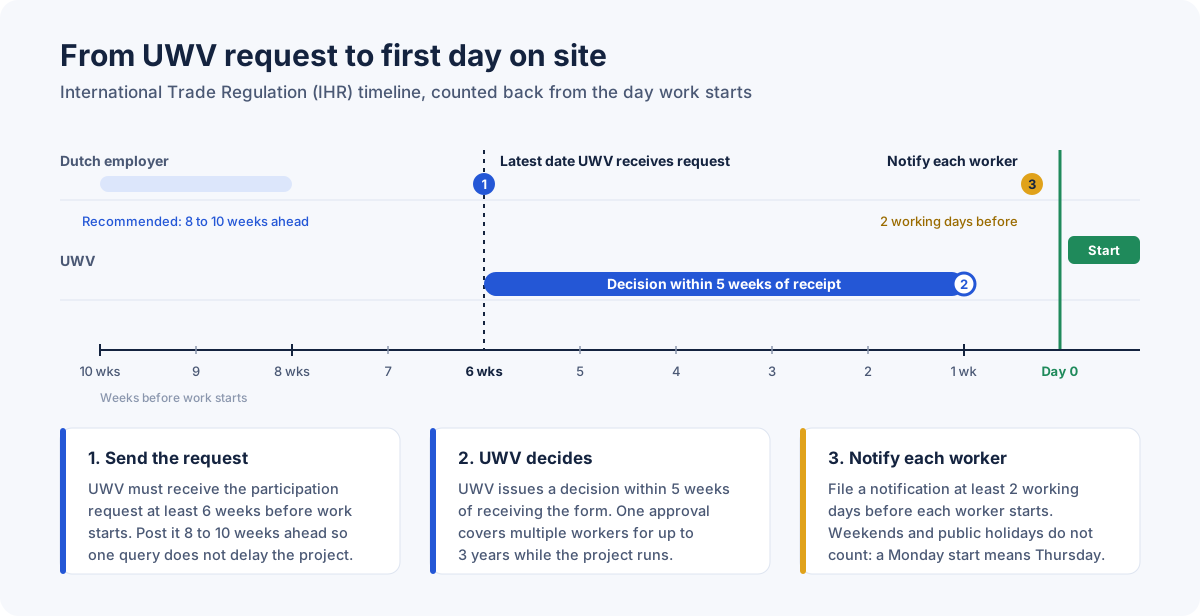
- Send the IHR participation request to UWV at least six weeks before work starts; UWV decides within five weeks, so plan for eight to ten weeks.
- The Dutch employer files the request, while the workers stay employed by the foreign company and must earn at least the Dutch statutory minimum wage.
- One approval covers multiple workers for up to three years, and each worker must be notified to UWV at least two working days before starting.
- IHR approval replaces the TWV only; workers staying three months or longer need an IND residence permit, and visa rules still depend on nationality.
- Notify UWV within three months after the project ends, or UWV can refuse your next participation request.
A Dutch client signs a contract with your overseas partner, and the installation crew needs to be on site in eight weeks. Filing a separate TWV for every engineer would mean individual UWV applications and, in most cases, a labour market test for each person. The Netherlands International Trade Regulation (Regeling Internationaal Handelsverkeer, or IHR) offers a faster route, because UWV approves the project once and you then register each foreign worker at least two working days before they start.
This guide explains who qualifies, how UWV approval works, what you must record, and where the scheme stops covering your team. If you are still comparing options for temporary deployments, our overview of short-term work assignments in the Netherlands sets out the wider landscape for employers.
What Is the Netherlands International Trade Regulation (IHR)?
The IHR is a work permit exemption managed by UWV, the Dutch Employee Insurance Agency. It applies to Dutch employers that do business with a foreign company and need that company's non-EU staff on site for a defined project. The scheme has applied since 1 July 2017 and replaced the earlier Knowledge Industry pilot.
- What is the Regeling Internationaal Handelsverkeer? The Regeling Internationaal Handelsverkeer is a Dutch scheme that lets non-EU, non-EEA and non-Swiss workers of a foreign company work temporarily in the Netherlands without a TWV. The exemption only applies to work on a project that UWV has approved, as confirmed on the UWV International Trade Regulation page. Any other work in the Netherlands still requires a regular work permit.
- Why did the Netherlands introduce a special arrangement for international project teams? The government wanted a flexible route for international trade, services and cooperation that does not displace local workers. One project approval replaces repeated per-employee work permit applications, which reduces administration for companies with recurring cross-border projects. The standard alternative is the individual TWV route, and our guide to Netherlands TWV work permit requirements covers that separate process in detail.
- How does UWV participation approval work for international project partners? The Dutch-based employer submits the participation request to UWV, not the overseas company. UWV assesses the project and decides within five weeks of receiving the form. Once UWV admits the project, the Dutch employer can bring in several workers under the same approval for up to three years.
- Which companies can benefit from this arrangement? The scheme suits Dutch companies with commercial ties to foreign suppliers, manufacturers, technology vendors or joint venture partners. Offshore energy, shipbuilding, specialist machinery and software delivery projects are typical users. The foreign workers remain on the overseas employer's payroll for the whole assignment.
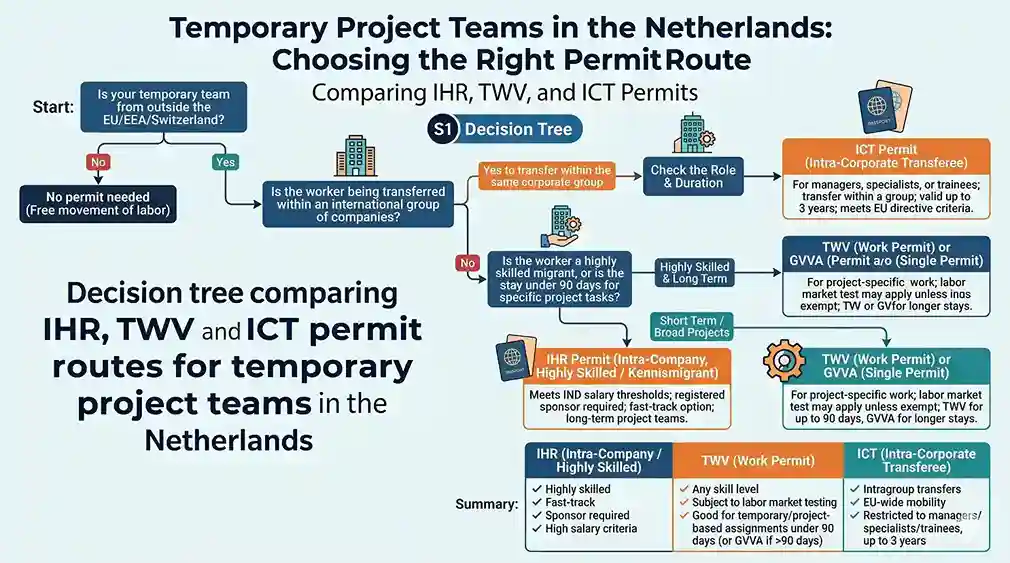
How does the IHR compare with other Dutch routes for temporary project teams?
If your project turns out not to fit the IHR, our Netherlands short-term work permit (TWV) service explains how Jobbatical manages the standard UWV route for each employee from assessment to approval.
Which International Business Activities Qualify for the IHR Scheme?
UWV looks at the substance of the project rather than the job title of each worker. The project must form part of international trade, services or cooperation between a Dutch company and a foreign company. UWV names a partnership, a project, a supply agreement for goods or services, and a training programme as examples.
- Does commercial cooperation or a supply contract between Dutch and foreign companies qualify? Joint ventures, cooperation agreements and contracts to supply goods or services are the classic IHR cases. You must show a documented relationship between the Dutch employer and the foreign company that employs the workers. A signed contract, framework agreement or purchase order usually serves as the core evidence.
- Can temporary project assignments under cross-border business agreements qualify? Temporary assignments qualify when they exist because of a specific agreement and end when the project ends. Workers may only work in the Netherlands for as long as the approved project runs. Open-ended placements and general staffing support fall outside the scheme.
- Are technical installation, maintenance and commissioning projects covered? Installation, commissioning and maintenance of equipment supplied under an international contract are among the most common IHR projects. The 2017 explanatory notes to the scheme confirm that inspections, controls and certifications can also count as international trade. The construction of a superyacht or the delivery of specialist software are frequently cited examples.
- Does specialist training and knowledge transfer between international businesses qualify? UWV explicitly lists training as a possible project type. Workers who come to receive training on equipment or processes, or who come to train Dutch staff, can qualify when the training is linked to the commercial relationship. Business meetings connected to the project can also fall under the scheme in some cases.
- What makes a project ineligible for the arrangement? UWV refuses admission when the work competes with workers available in the Netherlands, the EU/EEA or Switzerland. A request can also fail when the Dutch employer did not notify UWV about the end of a previous project within three months. Transfers within your own corporate group that last longer than three months generally belong under the Netherlands ICT permit for intra-company transfers rather than the IHR.
When the project team comes from your own group rather than a trading partner, our Netherlands Intra-Corporate Transfer (ICT) permit service covers the IND filing for transferred managers, specialists and trainees.
What Eligibility Conditions Must International Employers Meet?
Approval rests on a small set of conditions, and each one needs evidence. UWV checks the commercial link, the need for these particular workers and the temporary nature of the work. Weak evidence on a single point is the most common reason for delays.
- How do you demonstrate an established commercial relationship between the participating companies? Provide the signed contract, framework agreement or purchase order that connects the Dutch employer and the foreign company. The documents should name both entities and describe the goods, services or cooperation involved. UWV also weighs the value of the goods or services and the overall value of the project.
- How do you explain the business need for deploying foreign project specialists? You must show that the workers are needed because of their specific knowledge and expertise. A short technical explanation of why the overseas team holds the know-how, such as proprietary equipment or software, is far stronger than a general statement. UWV needs to be satisfied that a worker from the EU/EEA or Switzerland could not do the work.
- How do you establish the foreign employee's relationship with the overseas employer? The workers stay employed by the foreign company throughout the assignment. Employment contracts, payroll records or an employer letter confirm that link. This separates the IHR from local hiring, where the Dutch company becomes the legal employer.
- How do you demonstrate the temporary and project-specific nature of the assignment? Give UWV clear start and end dates, project milestones and the expected number of workers. Workers may only work in the Netherlands while the approved project runs. A realistic project plan prevents questions later, when you register employees or report changes.
- Which employment and remuneration conditions must you meet? The workers must receive at least the Dutch statutory minimum wage. The Dutch employer is responsible for compliance with the Minimum Wage and Minimum Holiday Allowance Act. Assignments longer than three months also bring residence permit and sponsor obligations, which are covered later in this guide.
Because UWV's non-competition test sits at the centre of IHR approval, our breakdown of GVVA labour market test exemptions shows how UWV judges local labour availability across other Dutch work permit routes.
How Can Employers Obtain UWV Approval Under the International Trade Regulation?
The participation request is still a paper process. You complete the UWV form for admission to the scheme, print it and post it to UWV in The Hague. UWV then has five weeks to decide.
- How do you submit an employer participation request to UWV? The Dutch employer completes the request form and sends it by post to UWV Bureau Tewerkstellingsvergunningen in The Hague, as set out on the UWV admission form page. UWV currently asks for the form to be sent by post rather than through an online portal. Keep a dated copy and proof of postage, because the six-week deadline depends on when UWV receives the request.
- Which international business agreements and project documentation should you prepare? Gather the commercial contract, a project description, the timeline and evidence that the foreign company is a registered business. Official foreign documents may need legalisation and translation, particularly where a residence permit application follows. A well-organised evidence pack shortens UWV's review and reduces follow-up questions.
- What details of the planned project activities and workforce must you provide? UWV evaluates the project's goals and scope, the specific tasks of each professional, the expected duration, the benefits of the goods or services, the number of non-EU workers and the overall added value. Answer each of these points directly in your request. Vague task descriptions are the most frequent trigger for UWV queries.
- How do you meet the six-week advance application requirement? UWV must receive the request at least six weeks before work starts. Six weeks is the legal minimum, but you should plan for eight to ten weeks so that a single UWV query does not push back the project start. Build this date into the commercial contract timeline from the first day of negotiations.
- What should you expect from UWV's assessment and participation approval? UWV issues a decision within five weeks of receiving the form. A positive decision admits your project to the scheme for up to three years. A refusal usually means falling back on individual TWV applications, which take longer and often require a labour market test.
UWV rules and procedures change regularly, so our summary of Netherlands work permit reforms for 2026 tracks the updates employers should check before filing any request.
How Does Employee Registration Work After UWV Approval?
Project approval does not authorise any individual worker on its own. Each person must be notified to UWV before they start work. This second step is where most of the scheme's flexibility lies.
- How do you register individual foreign employees under an approved arrangement? Complete the UWV notification form for workers under the International Trade Regulation for each person you deploy. Send it to the same UWV address as the original participation request. A worker can start on the approved project once the notification has been made on time.
- How do you meet the two-working-day advance notification requirement? UWV must receive the notification at least two working days before the worker starts. Weekends and Dutch public holidays do not count, so a Monday start means filing by the previous Thursday at the latest. Late notification can leave the worker without a valid exemption and expose the Dutch employer to fines under the Foreign Nationals Employment Act (Wav).
- What employee information must companies provide? Expect to provide each worker's personal details, nationality, passport information, project role and planned working dates. The notification should match the tasks described in the approved project. Keep these details consistent with any visa or residence permit application filed for the same person.
- How do you manage employee additions and replacements during an ongoing project? You can add or replace workers during the approval period by filing a new notification for each person. This is the main practical advantage over the TWV route, where every new worker needs a separate permit. Check that each new worker performs tasks within the approved scope before you file.
- How do you coordinate employee deployment with project start dates? Align notifications with visa appointments and flight dates for each worker. Visa-required nationals still need a Schengen short-stay visa for stays of up to 90 days. If the foreign employer is established in another EU/EEA country or Switzerland, also review the Netherlands posted worker notification requirements, because that separate filing follows its own rules and deadlines.
For workers who need a visa to travel, our Netherlands business visa service schedules Schengen visa appointments around your project calendar and UWV notification dates.
How Long Can Companies Deploy Foreign Project Teams Under the IHR Scheme?
The IHR runs on two separate clocks. The project approval lasts up to three years, while each worker's permitted stay depends on immigration rules for their nationality and length of stay. You should track both in your project plan.
- What is the three-year employer participation period? UWV grants participation in the scheme for a maximum of three years. During that period, workers on the approved project do not need a work permit. The approval effectively ends earlier if the project itself finishes sooner.
- How can you plan multiple project assignments within the approved period? A single approval can cover several waves of workers, such as an installation crew followed by maintenance engineers. Map each wave against the project timeline before filing, so that UWV sees the full scope in the original request. Work outside the approved project requires a new request.
- How do you manage extensions to existing international projects? If the project runs longer than planned but stays within the three-year approval, workers can continue for as long as the project lasts. Where the scope or timeline changes significantly, contact UWV before the change takes effect. A contract amendment between the companies does not automatically extend UWV's approval.
- What happens when an approved project changes or ends? Workers may only work in the Netherlands while the approved project lasts. When the project ends, you must notify UWV within three months. Missing this notification gives UWV grounds to refuse your next participation request.
- When must employers apply for a new participation approval? Apply again when the three-year period expires, when a new contract creates a separate project, or when the nature of the work changes materially. A new request is possible after three years as long as the requirements are still met. Submit it at least six weeks before the new work begins.
When a project role develops into a longer stay with local employment, our Netherlands GVVA single permit guide explains the combined residence and work permit route that usually applies next.
What Records Must Employers Maintain During IHR Project Assignments?
The IHR removes the work permit, but it does not remove the compliance burden. The Netherlands Labour Authority can inspect a site and ask for proof that every foreign worker is covered. Good records let you answer within hours rather than days.
- Which international commercial agreements and project approvals should you keep? Store the commercial contract, the UWV participation request and the UWV decision together in one file. Inspectors will check that the work on site matches the approved project. Keep copies available at the Dutch site as well as in your central HR system.
- How should you maintain employee registration and assignment records? Keep each UWV notification, with proof of the date it was sent, alongside the worker's passport copy and visa or residence documents. Dutch employers must verify and keep a copy of the identity document of every foreign worker. Record actual arrival and departure dates next to the planned dates.
- How do you document changes to project scope and workforce composition? Log every change in workers, tasks and dates, together with the reason and the date of the related UWV notification. A simple change log shows inspectors that the workforce stayed within the approved scope. It also makes your next participation request faster to prepare.
- How do you prepare for UWV inspections and compliance reviews? Assign one owner in HR or the project office for the IHR file. Run a regular check, ideally monthly on busy projects, to confirm that every worker on site has a valid notification and the right immigration status. Fines under the Wav are calculated per worker, so a single missing record can quickly become expensive.
- How do you manage employee departure and project closure documentation? Record each worker's final working day and keep evidence that they left the Netherlands or moved to another valid status. When the project ends, send the end-of-project notification to UWV within three months. Archive the complete file so that it can support your next participation request.
Our immigration case management platform keeps UWV notifications, permits and worker documents in one audit-ready record across every Dutch project you run.
How Can International Companies Plan Successful Project Deployments in the Netherlands?
Most IHR problems are timing problems. The project contract, UWV deadlines and immigration steps run on different schedules, and the slowest step sets your start date. You should build one integrated plan before you sign the client contract.
- How do you align UWV approval timelines with international project schedules? Work backwards from the first day on site. Allow eight to ten weeks for the participation request, and add visa lead times for each worker on top. Treat the UWV deadline as a formal dependency in the commercial project plan.
- How do you coordinate multiple employee arrivals and deployment dates? Group arrivals into waves and file notifications for each wave at least two working days ahead. A shared tracker between HR, the project manager and the foreign employer prevents last-minute filings. In practice, foreign partners often change crew names late (usually the week before travel), so build a buffer into every wave.
- How should you plan project documentation before submitting applications? Collect the contract, project plan, worker profiles and company registration evidence before you draft the UWV request. Agree with the foreign partner who supplies each document and by which date. Gaps found after filing cost far more time than gaps found before.
- How do you manage immigration requirements for employees with longer assignments? Workers who stay in the Netherlands for three months or longer need a residence permit from the IND, which can be valid for up to three years. According to the IND International Trade Regulation page, the permit states that no TWV is required for the specific IHR work. Recognised sponsors apply with form 7510, while other employers use form 7516.
- How do you build a repeatable process for future Dutch project deployments? Turn your first IHR file into a template with a document checklist, a timeline and named responsibilities. Reuse it for each new contract with the same or similar partners. Companies that standardise the process find their second and third requests much quicker to prepare.
If longer IHR assignments are likely, our Netherlands recognised sponsor guide explains how sponsor status speeds up IND residence permit applications for your project staff.
How Jobbatical Helps Companies Manage International Project Employee Relocations?
IHR deployments involve UWV, the IND, consulates and your foreign partner at the same time. Jobbatical combines immigration experts with a case management platform, so your HR team keeps one view of every worker and every deadline. We have supported more than 17,000 relocations across 45+ countries.
- How does Jobbatical assess whether an international project fits the IHR framework? Our experts review the contract, the planned tasks and your group structure before anything is filed. We confirm whether the IHR, a TWV, an ICT permit or a posting route fits your project best. This early check prevents a refused UWV request from delaying the project start.
- How does Jobbatical coordinate employee immigration and residence requirements? We prepare Schengen visa files for short stays and IND residence permit applications for stays of three months or longer. Each worker's immigration step is scheduled against their UWV notification date. Your team can follow the status of every case in real time.
- How does Jobbatical manage documentation across multiple employee relocations? The platform stores contracts, UWV filings, passports and permits in one secure, ISO 27001 certified workspace. Automated reminders flag upcoming deadlines and expiring documents. This gives you an audit-ready file at every stage of the project.
- How does Jobbatical support HR teams with project-based immigration case management? A dedicated case manager owns the timeline and liaises with the foreign employer on your behalf. You receive clear next steps instead of chasing updates. When the project ends, we help you close the file and prepare for the next deployment.
To see how Jobbatical manages Netherlands International Trade Regulation projects alongside every other Dutch immigration route, book a demo or explore our Netherlands immigration services hub.
For the official rules, read the UWV guidance on the scheme and the Business.gov.nl guide to employing foreign personnel before you file.
Disclaimer: Immigration rules change quite frequently; please verify with official sources or contact us for the latest info before making any decisions.
Frequently Asked Questions — Netherlands International Trade Regulation