.svg)


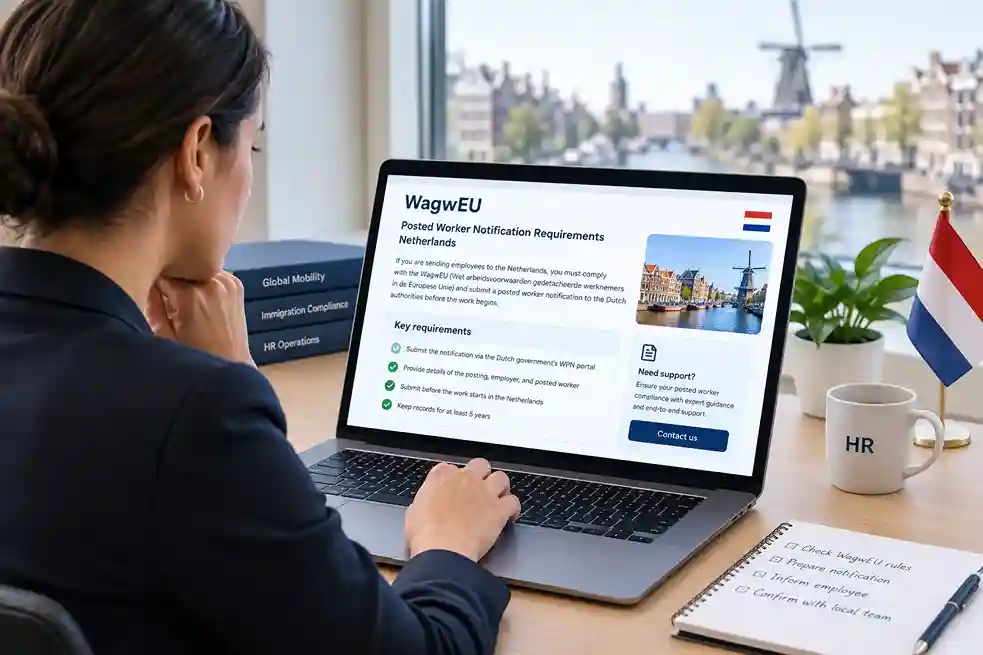
KEY TAKEAWAYS - Netherlands Posted Worker Notification
- File the posted worker notification in the Meldloket portal before any work begins; late filing counts as non-compliance.
- The duty is shared: the foreign employer files and the Dutch client verifies, and both can be fined up to €4,500 per worker.
- Notification is free, but you must keep contracts, payslips, and A1 forms for five years in Dutch, English, German, or French.
- Posted workers must receive core Dutch conditions, including the statutory minimum wage of €14.99 gross per hour for workers 21+ from July 2026.
- Third-country nationals always need a notification, and postings over three months need a Dutch residence permit.
Your project in the Netherlands can be legally sound and still get shut down over one missed online form. That form is the posted worker notification, and it must be filed before your team sets foot on site. This guide walks you through the WagwEU rules, the Meldloket duty, the process, costs, timelines, documents, and the penalties that make this a task worth getting right the first time.
What is the WagwEU, and who must file a posted worker notification?
The WagwEU is the Dutch law that protects workers who are temporarily posted to the Netherlands and requires their foreign employer to notify the authorities before work starts. If your company sends staff across the border to deliver a service, you almost certainly fall under it. Getting the basics right protects your business from fines and keeps your project on schedule.
- What WagwEU stands for: WagwEU is the Posted Workers in the European Union (Working Conditions) Act, the Dutch implementation of the EU Posting of Workers Directive. It sets the minimum employment conditions posted workers must receive and the administrative duties their employer must meet.
- Who the duty applies to: The notification duty applies to employers and self-employed people based in the EU, the EEA, or Switzerland who post workers to the Netherlands temporarily. It covers service contracts, intra-group secondments, and temporary agency postings.
- When it took effect: The duty to notify has applied since 1 March 2020. There is no retroactive duty for postings that began before that date, but every qualifying posting since then must be reported.
- Why it matters for your business: Notification lets the Dutch authorities confirm that your workers receive fair, safe, and lawful conditions. Skipping it exposes both your company and your Dutch client to penalties, so treat it as a project prerequisite rather than an afterthought.
For hands-off filing and verification, Jobbatical's Netherlands posted worker notification service handles every WagwEU submission and deadline on your behalf.
What is the Meldloket, and what does the notification duty require?
The Meldloket is the Dutch government's online portal for posted worker notifications. Every qualifying posting must be registered there before the first day of work. The portal also connects the foreign employer and the Dutch client, because both carry a legal role in the process.
- The official portal: The Meldloket WagwEU portal is the only accepted channel for filing. Paper or email notifications are not valid, and the submission must be complete before activity begins.
- A shared employer-client duty: The notification is a two-part obligation. The foreign employer submits the details, and the Dutch service recipient must verify that the notification is accurate and on time.
- What you register: You provide details of the employer, the posted workers, the Dutch client, the work location, and the assignment dates. Accurate data matters, because inspectors cross-check it against on-site documents.
- Handling changes mid-assignment: If anything about the posting changes, you must update the notification in the portal. The Dutch client then re-checks the amended entry, so build a simple internal process to flag changes early.
If you sponsor talent as well as post workers, our Netherlands recognised sponsorship service sets up the compliance and notification workflows that keep you in good standing with the IND.
When must you submit the posted worker notification?
Timing is the single most common compliance failure. The notification is always a task you complete before you start, not one you handle within a few days. A handful of situations also change what and when you file.
- Always before work begins: You must submit the notification prior to the start of activities in the Netherlands. Late filing counts as non-compliance even when the work itself is lawful.
- Third-country nationals always count: A notification must be filed for every posted worker from outside the EU, EEA, or Switzerland, with no exemptions. If the posting runs longer than three months, that worker also needs a Dutch residence permit.
- The one-year notification option: Some employers with frequent, short cross-border assignments can file a single one-year notification instead of one per posting. This suits small businesses and self-employed people who work near the border regularly.
- Report changes without delay: New workers, new dates, or a new site all trigger an update before those changes take effect. Waiting until an inspection is a costly mistake.
When a non-EU hire needs local authorisation rather than a posting, see our Netherlands short-term work permit (TWV) service, which covers UWV filing for assignments under 90 days.
How do you complete the posted worker notification, step by step?
The process is straightforward once you know the sequence and who owns each step. The key is coordination between your team abroad and your client in the Netherlands. Miss the hand-off and the whole notification can be treated as incomplete.
- Step one, the employer files: As the foreign employer, you log into the Meldloket portal and enter all required details before the assignment starts. Keep a copy of the confirmation for your records.
- Step two, the client verifies: Your Dutch client checks that the notification is correct and timely. In subcontracting arrangements, the client has up to five working days after the assignment starts to complete this check.
- Designate a Dutch contact person: You must appoint a contact person available in the Netherlands during the posting. This person is the point of contact for the Labour Inspectorate and can be one of your posted employees.
- Keep documents ready from day one: Inspectors can visit at any time, so have contracts, payslips, and A1 forms available on site. Preparation here prevents document-availability fines later.
For a step-by-step view of a parallel Dutch employer filing, read our Netherlands TWV work permit guide, which maps the full application workflow for HR teams.
What does a posted worker notification cost your business?
The notification itself carries no government fee, which surprises many HR teams. The real cost sits in the administrative time, coordination, and compliance risk around it. Under-resourcing this work is where budgets actually get hit.
- No filing fee: Submitting through the Meldloket portal is free of charge. You will not pay the Dutch government to register a posting.
- Administrative and coordination time: The cost is staff time spent gathering data, filing, briefing your Dutch client, and keeping records for years. For frequent postings, this adds up quickly.
- Compliance and penalty risk: Errors are the expensive part. Fines for missed notifications or missing documents dwarf the effort of doing the job correctly the first time.
- Wider mobility costs: If a posting becomes a longer assignment or a local hire, a work or residence permit route brings its own fees. Plan for that shift before it arrives.
When a posting becomes a permanent hire, our Netherlands Highly Skilled Migrant permit service outlines the salary-driven route and its cost structure.
What salary and employment conditions must you guarantee posted workers?
There is no special posting salary threshold in the way a work permit has one. Instead, posted workers are entitled to the core Dutch employment conditions for the duration of their assignment. Pay is calculated on actual hours worked, not on a fixed monthly figure.
What must you pay posted workers in 2026?
- At least the statutory minimum wage: You must pay at least the Dutch statutory hourly minimum wage, which rose to €14.99 gross for workers aged 21 and over from July 2026. Youth rates apply on a sliding scale for workers under 21.
- The applicable collective agreement (cao): Where a universally binding collective agreement covers the sector, its core pay and conditions apply to your posted workers too. Check the relevant cao before you set pay.
- Core working conditions: Posted workers are entitled to Dutch rules on working hours, rest breaks, safe workplaces, paid holiday, and equal treatment. These apply from the first day of the posting.
- Separate expense allowances clearly: Travel, board, and accommodation allowances do not count as wages. Show the wage and the expense portions separately on the payslip, or the whole amount may be treated as an allowance.
For current pay thresholds on the main hiring route, our Netherlands Highly Skilled Migrant sponsor guide breaks down the 2026 salary levels employers must meet.
Which documents must you keep available, and for how long?
Notification is only half of the compliance picture. You must also hold specific documents ready for inspection and retain them long after the work ends. Language and availability rules are strict, so plan your paperwork early.
- The core document set: You must keep employment contracts, payslips, a working-hours overview, A1 forms, and proof of wage payment. These must be available at the workplace, on paper or electronically.
- Accepted languages: Documents must be available in Dutch, English, German, or French. Translations prepared in advance save time during an inspection.
- Five-year retention: You must keep these documents for five years after the work ends. If the Labour Inspectorate requests them, you must submit them within four weeks.
- The A1 form matters most: The A1 certificate proves that your worker remains in their home social security system. Missing or unavailable A1 forms are a frequent trigger for inspection fines.
To prepare paperwork faster, use our Netherlands Kennismigrant document checklist, a free tool that lists every document HR teams need for a compliant file.
What are the posting timelines and rights milestones?
The longer a posting runs, the more Dutch employment law applies to it. Two milestones, at 12 and 18 months, change your obligations. Track them from the start so an extended assignment does not catch you out.
- The first 12 months: During the first year, posted workers receive the core Dutch employment conditions, including minimum wage, working time, and paid holiday. This is the baseline for every posting.
- After 12 months: Once a posting passes 12 months, workers become entitled to almost all Dutch labour law and applicable collective agreements. Occupational pensions and rules on contract formation or termination are the main exceptions.
- The optional six-month extension: You can extend a posting once by six months, which pushes the fuller entitlements to the 18-month mark. You must apply for this extension in the notification portal.
- Plan for the transition point: If an assignment is likely to run long, decide early whether a posting still fits or whether a work and residence permit is the better route.
For longer intra-group moves that outgrow a posting, our Netherlands Intra-Corporate Transfer (ICT) permit service explains duration limits and eligibility.
Who is exempt, and when does notification not apply?
Not every cross-border activity triggers a notification. Several clear exemptions exist, but they are narrow, and misreading them is risky. When in doubt, file the notification.
- Domestic and internal postings: You do not notify if your company is based in the Netherlands with Dutch contracts, or if you move workers within the Netherlands. The duty targets cross-border postings, not local moves.
- Certain sectors and incidental work: Some sectors are exempt, and short incidental activities such as business meetings, conferences, and emergency repairs do not require notification. Check the official exemption list before relying on this.
- The transport sector is different: Road transport postings follow separate rules and use the European road transport declaration portal rather than the standard Meldloket process.
- No exemption for third-country nationals: Sector and incidental-work exemptions never apply to workers from outside the EU, EEA, or Switzerland. A notification is always required for this group.
When an assignment exceeds 90 days and needs residence rights, our Netherlands GVVA combined work and residence permit service covers the single-permit route in full.
What are the compliance risks and penalties for employers?
WagwEU enforcement is active, and penalties can land on both sides of the posting. The Netherlands Labour Authority inspects, fines, and can act across borders. Treating notification as optional is a genuine financial risk.
What penalties apply for WagwEU breaches?
- Fines for missed notifications: Failure to notify, or notifying late or incorrectly, can bring a penalty of up to €4,500 per posted worker. The cost scales quickly across a team.
- The client is liable too: Your Dutch client faces the same penalty if it fails to verify the notification. This shared exposure makes clients strict about compliance before they let work begin.
- Document and information breaches: Missing on-site documents or a failure to provide requested information carry separate fines. A1 forms are a particularly common gap.
- Cross-border enforcement: Penalties can be issued across jurisdictions, so a foreign employer can be fined directly by the Dutch authority. Compliance at home does not shield you from Dutch enforcement.
Compliance obligations continue well past the first filing; see how our Netherlands change of employer service keeps sponsor and notification duties on track through staffing changes.
Posting workers to the Netherlands does not have to consume your HR team's week. Book a demo to see how Jobbatical files, verifies, and tracks WagwEU notifications so your projects start on time and stay compliant.
Disclaimer: Immigration rules change quite frequently; please verify with official sources or contact us for the latest info before making any decisions.
Frequently Asked Questions - Netherlands Posted Worker Notification

.svg)
.svg)