

.svg)



- The rule depends on the permit type: HQP holders need a new UGE application for every employer change; EU Blue Card holders need prior authorization only in the first 12 months after that, a communication to the authorities is usually enough.
- Same corporate group = same rules: Moving between subsidiaries or sister companies is treated as a change of employer unless Article 44 (transfer of undertaking) applies.
- Article 44 is the exemption: In a legal subrogation (merger, acquisition, transfer of undertaking), the existing permit stays valid only proof of the transfer is needed.
- UGE resolves in 20 working days with positive administrative silence, and the new authorization is valid for 3 years (or contract duration + 3 months, capped at 3 years).
- Timing is the compliance risk: Where prior authorization is required, the employee cannot start at the new company until it is granted.
Changing Employers in Spain on an EU Blue Card or HQP Permit: What HR Teams Need to Know
Spain has become one of the most attractive destinations in Europe for international professionals, thanks to the Highly Qualified Professional (HQP) residence permit and the EU Blue Card. But when an employee on either permit wants to change employers, the rules differ by permit type and by how long they have worked in Spain and getting them wrong can put legal status at risk.
- Two permits, one legal framework: Both routes are regulated under Law 14/2013, as amended by Law 11/2023, which transposed Directive (EU) 2021/1883 into Spanish law.
- Built for highly skilled hiring: They allow non-EU nationals to live and work in Spain in qualified roles across technology, engineering, finance, and research.
- The rules are not identical: HQP holders and Blue Card holders face different obligations when switching companies permit type and time in employment decide the route.
- Compliance mistakes are costly: Starting a new role before the right authorization or communication is in place can mean loss of legal status or fines.
- Still choosing a route? Our Spain EU Blue Card 2026 guide covers eligibility, salary thresholds, and the full application process.
┈┈┈┈┈┈┈┈┈┈┈┈┈┈┈┈┈┈┈┈┈┈┈┈┈┈┈┈┈┈┈┈┈┈┈┈┈┈┈┈┈┈┈┈┈┈┈
When Does a Spain EU Blue Card or HQP Holder Need a New Permit to Change Employers?
There is no single answer the requirement depends on which of the two Law 14/2013 permits the employee holds and, for Blue Card holders, how long they have been legally employed in Spain. Note that Spain's 2025 immigration regulation (RD 1155/2024) did not move these permits: both remain governed by Law 14/2013 and processed centrally by the UGE-CE.
- HQP (national permit): A new residence authorization application must be filed with the UGE for every change of employer, before the new role begins.
- EU Blue Card first 12 months: A change of employer requires prior authorization, so the authorities can verify the new position also meets the highly qualified criteria.
- EU Blue Card after 12 months: Only a communication of the change to the authorities is generally required, provided the new role remains highly qualified and meets the salary threshold.
- Same corporate group: A move between subsidiaries or sister companies is still a change of employer group membership alone does not exempt the case. Our breakdown of the Spain HQP permit vs EU Blue Card explains how each route treats mobility and company ties.
- The only true exemption: A transfer of undertaking under Article 44 of the Workers' Statute, where the initial permit continues to be valid and only proof of the transfer is submitted.
┈┈┈┈┈┈┈┈┈┈┈┈┈┈┈┈┈┈┈┈┈┈┈┈┈┈┈┈┈┈┈┈┈┈┈┈┈┈┈┈┈┈┈┈┈┈┈
EU Blue Card Spain: Changing Employer in the First 12 Months vs. After 12 Months
Directive (EU) 2021/1883 introduced a two-phase mobility rule for Blue Card holders, and Spain applies it through Law 14/2013. The 12-month mark of legal employment is the dividing line HR teams should track for every Blue Card employee.
- Inside 12 months prior authorization: The new employer's role must be re-verified as highly qualified employment before the switch; the employee cannot start until it is approved.
- After 12 months communication route: The change is notified to the authorities; no full new application is needed while the highly qualified conditions and salary threshold continue to be met.
- Who can file: Since Law 11/2023, either the company or the foreign professional can submit the filing the UGE informs the employer when the employee files directly.
- Salary still matters at every switch: The new contract must meet the current threshold run the numbers against the Spain EU Blue Card employer requirements before signing.
- Screen before the offer: A quick Spain work and residence permit eligibility check confirms the new role qualifies before the contract is drafted.
┈┈┈┈┈┈┈┈┈┈┈┈┈┈┈┈┈┈┈┈┈┈┈┈┈┈┈┈┈┈┈┈┈┈┈┈┈┈┈┈┈┈┈┈┈┈┈
HQP Permit vs. EU Blue Card: How the Job-Change Rules Differ in Spain
Both permits are highly qualified routes filed at the UGE-CE, but their change-of-employer mechanics are not the same. This is often the deciding factor for candidates who expect to move roles within their first years in Spain.
- HQP is employer-anchored: Every change of employer means a fresh application, whatever the timing.
- Blue Card unlocks flexibility at month 12: After a year of legal employment, switching becomes a notification exercise rather than a new filing.
- Both must stay highly qualified: Neither route allows a move into a role that does not meet the legal standard for highly qualified employment.
- Choosing between them: If EU-wide mobility or easier job changes matter to the hire, weigh the routes in our Digital Nomad Visa vs Highly Qualified vs EU Blue Card comparison.
┈┈┈┈┈┈┈┈┈┈┈┈┈┈┈┈┈┈┈┈┈┈┈┈┈┈┈┈┈┈┈┈┈┈┈┈┈┈┈┈┈┈┈┈┈┈┈
When You Do NOT Need a New Permit: The Article 44 Transfer of Undertaking
You do not need to apply for a new residence permit in the case of a transfer of undertaking under Article 44 of the Workers' Statute. This happens when a company takes over a workplace or business unit but maintains its operational identity typical in mergers, acquisitions, and corporate restructurings.
- Rights transfer automatically: The new employer inherits all rights and obligations towards Social Security and labor law.
- The employment relationship continues: No new application for residence authorization is initiated the existing permit remains valid.
- Documentation is still required: Proof of the legal subrogation must be submitted, and the worker's file updated to reflect the transition.
- All conditions must be met: ⚠️ If the situation does not meet every requirement of Article 44, the normal change-of-employer rules above apply in full.
- Plan for the edge cases: For more scenarios like salary drops, renewals, and intra-EU moves, see our guide to EU Blue Card compliance scenarios.
┈┈┈┈┈┈┈┈┈┈┈┈┈┈┈┈┈┈┈┈┈┈┈┈┈┈┈┈┈┈┈┈┈┈┈┈┈┈┈┈┈┈┈┈┈┈┈
Change of Employers for EU Blue Card Holders - A Complete Process
Changing employers under a Highly Qualified Worker permit or EU Blue Card is not automatic. You will need to follow a structured process to ensure legal compliance.
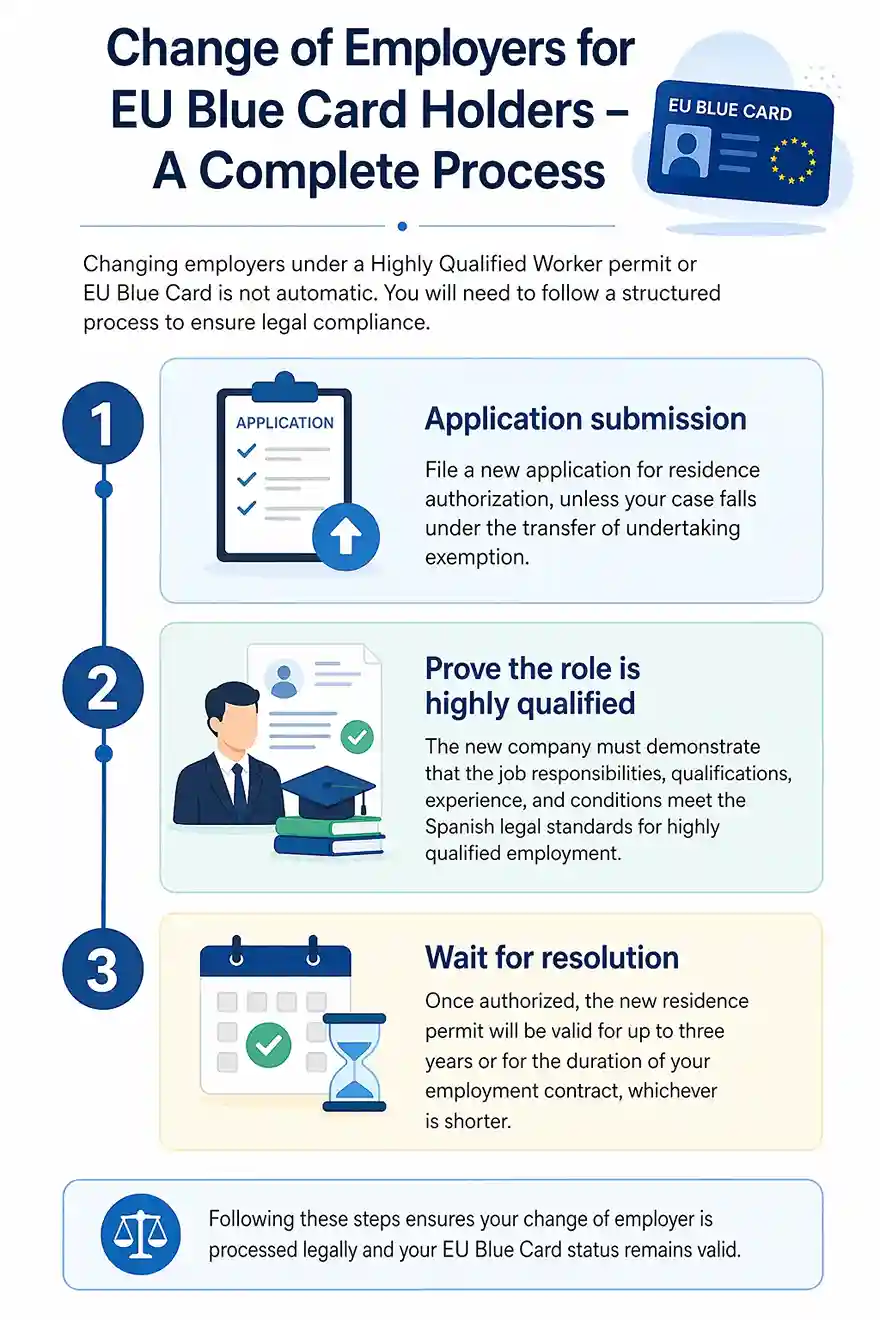
Application submission
File a new application for residence authorization, unless your case falls under the transfer of undertaking exemption. Because the application is employer-led and filed centrally, choosing the right partner matters our guide on how to choose EU Blue Card assistance services for Spain explains what to look for in a provider.
Prove the role is highly qualified
The new company must demonstrate that the job responsibilities, qualifications, experience, and conditions meet the Spanish legal standards for highly qualified employment.These standards mirror the Spain EU Blue Card employer requirements, including the 2026 salary thresholds and contract duration rules.
Wait for resolution
Once authorized, the new residence permit will be valid for up to three years or for the duration of your employment contract, whichever is shorter.When it approaches expiry, review our Spain residence permit renewal guidance to keep your status uninterrupted.
┈┈┈┈┈┈┈┈┈┈┈┈┈┈┈┈┈┈┈┈┈┈┈┈┈┈┈┈┈┈┈┈┈┈┈┈┈┈┈┈┈┈┈┈┈┈┈
What If the Employee Is Dismissed or Resigns Before the New Role Starts?
A gap between jobs does not automatically end the employee's legal status in Spain, but it does trigger obligations that HR and the employee must handle quickly. The key is communicating the change to the UGE and filing the next application inside the protected window.
- Communicate the change to the UGE: Dismissals and terminations must be reported to the Large Companies Unit under the seventh additional provision of Law 14/2013.
- A job-search window applies: Blue Card holders benefit from a grace period of around three months to secure a new highly qualified role before the permit is at risk.
- A new application restores full status: If the requirements are still met, a fresh filing grants a new initial authorization for its complete duration.
- Don't let the clock run out: Missing the window can force a change to a different permit category see the options in our guide to changing permit type in Spain.
- Voluntary resignations carry the same duty: The change in circumstances must still be reported, even when the employee initiated the exit.
Related Read:
If a new EU Blue Card or HQP application is refused, see the recovery routes in our Spain EU Blue Card refusal and UGE-CE appeal guide.
┈┈┈┈┈┈┈┈┈┈┈┈┈┈┈┈┈┈┈┈┈┈┈┈┈┈┈┈┈┈┈┈┈┈┈┈┈┈┈┈┈┈┈┈┈┈┈
Hiring an EU Blue Card Holder From Another EU Country: Intra-EU Mobility Into Spain
One of the Blue Card's biggest advantages for Spanish employers is mobility: you can hire a Blue Card holder already working elsewhere in the EU through a simplified route. Spain applies the updated Directive (EU) 2021/1883 rules through Law 14/2013.
- 12-month prior residence: The candidate must have held their Blue Card for at least 12 months in another Member State or 6 months if they have already used mobility once and resided in more than one country.
- Work from day of filing: The candidate has the right to enter, reside, and work in Spain from the submission of the complete Spanish Blue Card application no waiting for resolution.
- A Spanish card is still issued: Mobility simplifies the process but does not replace it; a new Spanish Blue Card must be obtained.
- Short-term mobility for projects: Blue Card holders from other Member States can also carry out professional activity in Spain for up to 90 days without a Spanish permit.
- Check whether it matches your case: Whether an employee can change employers or move within the EU on a Blue Card depends on how long they have held the card and where.
┈┈┈┈┈┈┈┈┈┈┈┈┈┈┈┈┈┈┈┈┈┈┈┈┈┈┈┈┈┈┈┈┈┈┈┈┈┈┈┈┈┈┈┈┈┈┈
Does Changing Employers Affect Long-Term Residence in Spain?
A common worry among candidates is that switching jobs resets their path to permanent status. It does not as long as the change is handled correctly and no gap in legal residence occurs.
- The 5-year clock keeps running: Long-term residence remains accessible after five years of legal and continuous residence, and a compliant employer change does not interrupt it.
- Gaps are the real risk: Working without the required authorization or letting status lapse between jobs is what breaks continuity.
- Renewals stay on track: A new authorization granted after an employer change renews on the normal cycle, with no penalty to the residence history.
- Update the records: Once the new permit or communication is processed, remember to update the employee's NIE and TIE records to reflect the change of employer.
┈┈┈┈┈┈┈┈┈┈┈┈┈┈┈┈┈┈┈┈┈┈┈┈┈┈┈┈┈┈┈┈┈┈┈┈┈┈┈┈┈┈┈┈┈┈┈
Key Compliance Points for HR Teams Managing a Spain Change of Employer
Most compliance failures in employer changes come down to timing and role qualification, not paperwork quality. Keep these rules front of mind before any start date is agreed.
- No early starts where authorization is required: In HQP cases and Blue Card changes inside the first 12 months, the employee cannot begin work until the authorization is granted.
- The new role must qualify: If the position does not meet the highly qualified standard, the employee will need to apply for a different type of work permit.
- Article 44 needs evidence, not assumptions: In mergers, acquisitions, or transfers, keep documentary proof of the subrogation on file.
- Track the 12-month mark for every Blue Card holder: It determines whether the next job change is an authorization or a simple communication.
- Verify employer-side compliance early: The new company must be up to date with tax and Social Security obligations before the filing will succeed.
When the card itself comes up for renewal, the filing follows a different route: Spain EU Blue Card renewal employer guide
Salary compliance also has to hold between employer changes, not just at each filing: EU Blue Card salary threshold breaches mid-contract
┈┈┈┈┈┈┈┈┈┈┈┈┈┈┈┈┈┈┈┈┈┈┈┈┈┈┈┈┈┈┈┈┈┈┈┈┈┈┈┈┈┈┈┈┈┈┈
Summary: When Is a New Authorization Required in Spain?
Changing Employers in Spain: Final Compliance Checklist for EU Blue Card and HQP Holders
For Highly Qualified Professionals and EU Blue Card holders in Spain, changing employers requires careful planning but the burden is not the same for everyone. Confirming the correct route and filing on time keeps work authorization uninterrupted and protects the employee's long-term future in Spain.
- HQP holders always file fresh: A new UGE application is required for every employer change, regardless of timing.
- Blue Card holders earn flexibility: After 12 months of legal employment, the change becomes a lighter communication to the authorities rather than a new application.
- Article 44 transfers stay simple: Mergers, acquisitions, and transfers of undertaking need only proof of the subrogation the existing permit continues.
- Timing protects status: Filing before the start date prevents legal issues and keeps the path to long-term residence in Spain's highly competitive market intact.
- Go deeper on the route itself: Read our detailed Guide on Spain EU Blue Card 2026 - Meaning, Benefits, and Salary Requirements.
┈┈┈┈┈┈┈┈┈┈┈┈┈┈┈┈┈┈┈┈┈┈┈┈┈┈┈┈┈┈┈┈┈┈┈┈┈┈┈┈┈┈┈┈┈┈┈
Disclaimer: Immigration rules change quite frequently; please verify with official sources or contact us for the latest info before making any decisions.
Frequently Asked Questions about Spain EU Blue Card and Highly Qualified Worker Employer Changes
Do I need a new permit if I change employers within the same corporate group in 2026?
Yes, as of 2026, you must apply for a new residence permit even if your new company is part of the same corporate group or a subsidiary of your previous employer.
What is the main exception to applying for a new work authorization?
The only exception is a transfer of undertaking under Article 44 of the Workers' Statute, where the new employer inherits all rights and the initial permit remains valid.
How long is a new Highly Qualified Worker permit valid for?
Once authorized, a new residence permit is valid for up to 3 years or for the specific duration of your employment contract, whichever period is shorter.
Can I start my new role before the authorization is granted in 2026?
No, throughout 2026, legal regulations strictly prohibit you from starting work for a new company until the specific authorization has been officially granted.
What happens if my new position is not considered highly skilled?
If the new role does not meet the legal standards for highly qualified employment, you will be required to apply for a different type of work permit entirely.

.svg)
.svg)
