
KEY TAKEAWAYS: Spain Highly Qualified Professional Hiring in 2026
- 67 days is the average timeline from opening a Spain HQP case to the employee's first working day, faster than most EU routes.
- 36-44 days is the typical pre-arrival processing time, covering the D-Visa (36 days) and HQP residence permit (44 days).
- 75 days is the average wait for the TIE resident card after arrival, which appears in roughly 51% of cases.
- 96% of completed cases receive approval with Jobbatical, indicating a high likelihood of successful applications.
- 17% of cases face delays due to employer documents, such as contracts and powers of attorney. HR teams can reduce these delays through early document preparation.
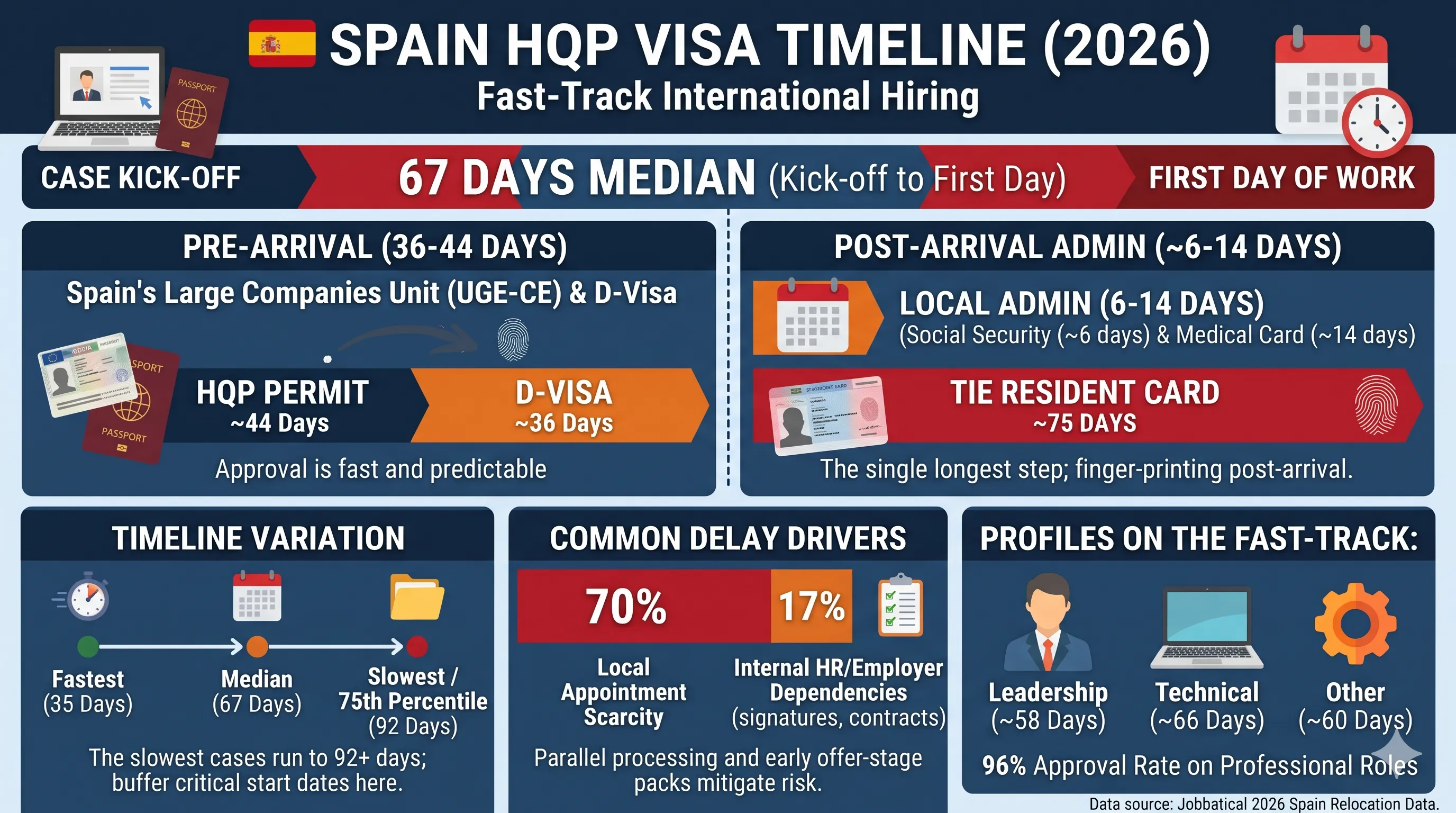
A Spain Highly Qualified Professional (HQP) hire takes a average of 67 days from case kick-off to the employee's first day. That figure comes from Jobbatical's own 2026 data across Spain HQP relocations, filed through the Large Companies Unit (UGE-CE).
This report shows where those days go, why the resident card is the real bottleneck, and what HR should do with the numbers.
Streamlining Global Hiring: What a 67-Day Spain HQP Hiring Timeline Means for HR Teams?
A 67-day timeline is the realistic baseline for a standard Spain Highly Qualified Professional (HQP) hire, measured from case kick-off to the employee's start date. As one of the fastest EU immigration routes, HR teams should use this as a foundation while factoring in buffers for critical onboarding dates.
- 67-day average timeline: This 9 to 10-week window is the full-journey average and the earliest realistic start date to promise candidates.
- 36-day D-Visa issuance: The entry visa takes roughly 36 days from filing, allowing the employee to relocate to Spain and begin work while subsequent steps process.
- 92-day buffer for critical hires: 25% of applications take 92 days or longer. Anchor business-critical start dates to this slower quartile to mitigate operational risk.
- 75-day TIE resident card: The physical card is the longest single step, requiring an in-person fingerprinting appointment post-arrival. Since it falls outside the initial joining window, budget this timeline separately.
HR Insights: Securing Reliable Start Dates for Spain Highly Qualified Professional (HQP) hire
- Initiate at offer acceptance: Integrate immigration case kick-offs directly into your offer workflow to capitalise on Spain's rapid approval times.
- Pad timelines for high-stakes roles: Protect fixed onboarding dates by forecasting to the 92-day mark rather than the 67-day median.
- Decouple the TIE card: Treat the physical resident card as an independent post-arrival task so it does not delay the employee's first day of work.
For the eligibility rules and UGE-CE filing process behind these timelines, see our Spain Highly Qualified Professional permit guide.
Securing the Spain HQP Visa in 36 Days: Pre-Arrival and Post-Arrival Strategies for HR
The Spain HQP journey splits into a highly efficient pre-arrival phase, managed through the UGE-CE (Large Companies Unit), and a slower post-arrival local compliance phase.
- Pre-arrival speed (36–44 days): Spain significantly outpaces other EU routes here. The HQP residence permit takes a median of 44 days, and the entry D-Visa processes in about 36 days.
- Post-arrival administration (6–14 days): Essential local registrations are swift but require coordination. A Social Security number takes roughly 6 days, a medical card about 14 days, and town hall registration is nearly immediate.
- The TIE resident card bottleneck (~75 days): Required in 51% of cases, the physical resident card is the longest single step due to in-person fingerprinting requirements. It accounts for the bulk of post-arrival wait times.
- Parallel processing: Queuing tasks sequentially puts start dates at risk. Running pre-arrival filings concurrently with post-arrival appointment bookings prevents the 75-day TIE card from undoing the speed of the initial approval.
When you need the process handled end to end, our Spain residence permit services manage everything from eligibility checks to TIE appointments and renewals.
How Jobbatical Accelerates Spain HQP timelines
To protect joining dates, Jobbatical actively manages the two most critical stages: document filing and appointment booking.
- Securing early TIE appointments: . We book the resident card slot the moment the initial permit is approved to neutralise the 75-day bottleneck.
- Eliminating employer dependencies: Waiting on employer paperwork delays roughly 17% of cases. We remove this administrative drag by preparing compliance document packs during the offer stage.
- Compressing post-arrival timelines: By running Social Security, town hall registration, and medical card applications in parallel rather than sequentially, we compress over 20 days of local administrative wait time into a single, seamless window.
The card and the number are often confused, so our breakdown of the difference between the NIE and the TIE clarifies which document does what and when each is issued.
Spain HQP stage timeline at a glance
To see how Spain's fast-track route compares with standard processing, read our guide to Spain's fast-track visa advantages for highly qualified talent.
From 58-Day Approvals to 70% Drop-Offs: Spain HQP Hiring Risks by Job Profile
The specific role you are hiring for heavily influences both the processing speed and the success rate of a Spain HQP visa. While senior and technical roles fit the criteria perfectly and clear in about two months, trade and education positions carry extended timelines and higher compliance risks.
- Leadership (58-day average): The fastest and most predictable group. With clear, senior profiles, management hires experience a minimal 2% drop-off rate.
- Non-Technical Professionals (60-day average): Non-technical specialists, such as product managers or consultants, seamlessly meet the 'highly qualified' bar and process without friction.
- Technical Roles (66-day average): Software and systems engineers form the largest hiring volume. Plan these against a solid 66-day baseline; they carry a low 8% drop-off risk.
- Education Roles (107-day average): Teaching positions take significantly longer because qualifications must be officially recognised before the application can even be filed.
- Trade & Blue-Collar (125-day average, 70% drop-off): Construction and trade roles rarely meet HQP requirements. Attempting this route causes severe delays and massive failure rates, as these profiles require a standard work visa and a labour-market test instead.
Appointment scarcity is a structural problem in Spain, and our deep dive into Spain’s cita previa delays and HR onboarding tactics explains how to keep hires moving while slots are scarce.
Actionable HR Strategies: Mitigating Role-Specific Risks for Spain HQP
- Standardise your professional hires: You can confidently plan leadership, technical, and specialist onboarding around a reliable 60 to 66-day window, backed by a strong 96% overall approval rate.
- Front-load education credential checks: Validate teaching qualifications long before filing. Catching recognition issues early prevents the 107-day timeline from stalling or restarting.
- Reroute trade roles immediately: Never force blue-collar hires onto the HQP path. Direct them to the general work visa route from day one to avoid the 70% drop-off trap.
For the wider picture behind these numbers, our analysis of Spain’s immigration appointment backlog sets out why extranjería offices are under strain in 2026.
Spain HQP role mix in 2026
For a full view of which roles and salary levels qualify across Spain’s work routes, see our guide to Spain Visa Eligibility Screener for Hiring International Talent.
How Jobbatical Resolves Spain HQP Delays and achieves a 96% Approval Rate
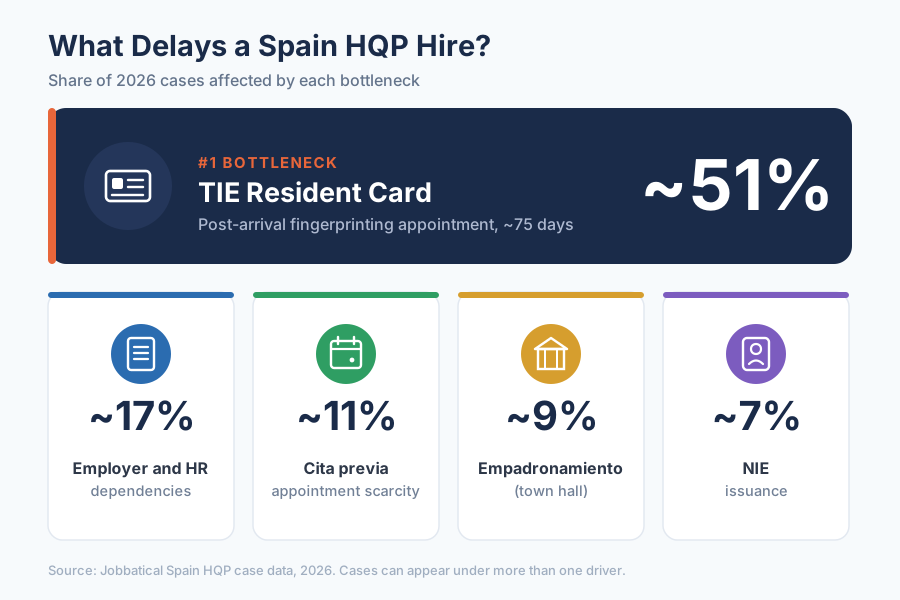
With the TIE resident card affecting about 51% of cases and employer dependencies about 17%, active case management protects the timeline. Jobbatical targets these Spain HQP friction points with a case-management platform, AI automation, and local Spain immigration experts.
- TIE card appointments booked early. The TIE resident card is the top delay at ~51% of cases and ~75 days, so booking the fingerprinting slot at permit approval is the highest-value post-arrival action.
- Employer documents ready before filing. Contracts and signatures delay ~17% of cases, so preparing the employer pack at offer stage prevents withdrawals and keeps the HQP filing on track.
- Cita previa scarcity managed. Appointment shortages hit ~11% of cases, so proactive NIE, Social Security, and TIE booking keeps the post-arrival block moving.
- AI automation across every stage. The platform tracks each deadline from the 36-day visa to the 75-day card and flags the next action automatically, so ~20 days of post-arrival admin never stalls.
- Local Spain immigration experts. Specialists handle UGE-CE and town-hall filings, where rules vary by city, protecting the ~96% approval rate and resolving appointment and document issues directly.
Securing that fingerprinting slot starts with the appointment system itself, and our step-by-step Spain cita previa Extranjería guide shows HR teams exactly how to book NIE, TIE, and fingerprinting appointments in 2026.
Top delay drivers in Spain HQP cases
If you are coordinating several Spain hires at once, book a demo to see how Jobbatical manages appointments, documents, and compliance in one place. For the full picture of how Spain routes different hires, visit our Spain immigration services hub.
Top 5 Metrics for HR Teams to Forecast Spain HQP Joining Dates
Accurate relocation forecasting relies on historical data, not theoretical estimates. Based on Jobbatical’s 2026 global mobility data, HR teams should anchor their Spain HQP planning to these five core metrics:
- 67-Day Average Timeline: This full-journey window from case kick-off to the joining date is your standard baseline. Treat 67 days as the absolute floor for any standard hire.
- 44-Day HQP Permit Decision: The residence authorisation, filed through the UGE-CE Large Companies Unit, is decided in a average of 44 days and is the core pre-arrival milestone. It runs under Spain’s administrative-silence rule, so a complete, clean filing is what keeps it fast.
- 96% Approval Rate: Across completed cases, about 96% are approved, making the HQP route a high-certainty plan rather than a gamble with Jobbatical.
- 75-Day TIE Resident Card: As the longest single step, the physical resident card is processed post-arrival. Budget this timeline completely separate from the initial joining date so it does not block onboarding.
- 17% Employer-Driven Delays: Internal document dependencies hold up nearly a fifth of cases. HR fully controls this timeline eliminate the administrative drag by preparing compliance document packs during the offer stage.
For a route-by-route view of Spain's work permits and their requirements, see our overview of Spain visa options and requirements.
For end-to-end support on the consular visa and the TIE process, see our Spain work visa service.
Disclaimer: Immigration rules change quite frequently; please verify with official sources or contact us for the latest info before making any decisions.
Frequently Asked Questions - Spain HQP Hiring Timelines 2026