.svg)


Key Takeaways: Spain Residence Permit Costs 2026
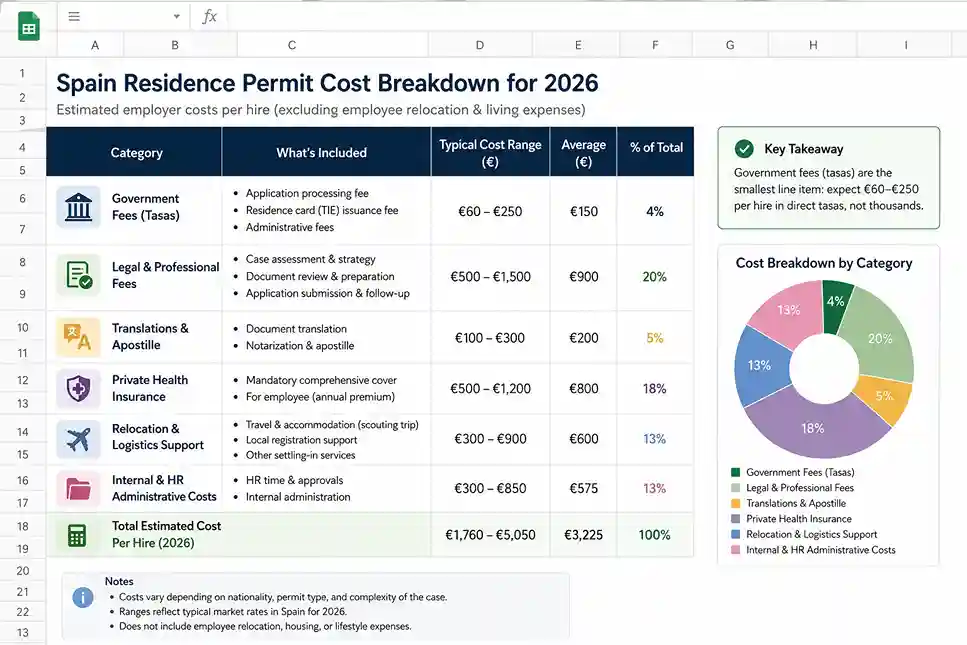
- Government fees are the smallest line item: expect €60–€250 per hire in direct tasas (administrative fees), not thousands.
- All-in employer cost per standard hire runs roughly €1,200–€3,500 once translations, apostilles, and legal support are counted.
- Split the fees correctly: the employer pays Modelo 790-062 (authorization), the employee pays 790-052 and 790-012 (TIE) write this into the offer letter.
- Renewals recur on a 1 + 2 + 2 year cycle before long-term residence, so budget across five years, not just year one.
- Add roughly €400–€900 per dependent when relocating families, and forecast it upfront rather than mid-process.
When HR teams plan the cost of a Spain residence permit, they will likely create an estimate that is either surprisingly low or wildly inflated. The true financial commitment lies between these two extremes.
- The primary budgeting mistake: Focusing exclusively on government fees leads to severe budget shortfalls once legal, translation, and administrative costs enter the equation.
- The financial breakdown: While direct government fees (tasas) are minimal, peripheral costs represent the vast majority of your per-hire expenditure.
- What this 2026 guide covers: Precise government fee structures, the legal employer-employee cost split, hidden ancillary expenses, and a full five-year financial outlook per hire.
Not sure which route your hire qualifies for? The route decides the fee band run a 2-minute Spain work and residence permit eligibility check first.
What Does a Spain Residence Permit Actually Cost Employers in 2026?
When budgeting for a standard sponsored hire in 2026, direct government fees account for a modest €60–€250. However, the true comprehensive "all-in" expenditure ranges between €1,200 and €3,500 once operational and professional support services are integrated. Bridging this gap is essential for accurate corporate financial modeling and strategic HR planning.
- Government fees represent a minor fraction of total outlay: The combined statutory tasas covering initial work authorization, application processing, and physical Foreigner Identity Card (TIE) issuance seldom exceed €250 per individual.
- The fully loaded cost dictates the true budget: Ancillary expenses including sworn translations, international document legalizations (apostilles), and external legal or mobility platform service fees comprise the vast majority of per-hire capital expenditure.
- Execution strategy determines resource allocation: Handling filings in-house reduces upfront third-party invoices, but shifts a heavy burden onto internal HR teams while increasing administrative friction, compliance risk, and potential start-date delays compared to using a fully managed service.
- Permit category minimally affects baseline statutory costs: Statutory government fees across standard work authorizations, EU Blue Cards, and Intra-Corporate Transfers (ICTs) remain largely uniform; the primary cost driver is the procedural complexity and document volume required by the specific application route.
- Incorporate a dedicated contingency buffer: Administrative friction such as procedural re-filings, document re-translations, and secondary consular appointments is common in cross-border mobility. HR teams should consistently factor a 10–15% contingency reserve into their initial financial models.
The Highly Qualified Professional (HQP) route is a fourth option with its own UGE-CE filing profile and document load, our Spain HQP permit guide breaks down criteria, costs, and process.
What Are the Government Fees for Each Spain Residence Permit Type?
The distinction most cost guides miss: Modelo 790-062 is the employer-side authorization fee, while 790-052 and 790-012 fall on the individual. Getting this split right avoids reimbursement conversations later.
For a complete overview of eligibility, requirements, and application steps, see our Spain residence permit service
Who Pays for Which Fees in a Spain Residence Permit Application?
Under Spanish immigration regulations, fee liabilities are assigned strictly by administrative procedure rather than by who ultimately benefits from the authorization. Consequently, a single international hire generates separate financial obligations for both the employer and the employee. Failure to clearly delineate these responsibilities within employment contracts and offer letters frequently creates friction during the onboarding phase.
- Employer statutory responsibility (Modelo 790-062): The sponsoring corporate entity is legally obligated to settle the employer-side residence and initial work authorization fee at the time of application submission.
- Employee individual liabilities (Modelo 790-052 & 790-012): The foreign national is typically responsible for paying the individual application processing fee alongside the biometric appointment fee for the physical Foreigner Identity Card (TIE).
- Discretionary administrative expenses ("The Grey Area"): Ancillary expenditures such as sworn document translations, international apostilles, and third-party legal representation have no statutory owner under Spanish law. Financial responsibility hinges entirely on your internal corporate policy.
- Codify cost splits in offer letters: Explicitly detail which immigration expenses are company-sponsored within candidate offer letters to prevent ad-hoc negotiations, unexpected reimbursement requests, and candidate friction.
- Establish a standardized global mobility policy: Implementing a clear, company-wide relocation policy removes operational ambiguity, aligns candidate expectations, and ensures predictable budget management across all international hires.
For a clearer breakdown of Spain work and residence permit costs, including which fees employers and employees typically pay, see our Spain work permit vs. residence permit guide.
What Hidden Expenses Apply to a Spain Residence Permit Beyond Government Fees?
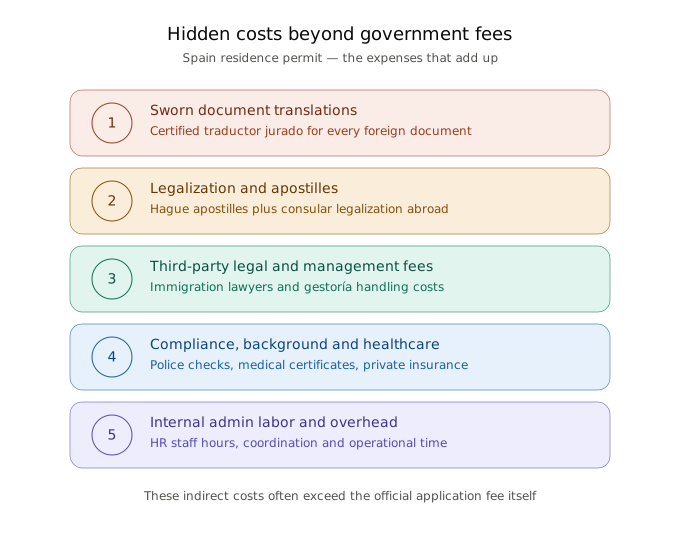
Statutory government tasas represent merely the foundation of your overall immigration expenditure. The ancillary line items detailed below frequently transform what appears to be a nominal €200 filing fee into a comprehensive €2,500 corporate investment making them the most prevalent omissions in preliminary HR financial forecasts.
- Sworn document translations (traductor jurado): Official submissions to Spanish authorities strictly require certified translations executed by Ministry-accredited sworn translators (traductores jurados). At an average rate of €30–€60 per document across multiple required corporate, legal, and civil records, translation fees rapidly accumulate.
- International document legalization and apostilles: While internal apostille processes are cost-free within Spain, authenticating foreign documentation in an applicant's country of origin carries mandatory fees. For instance, UK Hague Apostilles typically cost €35–€45 per document, with fees escalating further if solicitor or notary services are required.
- Third-party legal and immigration management fees: Engaging external legal counsel or a specialized global mobility platform typically ranges from €800 to €2,500 per candidate, depending on procedural complexity, the chosen permit route, and the level of high-touch support required.
- Compliance, background, and private healthcare costs: Fulfilling statutory visa prerequisites such as obtaining international criminal record clearances, official medical certificates, and comprehensive private health insurance coverage introduces variable yet unavoidable baseline expenses per applicant.
- Internal administrative labor and operational overhead: The internal HR, payroll, and mobility hours spent navigating administrative portals, scheduling appointments, and correcting document errors represent substantial operational costs that, while absent from vendor invoices, directly impact internal capacity and productivity.
Compare Spain visa and residence routes, costs, eligibility requirements, and compliance obligations in our comprehensive Spain immigration hub
What Is the Total Cost Per Hire for a Spain Residence Permit?
Here is what a single Spain hire actually costs across the three most common routes. While the permit fee barely fluctuates, the operational route you choose dictates the final total.
While a self-managed approach may seem economical initially, the hidden expenses such as internal labor hours, compliance risks, and onboarding delays substantially increase the true cost per hire. For organizations managing multiple international hires annually, dedicated immigration support consistently yields a clear return on investment. Book a demo to model your organization’s exact per-hire forecast.
To see actual spend per immigration case, per country and per entity instead of estimating it, see our immigration and mobility expense management module.
What Long-Term Renewal Costs Apply to a Spain Residence Permit?
Most organizations meticulously forecast year-one relocation expenses while overlooking the ongoing lifecycle of immigration compliance. A Spain residence permit is not a one-time transaction; it is a multi-year financial commitment. Fortunately, these renewals follow a predictable statutory rhythm, allowing proactive HR teams to accurately forecast downstream costs today.
- The standard renewal trajectory: Standard work permits typically follow a phased 1-year, then 2-year, then 2-year renewal cadence. This cycle continues until the employee reaches the mandatory five-year threshold required to qualify for long-term (permanent) residence.
- Recurring administrative expenses: Each stage of the renewal cycle triggers a new set of government tasas. Beyond the base fee, renewals frequently demand freshly sworn translations, updated international background checks, and ongoing professional legal support to manage the filing process.
- Adopt a comprehensive five-year perspective: A single sponsored employee will require three to four separate application cycles before their immigration status permanently stabilizes. Strategic budgeting models must reflect this entire lifecycle rather than just the initial entry costs.
- Scaling workforce complications: Immigration workflows compound exponentially as your team grows. A cohort of ten international hires onboarded this year will generate up to thirty overlapping renewal applications over the next four years, significantly increasing your administrative overhead.
- Centralize and automate date tracking: Allowing a permit to expire risks severe compliance breaches, potential lapses in work authorization, and business continuity disruptions. Furthermore, emergency re-filings to correct expired status incur premium legal costs that far exceed routine renewal fees.
Track recurring renewal requirements, costs, and deadlines across your workforce with our Spain permit renewal service.
How Much Does Dependent Relocation Add to a Spain Residence Permit Budget?
Corporate relocation rarely occurs in isolation. The inclusion of a spouse or dependents fundamentally alters the per-hire financial model. Addressing these variables during the initial candidate offer stage is critical to preventing unforecasted budgetary overruns later in the fiscal year.
- Per-dependent capital expenditure: Allocate a baseline of €400–€900 for each accompanying family member to encompass statutory application fees, physical Foreigner Identity Card (TIE) issuance, certified document translations, and required professional legal support.
- Multiplied administrative volume: Every dependent mandates an independent portfolio of authenticated civil records. Consequently, the volume of required sworn translations and international apostilles multiplies linearly with the candidate's household size.
- Independent statutory renewal timelines: Dependent residence authorizations adhere to independent legal renewal cycles. This compounding effect increases your organization's recurring administrative and financial obligations over the lifecycle of the employee's tenure.
- Proactive financial modeling: Discovering dependent reunification requirements mid-deployment consistently derails established operational timelines and invalidates initial financial forecasts.
- Strategic talent acquisition: Transparently codifying dependent immigration coverage within your corporate mobility policy not only eliminates financial ambiguity but significantly enhances your competitive positioning in the global talent market.
Our Spain family reunification guide explains the five-year dependent residence permit, eligibility requirements, application process, and key rules in detail.
What Should HR Include in a Spain Residence Permit Budget Forecast?
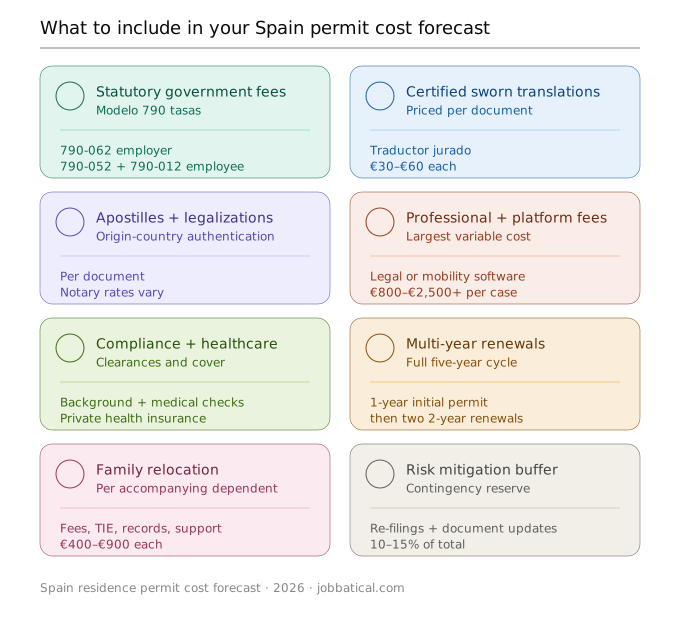
Integrate this comprehensive checklist directly into your corporate financial models and budgeting templates. Omitting any of these critical line items will result in an incomplete and under-budgeted Spain immigration forecast.
- Statutory government fees (tasas): Account for Modelo 790-062 (employer-paid initial authorization), Modelo 790-052 (individual application processing), and Modelo 790-012 (physical TIE card issuance), alongside any country-specific consular visa fees.
- Certified sworn translations: Calculate expenditure based on total document volume rather than headcount, allocating €30–€60 per official document requiring Ministry-accredited sworn translation.
- International apostilles and legalizations: Budget for origin-country document authentication on a per-document basis, accounting for local notary and diplomatic legalization rate variations.
- Professional services and platform fees: Allocate capital for external legal counsel or dedicated global mobility software typically your largest variable cost driver, ranging from €800 to €2,500+ per candidate.
- Compliance, background clearances, and healthcare: Factor in mandatory criminal background checks, official medical fitness certificates, and compliant private health insurance coverage.
- Multi-year lifecycle renewals: Model the complete five-year statutory trajectory (a 1-year initial permit followed by two 2-year renewal cycles) to capture long-term compliance obligations beyond year one.
- Family relocation allocations: Incorporate an additional €400–€900 per accompanying dependent to cover family application fees, individual TIE cards, translated civil records, and legal support.
- Risk mitigation buffer: Maintain a dedicated 10–15% contingency reserve to absorb unforecasted administrative expenses, procedural re-filings, document updates, or appointment adjustments.
Your 10–15% contingency mostly covers refusals and re-filings , our guide to the recurso de alzada explains what a Spain work permit appeal actually involves.
Disclaimer: Immigration rules change quite frequently; please verify with official sources or contact us for the latest info before making any decisions.
Frequently Asked Questions Spain Residence Permit Costs 2026

.svg)
.svg)