

KEY TAKEAWAYS: UK ILR Application Statistics
- Home Office ILR decisions ran a average of 11.7 days from submission, and 89% applications landed decision within 30 days when priority service was used.
- ILR Application preparation is about 69% of the total timeline and the Home Office decision only about 31%, so your biggest time lever sits before application submission.
- Employee document delays were the top bottleneck at 83% cases facing document issues.
- Every decided case was approved with a 0% refusal rate, but 42% still required post-approval SMS sponsor reporting.
- HR managers should plan around four gates: the qualifying date, employee data preparation, the priority decision, and your own post-approval reporting.
Based on our analysis of recently completed UK Indefinite Leave to Remain (ILR) cases at Jobbatical, the Home Office returned decisions in an average of 11.7 days following submission.However, government processing speed is rarely the primary bottleneck. The vast majority of the ILR timeline is spent in document preparation, a phase governed largely by employee response times.
Our 2026 UK ILR benchmark data breaks down where the time actually goes, giving your People and Mobility teams the clarity needed to plan every case with confidence.
Who Applies for UK ILR: A 104,000 GBP Median Salary Profile
The typical UK Indefinite Leave to Remain (ILR) applicant is an established, senior professional rather than an entry-level employee. With salaries consistently clustering in the six-figure range across tech and commercial functions, understanding this candidate profile enables People teams to forecast sponsorship budgets, streamline eligibility checks, and prepare evidential files effectively.
- Six-Figure Median Salary: The median base salary stands at £104,000 (mean: £99,566), ranging from £35,000 to £230,000. Align sponsorship budgets, Home Office application fees, and priority filing costs with these compensation benchmarks.
- Engineering and Commercial Leadership: Software Engineer represents the top job title, closely followed by senior commercial leads and department heads. Expect experienced candidates with detailed UK employment histories.
- Tech and Professional Services Concentration: The applicant demographic is concentrated heavily in technology, fintech, and professional services sectors accounting for the vast majority of UK Skilled Worker-to-ILR transitions.
- Tenured, Mid-Career Professionals: Because ILR requires a strict five-year continuous residence qualifying period, candidates are long-term residents rather than recent relocations, necessitating thorough continuous absence audits.
- Strategic Talent Retention: Settlement marks an investment in business-critical talent. Granting ILR ends recurring visa renewals, removes Certificate of Sponsorship (CoS) fees, and permanently eliminates ongoing employer sponsorship compliance duties.
ILR applicant profile at a glance
Check exactly when an employee crosses the qualifying line with Jobbatical's UK ILR eligibility calculator, which models qualifying periods, permitted absences, and costs for 2026.
UK ILR Timelines: 5 Days From Case Start to Settlement
End-to-end, completed UK Indefinite Leave to Remain (ILR) applications took a median of 5 days from initiation to settlement. The timeline split reveals a crucial operational insight: preparation accounts for 69% of the total duration, while Home Office adjudication represents just 31%. The primary, controllable bottleneck occurs before submission.
- Swift, Predictable Home Office Decisions: Submission to final decision averaged a median of 11.7 days, with 89% of outcomes received within 30 days, primarily driven by priority processing adoption.
- Pre-Submission Preparation as the Primary Driver: Case launch to submission recorded a median duration of 35.8 days. This phase encompasses document collation, legal review, and Life in the UK test completion, introducing the greatest variability across cases.
- Minimal Biometrics Scheduling Friction: Time from application submission to the biometrics appointment averaged a median of 2.1 days, followed by 6.0 days from biometrics to final outcome, indicating appointment availability rarely causes delays.
- High Priority Service Utilization: Over 50% of applicants opted for Priority or Super Priority processing routes, compressing standard multi-month statutory turnaround times down to approximately five working days.
- Dependant and Family Case Considerations: One in three filings (33%) involved a concurrent spouse or child dependant application. Global mobility teams must account for dependent pathways early, as eligible children may qualify directly for British citizenship registration rather than ILR.
In practice, most teams start too late. Open the case at least six weeks before the qualifying date, not after it.
UK ILR processing timeline by stage
Jobbatical manages the full UK ILR timeline, from eligibility to Home Office approval; see the UK ILR service for employers.
The Biggest ILR Bottleneck Affects 83% of Cases
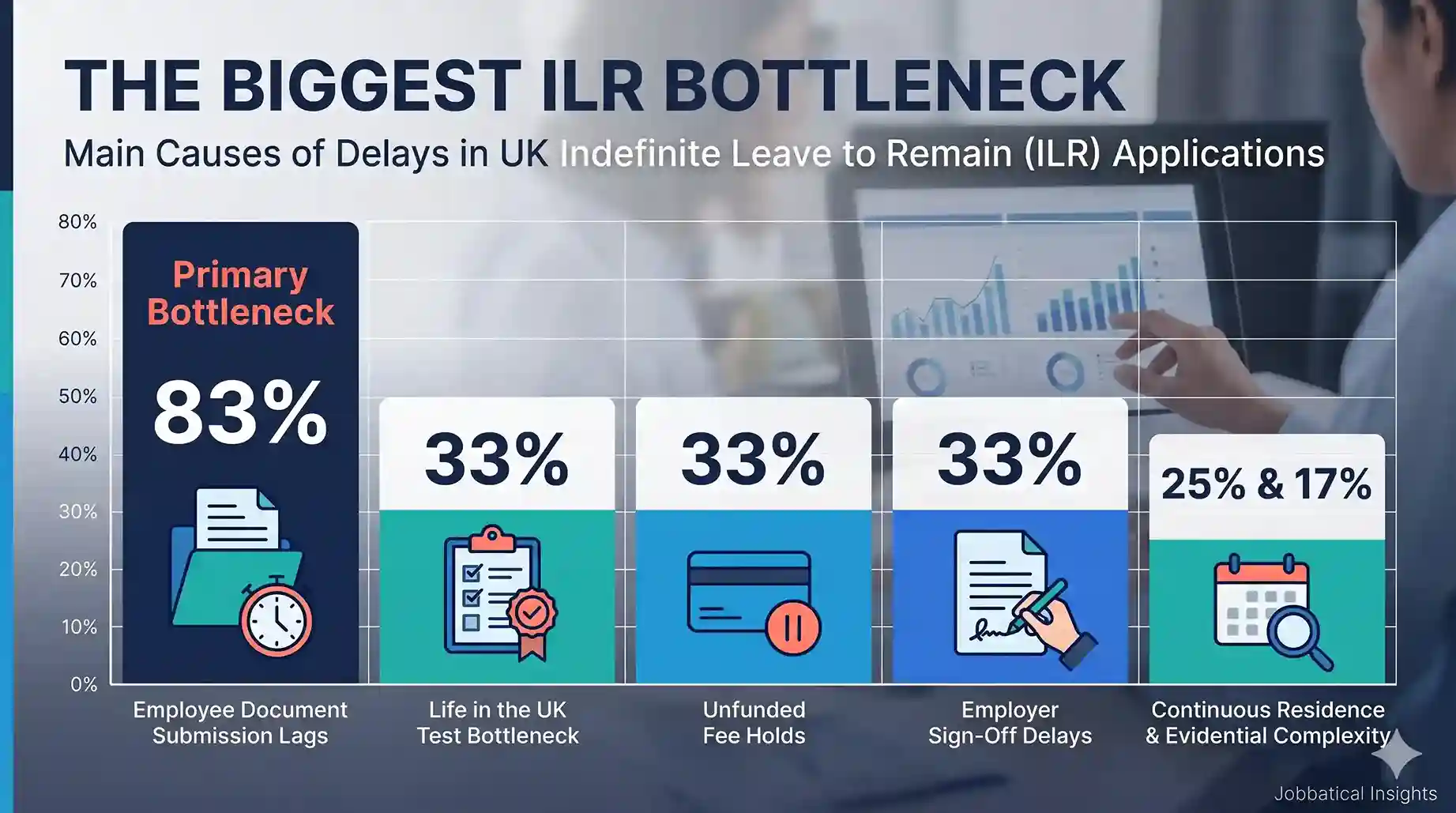
When UK Indefinite Leave to Remain (ILR) timelines slip, the Home Office is rarely the cause. Benchmark data shows candidate document lag is the single largest bottleneck, impacting the vast majority of filings. Identifying these operational friction points early allows People teams to resolve delays before they cost weeks.
- Employee Document Submission Lags: Candidate responsiveness drove delays in 83% of cases. With employee turnaround showing a 0.92 correlation with total processing duration, early, automated reminders yield significant timeline gains.
- Life in the UK Test Bottleneck: 33% of applications stalled awaiting Life in the UK Test results. As a mandatory prerequisite, HR should prompt candidates to sit and pass the test months before their qualifying window opens.
- Unfunded Fee Holds: One in three cases (33%) paused due to unapproved priority processing or biometric appointment charges. Pre-authorising immigration payment methods and budget codes eliminates these administrative freezes.
- Employer Sign-Off Delays: Another 33% of cases were held up by internal employer actions, including drafting formal employment letters and confirming salaries against original Certificates of Sponsorship (CoS). Brief company signatories well in advance.
- Continuous Residence and Evidential Complexity: 25% of cases had to pause for the mandatory five-year continuous residence date, while 17% encountered complex evidential hurdles, such as 180-day travel absence limits, salary discrepancies, or County Court Judgments (CCJs).
Top UK ILR bottlenecks by share of cases
See the full document list and eligibility checklist in Jobbatical's UK ILR requirements SET(O) form guide for HR.
Post-Approval Compliance: 42% of Cases Need SMS Reporting
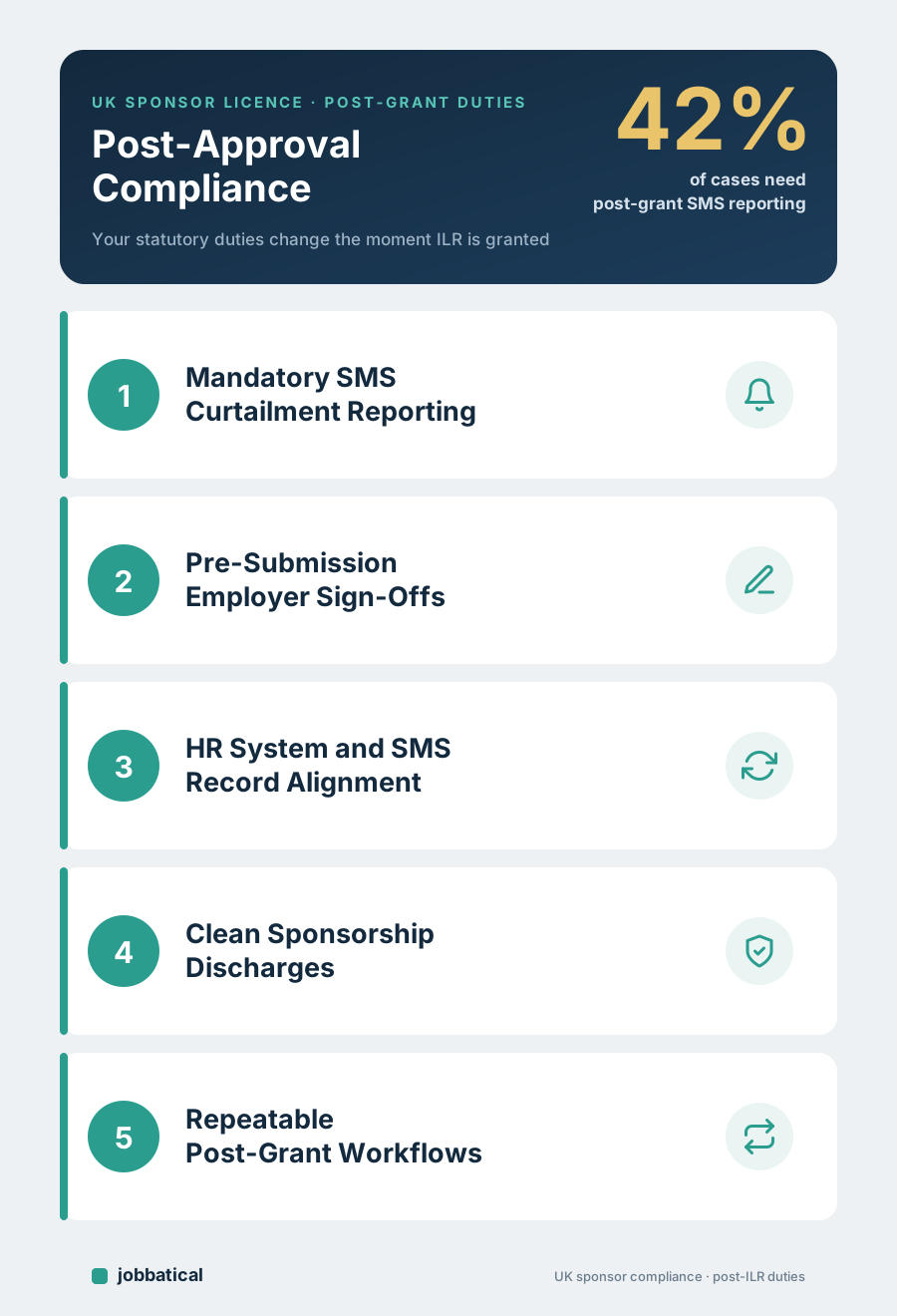
Securing Indefinite Leave to Remain (ILR) approval is not the finish line. Once settlement is granted, your statutory sponsor duties change immediately, requiring formal notifications via the Home Office Sponsor Management System (SMS). Overlooking this post-grant protocol exposes your organisation to sponsor licence compliance breaches on an otherwise successful filing.
- Mandatory SMS Curtailment Reporting: 42% of cases required a post-grant SMS notification to formally end sponsorship. Because UKVI penalises late or missed change-of-circumstance notifications, assign a dedicated Level 1 SMS user before decisions land.
- Pre-Submission Employer Sign-Offs: One in three cases (33%) required intermediate employer actions, such as drafting employment letters or confirming SOC code salaries against the original CoS. Without assigned stakeholders, these administrative steps stall filings.
- HR System and SMS Record Alignment: Cumulative changes to job titles, compensation, or work locations must match across platforms. Discrepancies between internal HRIS data and Home Office filings represent an acute UKVI audit vulnerability.
- Clean Sponsorship Discharges: Settled workers no longer need visa sponsorship. Reporting the change of circumstances formally terminates your sponsor monitoring obligations and protects your licence rating.
- Repeatable Post-Grant Workflows: Standardise compliance responsibilities by defining exact reporting triggers, designated filers, and statutory deadlines. A shared internal checklist prevents avoidable compliance risks after a grant.
Additional approvals and compliance steps
Jobbatical runs post-approval SMS reporting and day-to-day sponsor duties; see the UK Sponsor Management System service.
Jobbatical ILR Outcomes: 100% Approval and 0% Refusal in Decided Cases
With Jobbatical, every adjudicated UK Indefinite Leave to Remain (ILR) application in this dataset achieved a positive outcome. With zero Home Office refusals, a well-prepared settlement application proves to be a predictable milestone rather than an operational gamble.
- Flawless Approval Track Record: 100% of decided cases secured settlement. This clean success rate reflects rigorous upfront eligibility audits and comprehensive evidential review prior to submission.
- Zero Refusals Recorded: Across all decided filings, the refusal rate stood at 0%. One case transitioned to a Skilled Worker extension, a proactive route realignment rather than a refusal.
- Preparation Protects the Outcome: Positive decisions are won during pre-submission. Thoroughly validating continuous residence calculations and document bundles up front prevents downstream caseworker scrutiny.
- Priority Processing Buys Speed, Not Odds: Selecting UKVI Priority service compresses timelines, but eligibility and evidential accuracy alone drive the final grant.
- Plan for Success, Then Focus on Compliance: Given the high predictability of well-vetted applications, People teams should shift focus from approval anxiety to post-grant SMS reporting and licence maintenance.
UK ILR decision outcomes
See how settlement removes your ongoing sponsorship duties in Jobbatical's UK ILR employer guide.
Nine ILR Insights HR Should Know (Prep Is 69% of the Timeline)
Most UK Indefinite Leave to Remain (ILR) delays are operational and preventable. Derived from recent casework data, these insights highlight practical interventions People teams can implement immediately. Controlling the pre-submission phase is vital, as preparation is where application timelines are won or lost.
- Statutory Qualifying Date Constraints: 25% of cases were gated by the continuous residence anniversary. Because applications cannot precede the 28-day pre-eligibility window, have document bundles ready to submit on day one.
- Life in the UK Test Dependency: 33% of cases stalled awaiting test completion. Mandate that employees pass this statutory prerequisite well ahead of their qualifying date to eliminate critical-path friction.
- Employee Responsiveness Dictates Timelines: Candidate document turnaround was the top bottleneck in 83% of cases, correlating tightly (0.92) with total processing duration. Frequent, structured reminders yield immediate timeline improvements.
- Employer Compliance Responsibilities: Post-grant Sponsor Management System (SMS) reporting applies to 42% of cases, while internal sign-offs delayed 33%. Pre-brief internal signatories and establish clear reporting ownership before approval arrives.
- Fee Pre-Approval and Evidential Audits: A third of filings (33%) paused over unapproved priority or application fees, and 17% hit evidentiary hurdles such as travel absences, salary discrepancies, or County Court Judgments (CCJs).
- Priority Processing and Dependant Filings: UKVI Priority services deliver decisions in approximately five working days. Furthermore, 33% of filings ran concurrent family dependants, where eligible children may register directly for British citizenship instead of ILR.
Keep salary and role consistent with the Certificate of Sponsorship to avoid evidence delays; see Jobbatical's UK Certificate of Sponsorship service.
The ILR Timeline Has Three Gates and a Fourth Step
If you adopt one operational model from this data, make it this: an Indefinite Leave to Remain (ILR) case progresses through three sequential gates, followed by a fourth step owned entirely by the employer. Structuring workflows around all four milestones eliminates timeline unpredictability.
- Gate 1: The Statutory Qualifying Date: The earliest calendar date an employee meets continuous residence. Because statutory eligibility cannot be accelerated, diarise this date early and prepare files to submit on day one.
- Gate 2: Candidate Evidential Preparation: Compiling supporting documentation and clearing the Life in the UK test. As the single largest timeline variable, proactive follow-ups here drive the greatest operational gains.
- Gate 3: The Priority Processing Decision: A swift, predictable Home Office turnaround averaging five working days via UKVI Priority services. Pre-budget these expediting fees to prevent administrative halts.
- Step 4: Post-Grant SMS Curtailment Reporting: The often-overlooked employer compliance duty. Submitting a change-of-circumstances notification via the Sponsor Management System (SMS) formally concludes sponsorship and discharges monitoring obligations.
- Establish Clear Phase Ownership: Designate accountable stakeholders for every milestone. Casework benchmarks confirm that the fastest completions occurred when no stage waited on ambiguous ownership.
The four gates of a UK ILR case
Avoid the sponsor slips that follow a grant with Jobbatical's guide to UK SMS reporting pitfalls.
Your next ILR case is largely predictable if you treat preparation as the project and the decision as the easy part. Map the qualifying date, clear the settlement requirements, fund the fees, and set an owner for post-approval reporting. Book a demo to see how Jobbatical runs UK ILR cases end to end, from eligibility to settlement and sponsor compliance.
These figures are drawn from recently completed UK ILR cases managed by Jobbatical. They indicate operational patterns rather than official Home Office statistics, and individual timelines vary by route and circumstances.
Disclaimer: Immigration rules change quite frequently; please verify with official sources or contact us for the latest info before making any decisions.
Frequently Asked Questions - UK ILR Application Statistics