

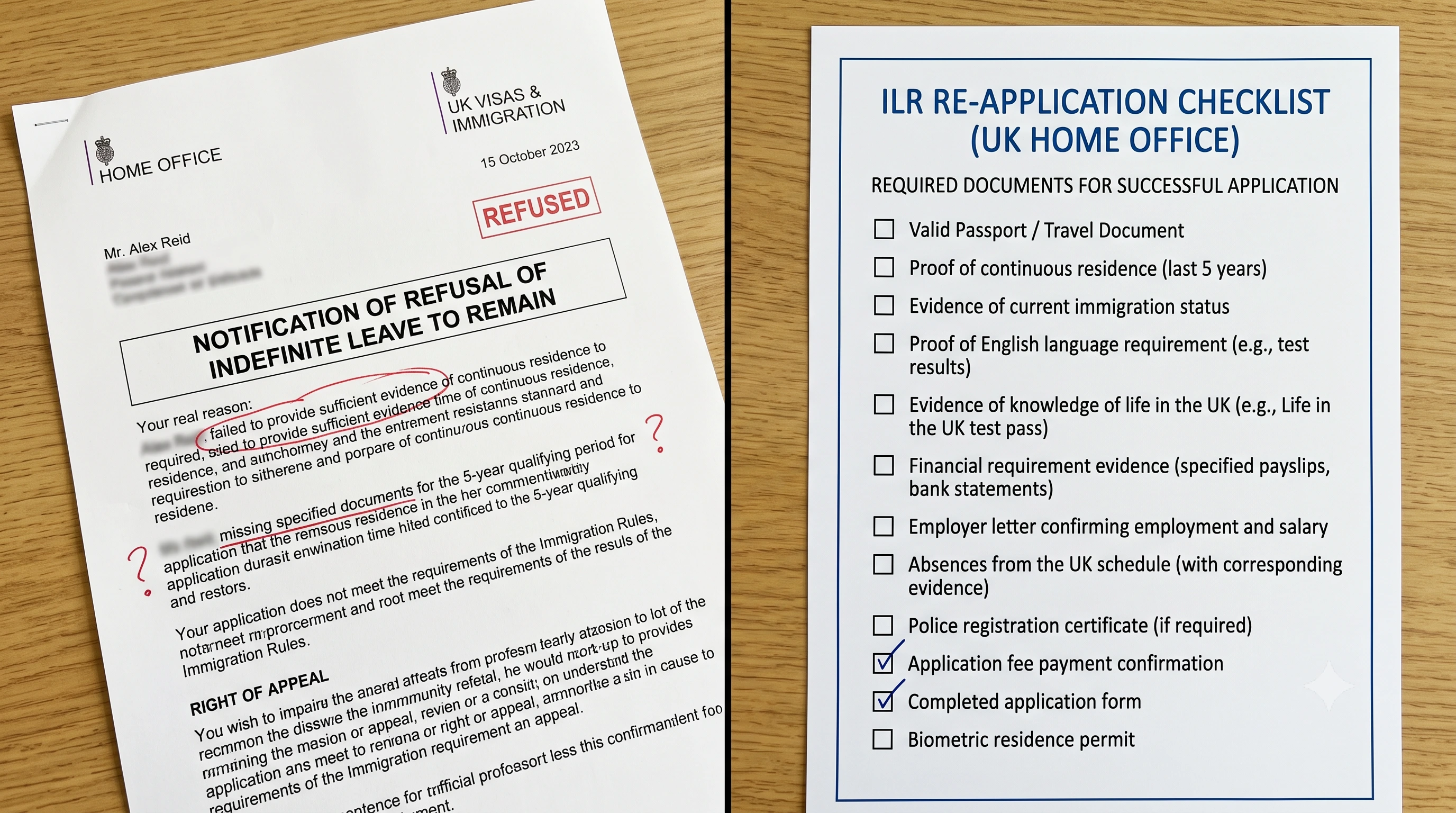
KEY TAKEAWAYS
- About 5% of ILR applications are refused; the £3,226 fee is non-refundable and your employee has 14 days to act
- Most refusals trace back to fixable errors: absences over 180 days, salary/CoS mismatches, or a defective employer support letter
- Skilled Worker refusals rarely carry appeal rights, so administrative review or a fresh application is the usual route
- For employer-caused refusals, reapplying with corrected documents is faster and often cheaper than administrative review
- Continuous absence tracking and pre-submission audits prevent almost all preventable refusals
Refusals are uncommon, but when they hit, they hit fast, and much of what needs to happen sits with you as the sponsor, not the employee. This guide covers the most common ILR refusal reasons in 2026, your employee's options inside the 14-day window, and where HR carries the real weight of fixing it.
What "ILR refused" means for your business
A refusal is not the same as a rejection for an incomplete form. It means the Home Office reviewed the application in full and decided your employee did not meet the requirements. The decision letter states the exact grounds and, critically, whether there is a right of appeal or administrative review.
Three practical consequences follow for you:
- Your employee may lose the right to work if their Skilled Worker visa has already expired
- Sponsor duties do not end, so you may need to issue a fresh Certificate of Sponsorship if reapplication requires it.
- Depending on the cause, your sponsor licence may face compliance scrutiny
Refusals that trace back to employer error, a wrong SOC code, a mistimed letter, a salary figure that does not match HMRC, are the ones that draw UKVI attention to your Sponsor Management System. For a broader overview of your obligations across settlement, see our UK ILR employer guide.
The 5 most common ILR refusal reasons in 2026
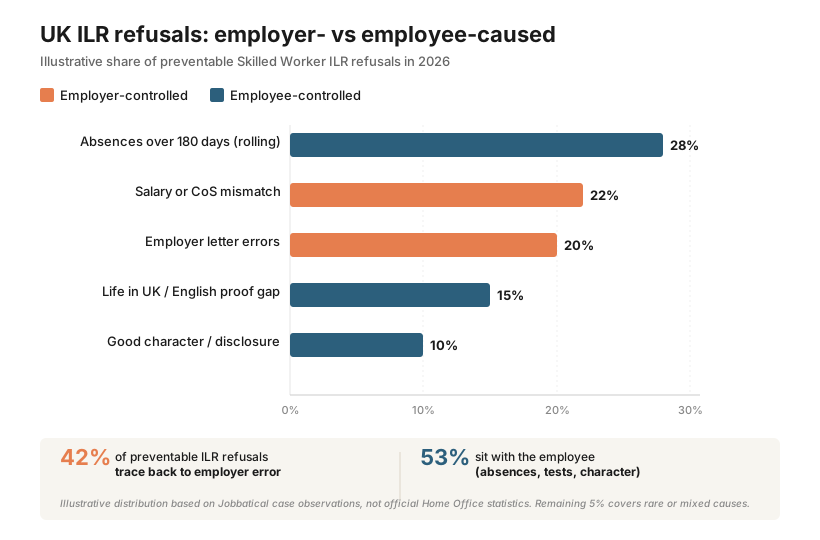
Some refusal causes sit with the employee. Others are firmly on you. Knowing the split matters when you decide how to reapply.
ILR refusal reasons: employer versus employee
1. The 180-day rolling absence rule
This is not a calendar year limit. Every consecutive 12-month period during the qualifying years is assessed independently. Business travel counts the same as personal holidays. A four-month project secondment in year 2 can wreck an application submitted three years later, because that particular 12-month window shows 190 days out.
2. Salary and Certificate of Sponsorship mismatches
The Home Office cross-checks the salary on the application against the CoS and against HMRC records. A promotion that raised the salary without a fresh CoS can trigger a refusal on its own. The 2026 Skilled Worker settlement threshold is £41,700 or the going rate for the role, whichever is higher.
3. Employer support letter errors
Missing SOC code. Dated more than 28 days before submission. Signed by the employee themselves. Old salary figure. Any of these can sink an otherwise clean application. Our detailed guide on the ILR employer support letter covers exactly what to include and when.
The 14-day clock: your employee's options after refusal
The refusal letter states the deadline and the routes available. Missing the deadline usually forfeits the option.
ILR Refusal: Options, Deadlines, and Costs
For most Skilled Worker refusals there is no full right of appeal. Administrative review is limited to caseworker errors, so you cannot submit new evidence. If the underlying issue is a documentation gap, reapplication is faster.
Success rates: appeals sit around 50% depending on evidence strength; administrative reviews are lower. Reapplications with the actual problem fixed typically clear.
Honest take: most companies waste time on administrative review when reapplication is the right move. If the refusal came from a fixable defect on your side (the letter, the CoS, the salary), a corrected fresh application is usually faster than a review, even at £3,226.
The Employer Reapplication Playbook
Once you have decided reapplication is the route (rather than review or appeal), work through this sequence
If the refusal touched on suitability under the new Part Suitability framework, the reapplication needs careful legal input, not just a documentation fix.
How to Prevent ILR Refusals Before They Happen
Prevention costs almost nothing compared to a refusal. For teams with 10 or more sponsored employees, a quarterly settlement audit catches most risks
- Track absences continuously, not only at application time. Every business trip logged against the rolling 12-month windo
- Align payroll, HR, and CoS data. Salary changes without a fresh CoS are a refusal risk.
- Start supporting documents 3 months before the eligibility date. Rushed employer letters are error-prone (and 28 days is a tight window if payroll needs updating)
- Use an eligibility calculator rather than manual date arithmetic; Jobbatical's ILR eligibility calculator handles the rolling window automatically.
- Run a pre-submission review on every application. A second pair of eyes on the employer letter and CoS alignment catches most preventable refusal
For companies with meaningful international headcount, this is where a managed ILR service earns back its cost several times over. One refusal remediation typically costs more than a year of managed service for that case.
When to bring in outside help
If the refusal cites suitability grounds, deception, or good character, do not reapply without immigration legal advice. These grounds trigger longer re-entry bans and affect future applications for your employee, and can flag your sponsor licence for review.
For clean-cause refusals (paperwork, salary, absence miscalculation), a specialist immigration partner can prepare a corrected reapplication within two weeks. That is often the difference between keeping your employee's right to work and losing it.
The next employee reaching ILR eligibility is already on your list somewhere. The question is whether their file is being audited now, or fixed in a 14-day scramble later. Book a demo to see how Jobbatical handles end-to-end UK ILR support for HR teams managing settlements at scale, including live refusal remediation.
Disclaimer: Immigration rules change quite frequently; please verify with official sources or contact us for the latest info before making any decisions.
Frequently Asked Questions : ILR Refused
What does "ILR refused" mean for my sponsored employee?
An ILR refusal means the Home Office has assessed the application and decided that the applicant does not meet the settlement requirements. The standard ILR application fee is generally non-refundable. If the employee’s existing immigration permission has already expired, their ability to remain and work in the UK will depend on whether they have an outstanding application, review, appeal, or other valid basis to stay under the Immigration Rules.
Can my employee stay in the UK after an ILR refusal?
If the employee still has valid permission to stay under their current visa, they may remain in the UK until that permission expires. If their leave has ended, they should seek immediate immigration advice to determine whether they are eligible to request an administrative review, lodge an appeal where available, submit a fresh application, or make other arrangements to avoid overstaying.
Can we reapply for ILR straight after a refusal?
Yes. If the refusal was caused by an issue that can be corrected, such as missing documentation or an employer administrative error, a fresh ILR application can usually be submitted once the problem has been resolved. A new application fee is payable for each application.
Is there a right of appeal for a Skilled Worker ILR refusal?
In most Skilled Worker ILR cases, there is no general statutory right of appeal. Depending on the circumstances, applicants may instead be eligible for an administrative review or, in limited situations involving human rights grounds, an appeal. The appropriate remedy depends on the reasons for refusal and should be assessed individually.
How much does an ILR administrative review cost?
The Home Office administrative review fee is £80. Applications for administrative review must normally be submitted within the applicable time limit stated in the refusal decision. An administrative review considers whether the Home Office made a caseworking error and does not allow applicants to submit new evidence unless specifically requested.
Can an employer error cause an ILR refusal?
Yes. Employer documentation errors can contribute to an ILR refusal. Examples include incorrect or inconsistent salary information, incomplete or inaccurate employer support letters, discrepancies between employment records and sponsorship records, or missing required information. Careful document review before submission helps reduce these risks.
Does an ILR refusal affect our UK sponsor licence?
A single ILR refusal does not automatically affect a sponsor licence. However, repeated employer-related errors or evidence of wider sponsorship compliance issues may prompt the Home Office to review a sponsor’s compliance systems. Maintaining accurate Sponsor Management System records and meeting sponsor duties helps reduce the risk of compliance action.

.svg)
.svg)