.svg)


KEY TAKEAWAYS - Netherlands ICT Permit
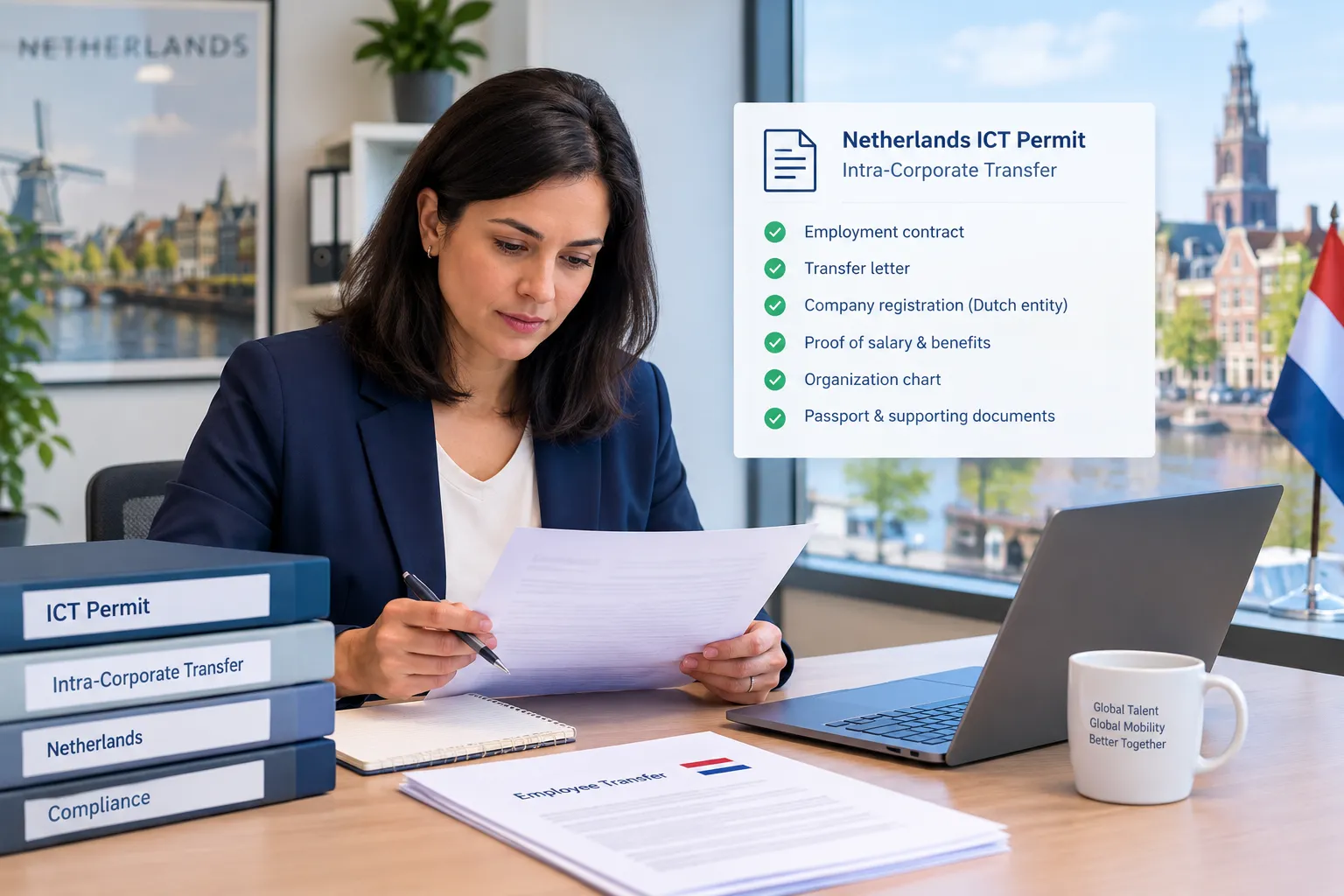
- The Netherlands ICT permit lets you move non-EU managers, specialists, and trainees from a group company into your Dutch entity without a labour market test.
- 2026 salary thresholds are EUR 5,942 gross per month for age 30+ and EUR 4,357 for under 30, both excluding the 8% holiday allowance.
- Recognised-sponsor entities get a fast-track IND decision in around two weeks; non-sponsors face up to a 90-day wait via UWV advice.
- The permit caps at three years for managers and specialists and one year for trainees, with no renewal beyond those limits.
- Plan the switch to Highly Skilled Migrant or EU Blue Card early, because ICT time does not count toward permanent residence.
You have a specialist in your Singapore office who needs to run a project from Amsterdam for two years. They are not an EU national, and you do not want to run a full local hire or a labour market test. The Netherlands intra-corporate transfer (ICT) permit is built for exactly this move. This guide walks HR and global mobility teams through eligibility, 2026 salary thresholds, costs, timelines, documents, and the compliance duties you take on once the transfer starts.
What is the Netherlands ICT (Intra-Corporate Transferee) permit and who is it for?
The Netherlands ICT (Intra-Corporate Transferee) permit is a combined work and residence permit designed for non-EU managers, specialists, and trainees transferring from a company outside the European Union to a Dutch entity within the same corporate group. Issued by the Immigration and Naturalisation Service (IND) under EU Directive 2014/66/EU, this permit is valid for the exact duration of the assignment. It is strictly intended for temporary corporate transfers and is not suitable for permanent local employment.
Key Features and Requirements:
- Managers and Specialists: This category applies to senior personnel or employees possessing specialized knowledge who will lead a Dutch team or manage a specific project. This is the most frequently utilized ICT profile for expanding businesses.
- Graduate Trainees: This route is for non-EU trainees participating in a structured career development program at a Dutch office. Eligible candidates must hold a master's degree and are subject to a shorter maximum permit duration.
- Strict Corporate Group Requirement: Both the sending organization and the receiving Dutch entity must belong to the exact same corporate group. External candidates or new local hires do not qualify for this immigration route.
- Exemption from Labour Market Testing: Unlike many standard work permits, the ICT route does not require a local labour market test. This significantly expedites the application process and removes a primary cause of delay for employers.
- Designed for Temporary Assignments: The validity of the permit is strictly tied to the length of the transfer. If your organization aims to retain the employee long-term, you must proactively plan a transition to a different residence permit before the ICT time cap is reached.
For a full breakdown of Dutch routes and how they fit different roles, see Jobbatical's Netherlands immigration hub, which maps every permit type employers use.
Who is eligible for the intra-corporate transferee residence permit?
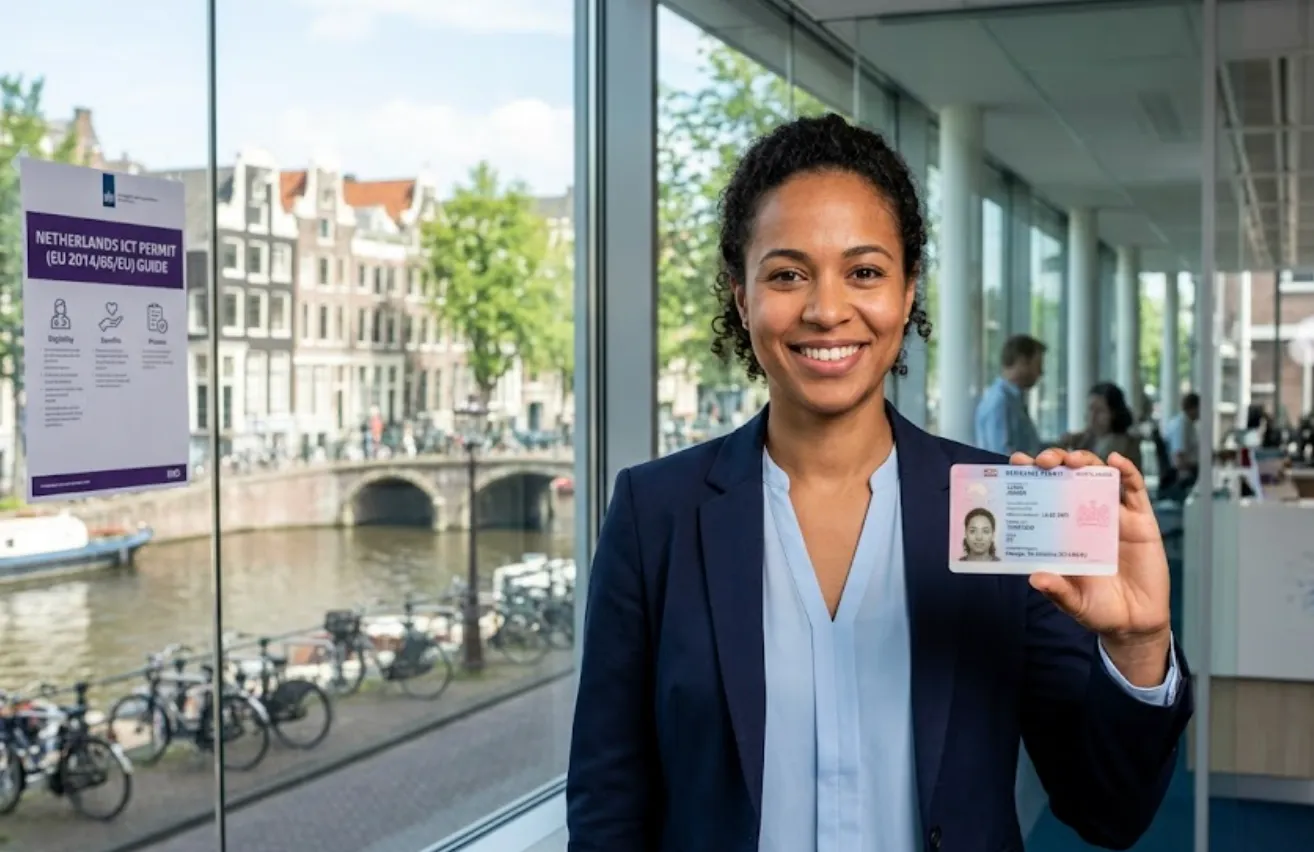
Eligibility for the ICT permit fundamentally depends on the corporate structure, the specifics of the role, and the transferee's employment history with the sending company. It is crucial to ensure these three elements are firmly established before filing an application, as insufficient proof of the corporate relationship is the most frequent cause of processing delays.
Core Eligibility Criteria:
- Qualifying Prior Employment: The transferee must have been employed by the sending entity for a continuous, specified period immediately preceding the transfer. This required tenure typically ranges from three to twelve months, depending on the specific role. Employers should ensure all relevant employment records are readily available to verify this history.
- Role Qualification: Candidates must meet strict educational and professional standards. Managers and specialists require either a relevant higher education degree or substantial, demonstrable professional experience. Graduate trainees, however, are strictly required to hold a master's degree that directly aligns with their designated training program.
- Genuine Corporate Group Link: Applicants must provide clear, documented evidence that both the sending company and the receiving Dutch entity operate under the same corporate umbrella. This relationship must be substantiated using detailed corporate structure charts, certificates of incorporation, and official commercial register extracts.
- Statutory Salary Thresholds: The transferee's guaranteed remuneration must meet or exceed the applicable IND salary thresholds set for 2026. This threshold is determined by the applicant's age category and is calculated strictly based on guaranteed gross base pay, before factoring in any tax advantages or temporary allowances.
- Non-EU Nationality Restriction: This immigration route is exclusively available to third-country nationals (citizens from outside the EU/EEA and Switzerland). Citizens of the EU, EEA, and Switzerland are exempt from this permit requirement, as they already hold the right to work in the Netherlands under European free-movement regulations.
Not sure whether your employee fits ICT or another route? Compare it against Jobbatical's Netherlands Highly Skilled Migrant permit service to confirm the right permit before you commit to a timeline.
What are the Netherlands ICT (Intra-Corporate Transferee) permit salary thresholds in 2026?
Salary is where most employers slip, so treat these figures as hard floors. The ICT thresholds track the Dutch Highly Skilled Migrant levels and exclude the 8% holiday allowance. The IND revises them every 1 January and 1 July, so confirm the live number before submission.
Netherlands ICT permit salary thresholds 2026
- Gross, before tax benefits: The IND assesses the threshold on gross salary. The 30% ruling does not reduce the figure you must meet on paper.
- Holiday allowance excluded: The 8% holiday allowance sits on top of the threshold. It does not count toward meeting the minimum.
- Age band locks at filing: The under-30 rate applies to the transferee's age at the start. Plan around a band change if a birthday is close.
- Market-level scrutiny: A salary set purely to clear the floor can invite questions. Be ready to justify pay against a scale or comparable roles.
- Mid-year revisions: Because figures reset twice a year, a case filed in July may face a higher number than one filed in June.
Benchmarking pay across routes? Jobbatical's 2026 Dutch salary threshold guide breaks down the current levels and how the indexed increase affects your offers.
How does the Netherlands ICT (Intra-Corporate Transferee) permit application process work?
The application process is initiated and managed entirely by the receiving Dutch entity, rather than the transferring employee. The procedural path diverges significantly early on based on whether your Dutch organization holds "Recognised Sponsor" status with the IND, as this single factor heavily dictates the overall processing timeline.
Step-by-Step Application Process:
- Confirm the Corporate Group Relationship: Begin by drafting a formal transfer agreement and compiling robust documentation to prove that both the sending and receiving entities operate within the same corporate structure. This evidence serves as the foundational element of a successful application file.
- Assess Eligibility and Salary Thresholds: Before submitting any paperwork, rigorously evaluate the candidate's proposed role, their tenure with the sending company, and their guaranteed salary. Ensure all elements strictly align with the current IND criteria and statutory wage bands.
- File the Single Permit Application with the IND: Submit the comprehensive application package directly to the IND. Because the ICT route utilizes a "single permit" structure that grants both work and residence rights simultaneously, employers benefit from dealing with one central immigration authority.
- UWV Assessment for Non-Recognised Sponsors: If the receiving Dutch entity is not an officially Recognised Sponsor, the IND is required to forward the application to the Dutch labor authority (UWV) to review the employment conditions. This mandatory referral step will inevitably extend the overall processing time.
- Biometrics and Residence Card Collection: Upon official approval of the application, the transferee must schedule an appointment in the Netherlands to submit their biometric data (fingerprints and a photograph). Finally, they will collect their physical residence card, which officially activates their legal right to live and work in the country.
Want the process handled end-to-end without your team living in the IND portal? See how Jobbatical runs the Netherlands ICT permit service from eligibility check to card collection.
How long does the Netherlands ICT (Intra-Corporate Transferee) permit take to process?
In reality, processing timelines vary significantly depending on the receiving Dutch entity's sponsor status. Recognised Sponsors benefit from highly expedited decisions. Conversely, applications from non-sponsored entities require mandatory consultation with the UWV, which can easily extend a standard corporate transfer into a three-month undertaking.
Timeline Expectations and Management:
- Recognised Sponsor Fast-Track: For entities holding official Recognised Sponsor status, the IND typically issues a decision within approximately two weeks. This rapid turnaround allows organizations to project onboarding and start dates with a high degree of confidence.
- Standard Route Processing (Up to 90 Days): For companies without Recognised Sponsor status, the statutory processing period can take up to 90 days. This extended timeline accounts for the mandatory employment condition review conducted by the Dutch labor authority (UWV).
- Front-Loaded Document Preparation: The administrative effort is heavily concentrated at the beginning of the process. Gathering, reviewing, and formalizing essential documents such as the transfer agreement, verifiable proof of prior employment, and any necessary legalizations typically requires at least a week before the application can even be filed.
- Biometrics and Appointment Scheduling: The final phase of the process is dictated by appointment availability at local IND desks. Booking biometrics appointments as early as possible is crucial to prevent unnecessary delays in securing the physical residence card.
- Strategic Buffer Planning: From a practical standpoint, many organizations initiate this immigration process too late. It is highly advisable to build a minimum buffer of six weeks into your project timeline prior to the anticipated start date, even when utilizing the fast-track route.
If speed matters, becoming a recognised sponsor changes everything. Learn what it involves in Jobbatical's Netherlands recognised sponsorship service.
How much does the Netherlands ICT (Intra-Corporate Transferee) permit cost?
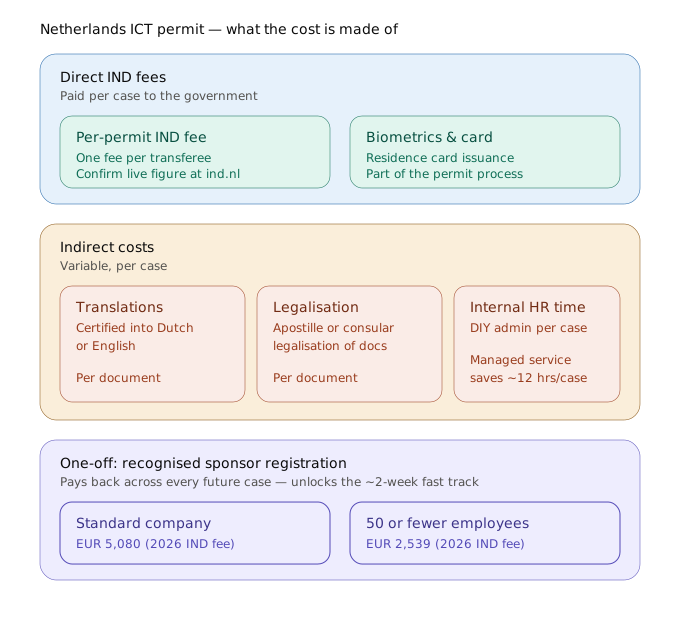
When budgeting for a transfer, organizations must account for two distinct cost layers: direct government fees mandated by the IND, and indirect expenditures related to documentation and internal resource allocation. Upgrading to Recognised Sponsor status is a separate, one-time investment that significantly streamlines future processing.
Strategic Budgeting and Cost Considerations:
- Per-Permit IND Application Fee: Every ICT permit application carries a mandatory government filing fee. For 2026, the standard application fee per transferee is €423. It is always best practice to verify the most current exact amount on the official IND website prior to finalizing your budget.
- Recognised Sponsor Registration Investment: Acquiring Recognised Sponsor status requires a one-time government fee. For 2026, standard companies face a fee of €5,080, while smaller firms (50 or fewer employees) benefit from a reduced rate of €2,539. This initial financial outlay frequently pays for itself through accelerated processing times across all future cases.
- Variable Document Costs: Employers must account for indirect, per-case administrative expenses. Obtaining certified translations, apostilles, and legalizations for corporate transfer agreements and the employee's civil documents will add variable, unavoidable costs to the total spend.
- Internal HR Resource Allocation: Managing complex immigration applications internally can severely impact Human Resources bandwidth. Engaging a managed service or specialized counsel typically saves internal teams an average of twelve hours of intensive administrative work per transfer.
- Long-Term Strategy and Switch-Planning: The time spent on an ICT permit does not count toward long-term residency or permanent settlement in the Netherlands. If permanent retention is the goal, organizations must proactively budget for the eventual administrative and financial costs of transitioning the employee to a Highly Skilled Migrant (HSM) or EU Blue Card status before the ICT cap is reached.
For a clear view of managed pricing versus DIY admin, see Jobbatical's pricing page, which lays out what a fully managed case includes.
What documents do employers need for the ICT (Intra-Corporate Transferee) permit?
Submitting an incomplete application file is the most common reason for weeks of unnecessary processing delays. The IND requires pristine, well-organized evidence that verifies the corporate group relationship, the specific nature of the role, and the transferee's employment history, all of which must be appropriately translated and legalized where mandatory.
Essential Document Checklist:
- Transfer Agreement or Assignment Letter: This foundational document formally outlines the specific role, exact assignment duration, guaranteed salary, and comprehensive terms of the intra-corporate transfer. It serves as the anchor and core justification for the entire application.
- Proof of Corporate Group Relationship: Robust corporate documentation such as detailed organizational charts, certificates of incorporation, or Chamber of Commerce extracts must be provided to clearly demonstrate that both the sending and receiving entities operate under the exact same group of undertakings.
- Evidence of Prior Employment: Employers must supply official records (such as continuous payslips, tax documents, or original employment contracts) verifying that the transferee has fulfilled the mandatory minimum employment tenure at the sending entity immediately prior to the move.
- Transferee Identity and Qualifications: The application requires a clear, complete copy of the applicant's valid passport, alongside verifiable evidence of their qualifications. This includes university degrees or documented proof of substantial professional experience to justify their classification as a manager, specialist, or graduate trainee.
- Legalization and Certified Translations: All foreign civil records and international corporate documents must adhere to strict IND documentation standards. This frequently necessitates obtaining an official apostille or consular legalization, as well as providing a certified translation into either Dutch or English prepared by a sworn translator.
What are the compliance duties for employers after approval of ICT (Intra-Corporate Transferee) ?
Securing permit approval marks the beginning of your compliance obligations, not the conclusion. The ICT route imposes strict time limits and rigorous record-keeping requirements, with the most critical challenge being the strict, non-renewable maximum duration cap. Failing to manage this timeline effectively means your employee will be legally obligated to depart the Netherlands.
Ongoing Compliance and Post-Approval Obligations:
- Proactively Track the Maximum Cap: ICT permits for managers and specialists carry a hard limit of three years, whereas graduate trainee permits max out at just one year. It is imperative to set internal HR alerts well in advance of the expiration date to strategize the employee's next steps.
- Strategize the Switch Route Early: Time spent on an ICT permit does not accrue toward permanent residence rights in the Netherlands. If your goal is long-term retention, you must proactively transition the employee to a Highly Skilled Migrant (HSM) or EU Blue Card permit well before their ICT cap is reached.
- Ensure Continuous Salary Compliance: The guaranteed statutory salary threshold must be maintained without interruption for the entire assignment. Crucially, starting in 2026, recognized sponsors must legally retain explicit proof such as business bank statements or batch payment overviews demonstrating that the salary was physically deposited into a bank account held in the employee's own name, as payslips alone are no longer sufficient.
- Maintain Pristine Records for IND Audits: Companies holding Recognised Sponsor status are subject to routine and unannounced audits by the IND. You are legally required to securely retain all case files, employment documentation, and verified payment evidence for a mandatory period of five years after the individual's sponsorship officially concludes.
- Manage EU Intra-Mobility Strictly: The ICT permit allows for short-term mobility to work at corporate branches in other EU Member States, but this is strictly capped at a maximum of 90 days within any 180-day period. Any assignment in another member state exceeding this timeframe necessitates a separate, long-term mobility application specific to that country.
When the cap approaches, the cleanest path is often a switch. See Jobbatical's Netherlands Highly Skilled Migrant permit service for the route most ICT holders move to.
Should you use the ICT (Intra-Corporate Transferee) permit or the Highly Skilled Migrant route?
These two immigration routes are fundamentally designed to solve different corporate mobility challenges. The ICT permit is specifically tailored for temporary intra-group transfers and includes built-in European mobility rights. Conversely, the Highly Skilled Migrant (HSM) permit is intended for long-term local employment in the Netherlands and provides a direct pathway to permanent residency. Selecting the wrong route initially will inevitably cost your organization administrative time and financial resources for a permit switch down the line.
Comparative Analysis and Strategic Selection:
- Choose ICT for Temporary Transfers: This route is the optimal choice for clearly defined, time-limited assignments within your corporate group. It bypasses the standard labour market test entirely and legally incorporates short-term mobility rights across other EU Member States.
- Choose HSM for Long-Term Retention: If the goal is to permanently integrate the employee into your Dutch operations, the HSM permit is the correct path. It can be extended for up to five years, and crucially, the time spent on this permit counts directly toward permanent Dutch residency unlike the ICT route.
- Sponsorship Status Requirements Differ: The procedural requirements contrast sharply between the two. The ICT permit can be utilized whether or not the Dutch receiving entity holds formal Recognised Sponsor status (though lacking it extends processing time). The HSM route, however, strictly mandates that the employer is an officially Recognised Sponsor from the very beginning.
- Consider the EU Blue Card Alternative: For highly educated hires holding recognized degrees who may require broad cross-EU portability in the future, the EU Blue Card often serves as a stronger long-term strategic fit than the standard ICT or HSM routes.
- Tax Optimization Overlaps (The 30% Ruling): Both the ICT and HSM permit routes can potentially be paired with the highly advantageous 30% ruling tax facility. For qualifying inbound employees, this allows up to 30% of their gross salary to be paid tax-free, significantly elevating their net take-home pay and making your relocation offers far more competitive.
Weighing the options side by side? Compare the routes with Jobbatical's Netherlands EU Blue Card service and factor in take-home pay using the Netherlands 30% ruling support service.
Ready to move your first ICT(Intra-Corporate Transferee) ?
The ICT permit removes real friction from group transfers, but the non-renewable cap and the sponsor-status split reward employers who plan early. Map your transferee's route now, decide whether recognised sponsorship is worth it for your volume, and set the switch reminder before the assignment even starts. Book a demo to see how Jobbatical handles the Netherlands ICT permit end-to-end for your HR team.
Disclaimer: Immigration rules change quite frequently; please verify with official sources or contact us for the latest info before making any decisions.
Frequently Asked Questions - Netherlands ICT Permit

.svg)
.svg)