

KEY TAKEAWAYS: Führungszeugnis and Police Clearance for German Work Visas
- Hires who never lived in Germany need a home country police clearance with an apostille or legalisation and a certified German translation.
- Hires previously registered in Germany order a Führungszeugnis as Belegart O, which the Federal Office of Justice sends directly to the requesting authority.
- Ordering the private Belegart N when an authority asked for Belegart O loses the €13 fee and adds about two weeks.
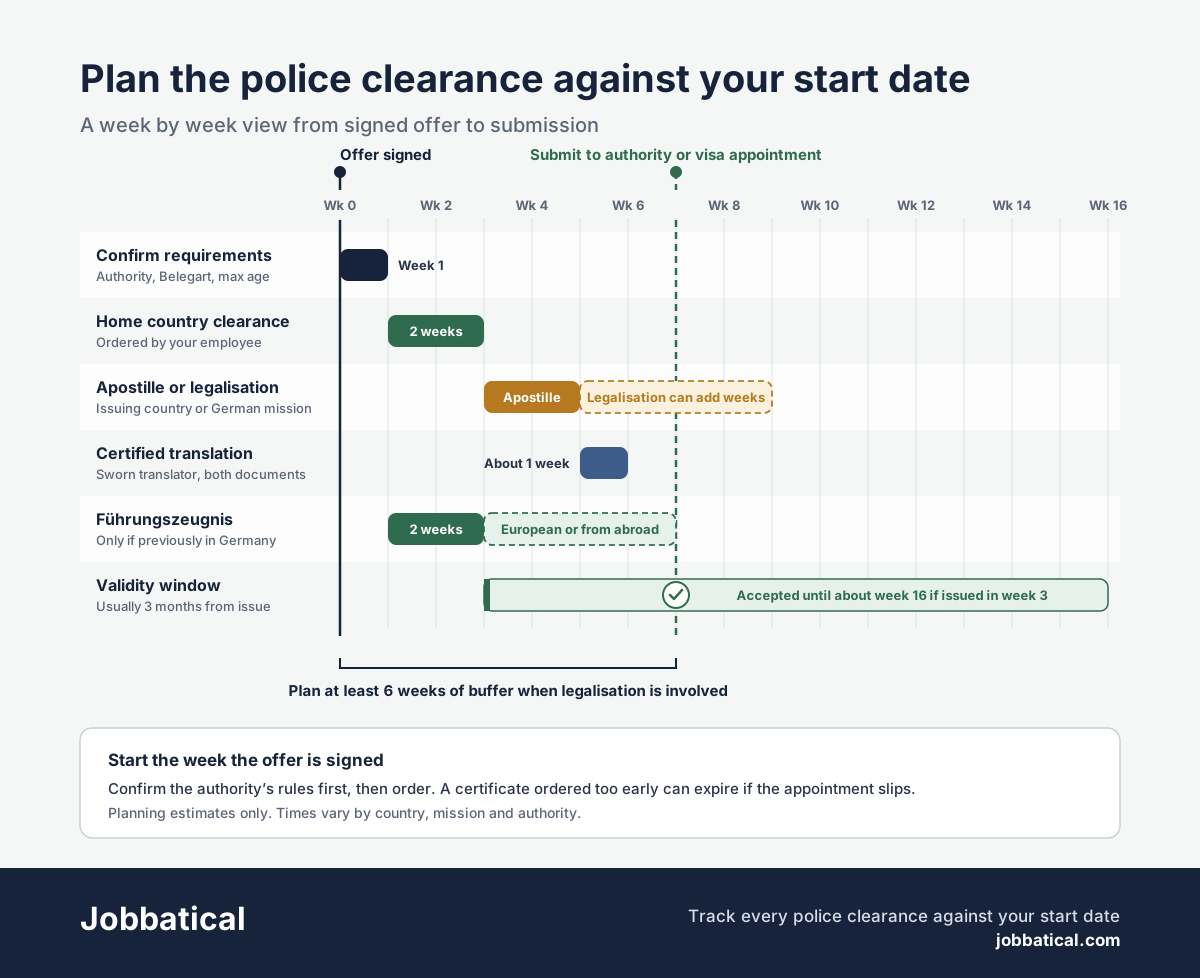
- Plan for about 2 weeks for a standard Führungszeugnis, 4 weeks for the European version, and at least 6 weeks when legalisation is involved.
- Authorities usually accept certificates up to three months old, and only your employee can apply; a power of attorney is not accepted.
Some German work visas and most regulated roles require proof of a clean criminal record: a German police clearance certificate, known as a Führungszeugnis, for hires previously registered in Germany, or a home country police clearance for everyone else. This document acts as a certificate of good conduct, proving you have no criminal record. Whether you need a standard background check for a German employer or an official record for immigration, understanding the correct type to order is crucial for your visa approval.
This guide shows you which Führungszeugnis or police clearance your employee needs for a German work visa, how to order it correctly, and when to start.
Which Police Clearance Does Your Hire Need?
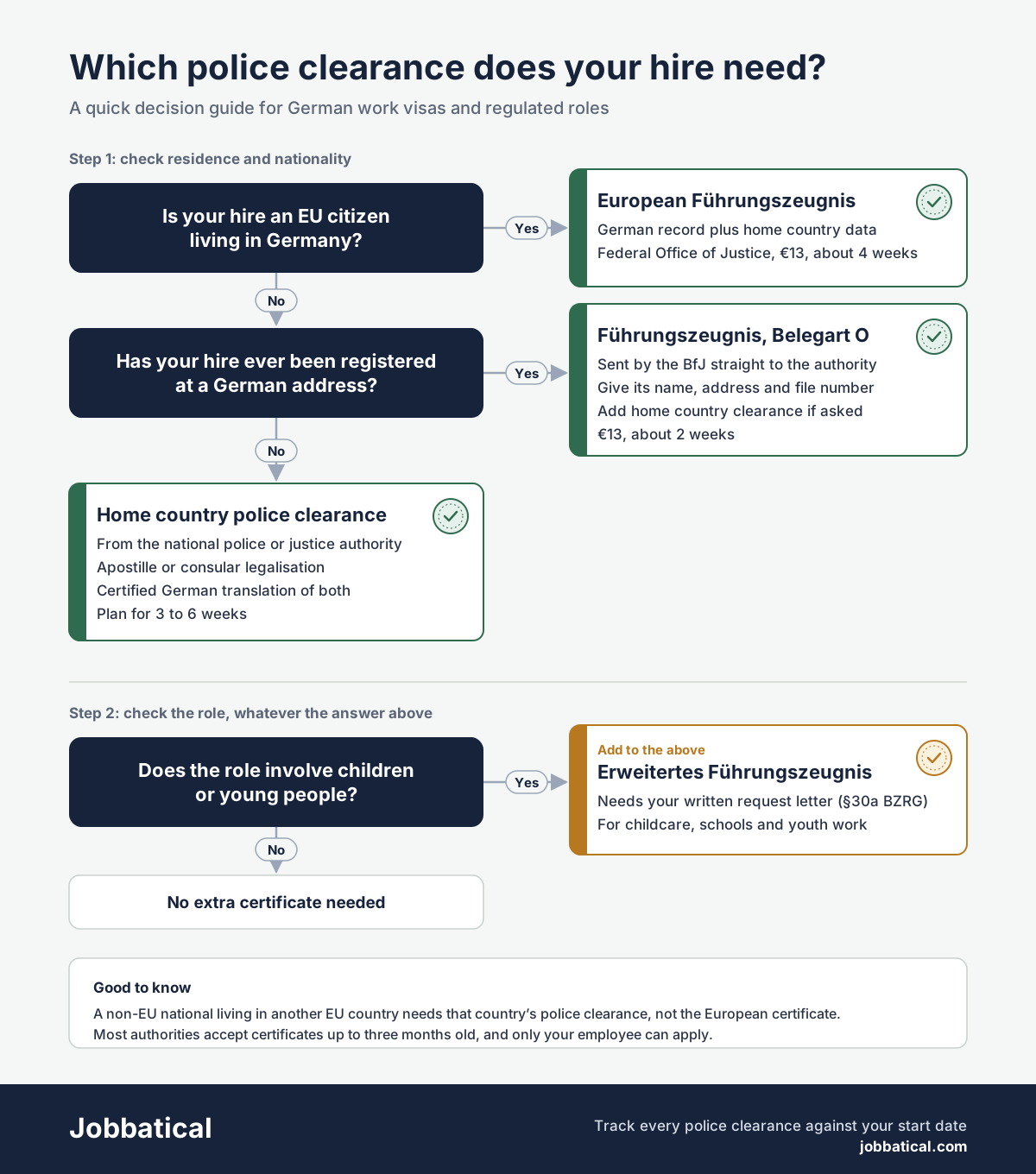
Quick decision table: police clearance by hire profile
| Your hire's situation | Certificate needed | Issued by |
|---|---|---|
| Never lived in Germany | Home country police clearance, legalised and translated | Home country police or justice authority |
| Previously registered in Germany | Führungszeugnis, Belegart O, plus home country clearance if asked | Federal Office of Justice (BfJ), Bonn |
| EU citizen living in Germany | Europäisches Führungszeugnis | BfJ, with data from the home country register |
| Role with children or young people | Erweitertes Führungszeugnis, on your written request | BfJ |
Führungszeugnis vs. home country police clearance: the key difference
- Führungszeugnis: an extract from Germany's Federal Central Register (Bundeszentralregister, BZR), issued by the BfJ in Bonn.
- Home country police clearance (PCC): shows the record in the country that issues it.
- They are not interchangeable. A German certificate says nothing about ten years in India, so many hires need both.
Never lived in Germany: home country PCC (legalised and translated)
- Licensing offices for nurses and doctors often want one from every country lived in for six months or more in recent years.
- It needs an apostille or legalisation and a certified German translation (section 4).
- Order it last, because freshness rules apply.
Previously resident in Germany: Führungszeugnis, Belegart O
Anyone ever registered at a German address has a BZR record. When a German authority asks for the certificate, your employee orders Belegart O and gives the authority's name, address and file number. The BfJ sends it straight there.
EU-resident hire: European Führungszeugnis (Europäisches Führungszeugnis)
- EU citizens living in Germany automatically receive the European version.
- It combines German entries with home country register data and takes about four weeks.
- A non-EU national living in another EU country does not qualify. They need that country's police clearance instead.
Belegart N vs. O, and why you must not order the "private" version
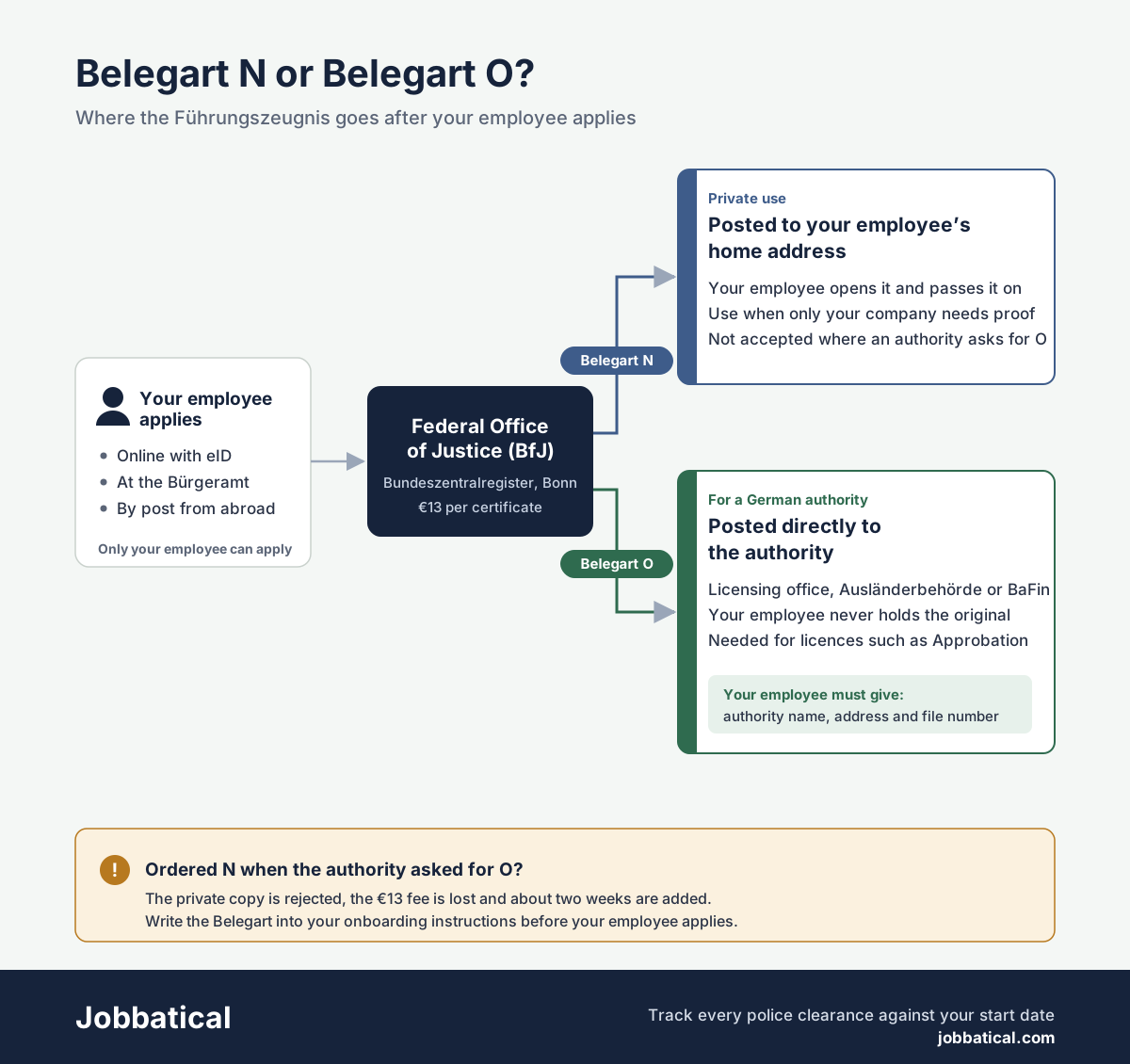
- Belegart N (private): posted to your employee's home address.
- Belegart O (for an authority): posted directly to the named German authority.
If an authority asks for Belegart O, a private copy will not be accepted. The €13 fee is lost and the two week wait starts again. Write the Belegart into your onboarding instructions. (One exception: if only your company wants proof for a non-regulated role, Belegart N is correct, since Belegart O cannot go to a private employer.)
Extended certificate (Erweitertes Führungszeugnis), only for roles with minors or vulnerable groups
- It lists sexual and child protection offences that the standard certificate leaves out.
- It is allowed only where section 30a BZRG applies, mainly childcare, schools and youth work.
- Your employee needs your written request letter confirming those conditions. Without it, the BfJ will refuse.
When Is a Police Clearance Actually Required?
Mandatory vs. discretionary background checks for German work visas
- Usually not required: most German missions do not list a police clearance as a standard document for the EU Blue Card or the Skilled Worker visa. Some missions still ask, so check the mission's checklist.
- Mandatory: regulated professions and roles where a specific law requires a check.
- Discretionary: you may ask only when the record is relevant to the job. Asking every hire creates GDPR risk (Article 10).
Regulated roles that require a clean criminal record
| Sector | What is checked | Typical certificate |
|---|---|---|
| Healthcare, nursing and Approbation | Reliability for the licence (Berufserlaubnis or Approbation) | Home country PCC, plus Belegart O if previously in Germany |
| Education, childcare and social work | Protection of minors (section 72a SGB VIII) | Erweitertes Führungszeugnis plus home country PCC |
| Aviation | Reliability check under section 7 LuftSiG | Authority checks registers; foreign PCC for time abroad |
| Defence | Security clearance under the SÜG | Clearance procedure started by your company |
| Banking | Fit and proper test for managers (BaFin) | Führungszeugnis, Belegart O |
| Critical infrastructure | Security vetting for sensitive roles | Depends on sector; often a security clearance |
For healthcare hires, the clearance is part of qualification recognition (Anerkennung), as the Make it in Germany nursing guide confirms. Get the state authority's exact list before anything is ordered.
How Your Employee Obtains the Certificate
Applying from within Germany
- Online: via the BfJ online portal, using the eID function of a German ID card or electronic residence permit.
- In person: at the local Bürgeramt with valid ID. Forwarding to the BfJ adds a few days.
Applying from abroad
- Online, if your employee still has a working German eID.
- Otherwise, the BfJ written application form, posted with proof of payment to Bundesamt für Justiz, 53094 Bonn.
- Signature and personal details must be certified by a German mission, a local authority with an official seal, or a notary. Missions charge for this, for example €60 in Australia.
Legalisation & Translation of Foreign Police Clearances
Apostille (Hague Convention) vs. consular legalisation
- Apostille: one stamp from the issuing country, used when both countries apply the Hague Convention.
- Consular legalisation: needed when the convention does not apply between Germany and that country, for example the Philippines and Azerbaijan. This can take weeks or months.
- In some countries the German mission verifies documents instead. Check its website early.
Certified German translation requirements (beeidigter Übersetzer)
- Use a sworn or authorised translator (beeidigter or ermächtigter Übersetzer).
- Translate the police clearance and the apostille or legalisation stamp.
- Legalise first, translate second.
See our guide to certified translation for German visa documents to check a translator's accreditation.
Cost, Processing Time & Validity
Police clearance costs and timelines at a glance
| Step | Cost | Plan for |
|---|---|---|
| Führungszeugnis (in Germany) | €13 | About 2 weeks |
| European Führungszeugnis | €13 | About 4 weeks |
| Führungszeugnis from abroad | €13 plus signature certification | 4 to 6 weeks including post |
| Home country PCC, apostille and translation | Varies by country | 3 to 6 weeks; longer with legalisation |
Fees, processing times and payment methods
Obtaining your certificate of good conduct in Germany is an affordable and straightforward step in the immigration process.
- €13 for each standard, extended or European certificate.
- Payment: ePayment online, cash or card at the Bürgeramt, or bank transfer to the Bundeskasse from abroad.
- Processing time: A standard certificate usually takes 1 to 2 weeks to arrive by mail. European certificates (Europäisches Führungszeugnis) require coordination with your home country and can take up to 4 weeks.
How long the certificate stays valid for visa authorities
The certificate has no legal expiry date. In practice, authorities usually accept certificates up to three months old, and some allow six. Ask the receiving authority, then work backwards from the submission date.
Can an employer or agent apply on the hire's behalf?
No. Your employee must apply personally; a power of attorney is not accepted. You can still issue the extended certificate request letter, supply the authority details for Belegart O, reimburse the fee and track the issue date.
Document Checklist for HR
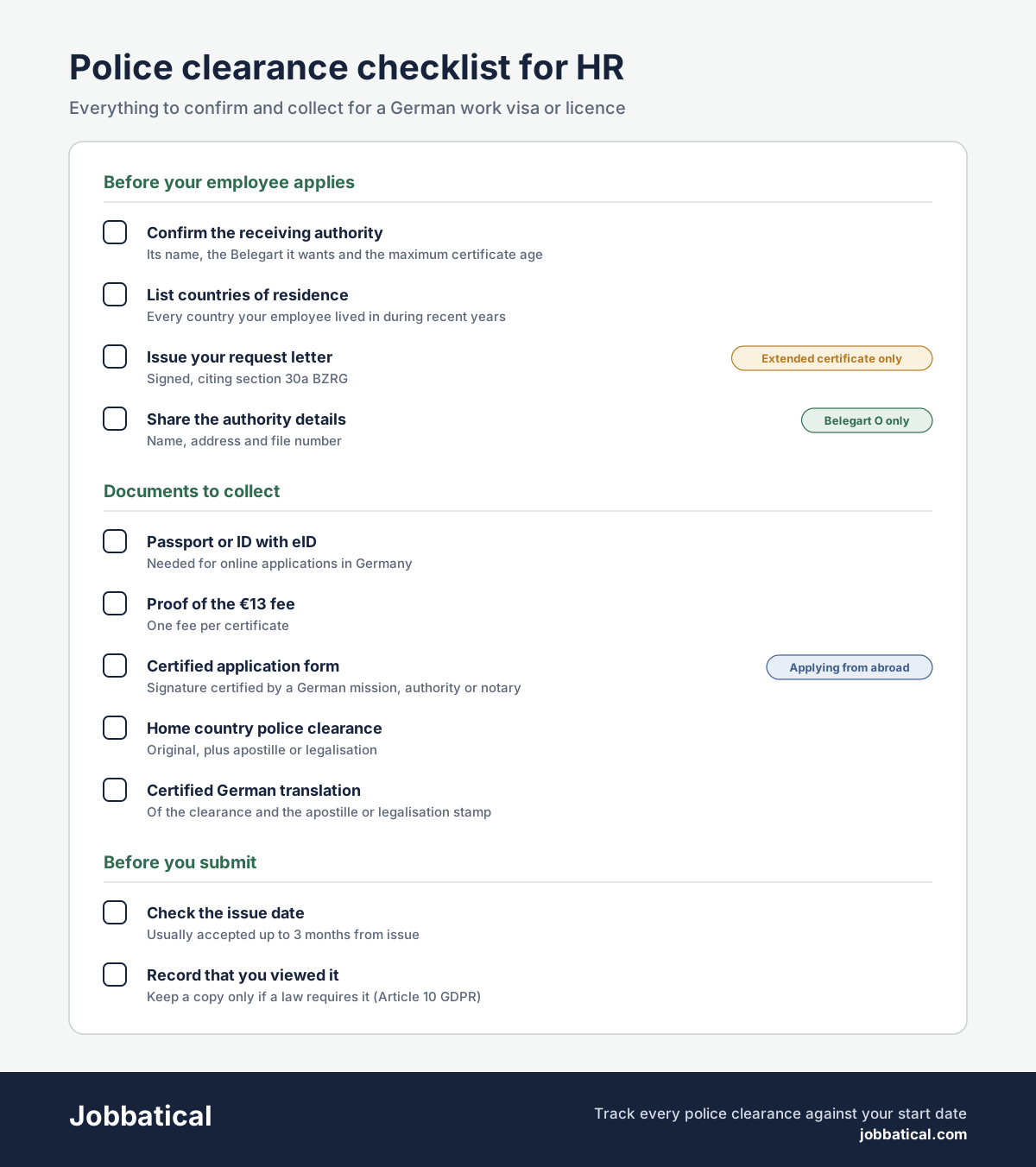
- Receiving authority, Belegart and maximum certificate age confirmed.
- Your employee's countries of residence in recent years.
- Signed request letter citing section 30a BZRG (extended only).
- Authority name, address and file number (Belegart O only).
- Passport or ID with eID; €13 fee proof; certified form if abroad.
- Home country PCC with apostille or legalisation, and certified translation of both.
- Issue date checked against the validity window.
- Note that you viewed the certificate; keep a copy only if a law requires it.
Running several regulated hires at once? Jobbatical tracks each certificate, its Belegart and its validity window alongside your Germany immigration cases. Book a demo and build clearances into your next hiring timeline. Legal basis: the Federal Central Register Act (BZRG).
Disclaimer: Immigration rules change quite frequently; please verify with official sources or contact us for the latest info before making any decisions.
Frequently Asked Questions: Führungszeugnis and Police Clearance for German Work Visas