.svg)



Key Take aways for EU Blue Card Germany
- Targets non-EU professionals with a recognized degree, a relevant job offer, and a minimum 6-month contract.
- 2026 salary thresholds: €50,700 general; €45,934.20 for shortage occupations like IT, engineering, and healthcare.
- Fast-track to permanent residency in 21 months (B1 German) or 33 months (A1 German).
- Application requires foreign degree recognition via Anabin, then embassy appointment, biometrics, and local registration on arrival.
The EU Blue Card is Germany's primary residence and work permit for highly qualified non-EU professionals. Whether you are an HR leader sponsoring international talent or a skilled professional planning your move, this guide covers everything you need - eligibility, 2026 salary thresholds, required documents, application steps, and the faster path to permanent residency.
What is the EU Blue Card in Germany?
The German EU Blue Card (Blaue Karte EU) is a special residence permit for highly qualified non-EU nationals who wish to live and work in Germany. Governed by Section 18g of the Residence Act (AufenthG), it was designed to address Europe's skills shortage by making it faster and simpler for talent to relocate. It offers faster permanent residency, easier family reunification, and EU mobility rights that standard work visas do not provide.
What are EU Blue Card Germany Benefit? 7 Advantages Over a Standard Work Permit
Holding an EU Blue Card in Germany comes with significant advantages over a standard work permit:
EU Blue Card Validity & Renewal
The EU Blue Card is generally valid for up to 4 years, but the actual validity period depends on the employee’s documentation and contract terms:
- Passport validity: If the employee’s passport expires before the 4-year mark, the Blue Card will usually be issued to matche the passport expiry date.
- Fixed-term employment contracts: If the employment contract has a defined end date, the Blue Card is generally issued to match that contract period. In these cases, extensions can usually be requested from within Germany before expiry.
Renewal for employers
To avoid disruption to employment authorization, renewal should be initiated with the employee’s local Ausländerbehörde before the current card expires. Where the employment relationship continues and the salary still meets the applicable threshold, renewals are generally more straightforward.
Renewal fees
Current renewal fees are typically:
- €100 for renewals of one year or more
- €93 for renewals of more than three months
- €96 for renewals of up to three months
Types of EU Blue Card in Germany
Germany offers four Blue Card variants depending on your career stage, profession, and whether you hold a formal degree:
You can compare all the routes for your candidate's profile with Jobbatical Germany visa navigator.
EU Blue Card Germany Salary Requirements
The 2026 general threshold sits above €48,000 gross annually, with lower figures for shortage occupations like STEM and healthcare. Thresholds are updated annually by the Federal Ministry of the Interior. Salary must be fixed and gross. Bonuses, commission, and variable pay are excluded.
New salary thresholds took effect on 1 January 2026. Read our Salary threshold blog for complete details.
EU Blue Card Eligibility Requirements
All applicants must meet these baseline requirements, regardless of Blue Card type:
- A valid job offer or signed employment contract with a German employer for at least 6 months
- The role must be related to employee's qualification or experience
- Salary must meet the 2026 threshold for employee's category (see above)
- No threat to public security, health, or policy, no pending criminal investigation
EU Blue Card Requirement for Standard Professionals (degree older than 3 years)
EU Blue Card Requirement for Young Professionals - Degree Within the Last 3 Years
If candidate's degree was awarded within the last 3 years (Junge Fachkräfte / Career Starters), they qualify for the reduced salary threshold. This is specifically designed to help recent graduates enter the German job market.
EU Blue Card Requirement for IT Specialists - No Degree Required
Germany explicitly allows IT professionals without a formal university degree to qualify for the EU Blue Card. This is the most common exception and applies specifically to tech roles.
For employers hiring experienced tech professionals, our guide to Germany IT Specialist EU Blue Card requirements explains the eligibility criteria, salary threshold, qualifying IT roles, and experience-based route for candidates without a university degree.
Shortage Occupations (MINT Blue Card)
Professionals in shortage occupations qualify for the lower salary threshold. The full list is maintained by the Federal Employment Agency, but key categories include:
- Managers in manufacturing, mining, construction, and distribution
- IT service managers and IT project leads
- Managers in childcare, healthcare, and education
- Academic STEM professionals (mathematics, informatics, natural science, technology)
- Experts in architecture, spatial and transport planning
- Medical doctors, veterinarians, dentists, and pharmacists
- Nursing and midwifery professionals
- Teachers and educators
For a broader overview of eligibility, salary thresholds, and the benefits of Germany’s reduced-threshold EU Blue Card, see our EU Blue Card guide for shortage occupations.
Application Process: Step by Step Guide
The process differs slightly depending on whether your employee is applying from outside Germany or already in-country
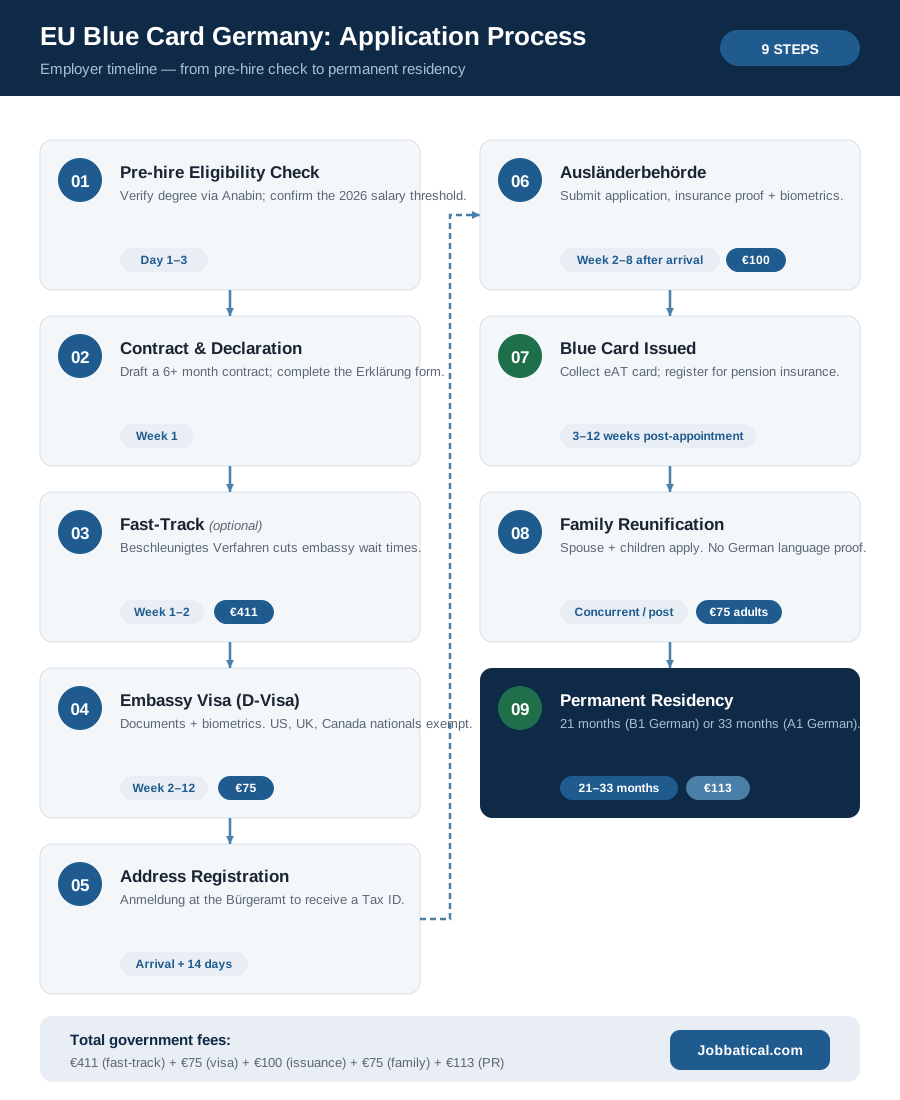
Processing Times & Fees for EU Blue Card
EU Blue Card Timeline for Employers: From Job Offer to Card-in-Hand
A practical, week-by-week map of every stage with your HR team's specific responsibilities called out at each step.
Employer's Checklist: Sponsoring an EU Blue Card in Germany
Prepare the key employer-side documents required for a successful Germany EU Blue Card application. Below is a quick Germany EU Blue Card employer document checklist. The complete step-by-step checklist and guidance are available at German EU Blue Card Document Checklist.
Changing Jobs
EU Blue Card holders can change employers, but there are rules for the first 12 months:
- During the first 12 months: Notify the Ausländerbehörde. The office may review the change and temporarily suspend employment for up to 30 days.
- After 12 months: Free to change employers without restriction, as long as the new role meets the salary threshold and is related to applicant's qualifications.
- If employment ends: A 3-month grace period applies to find a new qualifying role. The Blue Card is not immediately invalid.
EU Mobility
After holding a German EU Blue Card for 18 months, applicant may apply for an EU Blue Card in another member state (except Denmark and Ireland) without returning to your home country. This is one of the most valuable long-term benefits for internationally mobile professionals. Italy is one of the more common onward destinations for holders here's what the EU Blue Card process in Italy looks like if you're planning a future move.
Path to Permanent Residency
A standard German work permit requires 5 years before permanent residency. The EU Blue Card cuts this to 21–33 months.
Family Reunification
The EU Blue Card offers the most family-friendly terms of any German work permit:
- Spouses and children can join without needing to prove German language skills
- No requirement to demonstrate sufficient living space
- Spouses receive a residence permit with immediate, unrestricted work rights
- No minimum income requirement beyond the Blue Card holder's own salary
- If your spouse already holds an EU Blue Card in another EU country for 12+ months, they can apply for the Blue Card in Germany directly without returning home
For employers relocating international talent to Germany, understanding the family reunification process is essential to supporting employees whose spouses and children will join them after the move. Read our complete guide on Family Reunification for details.
Disclaimer: Immigration rules change quite frequently; please verify with official sources or contact us for the latest info before making any decisions.
Frequently Asked Questions About the German EU Blue Card and Employer Compliance
What is the EU Blue Card in Germany?
The EU Blue Card is a residence and work permit for highly qualified non-EU nationals. It allows professionals with a recognised degree or equivalent qualification to live and work in Germany, offering faster access to permanent residency and easier mobility within the EU compared to standard work permits.
Who is eligible for the EU Blue Card?
- Professionals with a recognised university degree and a qualifying job offer
- IT specialists with 3+ years of experience in the last 7 years (no degree required)
- Professionals in shortage occupations (e.g. MINT, healthcare, education)
- Recent graduates who completed their degree within the last 3 years
What are the 2026 salary thresholds for the EU Blue Card?
- General threshold: €50,700 gross per year
- Reduced threshold: €45,934.20 gross per year (for IT, shortage occupations, and young professionals)
Only fixed salary counts toward the threshold — bonuses are excluded. These thresholds are updated annually.
How long does the EU Blue Card application take?
- Embassy processing: 4–8 weeks
- Ausländerbehörde processing: 3–12 weeks (up to 90 days by law)
The fast-track procedure can reduce embassy processing time by 4–6+ weeks.
Can I change jobs on an EU Blue Card?
Yes. During the first 12 months, you must notify the Ausländerbehörde, which may review the change for up to 30 days. After 12 months, you can change employers freely, as long as the new role meets salary and qualification requirements.
How long until I can apply for permanent residency?
- 21 months with B1 German
- 33 months with A1 German
Applicants must also have paid into the German pension system during this period.
Do I need to speak German to get the EU Blue Card?
No. German language skills are not required to obtain an EU Blue Card. However, learning German helps you qualify for permanent residency faster — reducing the timeline from 33 months to 21 months.
Can US citizens apply for the EU Blue Card?
Yes. US citizens do not need an entry visa. They can enter Germany visa-free and apply for the EU Blue Card at the local Ausländerbehörde within 90 days of arrival.
What is the fast-track procedure (beschleunigtes Verfahren)?
The fast-track procedure allows employers to submit documents in advance through the authorities, speeding up visa processing. It can reduce embassy processing time by 4–6+ weeks. The government fee is €411, and the process is initiated by the employer.

.svg)


.svg)