

KEY TAKEAWAYS: UK Right to Work Documents
- You can only accept documents on the Home Office List A or List B; anything else leaves you without a statutory excuse.
- List A documents prove a permanent right to work and need no follow-up check; List B documents are time-limited and must be rechecked before permission expires.
- A UK or Irish birth certificate only works when paired with official proof of a National Insurance number, such as a P45, P60, or HMRC letter.
- Driving licences, standalone NI cards, old BRPs and BRCs, and any photocopy or emailed scan are never acceptable right to work documents.
- Getting a check wrong risks a civil penalty of up to £60,000 per worker and, for sponsors, direct sponsor licence risk.
Right to work documents are the specific items the Home Office lets you rely on. This guide covers the acceptable List A and List B documents, what you cannot accept, and how to run a manual check that actually holds up.
What Counts as a Right to Work Document?
A right to work document is any item on the Home Office List A or List B that proves a person can legally work for you in the UK. Check the right one correctly and you earn a statutory excuse. That excuse protects you from a civil penalty if the worker later turns out to be working illegally.
When You Still Need a Physical Document Check
Most non-British, non-Irish workers now prove their status online with a share code, not paper. Physical document checks still apply in a narrowing set of cases:
- British citizens who show a passport
- Irish citizens
- People with older ILR or no time limit endorsements inside a passport
- British and Irish citizens verified through identity document validation technology (IDVT)
If a worker holds a digital immigration status, you check it online instead of handling documents at all.
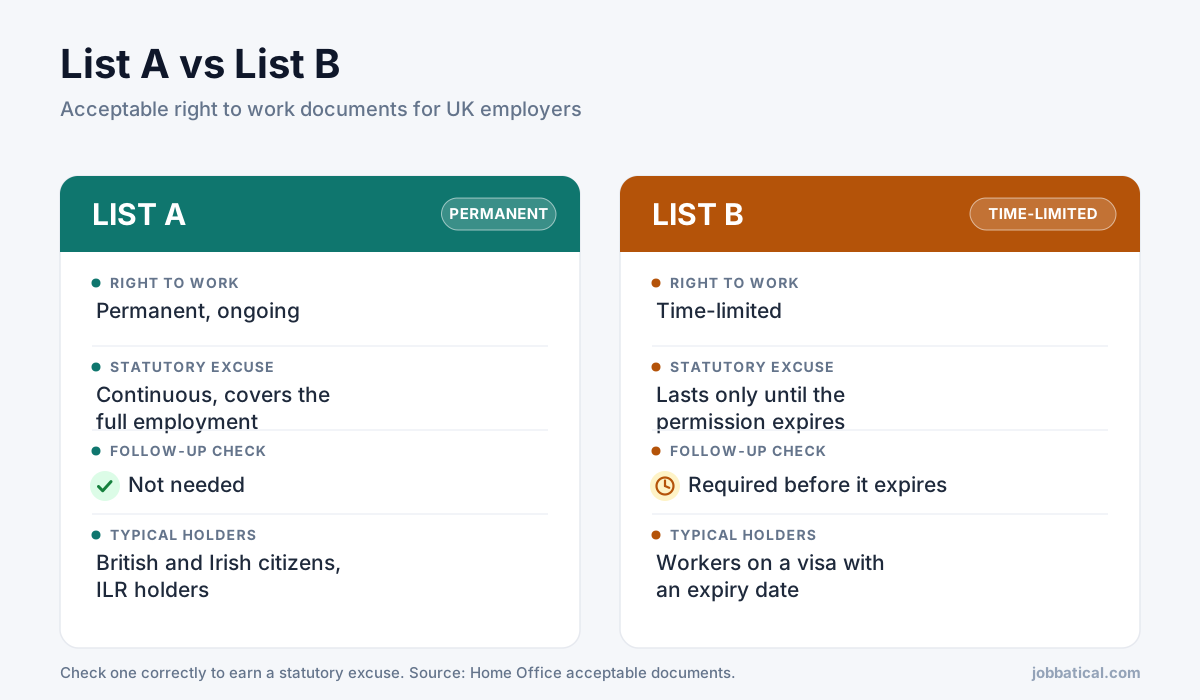
List A vs List B at a Glance
| Feature | List A | List B |
|---|---|---|
| Right to work | Permanent, ongoing | Time-limited |
| Statutory excuse | Continuous, whole employment | Time-limited |
| Follow-up check | Not needed | Required before permission expires |
| Typical holders | British and Irish citizens, ILR holders | Workers on a visa with an expiry date |
List A: Documents That Prove a Permanent Right to Work
List A documents show an ongoing right to work. Check one correctly and you never repeat the check for that employee.
Documents Accepted on Their Own
- A British citizen passport, current or expired
- An Irish passport or passport card, current or expired
- A current passport endorsed to show indefinite leave to remain, the right of abode, or no time limit
Documents You Must Pair With NI Number Proof
Some List A documents only work when combined with official proof of a National Insurance number:
- A UK or Irish birth or adoption certificate
- A certificate of naturalisation or registration as a British citizen
On their own, none of these prove right to work. The NI number evidence is what completes the check.
What Counts as Proof of a National Insurance Number
Acceptable proof shows the worker's name and number, issued by a government agency or a past employer. That includes a P45 or P60, a PAYE coding notice or HMRC letter, or a letter from a government department such as the DWP or Jobcentre Plus. A plastic National Insurance number card does not count.
List B: Documents for a Time-Limited Right to Work
List B covers workers whose permission has an end date. You get a time-limited statutory excuse, and you must schedule a follow-up check before their permission runs out. List B splits into two groups.
Group 1: Valid Until Permission Expires
Group 1 covers people whose leave is confirmed and dated:
- A current passport endorsed to show the holder can stay and do the work in question
- A current Immigration Status Document with a photo, endorsed the same way, plus official NI number proof
Your statutory excuse lasts until the expiry date on the permission.
Group 2: Documents That Need Home Office Verification
Group 2 is for workers with a pending application, an appeal, or an Application Registration Card. You cannot confirm these from the document alone. You verify them through the Employer Checking Service, which issues a Positive Verification Notice. That notice gives you a six-month statutory excuse, and the full process lives in that guide.
List A vs List B right to work documents comparison.
Documents You Cannot Accept
Plenty of official-looking documents carry no weight for right to work. Reject these every time:
- Driving licences. A UK or foreign licence is not on either list.
- National Insurance cards or numbers on their own. NI proof only supports certain List A documents; it never stands alone.
- BRPs, BRCs and other physical cards. These expired at the end of 2024. Holders now prove status with an eVisa and a share code, so the old cards are not valid evidence.
- Photocopies, scans and emailed images. You must see the original or complete an online check. A screenshot of someone's status is not a check.
Document Scenarios by Worker Type
Real cases rarely match the textbook. Here is how to handle the common ones.
How Each Worker Proves Their Right to Work
| Worker | Correct route |
|---|---|
| British citizen with a passport | Manual check, or IDVT through an identity service provider |
| British citizen without a passport | Birth certificate plus official NI number proof |
| Irish citizen | Passport or passport card; or birth certificate plus NI proof |
| Old ILR or no time limit endorsement | Manual List A check of the endorsed passport |
| EU, EEA or Swiss national | Online share code check; a passport no longer proves status |
EU, EEA and Swiss Nationals
Since July 2021, an EU passport no longer proves right to work on its own. These workers hold settled or pre-settled status and prove it with an online share code. Frontier workers follow a similar digital route; see our Frontier Worker permit guide for the detail.
Name Changes and Mismatched Documents
If the name on a document differs from the name the worker uses, ask for evidence of the change, such as a marriage certificate or deed poll. Keep a copy of that alongside the main document, or your audit trail looks inconsistent later.
How to Carry Out a Manual Document Check
The Home Office sets three steps: obtain, check, copy. Miss any one and your statutory excuse can fail, even when the worker genuinely has the right to work. In practice, this is where most audit problems start.
Obtain the Original Documents
Get original documents, not copies, and check them with the worker present. Photos and scans are not acceptable at this stage. You need the genuine item in front of you.
Check for Tampering and Conditions
With the worker in front of you:
- Confirm the photo and date of birth match the person and any other document
- Check dates have not expired, except where List A allows an expired British or Irish passport
- Look for signs of tampering or a clipped corner (a clipped-corner passport is not valid proof)
- Confirm any visa conditions allow the work you are offering
Copy and Date Your Records
Make a clear copy that cannot be altered, keep it secure, and record the date you made the check. A copy with no date gives you no statutory excuse. Keep records for the full employment plus two years after the worker leaves. Retention gaps are exactly where a sponsor licence review finds problems.
Across a growing team, this gets heavy fast. If you sponsor workers, right to work slips feed straight into sponsor licence risk, and the Home Office can suspend a licence over exactly this kind of gap.
Disclaimer: Immigration rules change quite frequently; please verify with official sources or contact us for the latest info before making any decisions.
Frequently Asked Questions — UK Right to Work Documents