

KEY TAKEAWAYS: Right to Work Checks in the UK
- Complete every right to work check before work starts; a correct, dated check gives you a statutory excuse against fines of up to £60,000 per illegal worker.
- Since 1 October 2026, checks also cover worker contracts, individual subcontractors and platform workers, but not arrangements made before that date.
- Use an online share code check for eVisa holders; British and Irish citizens need a manual check or a certified digital identity check.
- Recheck time-limited permission before it expires; British, Irish, ILR and EU settled status holders need no follow-up check.
- Keep right to work records for employment plus 2 years; Appendix D sponsor files follow a separate sponsorship plus 1 year rule.
Conducting a UK right to work check is a mandatory legal requirement for all employers. This process ensures that every prospective employee has the legal right to work in the United Kingdom. Following the correct right to work check process protects your business from compliance failures and aligns with the latest Home Office right to work guidance.
What Is a Right to Work Check?
A right to work check is the Home Office's prescribed process for confirming someone can legally do the work you offer in the UK.
The Legal Duty to Prevent Illegal Working
- The duty comes from the Immigration, Asylum and Nationality Act 2006, set out in the Home Office employer's guide to right to work checks.
- Employing someone without permission to work is a civil breach. Doing it knowingly is a crime.
The Statutory Excuse: How a Correct Check Protects Your Business
A correct check gives you a statutory excuse against the civil penalty, even if the person later turns out to be working illegally. It only holds if you:
- used the right method for that person
- finished the check before work began
- kept a dated record
Miss one and you have no defence.
What Changed in 2026: eVisas and the Extension to Non-Employees
- BRPs have not been valid since 31 December 2024. Most non-UK workers now use eVisas.
- 31 December 2026 is only the last day to set up a UKVI account with an expired BRP. It isn't a check deadline.
- From 1 October 2026, checks also cover worker contracts, individual subcontractors and online platforms. See what this means for gig, zero-hours and subcontractor arrangements.
Who You Must Check (and How to Avoid Discrimination)
The rules apply universally to avoid discrimination and ensure full legal compliance.
- New hires: Every prospective employee requires a UK right to work check before their first day of employment.
- Existing employees: You must conduct follow-up checks for staff members with temporary visas before their current permission to work expires.
Employees, Workers, Contractors and Platform Workers
Scope follows the Home Office criteria, not an IR35 decision or a personal service company setup.
- Employees: always in scope.
- Workers and individual subcontractors: in scope for arrangements made on or after 1 October 2026.
- Platform workers: in scope where you match them with work online.
- Agency staff: the agency checks its own employees. You don't repeat every check, but you need evidence its process works.
Check Everyone the Same Way: Avoiding Discrimination Claims
Discrimination claims usually start when one candidate is treated differently because of an accent, name or nationality.
- Check every candidate at the same stage, ideally at offer.
- Don't reject someone just because their permission is time-limited.
- Follow the Home Office anti-discrimination code, revised from 1 October 2026.
Sponsored Workers: Extra Duties for Sponsor Licence Holders
For sponsors, a failed check puts the whole licence at risk.
- Keep the check result in the worker's Appendix D file.
- Report through the SMS within 10 working days if a sponsored worker doesn't start.
- Keep role, salary and location in line with the CoS. See sponsor licence compliance duties.
When to Check: Before Day One and Beyond
Initial Checks Before Work Starts
Finish the check before the first hour of work, including induction or a trial shift. Run it at offer stage. In practice, a day-one check leaves no time to fix a share code that won't load.
Follow-Up Checks for Time-Limited Permission
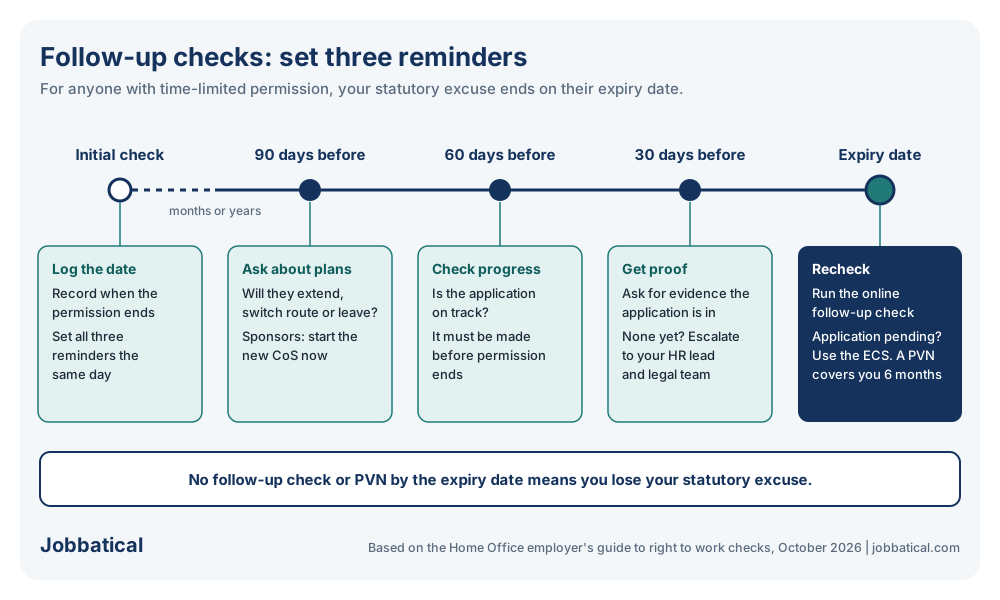
- If permission has an end date, your statutory excuse ends then too.
- Recheck before it expires.
- If the worker applied to extend in time, use the Employer Checking Service. A Positive Verification Notice (PVN) protects you for 6 months.
When You Do Not Need to Re-Check
- British and Irish citizens.
- People with ILR or EU settled status, once you hold a compliant check. See our right to work checklist after ILR.
- Employees with you continuously since before 29 February 2008.
- Each new intermittent assignment, unless the excuse is expiring.
Choosing the Right Check Method
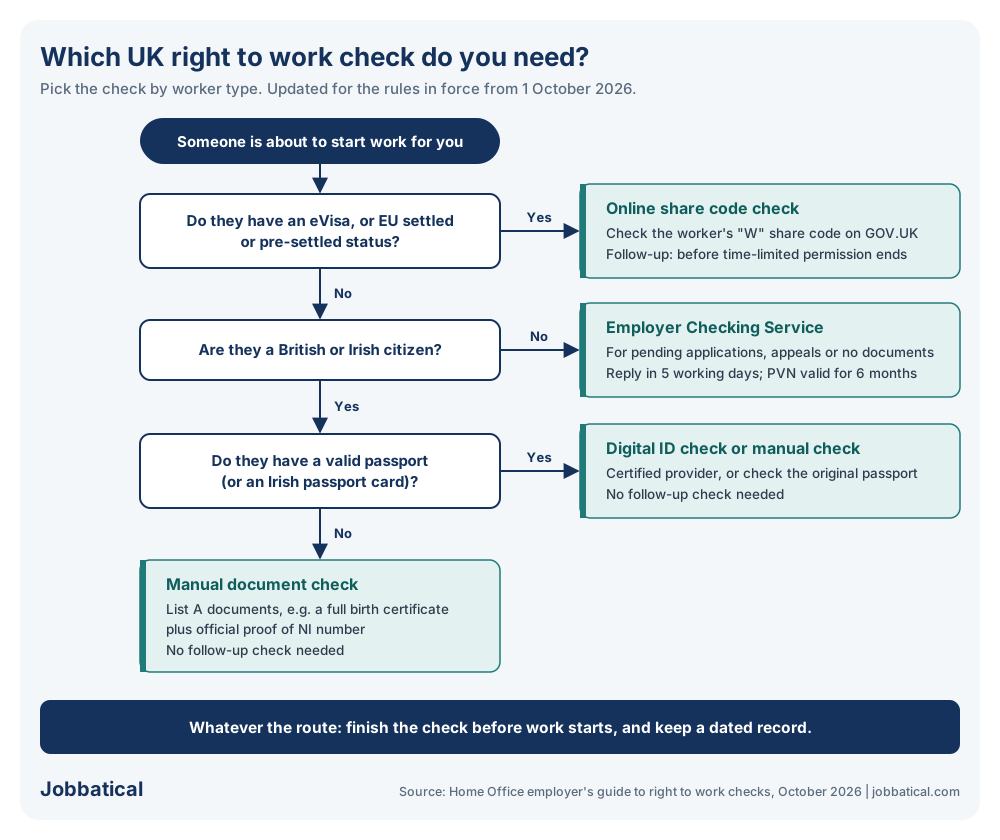
Depending on the employee's nationality and immigration status, you can complete the employer guide right to work UK requirements in three main ways.
- Manual checks: You must obtain original physical documents, such as a passport, check their validity in the presence of the holder, and retain a clear copy.
- Digital right to work check: You can use a certified right to work digital verification service provider (DVSP) to digitally verify British and Irish citizens.
- Home Office online check: You must use the official government portal alongside a share code provided by the applicant to verify their status online.
Decision Table: Which Check for Which Worker
| Worker | Check method | Follow-up |
|---|---|---|
| eVisa holder (most non-UK nationals) | Online share code check | Before permission ends, if time-limited |
| British or Irish citizen with a valid passport | Digital identity or manual check | None |
| British or Irish citizen without a passport | Manual check, e.g. full birth certificate plus official NI number proof | None |
| Pending application or appeal, or no documents | Employer Checking Service | Within 6 months of the PVN |
| EU settled or pre-settled status | Online share code check | Pre-settled: before it expires |
Online Check: When to Use It
Use it for eVisa holders. Enter the worker's "W" share code and date of birth on the GOV.UK checking service, then save the profile page as a dated PDF. For mismatches, see how to fix a share code mismatch.
Manual Document Check: When to Use It
Use it for British and Irish staff not using a digital provider. Check the original document with the person present (in person, or on live video if you hold the original), then copy and date it. Our List A and List B documents guide shows what counts.
Digital Identity Check via a Certified Provider (British & Irish Staff)
- For British and Irish citizens with a valid passport, including an Irish passport card.
- Use a provider certified for right to work checks, and confirm what it is certified to do.
- Suits remote and high-volume hiring.
When None of These Work
Use the Employer Checking Service when an application or appeal is pending. Replies come within 5 working days. See how ECS checks work.
Record-Keeping and Data Protection
What Evidence to Keep
- Online check: the profile page as a PDF.
- Manual check: a dated copy of each document.
- Digital identity check: the provider's output.
- ECS: the PVN.
How Long to Keep Right to Work Records
| Record | How long to keep it |
|---|---|
| Right to work check and PVN | Employment or engagement, plus 2 years |
| Appendix D sponsor files (CoS, contracts, payslips) | Sponsorship plus 1 year, or until a compliance officer has examined them, if sooner |
For sponsored workers both clocks run, so keep each record for its own period.
Storing Records Under UK GDPR
- Your lawful basis is legal obligation, so you don't need consent.
- Delete records when the period ends. Keeping them longer breaches data minimisation.
Sponsor files are covered in our Appendix D record-keeping guide.
Penalties for Getting It Wrong
Failing to conduct these checks properly can lead to severe consequences for your business.
- Civil fines: Employers can face right to work check penalties of up to £45,000 for each illegal worker on a first breach, rising to £60,000 for repeat breaches.
- Criminal charges: Knowingly employing someone without the right to work can result in an unlimited fine and up to five years in prison.
- Business disruption: Non-compliance can lead to the revocation of your sponsor licence, preventing you from hiring international talent in the future.
Civil Penalties per Illegal Worker
- Up to £45,000 per illegal worker for a first breach, and £60,000 for repeat breaches.
- Extended liability means another business in the supply chain can be fined if the direct employer can't be identified.
Sponsor Licence Downgrade, Suspension and Revocation
A breach can lead to a B-rating with a £1,579 action plan, suspension or revocation. Revocation blocks reapplying for at least 12 months. See what happens if your sponsor licence is revoked.
Criminal Liability for Knowingly Employing Illegal Workers
Employing someone you know, or have reasonable cause to believe, can't work carries up to 5 years in prison and an unlimited fine.
Building a Compliant Right to Work Process
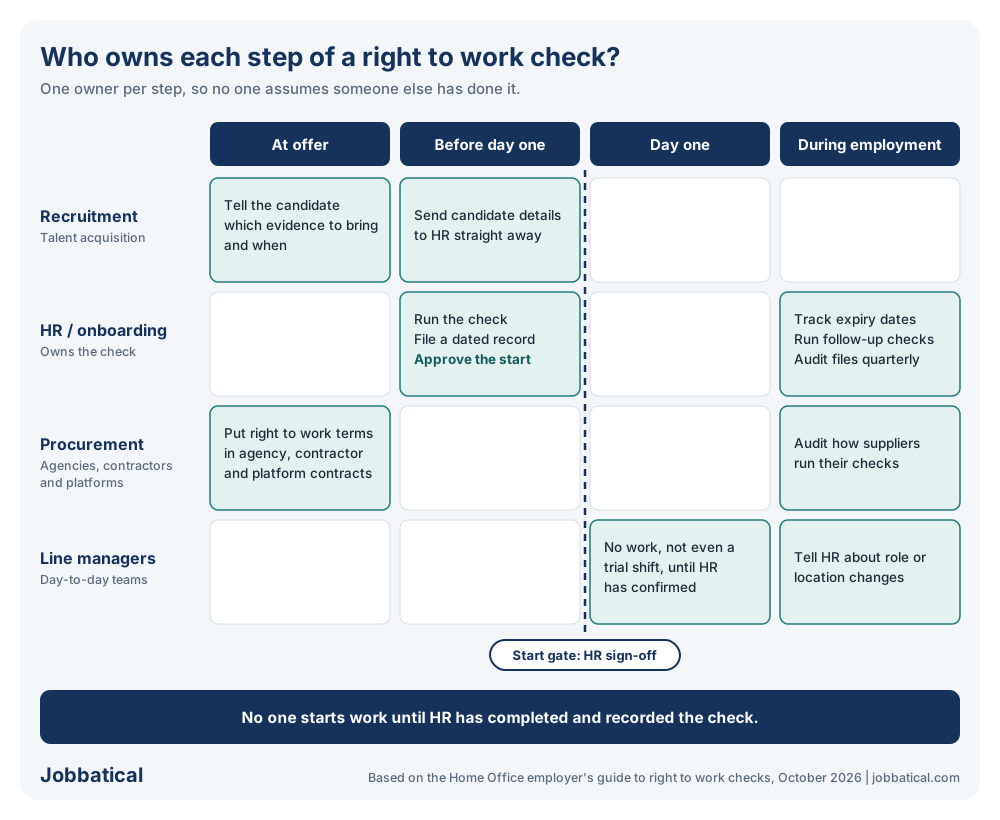
At 200+ staff, failures come from gaps between teams, not the check itself.
Assigning Ownership Across HR, Recruitment and Line Managers
- Recruitment: flags evidence needed at offer stage.
- HR: runs the check and files the record. No one starts without HR sign-off.
- Procurement: owns contractor, agency and platform terms and audits.
- Line managers: let no one work, even a trial shift, before HR confirms.
Writing a Right to Work Policy and Checklist
Cover who is in scope (including non-employees), which method fits which worker, who signs off, record storage and deletion, and what to do when a check fails.
Tracking Expiry Dates and Follow-Up Checks
- Log every time-limited permission with its end date.
- Set reminders at 90, 60 and 30 days.
Jobbatical's visa and permit renewals tracking flags expiry dates and follow-up checks automatically.
Internal Audits and Preparing for Home Office Visits
- Each quarter, sample at least 10% of files, plus every sponsored worker's file.
- Fix gaps with a fresh check and a file note.
See how to prepare for a Home Office compliance visit, or take the free compliance assessment.
Not sure your process covers contractors and agency staff? Talk to our UK immigration team about a right to work process review.
Disclaimer: Immigration rules change quite frequently; please verify with official sources or contact us for the latest info before making any decisions.
Frequently Asked Questions: Right to Work Checks in the UK