.svg)


KEY TAKEAWAYS: EU Blue Card vs ICT Permit Netherlands
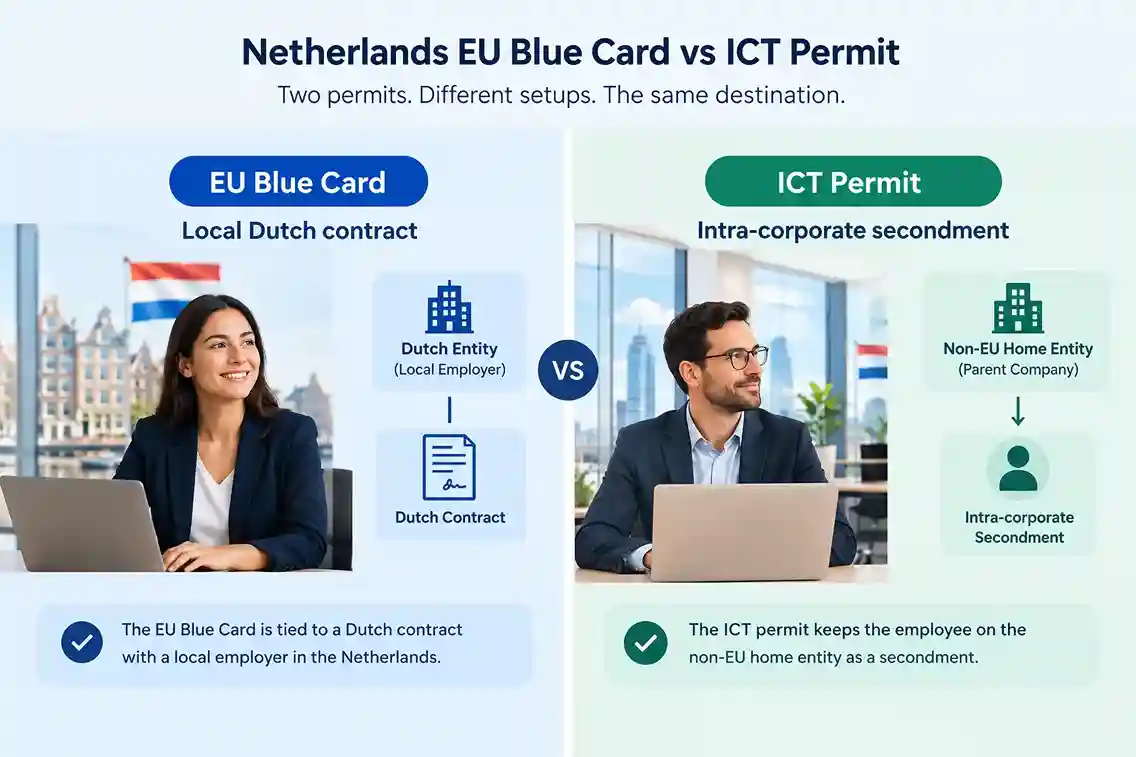
- The EU Blue Card localises a hire on a Dutch contract, while the ICT permit keeps the employee on the non-EU home entity as a secondment.
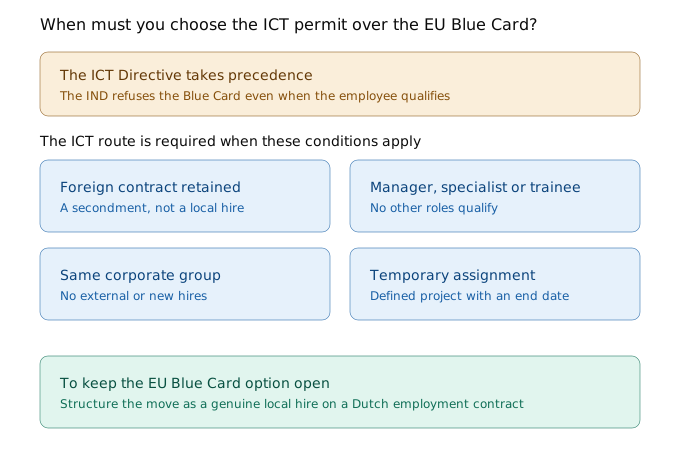
- The ICT Directive takes precedence: if the transfer fits ICT criteria, the IND refuses the Blue Card even when the employee qualifies, unless you offer a local Dutch contract.
- Both permits cost €423 at the IND in 2026 and share the €5,942 gross monthly threshold for staff aged 30 and over.
- The ICT permit caps at three years for managers and specialists, is non-renewable, and does not count toward permanent residence; the Blue Card renews and settles after 33 months.
- Choose ICT for temporary group projects and home-payroll retention; choose the Blue Card for permanent relocation, senior talent, and EU settlement.
Your specialist in the Singapore office qualifies for the EU Blue Card on paper. Salary, degree, tenure, everything checks out. Then the IND refuses that route and points you to the ICT permit instead. The two permits are not interchangeable, and the choice is often decided by law rather than preference. This guide compares the EU Blue Card and the ICT permit in the Netherlands so you select the right route before the transfer starts, not after it stalls.
How Do the EU Blue Card and ICT Permit Differ for Netherlands Employers?
Navigating immigration options in the Netherlands requires understanding that the EU Blue Card and the Intra-Corporate Transferee (ICT) permit are designed to solve fundamentally different business needs. One integrates a professional directly into your local Dutch payroll, while the other facilitates the temporary relocation of an existing employee within your global corporate structure. Grasping this core distinction is the critical first step in determining the right immigration strategy for your workforce.
- Local Hire vs. Internal Group Transfer: The EU Blue Card is designed for direct employment, treating your candidate as a new hire on a localized Dutch employment contract. Conversely, the ICT permit functions strictly as an intra-company transfer. Under the ICT route, the assigned worker remains on the payroll and employment contract of a parent or subsidiary company located outside the European Union. This structural split dictates almost every subsequent tax and administrative difference between the two routes.
- Long-Term Settlement vs. Fixed-Term Assignments: Strategic intent matters. The EU Blue Card is the ideal vehicle for talent you intend to retain long-term, offering a clear pathway to permanent residency and integration into the Netherlands. The ICT permit is explicitly temporary, engineered for defined, project-based assignments with a strict end date. Utilizing a temporary ICT permit for an employee you ultimately wish to retain permanently will create complex, avoidable administrative rework down the line.
- Broad Eligibility vs. Highly Restricted Roles: The EU Blue Card offers a relatively open pathway: any highly qualified professional can secure this permit, provided they meet specific statutory salary thresholds and possess a recognized higher education degree. The ICT permit is far more restricted. By law, it is exclusively available to managers, specialized experts, and graduate trainees who already have a proven tenure of employment within the same global corporate group.
- Distinct Legal Frameworks: It is crucial to recognize that these are not simply two interchangeable doors into the same room. The EU Blue Card is governed by EU Directive 2021/1883, while the ICT permit operates under EU Directive 2014/66/EU. Because they are rooted in separate legislative frameworks, each permit carries its own unique set of mobility rights across the EU, maximum duration caps, and spousal dependency rules.
For the full mechanics of the localised route, our Netherlands EU Blue Card employer guide sets out eligibility, thresholds, and the IND process in depth.
How Do the EU Blue Card and ICT Permit Netherlands Compare at a Glance?
Before the section by section detail, here is the side by side view HR teams ask for most. Use it as a quick screen, then confirm the finer points below.
EU Blue Card vs ICT Permit Netherlands: 2026 Comparison Table
- The filing fees are identical: Both permits cost €423 at the IND in 2026, so the government fee is never the deciding factor. Real cost differences sit in translations, diploma evaluation, and payroll setup, covered further down.
- The salary floors nearly match: For staff aged 30 and over, both routes require €5,942 gross per month. The gap only appears for younger talent, where the ICT under-30 rate and the Blue Card graduate rate differ.
- Duration is the sharpest divide: The Blue Card renews and builds toward settlement. The ICT permit stops at three years for managers and specialists with no renewal, which forces a switch or an exit.
- Structure decides, not price: The choice turns on contract type, role, and how long you want the person in the Netherlands, not on the headline fee.
If you are also weighing the Highly Skilled Migrant route, our Netherlands work permit vs EU Blue Card comparison maps all three options side by side.
Does the EU Blue Card or ICT Permit Netherlands Need a Local Dutch Contract or a Secondment?
The fundamental mechanical difference between these two immigration routes lies in their employment structures. This choice is not merely an administrative detail; it dictates which permit is legally applicable to your candidate. Ultimately, the EU Blue Card fully localizes the employee, whereas the ICT permit keeps their primary employment anchored to the foreign home entity.
- The EU Blue Card requires a localized Dutch contract: Under this framework, your Netherlands-based entity becomes the sole legal employer. The employee must sever their direct employment relationship with the foreign company and transition entirely onto a local Dutch payroll. This complete localization establishes the Blue Card as a long-term settlement pathway rather than a temporary international posting.
- The ICT permit is structured as a temporary secondment: Unlike a local hire, an ICT assignee maintains their original employment contract with the non-EU sending company. They are officially seconded to the Dutch entity for a strictly defined period. Because the core employment relationship remains abroad, this structure perfectly aligns with the legislative intent of the ICT Directive.
- Payroll and tax obligations differ significantly: Localizing a hire via the EU Blue Card triggers immediate integration into the Dutch system, requiring local payroll processing, standard wage taxes, and mandatory social security contributions from day one. Conversely, an ICT secondment frequently allows the employee to remain on their home-country payroll and retain their existing pension scheme, which is highly advantageous for companies seeking to protect an assigned employee's vested benefits during a relocation.
- The 30% tax facility remains available for both: A critical shared benefit is that qualifying inbound expatriates on either permit may be eligible for the Dutch 30% ruling. This tax advantage allows employers to pay up to 30% of the employee's gross salary tax-free. By boosting net take-home pay, this facility ensures your compensation packages remain globally competitive, regardless of the permit structure selected.
- Contract architecture dictates the immigration route: The type of contract you offer will force your hand regarding the permit type. Issuing a standard local Dutch employment contract immediately directs you toward the EU Blue Card. Electing to keep the employee legally bound to the foreign entity triggers the mandatory application of the ICT Directive. The employment contract is not a minor HR formality; it acts as the definitive trigger for your legal immigration strategy.
To model take-home pay under either route, our Netherlands 30% ruling support service covers qualifying highly skilled migrants.
How Do Document Requirements Compare for the EU Blue Card and ICT Permit Netherlands?
While both permit applications require extensive documentation, they serve fundamentally different evidentiary purposes. The EU Blue Card focuses primarily on verifying the individual candidate's academic and professional qualifications, whereas the ICT permit focuses on validating the structural corporate relationship between the sending and receiving entities.
- The EU Blue Card requires rigorous qualification verification: To qualify, the candidate must possess a recognized higher education degree. If earned abroad, the degree must undergo a formal credential evaluation by Nuffic to establish Dutch equivalency. Because this evaluation adds necessary lead time and incurs administrative costs ranging from roughly €130 to €250, it should be initiated during the week the offer letter is signed to prevent processing bottlenecks.
- The ICT permit demands concrete proof of corporate affiliation: You must conclusively demonstrate that the foreign sending company and the receiving Dutch entity belong to the same parent corporate group. This requires submitting official organization charts, certificates of incorporation, and commercial register extracts. Incomplete or ambiguous proof of this corporate link is the single most common cause of processing delays with the Dutch Immigration and Naturalisation Service (IND).
- Prior tenure obligations apply exclusively to the ICT route: To qualify for an ICT transfer, the employee must prove a continuous period of prior employment with the foreign sending entity typically between three to twelve months immediately preceding the relocation. Conversely, the EU Blue Card carries no prior-tenure requirement, allowing you to hire qualified candidates directly from the external talent market.
- Both routes require certified translation and legalisation: Any foreign civil status documents (such as birth or marriage certificates) or corporate filings must be accompanied by certified translations into either Dutch or English. Furthermore, depending on the issuing country, documents usually require an Apostille or consular legalisation, introducing variable per-case costs and administrative lead times that should be factored into your overall onboarding schedule.
Our Netherlands ICT permit employer guide lists the full corporate-group document checklist the IND expects.
When Must Netherlands Employers Choose the ICT Permit Over the EU Blue Card?
If an international transfer technically aligns with the parameters of the European Intra-Corporate Transferee (ICT) Directive, the Dutch Immigration and Naturalisation Service (IND) strictly mandates the use of that specific route. This legal precedence applies even if your employee comfortably meets every salary and educational threshold required for an EU Blue Card.
- The Strict ICT Directive Precedence Rule: When a non-EU employee remains on the payroll of a foreign group company and is temporarily assigned to your Dutch entity, the application automatically falls under the jurisdiction of the ICT Directive. Under Dutch immigration policy, when a case meets these specific ICT criteria, the IND will categorically refuse to issue an EU Blue Card or a Highly Skilled Migrant permit regardless of how highly compensated or qualified the candidate may be.
- Strategic Structuring for EU Blue Card Eligibility: If obtaining an EU Blue Card is critical for your long-term retention or settlement strategy, you must fundamentally restructure the relocation. The move must be designed from the ground up as a genuine local hire, complete with a direct Dutch employment contract, thereby purposefully breaking the ICT criteria. This must be a deliberate, structural design choice executed before submitting any applications; it cannot be retroactively applied as a quick fix if an application hits a roadblock.
- Rigid Role Restrictions on the ICT Route: The ICT permit is bound by strict functional limitations. It is exclusively available to three defined categories of employees: corporate managers, highly specialized experts, and graduate trainees on established rotational programs. If your transferee’s job description does not clearly align with one of these specific designations, the ICT route is legally closed. In such cases, you must localize the contract and utilize the EU Blue Card or an alternative national permit.
- Corporate Group Membership is Non-Negotiable: The ICT permit is designed strictly to facilitate internal corporate mobility. Consequently, only employees actively moving between entities within the same verified corporate group are eligible. A newly sourced external hire, or a candidate transitioning from an entirely unrelated foreign enterprise, is immediately disqualified from the ICT permit, irrespective of their executive seniority, specialized skills, or proposed salary package.
- The Nuanced Impact of Recognised Sponsor Status: Holding 'Recognised Sponsor' status with the IND accelerates processing for both permits, but in entirely different ways. For the ICT route, this trusted status is the primary engine for speed, often reducing IND decision times to approximately two weeks. Conversely, the EU Blue Card does not legally require the employer to be a Recognised Sponsor to file an application. While a standard Blue Card application from an unrecognised employer might take up to the statutory 90-day maximum, holding Recognised Sponsor status can significantly compress that timeline toward the faster end of the spectrum.
Recognised sponsorship changes your timeline on both routes; see what it involves in our Netherlands recognised sponsorship service.
How Do Salary Thresholds and Costs Compare for the EU Blue Card vs ICT Permit Netherlands?
At first glance, the financial investments required for the EU Blue Card and the Intra-Corporate Transferee (ICT) permit appear virtually identical a reality that often surprises HR and global mobility teams. However, the most meaningful cost differentials are not found in the statutory filing fees paid to the Dutch Immigration and Naturalisation Service (IND). Instead, the true financial impact hides within the supporting administrative workflows and structural setups required for each route.
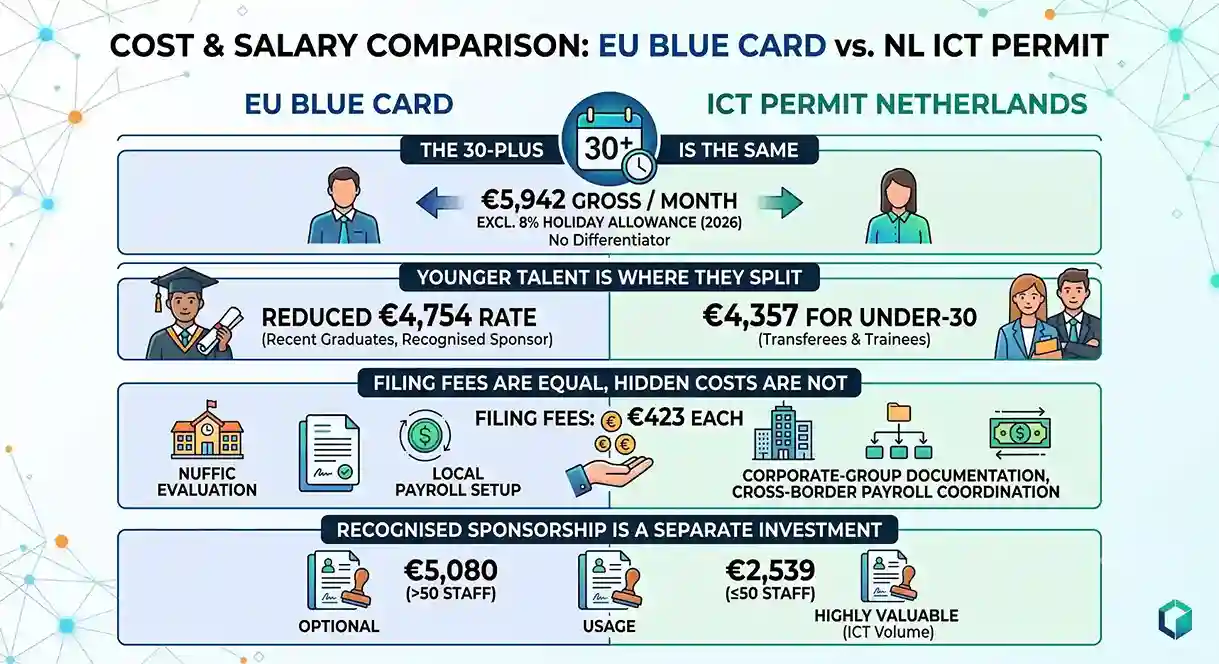
- Identical Thresholds for Senior Talent (30+): For established professionals aged 30 and older, both the EU Blue Card and the ICT permit mandate an identical minimum gross monthly salary of €5,942 in 2026, explicitly excluding the mandatory 8% Dutch holiday allowance. Because this baseline compensation requirement is exactly the same at this seniority band, statutory salary levels will not dictate which permit is more cost-effective for your senior hires.
- Divergent Thresholds for Younger Professionals: The salary requirements split significantly when recruiting early-career talent. The EU Blue Card provides a reduced salary threshold of €4,754 per month specifically for recent graduates, though this concession is generally tied to the employer holding Recognised Sponsor status. Conversely, the ICT permit leverages the age-based criteria of the Highly Skilled Migrant scheme, setting a lower threshold of €4,357 for transferees and rotational graduate trainees under the age of 30.
- Equal Filing Fees vs. Hidden Administrative Costs: The standard IND application processing fee is leveled at exactly €423 per applicant for both immigration routes. The actual financial divergence emerges in the hidden procedural overhead. Securing an EU Blue Card requires funding a Nuffic degree evaluation and executing an immediate local Dutch payroll setup. In stark contrast, the ICT permit demands the compilation of extensive corporate-group legal documentation and necessitates the ongoing administrative complexity and associated advisory fees of coordinating cross-border shadow payrolls.
- The Strategic Investment of Recognised Sponsorship: Acquiring 'Recognised Sponsor' status requires a separate, upfront governmental investment of €5,080, which is reduced to €2,539 for small enterprises with 50 or fewer employees. While holding this trusted status is technically optional for filing a standard EU Blue Card application, it is a highly strategic, and often indispensable, investment if your organization intends to process a steady volume of ICT transfers, as it unlocks dramatically faster IND decision timelines.
For the full pay picture across Dutch routes, our 2026 Netherlands highly skilled migrant salary thresholds guide breaks down the current levels.
How Do Duration, EU Mobility, and Settlement Rights Compare for the EU Blue Card and ICT Permit Netherlands?
If retention is the goal, this section decides the route. The permits diverge most on how long the employee can stay and whether that time counts toward permanent residence.
- The ICT permit has a hard cap: Managers and specialists get up to three years, trainees up to one, with no renewal beyond those limits. Reaching the cap means a switch to another permit or the employee leaves the Netherlands.
- The Blue Card renews and settles: The Blue Card is renewable and leads toward EU Long-Term Resident status. It is the route for talent you intend to keep for the long run.
- Settlement time counts only on the Blue Card: Blue Card residence builds toward permanent residency, reachable after 33 months, or 21 months with sufficient Dutch language skills. ICT time does not count toward settlement, which is the single biggest limitation of that route.
- EU mobility works differently on each: A Blue Card holder can move to another EU country after 12 months under a simplified procedure. An ICT holder can work short-term in group branches elsewhere in the EU for up to 90 days in any 180-day period.
- The cooling-off catch on ICT: After the maximum ICT period, a further transfer usually requires a cooling-off gap. The Blue Card carries no such pause, which is why permanent relocations lean toward it.
When an ICT cap approaches, plan the switch early with our Netherlands ICT permit expiry guide.
How Should Netherlands Employers Choose Between the EU Blue Card and ICT Permit?
Selecting the correct immigration route ultimately hinges on answering four strategic questions regarding your corporate intent, employment structure, and long-term timeline. These critical decisions must be finalized before an offer letter is issued, as the specific contract architecture you choose will legally lock you into the corresponding permit.
Here is how to evaluate the four determining factors to select the most effective route:
- Assess the Intended Length of Stay: The nature of the role dictates the permit. For a strictly defined, project-based assignment with a clear expiration date, the ICT permit is practically built for the task. Conversely, if you are bringing on an open-ended hire whom you intend to retain indefinitely, the EU Blue Card provides a vastly stronger and more stable foundation for long-term employment.
- Evaluate the Importance of Permanent Settlement: If the incoming employee desires a clear, uninterrupted pathway to permanent EU residence or naturalization, only the EU Blue Card can deliver it. Time spent on an ICT permit is a statutory dead end for settlement purposes; it does not accrue toward permanent residency requirements. Therefore, senior executive hires who are eyeing a long-term future in the Netherlands should always be localized on a Dutch contract.
- Determine the Optimal Payroll and Benefits Strategy: If keeping an employee seamlessly integrated into their home-country payroll, pension, and existing benefits structure is a non-negotiable term of their relocation, the ICT secondment framework legally protects that arrangement. However, if migrating the employee onto a clean, fully compliant Dutch local payroll is acceptable to both parties, the EU Blue Card significantly reduces long-term cross-border administrative complexities.
- Verify the Role Classification and Corporate Group Link: The ICT route is legally walled off. It mandates that the candidate must be a corporate manager, a highly specialized expert, or a graduate trainee moving explicitly within the same verified international corporate group. If the candidate misses even one of these rigid legal conditions, the ICT route is invalidated, and the EU Blue Card or an alternative national permit automatically becomes your default path.
Not sure which route your transfer fits? Talk to our immigration team and we will map the right Netherlands permit before you file
Disclaimer: Immigration rules change quite frequently; please verify with official sources or contact us for the latest info before making any decisions.
Frequently Asked Questions - EU Blue Card vs ICT Permit Netherlands

.svg)
.svg)