

KEY TAKEAWAYS: Netherlands Foreign Worker Compliance
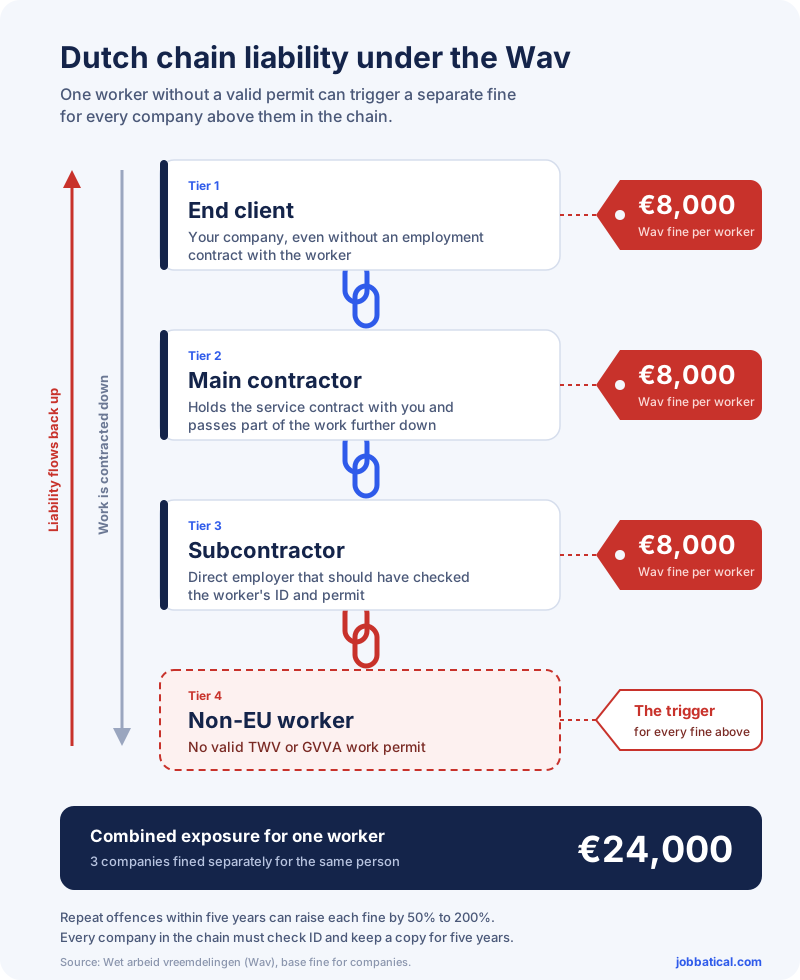
- Under the Wav, every company in the chain counts as an employer, and each can be fined €8,000 per worker who lacks a valid TWV or GVVA.
- Your company can also be jointly liable for a subcontractor's unpaid wages under the WAS and for unpaid payroll taxes under the Collection of State Taxes Act.
- Every employer in the chain must check an original identity document before work starts and keep a copy for five years after the work ends.
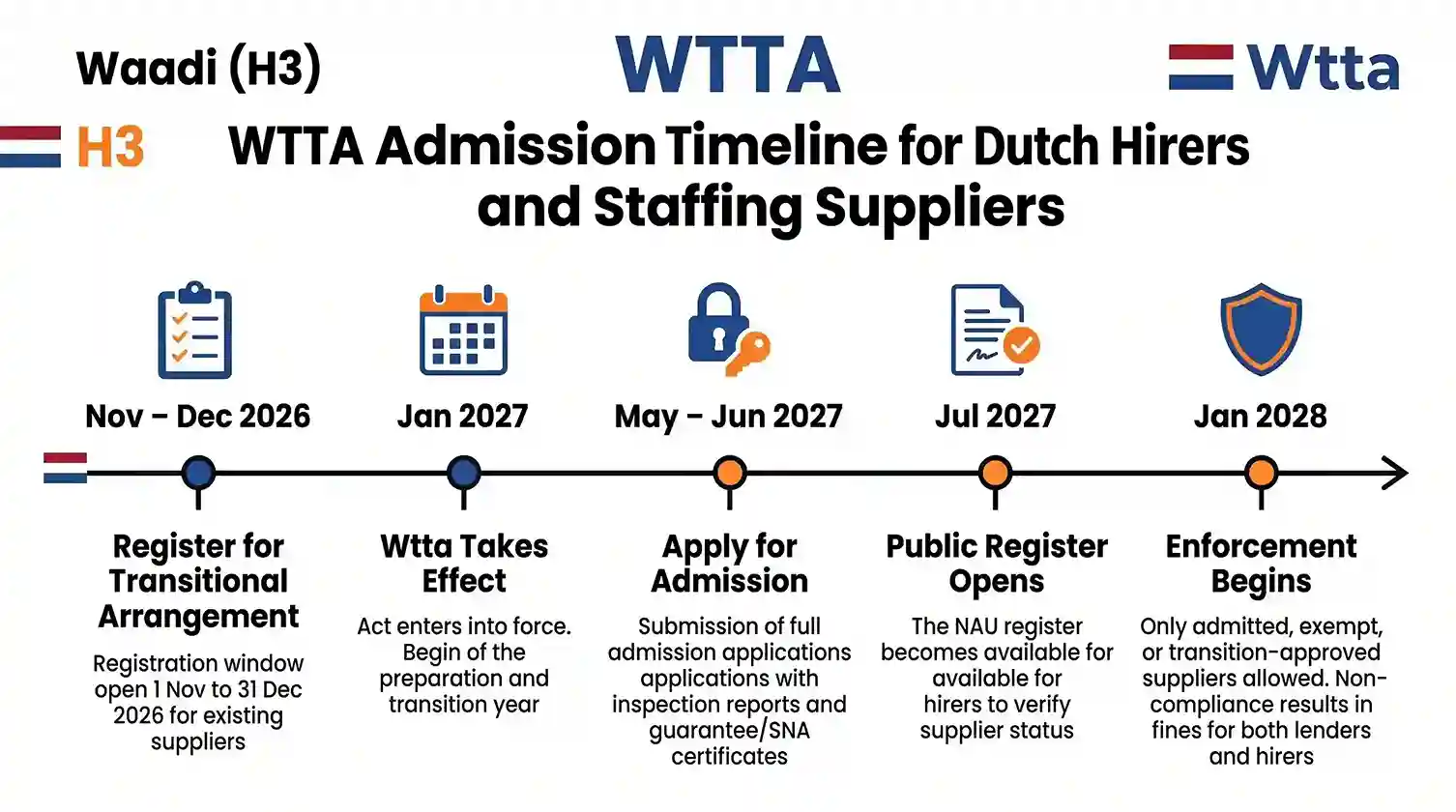
- The Wtta takes effect on 1 January 2027, and from 1 January 2028 hirers can be fined for using staffing suppliers without official admission.
- Written subcontracting approval, audit rights and central records reduce your fines, while indemnities only help you recover costs afterwards.
Netherlands foreign worker compliance does not stop at your own payroll, because the Dutch Foreign Nationals Employment Act (Wav) treats every business that benefits from the work as an employer.
This guide explains who is legally responsible, what it costs when the chain fails, and how your HR and procurement teams can close the gaps.
Who Is Legally Responsible for Foreign Workers Under Dutch Chain Liability (Ketenaansprakelijkheid)?
Dutch law spreads responsibility across the whole supply chain rather than placing it only on the company that signs the employment contract. Ketenaansprakelijkheid, or chain liability, means that clients, main contractors, subcontractors and hirers can each be held accountable for the same foreign worker.
What Responsibility Does the Principal Employer Carry Under the Foreign Nationals Employment Act (Wav)?
- Broad employer definition: The Wav defines an employer as anyone who has work performed in the course of a business or profession. Your company can therefore be an employer under the Wav even when it has no employment contract with the foreign worker.
- Permit verification duty: Every employer in the chain must confirm that a non-EU worker holds a valid TWV or GVVA, or is exempt from the permit requirement. A contractor's verbal assurance does not satisfy this duty.
- Identity check before day one: Each employer must check an original identity document before work starts and keep a copy in its own records. The Wav requires you to retain that copy for five years after the work ends.
- Separate fines for each party: The Netherlands Labour Authority (Nederlandse Arbeidsinspectie) can report every employer in the chain for the same worker. One unauthorised worker can therefore lead to several fines across different companies.
When Does a Client Become the Legal Employer and Assume Compliance Risk?
- Direction and supervision: A client that directs and supervises the daily work of contractor staff is treated as an employer under the Wav. In practice, labour inspectors look at who assigns tasks, sets working hours and approves leave.
- Work on your premises: Work carried out at your location, with your equipment or under your site rules, strongly signals that your company is a factual employer. Your duty to control applies even when your contractor runs the payroll.
- Integration into your organisation: Contractor staff who use your email accounts, attend your team meetings or appear in your organisation charts look like your own employees. This integration weakens any argument that your company only purchased a service.
- Contract labels are not decisive: Calling an arrangement a service agreement does not change how the authorities assess it. The Labour Authority examines how the work is actually performed, not what the contract says.
How Does Liability Flow Through Multiple Subcontracting Levels?
- Every link counts: Wav liability attaches to each company in the chain, from the end client to the lowest-tier subcontractor. A violation at the fourth tier can still lead to a fine at the first tier.
- Wage claims move up the chain: Under the WAS, an underpaid worker can claim wages from the direct employer and then from the client or contractor above it. Each party can only escape this chain liability for wages by showing it took reasonable steps to prevent underpayment.
- Payroll tax liability travels too: The Dutch Tax Administration can hold a main contractor or hirer liable for wage tax and social security premiums that a subcontractor failed to pay. The chain liability rules for payroll taxes cover both subcontracted work and hired staff.
- Visibility shrinks with each tier: The further down the chain a worker sits, the less information your company usually holds about that person. This gap is exactly where inspectors find most unauthorised employment.
For the full WagwEU filing and client verification process, our guide to Netherlands posted worker compliance requirements sets out every deadline, document and fine that applies to foreign service providers and their Dutch clients.
What Does Illegal Employment and Wav Non-Compliance Cost Your Company?
The Wav fine is only the most visible cost of a compliance failure. Your company can also face wage claims, payroll tax assessments and, for repeat offences, a temporary stop on work.
How Do Wav Fines of €8,000 Per Worker Apply Across the Chain?
- Standard fine amount: The base fine is €8,000 per illegally employed worker for a company and €4,000 for a private individual. Because the fine applies per worker, ten unauthorised workers can cost a single employer €80,000.
- Fines multiply across companies: The authorities can impose the full fine on each employer in the chain. A Dutch freelance platform was recently fined €66,000 for Wav violations, while nine companies that used its workers received fines totalling €80,500.
- Repeat offences raise the penalty: A further violation within five years can increase the fine by 50%, 100% or even 200%. Repeat offenders also risk an order to temporarily stop work at the affected business.
- Warnings for small first violations: For a first violation involving no more than five foreign nationals, the authorities may issue a written warning instead of a fine in certain cases. You should not plan around this outcome, because the warning is discretionary.
What Is Your Exposure to Unpaid Wages, Payroll Taxes and Social Security?
- Wage chain liability: Under the WAS, your company can be jointly liable for wages that a subcontractor or agency failed to pay, including the statutory minimum wage. From 1 July 2026, the minimum wage for workers aged 21 and over is €14.99 gross per hour.
- Collective agreement wages: Where a generally binding collective labour agreement (CAO) applies, the wage claim can include the higher CAO wage scales. Back pay claims can therefore exceed the statutory minimum by a wide margin.
- Payroll tax and premium assessments: The Dutch Tax Administration can recover unpaid wage tax and social security premiums from the main contractor or the hirer. These assessments can cover the full duration of the contract, not only the period that was inspected.
- G-account protection: Paying the wage tax portion of each invoice into the supplier's blocked G-account (geblokkeerde rekening) can limit your tax liability. Your company still needs records that show the payments match the work performed.
How Do Intent and Negligence Affect Corporate Liability?
- Culpability shapes the fine: When setting a fine, the authorities must distinguish between intent, gross negligence, normal culpability and reduced culpability. In one reported case, a fine fell from €36,000 to €18,000 because the company showed reduced culpability.
- Documented checks reduce the fine: Companies that can prove they checked identities, permits and contractor credentials have a stronger case for a lower penalty. Without that paper trail, the authorities will assume normal culpability at best.
- Ignorance is not a defence: A company that let a foreign national work without a permit for a single day out of ignorance can still receive the full €8,000 fine. The Wav does not require intent for a violation to exist.
- Wage liability has its own exit: Under the WAS, a client can avoid wage liability by proving it cannot be blamed for the underpayment. Certified suppliers and written compliance checks are the usual way to build that proof.
Penalties often surface during inspections, and our breakdown of Netherlands immigration sponsor compliance audits explains the triggers, sanctions and record-keeping steps that keep your company ready for a visit from the authorities.
Which Business Arrangements Create the Highest Immigration Compliance Risks?
Not every outsourcing model carries the same level of risk. The danger grows when your company loses sight of who is doing the work and who employs them. Three arrangements account for most chain liability problems in the Netherlands.
Why Does Hiring Through Multiple Layers of Contractors and Subcontractors Increase Risk?
- Unapproved subcontracting: Main contractors often outsource work without notifying you, leaving your company liable for undocumented workers you never knew were on site.
- Price pressure lower in the chain: Shrinking margins at lower tiers heavily incentivize wage cuts and skipped permit applications. Always scrutinize unusually low quotes before signing.
- Fragmented records: If ID copies and work permits are held by lower-tier subcontractors and your company cannot produce them during an inspection, authorities will treat those records as missing.
- Sectors under active inspection: Construction, logistics, agriculture, cleaning, and hospitality face intense scrutiny due to their long subcontracting chains. Expect frequent inspections if you operate in these industries.
What Risks Come With Staffing Agencies (Waadi Compliance) and Labour Brokers?
- Waadi registration duty: Under the Waadi, every labour supplier must be registered in the Dutch Trade Register. Hiring from an unregistered supplier guarantees fines for your company.
- Wtta admission from 2027: Taking effect on 1 January 2027, the Wtta requires all staffing agencies, payroll companies, and secondment firms to hold official admission. Hirers must exclusively use admitted suppliers or those approved under the transitional scheme.
- The registration window is open now: Suppliers entering the transitional scheme must register between 1 November 2026 and 1 January 2027. Full enforcement against hirers and suppliers begins 1 January 2028, but you must audit your supply chain immediately to avoid disruption.
- Foreign agencies are included: The Wtta strictly applies to foreign companies supplying workers in the Netherlands. Using an unadmitted foreign agency carries the exact same hirer fines as using an unadmitted Dutch entity.
- Brokers in the middle: If a broker sources workers from an agency for you, every single supplier in that chain needs valid Wtta admission. Your due diligence must cover every link, not just the company sending you the final invoice.
What Are the Risks of Engaging Self-Employed Foreign Professionals (ZZP'ers)?
- Permit status still matters: A non-EU freelancer is only outside the Wav if their residence permit allows self-employment or they work purely on their own account. A residence permit that does not allow independent work leaves your company exposed to a fine.
- False self-employment: If you direct a freelancer's work in the same way as an employee's, the authorities can treat the arrangement as employment. Dutch enforcement against false self-employment resumed in 2025.
- Platform arrangements: Freelance platforms do not shift Wav liability away from the companies that use the workers. The €80,500 in fines imposed on nine companies that used one platform shows how this plays out in practice.
- Payroll tax reclassification: A reclassified freelancer can trigger retroactive wage tax and social security premiums for your company. These amounts often exceed the Wav fine itself.
For foreign specialists sent to the Netherlands on brief projects, our guide to short-term international work assignments in the Netherlands maps each scenario to the correct permit, notification and A1 certificate requirements.
What Are Your Legal Obligations When Using Third-Party Foreign Labour in the Netherlands?
Outsourcing the work does not outsource the legal duties attached to it. Your company still needs to verify permits, assess the true nature of each contract and confirm that workers receive Dutch minimum terms. These three checks form the core of Netherlands contractor compliance.
How Should You Validate TWV and GVVA Work Permits Across the Supply Chain?
- Know which permit applies: The UWV issues TWVs for work up to 90 days, while the IND issues GVVA single permits for longer stays. Each permit strictly ties to a specific employer and job type.
- Check the employer named on the permit: A permit issued to a different company does not authorise work for your contractor. Always verify that the named employer matches the exact entity deploying the worker.
- Confirm EU posting exemptions: Non-EU nationals legally employed in another EU state and posted for a genuine service may be exempt from TWV requirements, provided they hold a posted worker notification and a valid A1 certificate.
- Track expiry dates: Expired permits make continued work immediately illegal. Proactively demand renewal evidence from contractors well before the expiry date hits.
How Do You Distinguish a Genuine Service Contract From Labour Supply?
- Who gives the instructions: In a genuine service contract (aanneming van werk), the contractor directs its own staff to deliver a set result. If your managers issue daily instructions, authorities will classify it as labour supply.
- Who carries the risk: True contractors bear the commercial risk and bill per deliverable. Billing per hour without a defined output strongly indicates labour supply.
- Who owns the tools: Independent service providers bring their own equipment and methods. Workers relying exclusively on your tools and site processes are viewed as hired staff.
- Why the label matters: Labour supply triggers Waadi registration, upcoming 2027 Wtta admission rules, and hirer liability for payroll taxes. Misclassification exposes your business to all three risks simultaneously.
How Do You Ensure Compliance With Collective Labour Agreements (CAO) and Minimum Wage Standards?
- Statutory minimum wage: All workers in the Netherlands, including posted and agency staff, must earn the statutory minimum wage. From 1 July 2026, this sits at €14.99 gross per hour for workers 21 and over, indexed every January and July.
- Generally binding CAOs: If a sector CAO is generally binding, its specific wage scales and core terms apply directly to foreign workers. Agency staff typically fall under a staffing sector CAO.
- Posted workers after 12 months: Posted workers are entitled to core Dutch employment terms from day one. After 12 months on the ground, almost all standard Dutch terms and conditions apply.
- Ask for payslips, not promises: Routinely request anonymised payslips and timesheets from contractors on a sample basis. These records are your absolute strongest defence if a supply chain wage claim reaches your company.
For the UWV filing route, eligibility checks and processing times, our guide to Netherlands TWV work permit requirements walks your team through each step of a compliant short-term permit application.
How Should HR and Procurement Run Contractor Compliance Due Diligence?
Most chain liability cases start with a supplier that nobody checked properly. A clear due diligence routine, owned jointly by HR and procurement, turns a legal risk into a manageable process. The reality is that a single check at onboarding is not enough, so repeat these steps at every contract renewal.
How Do You Vet a Contractor's Legal Structure and Financial Standing?
- Trade Register extract: Request a recent Chamber of Commerce (KVK) extract to confirm the company's registered activities match your project. Labour suppliers must explicitly show registration for supplying workers.
- Certification and admission: Verify the supplier holds SNA certification (NEN 4400-1) in the public register. Note that by 2027, Wtta admission becomes the mandatory legal credential for any staffing provider.
- Tax compliance statement: Demand a recent payment behaviour statement (verklaring betalingsgedrag) from the Dutch Tax Administration to prove the supplier is up to date on wage taxes and premiums.
- Financial red flags: Treat rock-bottom rates, frequent legal entity changes, and short trading histories as high-risk markers. Escalate these internally before signing any contracts.
How Do You Set Up Identity Verification and Audit Trail Protocols?
- Site access controls: Mandate physical checks of original ID documents before granting site access. Link entry badges directly to verified individual identities, not just the contractor's company name.
- Central document register: Store ID copies, work permits, and A1 certificates in a secure, company-controlled system. Under the Wav, relying on a contractor's file is legally insufficient; you must maintain your own records.
- Five-year retention: The Wav requires you to securely retain ID copies for at least five years after the work concludes, ensuring you also meet GDPR standards for sensitive data.
- Regular spot checks: Conduct quarterly physical audits comparing on-site workers against your central records. Mismatches are the fastest way to uncover unapproved subcontracting before an inspector does.
How Do You Enforce Contractual Indemnities and Liability Clauses?
- Consent for subcontracting: Require strict written approval before a contractor outsources any work. Make unauthorized subcontracting immediate grounds for contract termination.
- Document delivery obligations: Contractually obligate suppliers to provide IDs, permits, and posting notifications before any worker begins, backed by strict deadlines and financial penalties for delays.
- Indemnity clauses: Use indemnities to recover Wav fines or wage claims from the at-fault contractor. Remember that indemnities are financial recovery tools; they do not shield your company from receiving the initial government fine.
- Audit rights: Reserve the right to inspect a contractor's payroll records, timesheets, and permits on short notice—and actively exercise this right at least once per contract year.
When due diligence shows that a contractor's worker should move onto your own payroll, our guide to changing employers in the Netherlands explains the IND notification, salary threshold and sponsor transfer steps involved.
Should You Use an EOR, Become an IND Recognised Sponsor or Outsource Your Dutch Workforce?
The way you structure your Dutch workforce decides how much chain liability your company carries. Each model places the legal employer role with a different party, and each comes with its own compliance duties.
How Do EOR, Recognised Sponsorship and Outsourcing Compare on Chain Liability?
How Do You Align Your Workforce Model to Minimise Chain Liability?
- Match the model to the role: Long-term and strategic roles belong on your own payroll or with an EOR, where permits and pay stay visible to you. Contractors make sense for defined projects with a clear result.
- Keep sponsorship close to control: If your managers direct the work, the safest model is one where your company or your EOR acts as the sponsor. This removes the gap between the party that controls the work and the party that holds the permit.
- Check your EOR's credentials: An EOR that places workers with your company acts as a labour supplier, so it needs Waadi registration now and Wtta admission from 2027. Ask for proof of its IND recognised sponsor status as well.
- Plan the transition early: Many companies start with an EOR and move workers onto their own entity once they gain recognised sponsor status. That move requires a change of employer notification to the IND and a fresh salary threshold check.
For a side-by-side view of costs, timelines and control, our comparison of EOR vs recognised sponsor in the Netherlands helps you choose the right route for each non-EU hire.
How Can Jobbatical Help You Prevent Chain Liability in the Netherlands?
Chain liability is fundamentally a visibility problem before it becomes a legal one. Jobbatical equips your HR team with a centralized overview of every foreign worker, permit, and notification tied to your Dutch operations.
How Does Jobbatical Centralise Immigration Visibility Across Your Supply Chain?
- One record per worker: Consolidate IDs, permits, A1 certificates, and notifications into a single platform, allowing your team to produce a complete file instantly during a Labour Authority inspection.
- Expiry alerts: Track work permit and residence card expiration dates with automated alerts, preventing the most common cause of accidental illegal employment.
- Posted worker filings: We handle WagwEU notifications for foreign employers and complete the Dutch client's verification step, ensuring full compliance before the worker's first day.
- Recognised sponsor support: Secure and maintain IND recognised sponsor status—including mandatory record-keeping and notifications—so you can safely transition key contractor staff directly onto your payroll.
How Do Risk-Based Compliance Audits Protect Your International Workforce?
- Supplier risk review: Our experts audit your contractor and staffing agency networks against Wav, WAS, Waadi, and Wtta regulations, actively flagging high-risk suppliers for immediate action.
- Contract structure review: We evaluate whether your arrangements classify as genuine service contracts or labour supply, clarifying your exact registration, admission, and payroll tax obligations.
- Mock inspections: We pressure-test your documentation exactly as the Labour Authority and IND would, allowing you to close administrative gaps before a real inspection occurs.
- Wtta readiness: With the Wtta entering into force on 1 January 2027, we verify which of your staffing suppliers have registered for admission, giving you a full year to phase out non-compliant partners before strict enforcement begins in 2028.
Netherlands foreign worker compliance now depends as much on your suppliers as on your own HR processes. Review your contractor and agency list before the Wtta takes effect on 1 January 2027, and book a demo to see how Jobbatical brings every foreign worker in your chain into one view.
To sponsor key hires directly, explore our Netherlands IND recognised sponsorship services, and when foreign suppliers post staff to your sites, our managed Netherlands posted worker notification service handles every WagwEU filing and client verification.
Disclaimer: Immigration rules change quite frequently; please verify with official sources or contact us for the latest info before making any decisions.
Frequently Asked Questions: Netherlands Contractor and Subcontractor Liability