.svg)



KEY TAKEAWAYS: Posting Workers to Spain
- File the Comunicación de Desplazamiento with the regional labour authority before the first working day; filing late is a serious infringement.
- The A1 certificate and the posting declaration answer to different authorities, so a valid A1 will not protect you from a declaration fine.
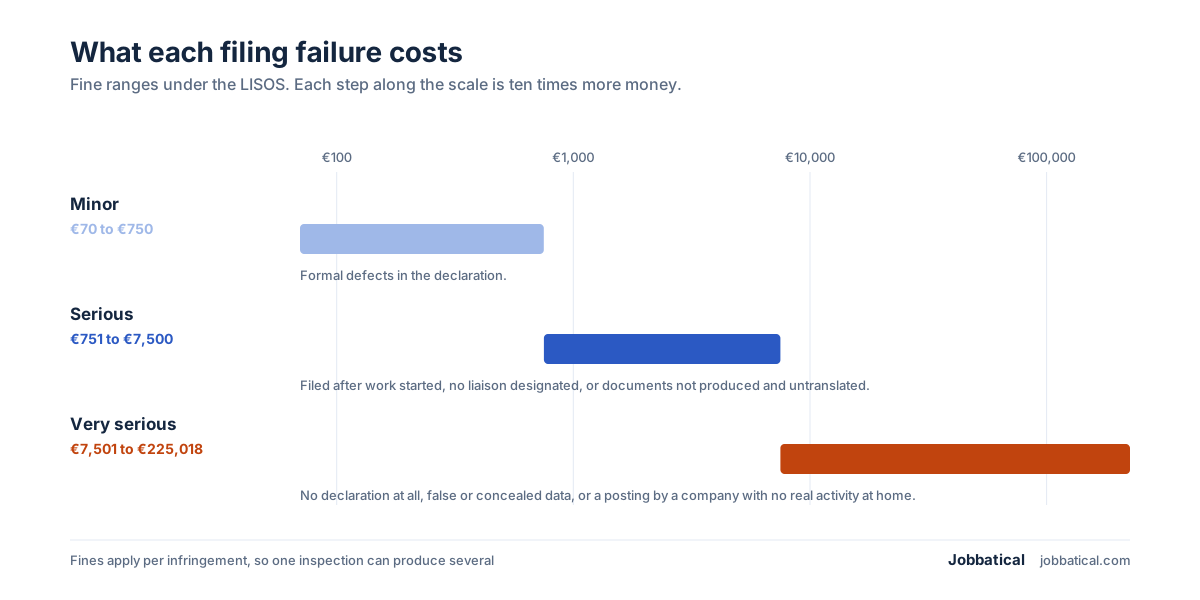
- LISOS fines run from €70 for formal defects to €225,018 where no declaration was filed or data was concealed.
- Postings of eight days or less can be exempt from filing, but equal treatment and A1 duties still apply from day one.
- A standard posting lasts 12 months and extends to 18 only with a motivated notification filed before month 12 closes.
A Spanish Inspección de Trabajo y Seguridad Social (ITSS) labour inspector can conduct an unannounced client site audit and request your compliance documentation on the spot. Two essential documents dictate the compliance: the A1 Certificate and the Comunicación de Desplazamiento. Authorities evaluate these files jointly during inspections.
Which EU Regulations Govern Posting a Worker to Spain?
The Posted Workers Directive (96/71/EC and the 2018 revision)
EU Posted Workers Directive 96/71/EC and the 2018/957 revision establish the cross-border framework, transposed into Spanish national law through Ley 45/1999.
Key compliance rules include:
- Equal Pay and Working Conditions: Posted employees must receive local minimum wage and benefits defined by the relevant Spanish collective bargaining agreement (convenio colectivo).
- Standard Assignment Duration: Standard posted worker status lasts up to 12 months.
- Posting Extension: Submitting a motivated notification before the 12th month extends the maximum posting period to 18 months.
- Long-Term Postings: Exceeding 18 months subjects the employment relationship directly to almost all core Spanish employment laws.
EU Enforcement Directive and ITSS Inspection Powers
EU Directive 2014/67/EU and Royal Decree-Law 9/2017 define ITSS audit authority for employees posted to Spain.
- Document Translation: ITSS inspectors can demand compliance documents translated into Spanish during or after the assignment.
- Local Liaison: Employers must designate a liaison person located in Spain to handle official communications.
- Cross-Border Fines: Spanish administrative penalties for non-compliance can be enforced in your home country.
Social Security Coordination and Regulation 883/2004
EU Regulation 883/2004 governs social security jurisdiction for cross-border workers in Spain.
- Coverage Duration: Posted employees can maintain home country social security coverage for up to 24 months.
- A1 Certificate Proof: The A1 certificate serves as mandatory evidence of home country social security coverage.
- Contribution Penalty: Operating without an A1 certificate allows Spanish authorities to claim local social security contributions from day one.
What Social Security Document Does a Posted Worker Need in Spain?
A1 for EU/EEA senders vs. Certificate of Coverage for treaty countries
- EU, EEA, or Switzerland: Employers must obtain an A1 certificate from the home country social security authority prior to the posting.
- Bilateral Treaty Countries: Employers from countries with social security agreements, such as the US, Japan, Brazil, or Morocco, must secure an official Certificate of Coverage.
- Non-Treaty Countries: Employees originating from countries without a bilateral agreement must register with Spanish social security from day one.
A1 Certificate vs Intra-Corporate Transfer (ICT) to Spain
- Posted Worker Route: Employees remain on home country employment contracts and payroll while utilizing an A1 certificate for social security exemption.
- ICT Transfer Route: Intra-Corporate Transfer (ICT) permits provide immigration pathways for non-EU nationals moving within a corporate group, following distinct social security rules.
- Compliance Sequence: Selecting the correct mobility route first dictates all subsequent Spanish immigration, tax, and social security filings.
Where to find A1 issuing authorities and timelines
- The A1 comes from the sending country, not from Spain.
- Apply before departure. Retroactive A1s are possible, but they read badly in an inspection.
- Certificates of Coverage can take months, so start early.
For the full breakdown of A1 certificates, Certificates of Coverage, and issuing authorities by country, see our guide to Spain ICT social security.
How Does the A1 Pair With the Spanish Posting Declaration?
- Dual Compliance Requirements: Social security authorities oversee the A1 certificate, while Spanish labour inspectors evaluate the posted worker declaration.
- Distinct Regulatory Scopes: The A1 certificate verifies home country social security coverage, whereas the posting declaration confirms compliance with Spanish labour laws.
- Penalty Risk: Possessing a valid A1 certificate does not exempt employers from administrative fines if they omit the mandatory Spanish posting declaration.
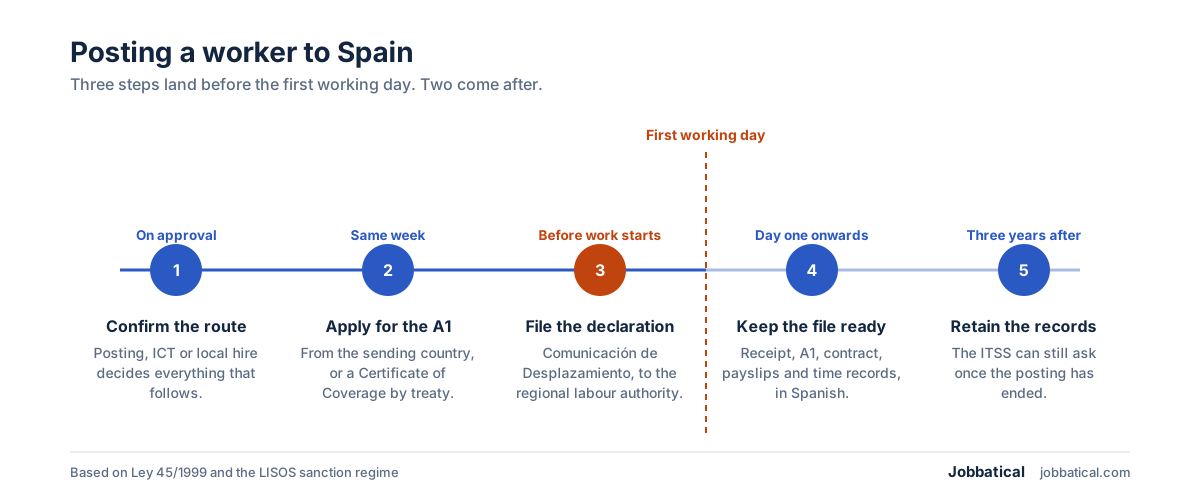
Timeline for Spanish Posting Declaration and A1 Certificate
- Early A1 Application: Apply for the home country A1 certificate immediately after the worker's Spanish assignment is approved.
- Mandatory Filing Deadline: Submit the official Spanish posting declaration before the employee starts their first working day in Spain.
- Pending Application Protocol: File the posting declaration on time even if the A1 certificate remains pending, retaining the application receipt to prevent severe late submission penalties.
ITSS Inspection Readiness and Compliance File Requirements
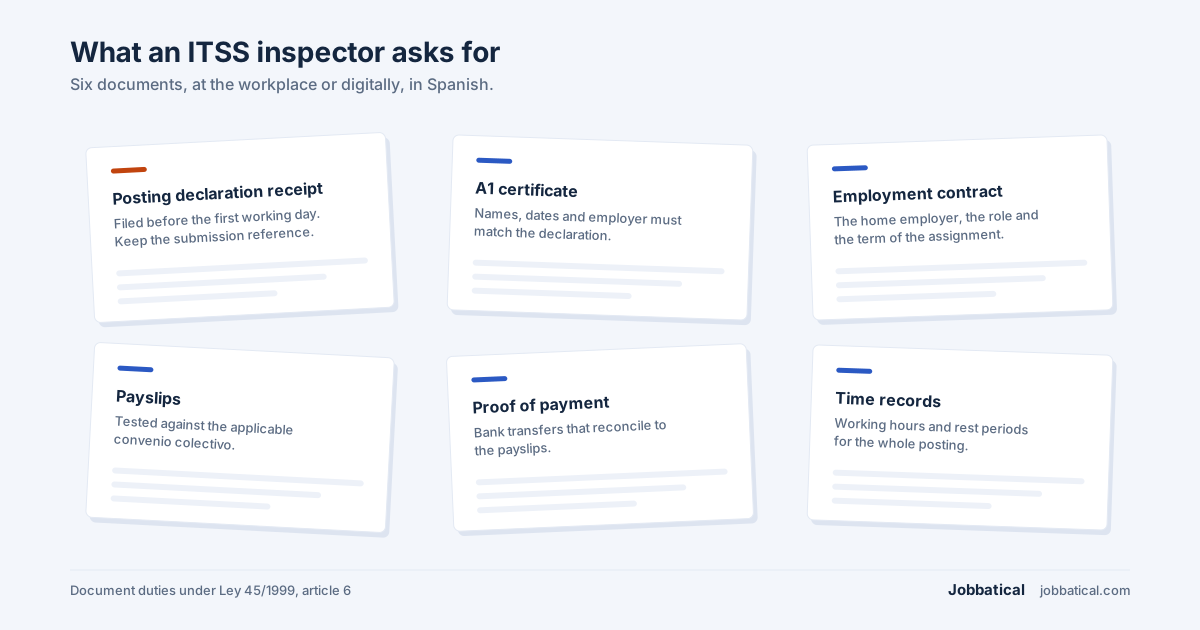
- Centralized Digital File: Maintain an easily accessible digital folder per posted worker containing the declaration receipt, A1 certificate, employment contract, payslips, proof of payment, and time records.
- Language Translation Compliance: Prepare required Spanish or regional co-official language translations in advance to ensure immediate presentation during an ITSS labour inspection audit.
What Must a Spanish Posting Declaration Contain?
Required Information for a Spanish Posting Declaration
- Employer Identification: Sending company legal name, contact details, and foreign tax identification numbers.
- Worker Details: Personal identification, job title, and professional credentials for each posted employee.
- Host Company Information: Legal name and tax identification number of the receiving Spanish host company.
- Assignment Schedule and Location:
- Start date and expected duration.
- Workplace address in Spain.
- What the service actually is. Vague wording invites follow-up questions.
- Service Scope: Specific description of cross-border services rendered to satisfy ITSS compliance requirements and avoid audit inquiries.
- Designated Local Liaison: Contact details for a nominated representative in Spain authorized to receive official legal notices and engage with worker representatives.
- Spanish Service Address:
- A person or entity in Spain who receives official documents and notices.
- A contact able to represent you with worker representatives.
- Active, valid postal address in Spain designated for receiving official ITSS notifications and administrative communications.
Where and When Is the Posting Declaration Filed?
Filing Destinations for Spanish Posting Declarations
- Regional Labour Authority: Submissions go to the specific autonomous community where work occurs via the official Ley 45 electronic portal.
- Ceuta and Melilla Submissions: Assignments in Ceuta and Melilla require filing directly with local Spanish Government Delegations.
- Multi-Region Postings: Cross-border assignments across multiple autonomous communities require separate posting declarations in each region.
Filing Deadlines and Short-Term Exemptions in Spain
- Pre-Activity Submission: Posting declarations must be filed before the employee begins work, regardless of assignment duration.
- Eight-Day Exemption: Postings lasting eight days or less are exempt from declaration filing, except for temporary employment agency assignments.
- Immediate Statutory Duties: The eight-day exemption applies only to declaration filing, leaving A1 certificate rules and equal pay requirements active from day one.
Regional Variations and Sector Requirements in Spain
- Provincial Office Routing: Administrative workflows vary by autonomous community, with several regions routing filings through provincial labour offices.
- Co-Official Language Requirements: Regional authorities in Catalonia, the Basque Country, Galicia, and Valencia may request co-official language translations.
- Construction Sector REA Filing: Construction industry postings require mandatory registration in the Register of Accredited Companies (REA) before activity begins.
How Do the A1 and Posting Declaration Work Together in an ITSS Inspection?
What inspectors cross-check between the two documents
- Names, dates and employer details on the A1 against the declaration.
- The declared service against what the team is doing on site.
- Whether the sending company genuinely trades at home. Joint Spain and Portugal operations target exactly this.
Records you must retain and for how long
- During the posting: at the workplace or digital, for immediate consultation.
- After it ends: produced on request by the labour inspection.
- No single retention period exists in law. Infringements can be pursued for three years, so treat three years as your floor.
Common documentation gaps that trigger findings
- Late Declaration Submissions: Declaration filed a day or two after work started triggers immediate non-compliance penalties.
- Inactive Local Liaisons: Liaison named on the form but no longer contactable.
- Unextended Assignment Limits: Assignment past 12 months with no motivated notification.
- Untranslated Pay Records: Payslips available in the home language only.
- Misallocated Per diems: Improperly counting travel allowances or per diems toward Spanish collective bargaining agreement minimum wage standards causes pay non-compliance.
What Are the Penalties for Missing or Incorrect Documentation?
The LISOS sanction tiers (minor, serious, very serious)
Fines apply per infringement under the LISOS, and one visit can produce several.
Joint liability between sending and host company
- Shared Employer Liability: Foreign sending employers and Spanish host companies share joint legal liability for ITSS non-compliance penalties within supply chains.
- Host Verification Standards: Host companies in Spain routinely inspect posting declaration receipts and A1 certificates before permitting contractor site entry.
Operational Impact of ITSS Labor Sanctions
- Repeat Inspection Trigger: Administrative sanction records significantly increase the likelihood of future unannounced ITSS labor inspections.
- Immigration Filing Complications: Recorded labor violations resurface to hinder future Spanish work permit and immigration applications.
- Contractor Vetting Barriers: Enterprise clients in Spain audit vendor compliance records and exclude suppliers with active labor sanctions.
How Can HR Standardise Posting Compliance Across Multiple EU Markets?
Building a repeatable pre-departure checklist
- Confirm the route: posting, ICT or local hire.
- Apply for the A1 or Certificate of Coverage.
- Check pay against the convenio colectivo.
- Appoint the liaison and confirm the Spanish address.
- File, save the receipt, brief the on-site manager.
Centralised tracking for A1s and declarations
- One record per assignment, holding both document numbers and both end dates.
- An alert at month 10, so the 18-month extension is never missed.
- Map each market separately. The Netherlands notification works nothing like the Spanish one.
If you are using spreadsheets, then remember that they can cope with roughly 20 live assignments. After that they start failing quietly. Jobbatical platform manages tracking, reminders, documentation and process workflow, all in a highly automated manner reducing the workload for the HR team. Talk to us to see it live in action.
When to Appoint Local Representation for Spanish Worker Postings
- Lack of Local Presence: Sending employers without a Spanish legal entity or permanent local contact must engage local representation to meet liaison rules.
- Complex or Extended Postings: Assignments spanning multiple autonomous communities or extending beyond 12 months require specialized local legal guidance.
- Active ITSS Inspections: Employers facing an open Spanish labor inspectorate audit require immediate local representation to manage proceedings.
How Jobbatical helps with Posting workers to Spain
Jobbatical handles filings, liaison and records for posting workers to Spain and across the EU, so your team tracks assignments instead of chasing forms. Book a demo.
Before the next Spanish assignment is signed off, ask one question: could you produce the declaration receipt and the A1 within an hour?
Disclaimer: Immigration rules change quite frequently; please verify with official sources or contact us for the latest info before making any decisions.
Frequently Asked Questions: Posting Workers to Spain

.svg)
.svg)