



KEY TAKEAWAYS
- The 180-day rule is a rolling 12-month check, not a calendar year limit. A heavy travel stretch buried mid-cycle can break ILR eligibility years before application.
- Business travel counts as absence for Skilled Worker ILR unless it fits a narrow Home Office exception (approved research, humanitarian work, or compelling compassionate reasons).
- The Home Office assesses every possible 12-month window across the 5-year qualifying period; two trips 11 months apart can both fall inside the same rolling window.
- Amber alerts at 130 days per rolling window give HR time to reroute travel; red at 150+ needs immigration input before the next trip is booked.
Business travel: the ILR risk hiding in your employee's travel logs
The application fails. Fees are gone, retention is at risk, and the sponsorship clock resets. This guide covers how the rule works, which business travel patterns break eligibility, and how to build an absence tracker. For the full documentation set at settlement, see our UK ILR employer guide.
How the 180-day rule actually works
The rule is set out in the Home Office's Continuous Residence guidance and applies to Skilled Worker, Health and Care Worker, Global Talent, Scale-up, and most other work-based ILR routes.
Core mechanics:
- Your employee must not have spent more than 180 whole days outside the UK in any rolling 12-month period during the qualifying years.
- The 12-month window is rolling, not a fixed calendar year.
- Absences before the employee physically entered the UK (the gap between visa start date and arrival) also count against the first rolling window.
- A single breach in any one rolling window is enough to break continuous residence.
- Part-day absences under 24 hours are not counted; anything spanning midnight counts as a full day.
Two trips 11 months apart can fall within the same rolling 12-month window. If each trip is 100 days, the calendar view looks fine, but the rolling check shows 200 days and the application fails.
Check your UK settlement timeline with the ILR Eligibility Calculator and find your earliest application date.
Rolling vs calendar view
The four business travel patterns that break eligibility
If any of these look familiar, your absence exposure is already growing.
- Product or launch support abroad. A senior engineer or PM is embedded with an overseas team for 3 to 4 months. Reads as normal project work internally; immigration-wise it is a rolling window spike.
- Client-site delivery. Consulting, IT, and delivery-heavy roles ship staff to client locations for weeks at a time. Repeat trips within a rolling window compound quickly.
- ICT-adjacent assignments on the wrong visa. Skilled Worker holders sent on informal temporary transfers rather than through Global Business Mobility. The travel is real; the tracking often isn't. See our guide on the line between UK visitor and work activities.
- Back-to-back conferences and trade shows. Individually short, cumulatively significant. A senior salesperson doing eight regional events across two continents can easily hit 60 to 80 days a year, before any personal travel.
What counts as an absence, and what doesn't
The Home Office treats most work-related travel as ordinary absence. There is no automatic exemption for business trips. A narrow set of exceptions is defined in the Immigration Rules.
Absences that don't count towards the 180-day limit
Ordinary business travel does not fit any of these categories. Assume it counts.
ILR absence tracker: Track your employee's absences
Most HR teams start tracking absences seriously in year 4, when ILR conversations come up. By then, the damage is already logged. The tracker needs to start on day one of the Skilled Worker visa and run through to the day of ILR submission. Check our ILR absence tracker.
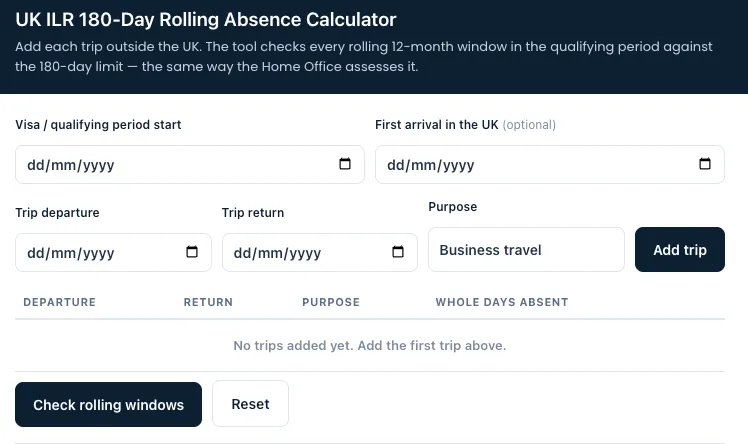
Also check our free UK ILR eligibility calculator which handles other checks.
Alert thresholds for HR intervention
If your employee has already crossed 180 days
Do not assume the application is dead. There are three paths worth checking before writing off the qualifying period.
- Test the exception grounds. If any absence was linked to sponsor-approved research, a family bereavement, or a Home Office-recognised crisis, gather the evidence and prepare a discretion request.
- Recalculate from the most favourable start date. The Home Office allows applicants to count the qualifying period backwards from the application date, up to 28 days after it, or the decision date, whichever helps most. The 28-day application window can sometimes shift a breach out of the qualifying period entirely.
- Plan a restart. If no exception applies, sponsorship extends. Budget for another Immigration Skills Charge cycle, an updated Certificate of Sponsorship, and a new five-year clock. With the qualifying period potentially moving to 10 years under the earned settlement model, the cost of a restart is only going up.
And remember that travel-heavy employees cannot leave the UK while their ILR application is pending — the priority and super priority services shrink that no-travel window from months to days.
Disclaimer: Immigration rules change quite frequently; please verify with official sources or contact us for the latest info before making any decisions.
Frequently Asked Questions : UK ILR 180-Day Rule & Business Travel
Does business travel count towards the 180-day ILR absence limit?
Yes. For most Skilled Worker visa holders, business travel counts towards the ILR absence limit unless a specific exception under the Immigration Rules applies. Limited exceptions may include certain sponsor-approved research activities or other circumstances recognised by the Home Office. In most cases, work-related travel is treated the same as personal travel when calculating absences.
How is the 180-day rule calculated — by calendar year or rolling year?
The Home Office applies a rolling 12-month assessment. Every consecutive 12-month period during the qualifying residence period is considered. This means absences spread across two calendar years may still exceed the permitted limit within a single rolling 12-month window.
What happens if my sponsored employee exceeds 180 days in one 12-month window?
Exceeding the permitted absence limit may break the employee’s continuous residence for ILR purposes, meaning they may need to begin a new qualifying residence period. The Home Office may exercise discretion in limited circumstances, such as serious illness or other exceptional situations, where appropriate evidence is provided.
Do partial travel days count as full absence days for ILR?
The Home Office counts whole days of absence. An absence that spans midnight is generally counted as a full day outside the UK. In most cases, the day of departure counts as an absence day, while the day of return does not if the individual returns to the UK before the end of that day.
Are there any absences that do not count towards the 180 days?
Yes, but only in limited circumstances recognised under the Immigration Rules. Depending on the route and the facts of the case, these may include certain approved overseas research activities, humanitarian work, travel affected by exceptional global events, or compelling compassionate circumstances. Supporting evidence is required for any claimed exception.
What should HR track to prevent 180-day rule breaches?
HR should maintain accurate records of every overseas trip, including departure and return dates, destination, travel purpose, and the total number of days spent outside the UK during each rolling 12-month period. Keeping these records up to date throughout employment makes future ILR applications significantly easier and reduces the risk of calculation errors.
Can we reduce a sponsored employee’s overseas travel if they are near the 180-day limit?
Yes. Employers should monitor absence totals proactively and review travel plans where an employee is approaching the permitted limit. Alternative arrangements, such as shorter business trips, remote meetings, or distributing travel across different team members, can help protect the employee’s eligibility for settlement while meeting business needs.

.svg)
.svg)
