
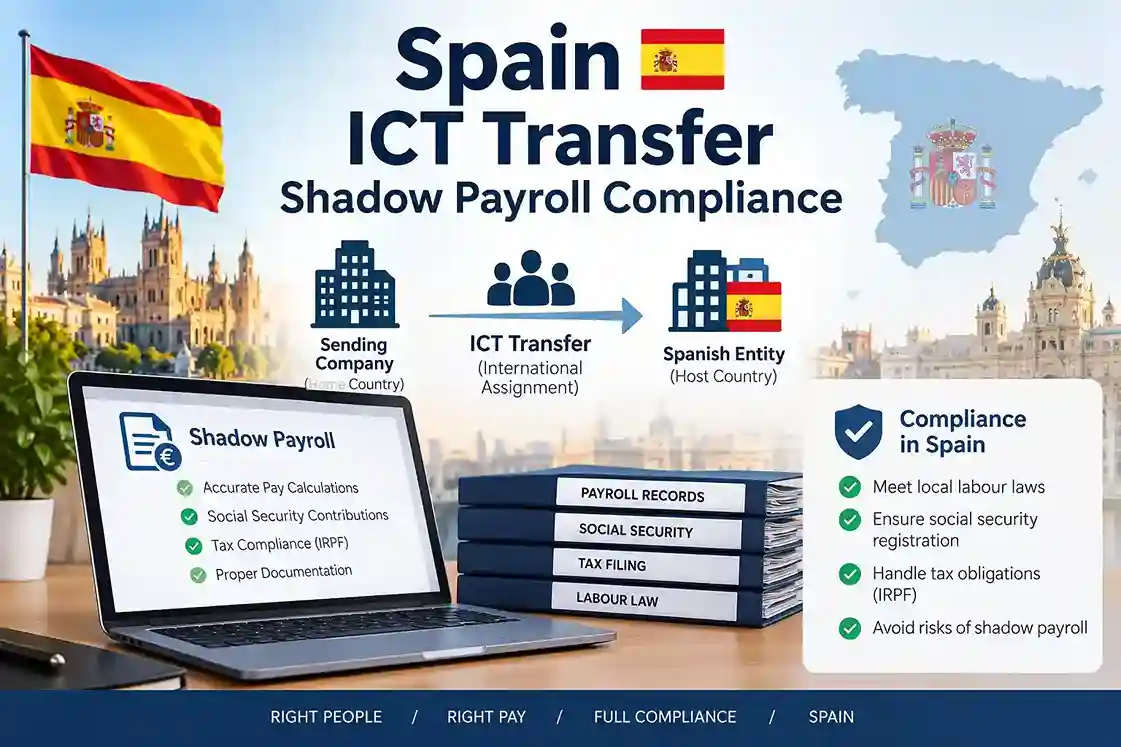
KEY TAKEAWAYS: Spain ICT Transfer Shadow Payroll
- A Spain ICT transfer triggers shadow payroll once your transferee is taxable in Spain on pay your home payroll is not withholding, most often after 183 days in a calendar year.
- Spanish tax residents are taxed on worldwide income at IRPF rates of 19% to 47%, and there is no part-year status, so the whole year counts once the threshold is crossed.
- The Beckham Law can tax a qualifying ICT transferee at a flat 24% on Spanish employment income up to 600,000 euros for six years; an intra-company transfer is a valid entry reason, applied for via Modelo 149.
- Shadow payroll means registering as an AEAT withholding agent and remitting IRPF monthly on Modelo 111, with the annual summary on Modelo 190; it is separate from social security.
- Get it wrong and you face AEAT surcharges, ICT renewal refusals, and permanent establishment exposure taxed at the 25% corporate rate.
Navigating a Spanish Intra-Corporate Transferee (ICT) permit can quickly turn into a tax compliance minefield if your foreign entity overlooks local reporting rules. While an ICT visa allows seamless employee mobility, crossing specific thresholds like the 183-day residency mark or local cost recharges instantly triggers shadow payroll obligations in Spain.
This guide shows HR and global mobility teams exactly when Spain ICT transfer shadow payroll becomes mandatory, and what to put in place before the first Spanish payroll run.
How Do Spain ICT Transfers and Global Payroll Intersect?
Immigration approval and tax compliance represent two distinct regulatory milestones. While a Spain Intra-Corporate Transfer (ICT) permit legally authorises an employee to live and work in the country, it does not determine their tax residency or salary taxation.
- What the Spain ICT permit authorises: The Intra-Corporate Transfer permit enables a non-EU employee to relocate from a foreign group company to a Spanish corporate entity. It strictly validates the legal right to work, entirely independent of the tax treatment applied to the employee's remuneration.
- Why immigration approval is not tax compliance: Securing a work permit does not automatically register an expatriate with the Spanish tax authority (AEAT). Payroll processing, income tax withholding, and statutory reporting are distinct legal obligations managed separately from the immigration process and are subject to independent AEAT audits.
- The home payroll compliance gap: Throughout an ICT assignment, the employment contract typically remains with the home-country entity, meaning compensation continues through the home payroll system. However, once Spain establishes taxing rights over the employee, foreign tax withholding no longer satisfies Spanish statutory tax laws.
- The role of the Spanish host entity: The local Spanish enterprise must act as the registered withholding agent responsible for remitting applicable taxes.
- Internal risk management and ownership: Global mobility teams typically manage the immigration permit process, whereas finance and payroll departments handle tax obligations. Failing to seamlessly align these functions creates substantial corporate compliance risks.
For the full permit mechanics behind every transfer, our Spain intra-company transfer ICT permit guide breaks down eligibility, costs, and timelines, so your payroll planning starts from the right facts.
What Is Shadow Payroll, and Why Should HR Care for Spain ICT Transfers?
Shadow payroll is a parallel reporting mechanism maintained in Spain for expatriate employees compensated by a foreign entity while working locally.
- Defining shadow payroll: It mirrors the foreign home salary within Spain to accurately withhold and report the correct IRPF (personal income tax). The employee continues to receive a single net payment, while the local record formally captures statutory tax obligations.
- The zero net pay mechanism: Spanish payroll records the gross compensation and local tax withholding, offsetting the net amount to prevent duplicate payments. This produces a fully compliant Spanish tax filing without issuing a second salary.
- Facilitating tax equalisation: Expatriate assignment policies often ensure employees face no adverse tax impact. Shadow payroll generates the auditable financial data required to accurately calculate and administer tax equalisation or protection.
- Common shadow payroll misconceptions: It does not constitute a local employment contract, a duplicate salary, or a local social security registration. Misclassifying these elements risks costly double contributions or severe tax non-compliance penalties.
- Aligning Finance and HR: Gross compensation data resides with the home country payroll, while statutory tax filings are managed by the Spanish host entity. Seamless cross-border data integration is essential to ensure the shadow payroll accurately matches actual compensation.
Shadow payroll covers the tax side, but the transfer itself needs expert handling too; our Spain intra-corporate transfer (ICT) permit service gives HR teams end-to-end, specialist-led support for the move, so immigration, tax, and contributions stay in step.
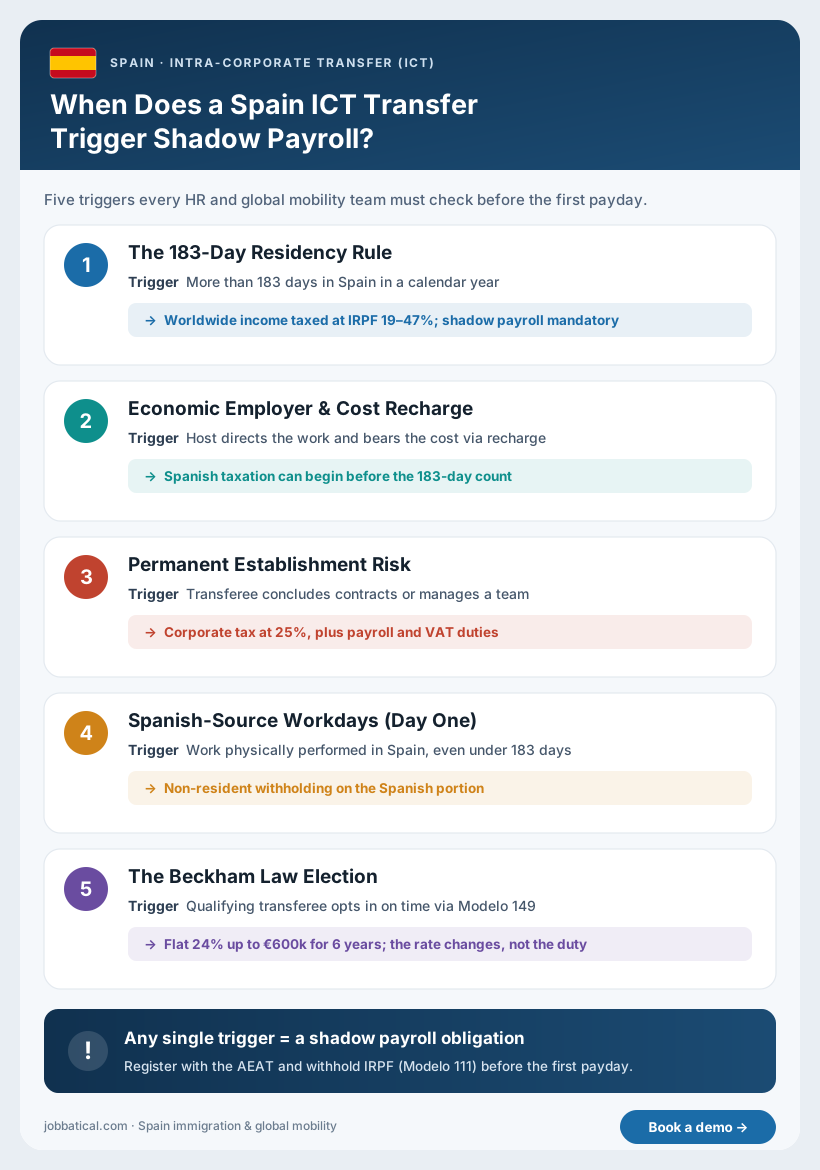
When Does a Spain ICT Transfer Trigger Shadow Payroll?
Human Resources departments frequently err by treating the 183-day presence test as the sole determinant for expatriate tax liability. While this is the primary trigger, several alternative factors can establish a Spanish tax obligation much earlier.
- The 183-day tax residency rule: Exceeding 183 days in Spain during a calendar year establishes Spanish tax residency, subjecting the employee's worldwide income to progressive IRPF rates of 19% to 47%.
- Economic employer rules and cost recharges: If the Spanish host entity directs the expatriate's daily activities and absorbs their salary costs via an intercompany recharge, tax authorities may classify the host as the "economic employer." This interpretation triggers local tax liabilities well before the 183-day count is met.
- Permanent establishment (PE) risk: Expatriates with the authority to manage local teams or execute corporate contracts can inadvertently create a permanent establishment for the foreign parent company.
- Spanish-source income from day one: Income derived from professional duties physically performed within Spanish territory can be classified as Spanish-source, subjecting it to non-resident income tax withholding even if the total stay is under 183 days. Short-term corporate assignments are not automatically tax-exempt.
- The Beckham Law (Modelo 149) election: Eligible expatriates can opt into the special impatriate tax regime, securing a flat 24% income tax rate on earnings up to €600,000 for six years.
Which Triggers Create a Spain Shadow Payroll Obligation?
Payroll timing and permit timing have to line up, which is why our guide to the Spain ICT 3-month prior employment rule is worth reading beside this one; it maps the transfer window your tax setup has to match.
How Does Social Security Work During a Spanish Transfer?
Corporate income tax and expatriate social security obligations are frequently conflated, creating significant financial and compliance risks. While a shadow payroll strictly manages income tax withholding, social security operates under independent regulatory frameworks. During most Intra-Corporate Transfers (ICT) to Spain, the employee remains within their home-country system.
- The A1 certificate for EU/EEA transfers: For intra-European assignments, an A1 certificate retains the expatriate within their home social security scheme. It legally dictates the applicable social system, not the jurisdiction governing the employee's income tax.
- Certificates of Coverage under bilateral agreements: For non-EU nations with totalization agreements (such as the United States), a Certificate of Coverage functions similarly to an A1 document, effectively preventing duplicate social security contributions during the Spanish assignment.
- When Spanish host-country contributions apply: In the absence of a bilateral agreement, the Spanish host entity must register the expatriate and remit local social security contributions. The Spanish employer liability is approximately 30.8% of gross salary—a substantial and frequently unbudgeted corporate expense.
- The 2024 regulatory procedural change: Spain recently eliminated the provisional "letter of commitment" workaround. Employers must now secure the requisite social security coverage documentation before filing the ICT permit application; failure to do so will stall the entire immigration transfer.
- Distinct duties and regulatory authorities: Securing a valid A1 or Certificate of Coverage exclusively resolves social security compliance. It does not eliminate or offset the statutory Spanish income tax withholding obligations that your shadow payroll is designed to execute.
Because the contribution side has its own filings and deadlines, our Spain ICT social security HR guide sets out the full sequence, so you can run tax and social security in parallel without gaps.
How Do You Set Up a Shadow Payroll in Spain for ICT Transfers?
Establishing a Spanish shadow payroll follows a strict, sequential process for Intra-Corporate Transfers (ICT). Missing a regulatory registration step invalidates subsequent tax filings. Below is the optimized compliance sequence.
- Step 1, secure the NIE and TIE: The transferee needs the Foreigner Identity Number (NIE) before any Spanish tax or payroll record can open. The physical TIE card follows once the ICT permit is granted.
- Step 2, register as a withholding agent: The Spanish host registers with the Agencia Tributaria to withhold and remit IRPF. Without this registration there is no lawful way to deposit the tax.
- Step 3, align home and host payroll data: Home payroll shares gross salary, bonuses, and benefits in kind; host payroll converts them into the Spanish calculation. A single monthly data feed keeps both records in step.
- Step 4, calculate and remit IRPF: Spanish withholding is deposited on Modelo 111, monthly or quarterly, with the annual summary on Modelo 190. If the Beckham Law applies, the flat 24% rate drives the calculation.
- Step 5, reconcile at year-end: Match the shadow figures to the home payroll and the employee's return, filed on Modelo 100 under the general regime or Modelo 151 under Beckham. Clean reconciliation is what survives an audit.
US-to-Spain moves raise their own payroll and permit questions, so our L-1 visa versus Spain ICT permit guide for US companies is a useful companion when you are structuring the assignment itself.
What Does Non-Compliance Cost Multinational Employers for Spain ICT Transfers?
The Spanish tax authority (Agencia Tributaria / AEAT) rarely overlooks an omitted shadow payroll once identified. Regulatory penalties stack up across tax compliance, immigration status, and corporate exposure, usually surfacing simultaneously during audits.
- Penalties for unreported income: Late or missing IRPF withholdings trigger statutory AEAT surcharges, late-payment interest, and administrative penalties on top of the underlying tax liability. Authorities can reopen prior tax years, compounding the total financial exposure.
- ICT permit renewal rejections: Spanish immigration authorities require a clean tax compliance history to approve permit extensions. Unresolved tax liabilities or unfiled returns can cause renewal rejections, stranding key personnel in Spain.
- Permanent establishment (PE) corporate tax assessment: If an expatriate's local operational duties create a PE, the foreign parent company faces Spanish Corporate Income Tax (CIT) at a standard 24%–25% rate on attributed profits, plus retroactive payroll tax and VAT obligations.
- Joint tax and labor audit exposure: A payroll audit frequently triggers broader labor inspections. Under Spanish regulations, non-compliance with mandatory daily time tracking records carries independent fines, turning a single tax discrepancy into a multi-departmental audit.
- Financial and tax detriment to the transferee: Mismanaging payroll can invalidate the employee's eligibility window for the Beckham Law or create unresolvable double-taxation scenarios. This damages corporate trust and jeopardizes global mobility programs.
Most renewal problems trace back to compliance gaps that were avoidable; our guide to Spain ICT permit rejection reasons shows the patterns that trip up HR teams, so you can close them before they cost a renewal.
How Do You Streamline Global Mobility to Spain?
Start the tax conversation on the day the permit decision is made, not on the day the employee lands. The teams that plan payroll and permit together almost never get caught by a surprise residency date.
- Decide the regime early: Confirm whether the transferee will elect the Beckham Law, because the election deadline is tight and the saving is significant. Model both the flat 24% and the progressive rate before you commit.
- Set one owner for the handoff: Name a single person to connect global mobility, payroll, and the Spanish host. That role is what stops the obligation from falling between teams.
If you would rather run Spain transfers without stitching this together case by case, book a demo and see how Jobbatical keeps permit, payroll, and compliance on one timeline.
For a quick check on which permit route even applies before payroll enters the picture, our Spain ICT-EU versus National ICT permit guide settles that first decision.
Authoritative sources: the Agencia Tributaria guidance on habitual residence and the Spanish Social Security (Seguridad Social) portal.
Disclaimer: Immigration rules change quite frequently; please verify with official sources or contact us for the latest info before making any decisions.
Frequently Asked Questions: Spain ICT Transfer Shadow Payroll