


- University Degree or Equivalent: You need a recognized university degree, or proof of at least three years of relevant professional experience in the IT field within the last seven years.
- Job Offer: You must have a concrete job offer from a German employer in the field of information and communication technology.
- Salary Threshold: The job offer needs to meet a minimum salary requirement. For 2026, the minimum IT specialist salary in Germany for IT specialists is €45,934.20.
- Relevance of Experience: Your professional experience should be relevant to the job you are being offered in Germany.
- Non-EU Citizen: The EU Blue Card is for non-EU citizens.
Known as the "Blaue Karte EU für IT-Fachkräfte Visum" in German, the route offers competitive salaries for IT specialists in Germany, a path to permanent residency, and family reunification. The Federal Employment Agency consistently lists software developers, system architects, data engineers, and cybersecurity professionals among the roles with the fewest qualified domestic applicants.
Germany EU Blue Card Salary Threshold 2026 for IT Specialists (Gehalt für IT-Spezialisten in Deutschland)
The official 2026 EU Blue Card salary threshold for IT specialists in Germany is €45,934.20 gross per year. This is the shortage-occupation rate, set below the general Blue Card threshold because IT is classified as a bottleneck profession under the Skilled Immigration Act (Fachkräfteeinwanderungsgesetz).
The salary must be fixed in the employment contract. Bonuses, commissions and other variable pay do not count towards the threshold. If your offer sits below the figure, the application will be refused regardless of the candidate's skill.
For the full 2026 figures across general and shortage occupations, see the full salary threshold breakdown in our salary guide. You can verify any offer against the current thresholds with Jobbatical's Germany EU Blue Card salary calculator.
IT Specialist Salary in Germany Per Month
The €45,934.20 figure is the visa threshold, not the market rate. Do not confuse the two. Split across 12 months, the minimum threshold works out to roughly €3,828 gross per month. Most experienced IT specialists in Germany earn well above this.
In practice, market salaries for senior developers, cloud engineers and cybersecurity specialists in cities like Berlin, Munich and Frankfurt often sit far higher than the threshold. That matters for your application: paying only the minimum on a senior role can trigger questions from the Federal Employment Agency, because pay must be comparable to what a domestic peer would earn.
Visa Threshold vs Market Salary
Eligibility for the IT Specialist Visa in Germany: What Employers Need to Confirm
As an employer or HR lead, confirm your IT candidates meet these core EU Blue Card criteria:
Salary Thresholds for IT Specialist
The EU Blue Card for IT specialists carries a reduced salary threshold compared to the general Blue Card. This is because IT is officially classified as a shortage occupation in Germany. For 2026 figures across general and shortage occupations, see the full salary threshold breakdown in our salary guide.
You can verify any offer against the current thresholds with Jobbatical Germany EU Blue Card salary calculator.
Which Tech Roles Qualify for the Germany IT Visa
Not every job with "IT" in the title qualifies. The role itself must be a genuine IT specialist function requiring university-level skills. Adjacent support roles usually do not meet the bar.
If your candidate's role sits in a grey area, run a pre-hiring visa check before you extend the offer. It is far cheaper than a refusal after the contract is signed.
Eligibility for the IT Specialist Visa in Germany (Visum für IT-Spezialisten in Deutschland): What Employers Need to Confirm
As an employer or HR lead, confirm your IT candidates meet these core EU Blue Card criteria before you make an offer.
EU Blue Card IT Specialist Eligibility Criteria
Employer's Step-by-Step Application Process
The 5-Step EU Blue Card Application Process
Employer tip: Offer at least 5–10% above the minimum threshold where possible. This reduces the risk of the application being questioned, demonstrates good faith, and strengthens your employer brand for international talent.
Documents the Employer Must Provide
- Signed employment contract
- Company registration document (Handelsregisterauszug)
- Employer's declaration of employment (Erklärung zum Beschäftigungsverhältnis) — in German
- For no-degree candidates: detailed role description and experience relevance statement
Documents the Employee Must Provide
- Valid passport (valid for at least 6 months beyond the intended stay)
- Completed visa/Blue Card application form
- Biometric passport photos
- Proof of recognised qualification or IT work experience certificates
- CV in German or English
- Proof of accommodation in Germany
- Health insurance certificate (German public or private)
- Registration certificate (Meldebescheinigung) from Einwohnermeldeamt
Hiring IT Specialists Without a University Degree
This is the most commonly misunderstood part of the IT Blue Card. Many HR teams assume a degree is mandatory. It is not.
How the Experience-Based Route Works
Under the Skilled Immigration Act (Fachkräfteeinwanderungsgesetz), IT specialists can qualify for the EU Blue Card on professional experience alone. The requirements are:
- At least three years of professional IT experience within the last seven years
- Experience directly relevant to the role being offered in Germany
- Evidence via employment certificates (Arbeitszeugnisse), reference letters, payslips, and a detailed CV
- The Ausländerbehörde has discretion in assessing equivalence, so preparation is key
When the No-Degree Route Works
Your candidate is a strong fit for the no-degree pathway when:
- They have at least 3 years of IT-specific experience within the last 7 years, in roles requiring university-level skills.
- The experience is documentable: signed reference letters, contracts, project scopes or certifications that map to the offered role.
- The offer sits at or above €45,934.20 gross per year (2026 threshold), stated as fixed salary, excluding bonuses.
- The role is clearly IT: software development, systems architecture, cybersecurity or data engineering, not an adjacent function.
- Pay and conditions are comparable to a degree-holding peer in the same role, a criterion the Federal Employment Agency checks directly.
You can explore which German visa routes fit a candidate's profile with Jobbatical's visa career explorer.
What HR Teams Must Prepare for No-Degree Applicants
- A detailed employment verification letter on company letterhead confirming role, duration and responsibilities
- The candidate's portfolio or GitHub profile if relevant
- A written assessment of role-to-experience relevance (your immigration advisor can draft this)
- Any professional certifications (AWS, Azure, Google Cloud, CISSP, PMP), which strengthen the application significantly
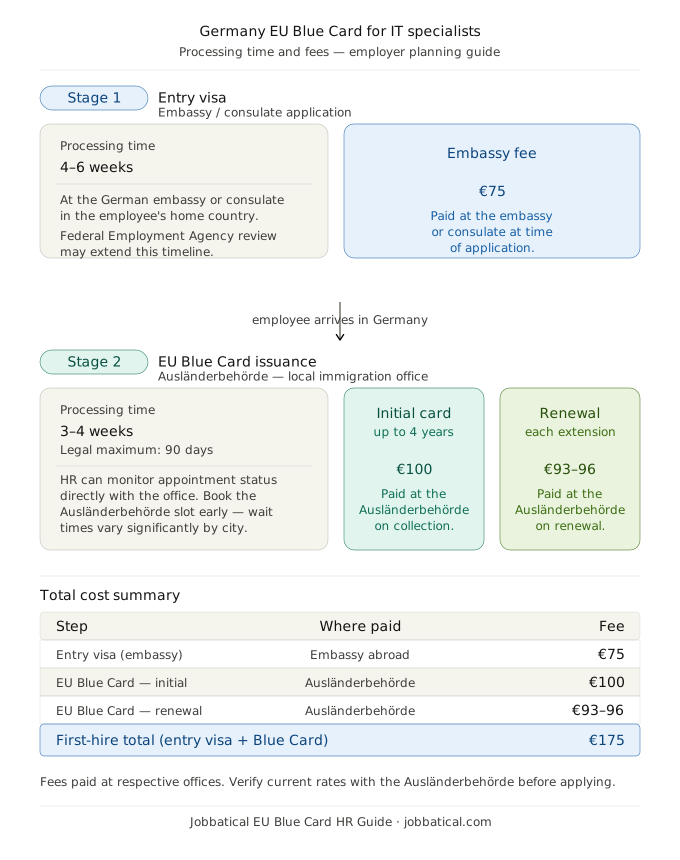
Processing Time for the IT Specialist Visa in Germany
- Visa Processing: 4–6 weeks at embassies; factor this into onboarding. Federal Employment Agency reviews may extend it.
- Blue Card Issuance: 3–4 weeks at the Ausländerbehörde (max 90 days). HR can monitor progress.
Fees for the EU Blue Card IT Specialist Application
- Entry Visa: €75 at the embassy or consulate.
- EU Blue Card: €100 initial (up to 1 year or longer); renewals €93–€96. Paid at the Immigration Office.
Disclaimer: Immigration rules change quite frequently; please verify with official sources or contact us for the latest info before making any decisions.
Frequently Asked Questions About the EU Blue Card for IT Specialists in Germany (2026)

.svg)



.svg)