

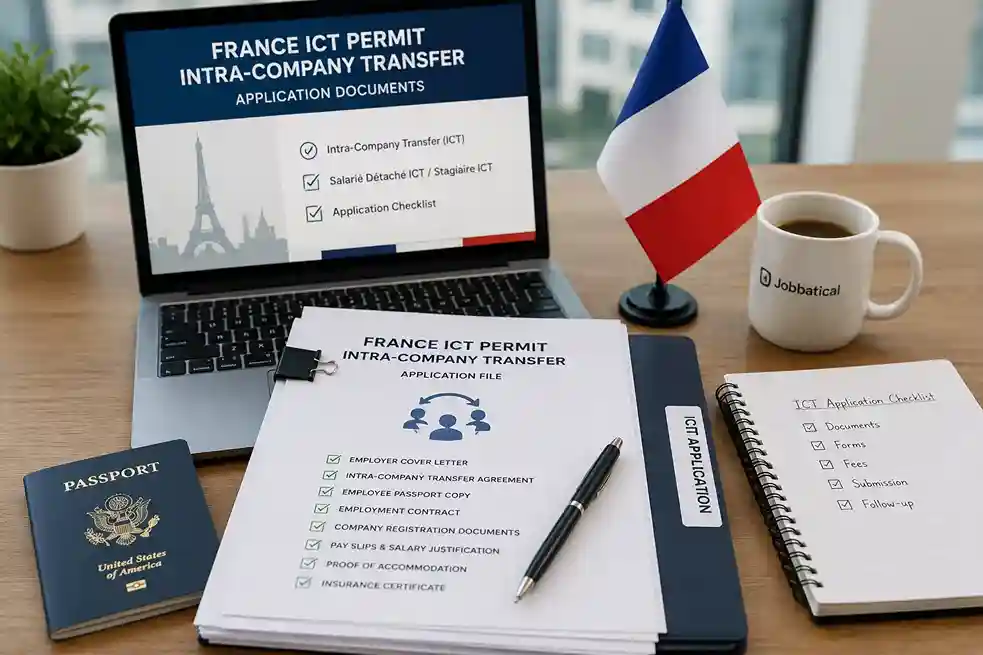
POINTS CLÉS – Permis TIC en France
- Le permis ICT français (Salarié détaché ICT) permet de faire venir des cadres, des spécialistes et des stagiaires au sein de votre entité française sans test de marché du travail.
- Les missions sont classées en fonction de leur durée : la carte pluriannuelle pour les missions de plus de 12 mois, et le visa « stagiaire TIC » pour les missions d'une durée maximale de 12 mois.
- Le salaire minimum pour 2026 s'élève à 1 867,02 € bruts par mois (SMIC) et est garanti par l'entité du groupe d'origine pendant toute la durée de la mission.
- Les employeurs déposent une demande d'autorisation de travail sur la plateforme ANEF et s'acquittent d'une taxe patronale de 108 € avant la phase de délivrance du visa consulaire.
- Le permis est valable pour une durée maximale de 3 ans et n'est pas renouvelable ; veillez donc à prévoir suffisamment à l'avance un changement de statut ou une période de réflexion de 6 mois.
Le titre de séjour ICT français, appelé « Salarié détaché ICT », est un titre de séjour destiné aux cadres, spécialistes et stagiaires non ressortissants de l'UE qui sont temporairement affectés à une entité française au sein d'un même groupe d'entreprises. Il s'appuie sur la directive européenne ICT (2014/66/UE), ce qui garantit une harmonisation du cadre réglementaire entre les États membres.
Ce guide présente aux équipes RH les différentes options, les règles salariales, les mesures à prendre par les employeurs, les coûts, les délais et les obligations réglementaires pour 2026.
Qu'est-ce que le permis TIC français et à qui s'adresse-t-il ?
Le permis de transfert intra-entreprise (ICT) en France, officiellement dénommé « Salarié détaché ICT », est une voie d’immigration spécifique destinée aux multinationales. Il permet à un groupe d’entreprises de détacher un salarié étranger déjà en poste vers une filiale ou une succursale française sans avoir à l’embaucher dans le cadre d’un contrat de travail français local. Le salarié détaché reste sur la liste de paie de l’entité de son pays d’origine tout en effectuant une mission temporaire et bien définie en France, ce qui garantit un transfert de savoir-faire sans heurts et la continuité des activités.
- Cadres supérieurs : dirigeants de haut niveau chargés de diriger l'entité française ou de gérer un département ou une fonction majeure au sein de celle-ci.
- Spécialistes : Personnel clé possédant des connaissances approfondies et hautement spécialisées ou un savoir-faire exclusif, indispensables aux activités, aux services ou aux équipements de l'entreprise d'accueil.
- Stagiaires diplômés : jeunes diplômés universitaires qui s'installent en France dans le cadre d'un programme structuré de développement de carrière en entreprise ou d'un programme de formation à la gestion.
- Condition d'appartenance au même groupe : l'entité d'origine (étrangère) et l'entité d'accueil (française) doivent appartenir exactement au même groupe de sociétés. Les services de l'immigration exigent la présentation de pièces justificatives attestant l'existence d'un lien capitalistique réel entre les deux sociétés.
- Caractère temporaire : ce poste est strictement destiné à des missions temporaires et ne constitue pas un emploi à durée indéterminée. À l'issue de la mission, le salarié est tenu de réintégrer son organisation d'origine ou d'être muté dans une autre succursale à l'international.
Pour avoir une vue d'ensemble des voies d'accès à la France par le biais d'un employeur, consultez notre guide sur la manière de parrainer des salariés en France, qui présente le paysage global du parrainage et la place qu'y occupe l'ICT.
Quels sont les différents types de permis TIC en France ?
Le parcours TIC que vous choisirez dépendra entièrement de l'ancienneté du candidat et de la durée de la mission. La France propose deux types principaux de TIC, ainsi qu'une option de mobilité simplifiée pour les titulaires de permis résidant déjà au sein de l'UE.
- Salarié détaché dans le secteur des TIC (plus de 12 mois) : il s’agit d’une carte de séjour pluriannuelle destinée aux cadres supérieurs et aux spécialistes effectuant des missions stratégiques de longue durée.
- Stagiaire en TIC (jusqu'à 12 mois) : délivré sous la forme d'un visa de long séjour valant titre de séjour (VLS-TS), ce dispositif est strictement réservé aux stagiaires diplômés et aux missions de courte durée.
- ICT mobile (depuis un autre État membre de l'UE) : une procédure simplifiée et accélérée destinée aux ressortissants étrangers déjà titulaires d'un titre ICT en cours de validité dans un autre État membre de l'UE, leur permettant de s'installer en France dans le cadre d'un projet sans avoir à déposer une demande complète à partir de zéro.
Limites de durée et règles de renouvellement strictes :
- Durée maximale du séjour : la durée maximale autorisée est strictement limitée à trois ans pour les cadres et les spécialistes, et à un an pour les stagiaires.
- Non renouvelables : aucun de ces deux types de permis ne peut être prolongé au-delà de la durée maximale prévue. À l'expiration du permis, le bénéficiaire doit soit entamer une procédure de changement de statut (par exemple, pour obtenir un contrat de travail français), soit respecter une période de réflexion obligatoire hors de France.
Comparaison des différents types de permis TIC en France (2026)
Si votre groupe procède également à des transferts de personnel vers d'autres marchés, notre guide sur les transferts intra-entreprises en Espagne explique comment cette même directive européenne s'applique dans le cadre d'une procédure nationale différente.
Quels sont les seuils salariaux pour le permis TIC en France ?
La rémunération est l'un des aspects les plus minutieusement examinés dans toute application TIC. Les autorités françaises contrôlent rigoureusement les salaires afin de protéger le marché du travail local et de garantir le respect des normes nationales.
- Le salaire minimum pour 2026 : à compter du 1er juin 2026, le seuil salarial minimum absolu correspond au salaire minimum interprofessionnel de croissance (SMIC) français, qui s’élève à 1 867,02 € bruts par mois.
- Garantie par le groupe : L'entité d'origine à l'étranger doit fournir une garantie écrite et officielle attestant que ce salaire précis sera maintenu pendant toute la durée de la mission en France.
- Seuils locaux plus élevés : le respect du SMIC n'est pas toujours suffisant. Le droit du travail français impose le « principe d'égalité de traitement », ce qui signifie que certaines préfectures ou certaines conventions collectives sectorielles peuvent exiger un salaire nettement supérieur au SMIC pour des postes locaux comparables.
- Paiement en euros : afin d'éviter tout problème de conformité lié aux fluctuations des taux de change, l'intégralité du salaire doit être versée en euros, de préférence sur un compte bancaire français.
- Ancienneté au sein du groupe : le salarié doit avoir accumulé au moins 6 mois d'ancienneté ininterrompue au sein du groupe avant de demander son transfert.
Les écarts salariaux sont souvent à l'origine des refus de candidature. Il est vivement recommandé de viser un salaire nettement supérieur au SMIC plutôt que de s'en tenir strictement à ce montant, en particulier dans les régions où le coût de la vie est élevé, comme à Paris. Vous pouvez tester la viabilité d'un profil avant de vous engager grâce à notre outil de vérification d'éligibilité préalable à l'embauche en France, qui signale d'emblée les problèmes liés au salaire et au parcours professionnel.
Quelles sont les démarches que l'employeur doit effectuer pour obtenir un permis ICT en France ?
La procédure d'obtention du permis TIC français est entièrement prise en charge par l'employeur. C'est votre entreprise qui assume la grande majorité des démarches administratives initiales, et il est essentiel de respecter scrupuleusement la séquence procédurale, car la phase relative au visa du salarié ne peut débuter tant que l'autorisation de travail n'est pas définitivement obtenue.
- Justifier le lien entre les entités du groupe : fournir des documents officiels tels qu'un organigramme, un acte constitutif et une attestation juridique démontrant le lien direct de participation entre l'entité d'origine et l'entité d'accueil.
- Déposer la demande d'autorisation de travail : soumettez la demande officielle d'autorisation de détachement directement via le portail des employeurs sur la plateforme numérique de l'ANEF (Administration Numérique pour les Étrangers en France).
- Rédiger la lettre d'affectation : rédiger et signer une lettre d'affectation ou de détachement détaillée, précisant la mission spécifique de la personne affectée, son intitulé de poste, la durée exacte de l'affectation et les conditions de rémunération.
- Déposer la déclaration SIPSI : avant la date d'entrée en fonction du salarié, déposez une déclaration de détachement sur le portail national SIPSI. Sachez que les inspecteurs du travail recoupent systématiquement les données SIPSI avec celles de l'ANEF afin de s'assurer du respect total de la réglementation.
- Justifier le salaire : fournir des preuves solides attestant que la rémunération atteint le seuil du SMIC 2026, ainsi qu'une description détaillée du poste justifiant les compétences spécialisées ou le statut d'encadrement du salarié.
Dans la pratique, la justification des liens au sein du groupe est l'étape qui retarde le plus le traitement des demandes ; il est donc conseillé de commencer à rassembler les registres des actionnaires dès que possible. Nous vous recommandons également de consulter notre présentation des règles fiscales françaises applicables aux employeurs qui embauchent des salariés étrangers, car la structure de la masse salariale a une incidence directe sur les justificatifs relatifs à l'ICT.
Où faut-il faire la demande de permis TIC en France ?
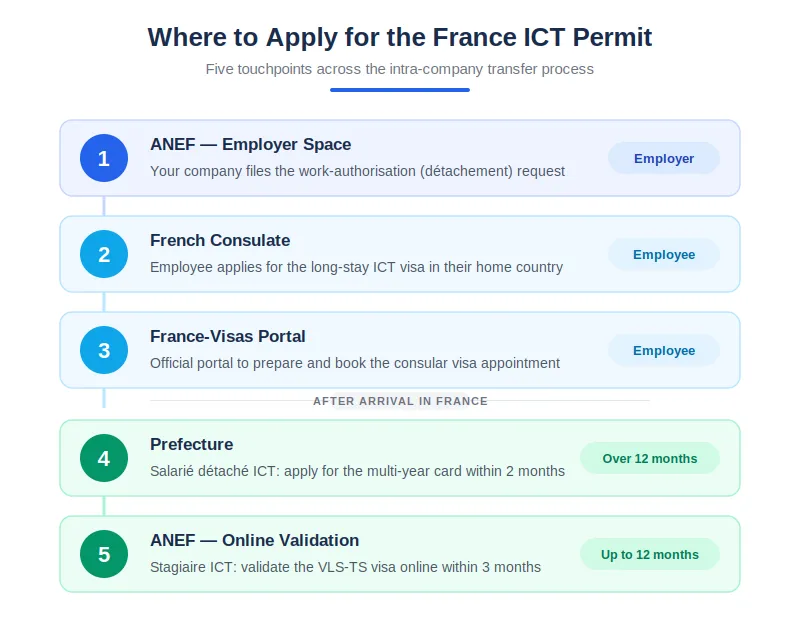
La gestion d'un transfert intra-entreprise (TIE) en France en 2026 nécessite de suivre une procédure d'immigration en plusieurs étapes. Les demandes de TIE passent par différents services administratifs, et le fait de savoir précisément quel organisme public est en charge de chaque étape permet d'éviter des retards coûteux et de garantir le bon déroulement de votre dossier de mobilité internationale.
- ANEF (Espace employeur) : L’Administration Numérique pour les Étrangers en France (ANEF) est la plateforme numérique obligatoire sur laquelle votre entreprise doit entamer la procédure d’immigration. L’employeur doit se connecter à son espace ANEF dédié pour déposer la demande officielle d’autorisation de travail pour détachement. Cette première étape cruciale doit être entièrement validée par les autorités françaises avant que le salarié ne puisse entreprendre toute démarche concernant son visa.
- Consulat de France (ou centre de demande de visa) : il s'agit du lieu physique situé dans le pays de résidence actuel du salarié où celui-ci dépose officiellement sa demande de visa de long séjour. Le consulat, qui travaille souvent en collaboration avec des partenaires externalisés tels que VFS Global ou TLScontact, vérifie les documents d'entreprise approuvés, recueille les données biométriques (telles que les empreintes digitales) et délivre la vignette de visa permettant l'entrée légale dans l'espace Schengen.
- France-Visas : le portail officiel et centralisé du gouvernement français destiné à faciliter la préparation des démarches consulaires. Une fois que l'employeur a obtenu l'autorisation de l'ANEF, le salarié utilise la plateforme France-Visas pour remplir son formulaire de demande en ligne, générer une liste personnalisée des pièces justificatives requises et prendre rendez-vous en toute sécurité auprès du consulat local.
- Préfecture locale : le centre administratif de référence après l’arrivée pour les missions de longue durée. Pour les cadres supérieurs et les spécialistes arrivant avec un visa d’entrée standard « salarié détaché ICT » (souvent assorti d’une obligation de demander une carte à l’arrivée), le salarié doit régulariser son statut d’immigration en demandant une carte de séjour physique pluriannuelle auprès de la préfecture régionale. Cette démarche doit généralement être effectuée dans les deux mois suivant l’arrivée en France et nécessite la présentation d’un justificatif de domicile local.
- ANEF (validation en ligne) : procédure simplifiée après l’arrivée, destinée aux missions de courte durée. Les stagiaires diplômés titulaires d’un titre de séjour « stagiaire TIC » se voient généralement délivrer un VLS-TS (visa de long séjour équivalent à un titre de séjour). Au lieu de se rendre à un rendez-vous dans une préfecture, ces personnes doivent valider leur visa entièrement en ligne via la plateforme ANEF dans les trois mois suivant leur arrivée en France. Le non-respect de cette obligation de validation numérique rend le séjour du salarié illégal.
La carte ICT étant retirée au niveau local, la préfecture compétente pour votre dossier dépend du lieu de résidence de l'employé en France. Notre service dédié au titre de séjour en France explique le déroulement de la procédure auprès de la préfecture et ce à quoi vous devez vous attendre lors du retrait.
Comment faire une demande de permis TIC en France, étape par étape ?
Voici le déroulement complet d’un dossier type de salarié détaché dans le secteur des TIC pour une durée supérieure à 12 mois. Les dossiers de stagiaires suivent le même schéma, mais se terminent par une validation en ligne au lieu d’une carte délivrée par la préfecture.
Si vous hésitez entre les TIC et un transfert dans le cadre d'un contrat français, notre comparaison entre le visa de travail français et le « Talent Passport » vous indique dans quels cas chacune de ces options correspond le mieux à votre projet de mobilité.
Combien coûte le permis TIC français et combien de temps faut-il pour l'obtenir ?
Bien que les frais administratifs directs liés à l’obtention d’un permis TIC soient relativement modestes par rapport à l’engagement financier considérable que représentent le salaire du salarié détaché et l’ensemble de ses avantages liés à la relocalisation, la gestion des délais de traitement doit constituer le principal facteur déterminant de votre planification en matière de mobilité internationale. Il est absolument essentiel de prévoir une marge de manœuvre suffisante en termes de temps ; en effet, pendant les périodes de pointe en matière d’immigration, la disponibilité des rendez-vous consulaires et les files d’attente dans les préfectures régionales sont poussées à leurs limites.
- Taxe ANEF à la charge de l’employeur : une taxe nominale à la charge de l’employeur, s’élevant généralement à environ 108 €, doit être réglée en ligne au moment même où la demande d’autorisation de travail pour l’entreprise est déposée sur le portail de l’ANEF. Il convient de noter que la voie ICT présente un avantage stratégique pour les budgets des entreprises, car elle est strictement exonérée de la lourde taxe OFII de 55 % à la charge de l’employeur (plafonnée à 2 506,67 €) qui s’applique aux contrats de travail locaux français standard.
- Frais de visa consulaire : les frais liés à la demande initiale de visa de long séjour traitée au consulat s’élèvent à environ 99 €, somme généralement réglée par le salarié ou en son nom lors de son rendez-vous en personne. Toutefois, les services des ressources humaines doivent également prévoir dans leur budget les frais liés à la délivrance du titre de séjour après l’arrivée ou à la validation du VLS-TS, dont le montant a officiellement été porté à 300 € à compter du 1er mai 2026, conformément à la nouvelle grille tarifaire nationale française en matière d’immigration.
- Délai cible pour l'autorisation de travail : L'administration française fixe un délai de traitement standard d'environ 30 jours pour l'examen de la demande initiale de l'employeur au stade de l'ANEF. Il s'agit toutefois d'un objectif administratif et non d'une garantie juridiquement contraignante : des documents d'entreprise manquants, des données salariales incohérentes ou des pièces justificatives mal traduites suspendront immédiatement ce délai et retarderont l'ensemble de la procédure.
- Délai global : lorsque la demande est gérée de bout en bout avec l’aide d’experts en immigration, un dossier ICT standard prend généralement entre 4 et 8 semaines, depuis le dépôt de la demande jusqu’à l’arrivée légale du salarié en France. En revanche, les entreprises qui tentent de s’y retrouver seules sur les portails destinés aux employeurs et les systèmes de prise de rendez-vous sont souvent confrontées à des délais prolongés de 3 à 4 mois, en raison d’erreurs de procédure et de rejets techniques qui auraient pu être évités.
- Extension familiale : si le bénéficiaire est muté avec son conjoint ou ses enfants à charge, les demandes de permis ICT « famille » correspondantes doivent être traitées simultanément. Bien que ce statut dérivé soit très avantageux pour le salarié (il confère au conjoint un droit immédiat au travail), la synchronisation des demandes familiales, la collecte des actes de mariage et de naissance traduits par un traducteur agréé, ainsi que la prise de rendez-vous consulaires communs allongent généralement le délai global du projet de 2 à 3 semaines supplémentaires.
Aperçu des coûts et des délais liés au permis TIC en France (2026)
Les tarifs sont susceptibles d'évoluer à tout moment ; ces chiffres sont donc donnés à titre indicatif. Pour évaluer un cas précis à partir des chiffres actuels, prenez rendez-vous avec notre équipe en France pour une démonstration.
Quelles sont les obligations réglementaires liées au permis TIC français ?
L'obtention du visa n'est que le début de votre parcours de mobilité d'entreprise. Le respect continu de la réglementation incombe entièrement à l'employeur pendant toute la durée de la mission de l'expatrié en France. Plus important encore, la durée maximale stricte de trois ans, souvent appelée « ICT cliff », constitue le principal obstacle réglementaire qui prend fréquemment au dépourvu les équipes internationales des ressources humaines et de la mobilité.
Afin de garantir le respect constant de la législation, les employeurs doivent gérer de manière proactive les conditions suivantes après l'arrivée des salariés :
- La limite stricte de trois ans : le permis « Salarié détaché ICT » est valable strictement pour une durée maximale de trois ans et n'est en aucun cas renouvelable. Les équipes RH doivent suivre de près cette date d'expiration et finaliser la stratégie de départ ou de transition du salarié bien avant l'expiration du permis en cours.
- Période de réflexion obligatoire : une fois la limite de trois ans atteinte, le salarié détaché est tenu par la loi de quitter la France. Si le groupe souhaite renvoyer ce même salarié en France avec un autre titre ICT, celui-ci doit respecter une période de réflexion obligatoire de six mois en dehors de l'Union européenne avant qu'une nouvelle demande puisse être déposée.
- Options stratégiques de changement de statut : si l’entreprise a besoin que le salarié reste en France au-delà de la limite de trois ans, il n’est pas possible de simplement prolonger la carte ICT. L’entreprise doit proposer au salarié un contrat de travail français et lui permettre de passer en douceur à un autre dispositif d’immigration, tel que le« Passeport Talent », qui offre une grande flexibilité. Ce changement de statut doit être initié via le portail de l’ANEF au plus tard deux à quatre mois avant l’expiration de la carte ICT en cours de validité.
- Pas de télétravail transfrontalier non autorisé : le permis TIC est explicitement délivré pour une mission devant être effectuée physiquement au sein de l’entité d’accueil française. Un télétravail prolongé ou non autorisé effectué depuis un pays tiers pendant la durée de la mission peut donner lieu à des contrôles de conformité et entraîner l’annulation du permis TIC français ainsi que de la couverture sociale associée.
- Validations strictes après l'arrivée : les formalités d'immigration ne s'arrêtent pas à l'aéroport. À leur arrivée, les personnes en mission de longue durée ne disposent que de deux mois pour demander leur carte de séjour physique auprès de la préfecture locale. De leur côté, les stagiaires titulaires d'un visa « Stagiaire ICT » doivent valider leur VLS-TS en ligne via l'ANEF dans les trois mois suivant leur entrée sur le territoire. Le non-respect de ces délais impératifs entraîne immédiatement l'invalidation du titre de séjour, rendant ainsi le séjour et le travail du salarié illégaux.
Le non-respect d'une période de renouvellement ou de validation est la principale cause pour laquelle un transfert conforme peut se transformer en problème. Notre service de gestion des titres de séjour TIC en France assure le suivi de toutes les échéances et de toutes les périodes de changement de statut pour votre équipe RH, afin qu'aucun élément ne passe inaperçu avant l'expiration du délai de trois ans.
Faut-il gérer les transferts dans le secteur des TIC en France en interne ou avec un partenaire ?
Si la gestion d'un transfert ponctuel en interne peut sembler gérable, la gestion d'un vivier de talents continu couvrant plusieurs préfectures françaises, avec des durées de mission variables et des plateformes numériques en constante évolution (comme l'ANEF et le SIPSI), est un domaine où les charges administratives s'alourdissent rapidement. Sans stratégie centralisée et s'appuyant sur la technologie, de simples négligences procédurales peuvent rapidement se transformer en retards opérationnels coûteux, en refus de visa et en risques de non-conformité.
- Évolutivité et standardisation : les transferts d'employés récurrents nécessitent un cadre structuré et reproductible, plutôt que des initiatives ponctuelles et disparates. La standardisation de vos processus d'immigration à tous les niveaux d'affectation garantit une qualité constante des dossiers, des critères opérationnels clairs et des délais d'arrivée prévisibles.
- Réduire les risques liés à la conformité : la mise en place d'un suivi automatisé des étapes réglementaires incontournables, telles que les validations obligatoires auprès de la préfecture après l'arrivée, les déclarations SIPSI et le plafond strict de trois ans imposé aux professionnels des TIC, réduit considérablement les risques juridiques et protège votre organisation contre les sanctions liées aux contrôles du travail.
- Optimisation des ressources des RH : la mise en place d’un processus de gestion de la mobilité permet de décharger les équipes RH internes et celles chargées de la mobilité internationale des tâches administratives fastidieuses, telles que la recherche de documents étrangers, le suivi des mises à jour du portail de l’ANEF et la gestion des communications avec les préfectures locales.
- Coordination familiale synchronisée : les demandes de titre de séjour pour les conjoints et les personnes à charge (ICT famille) doivent être traitées en parallèle avec le dossier du titulaire principal. La gestion simultanée des formalités familiales permet d'éviter que la famille n'arrive en plusieurs fois et garantit aux conjoints une autorisation de travail immédiate dès leur arrivée.
- Intégration au SIRH et intégrité des données : l'interconnexion transparente de vos processus de gestion de la mobilité avec les plateformes SIRH existantes (telles que Workday, BambooHR ou SAP SuccessFactors) élimine la saisie manuelle redondante des données, évite les erreurs typographiques coûteuses et garantit une source unique et fiable d'informations pour l'ensemble de votre effectif international.
Si vous prévoyez des transferts vers la France cette année, la prochaine étape est simple : dressez la liste des candidats potentiels, confirmez le parcours et le salaire de chaque salarié, puis désignez la personne chargée du suivi des échéances. Contactez nos experts en immigration en France pour gérer votre premier dossier ICT de A à Z.
Avertissement : les règles en matière d'immigration changent assez fréquemment ; veuillez vous renseigner auprès de sources officielles ou nous contacter pour obtenir les dernières informations avant de prendre toute décision.
Foire aux questions : Permis ICT en France (Salarié détaché ICT)

.svg)
.svg)