

POINTS CLÉS
- Le permis général de travail (autorización de residencia y trabajo por cuenta ajena) constitue la voie par défaut en Espagne pour les postes classiques, ne nécessitant pas de qualifications élevées, dont la rémunération est inférieure aux seuils salariaux fixés pour les travailleurs hautement qualifiés (HQP) et la Carte bleue européenne.
- La plupart des demandes nécessitent une évaluation du marché du travail (Situación Nacional de Empleo) : une publication de l'offre d'emploi par le SEPE pendant 15 jours, suivie d'un certificat de non-disponibilité, ce qui ajoute 3 à 4 semaines au processus, sauf si le poste figure sur la liste des métiers en pénurie.
- L'employeur dépose le formulaire EX-03 auprès de l'Oficina de Extranjería provinciale et s'acquitte de la redevance 790-062 ; le salarié s'acquitte quant à lui de la redevance 790-052.
- Le délai de traitement standard est de 1 à 3 mois par province, contre environ 20 jours ouvrés pour les dossiers relatifs aux professionnels hautement qualifiés (HQP) et aux titulaires de la « Blue Card » traités par l'UGE-CE.
Lorsqu'un poste en Espagne ne répond pas aux critères salariaux ou de spécialisation requis pour l'obtention du visa de « professionnel hautement qualifié » (HQP) prévu par la loi n° 14/2013, le permis général de travail (Autorización de Residencia y Trabajo por Cuenta Ajena) constitue la principale voie d'accès.
Qu'est-ce que le permis de travail salarié (Cuenta ajena) ?
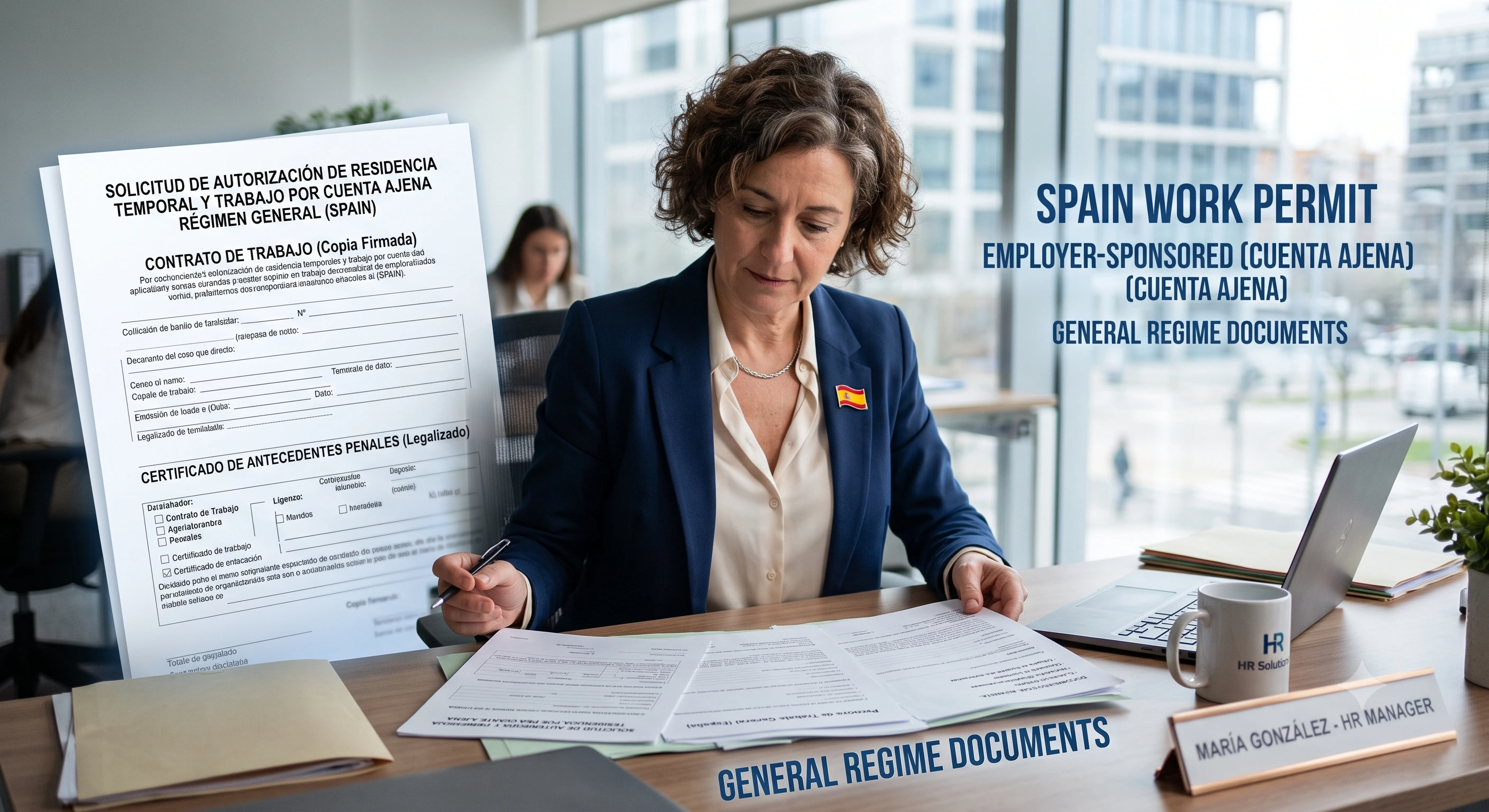
Le permis général de travail, officiellement appelé « autorización de residencia y trabajo por cuenta ajena », est l’autorisation de travail et de séjour par défaut en Espagne pour les ressortissants de pays hors UE occupant des postes classiques parrainés par un employeur. Il s’inscrit dans le cadre du régime général d’immigration espagnol régi par le décret royal 1155/2024, en vigueur depuis mai 2025. Dans les documents officiels et sur les portails de l'Extranjería, vous le verrez également désigné sous les formes abrégées « residencia por cuenta ajena » ou « trabajo por cuenta ajena » — toutes ces expressions désignent la même autorisation de travailler « por cuenta ajena » (en tant que salarié) en Espagne.
À utiliser lorsque le rôle ne remplit pas les conditions requises pour bénéficier des itinéraires plus rapides :
- Salaire inférieur au seuil d'environ 40 000 € requis pour l'autorisation de séjour « HQP » ou la Carte bleue européenne.
- Un poste qui n'est pas considéré comme hautement qualifié, par exemple les fonctions opérationnelles courantes, d'assistance ou administratives.
- Un recrutement sans le diplôme ni les cinq ans d'expérience équivalente requis pour les dossiers HQP et Carte Bleue.
Pour les postes éligibles, notre visa de travail en Espagne destiné aux travailleurs qualifiés couvre les options plus rapides que sont le HQP et la Carte Bleue.
Le principal obstacle : le test du marché du travail (Situación Nacional de Empleo)
La « Situación Nacional de Empleo » (SNE) est l’élément qui pose problème aux équipes. Elle a pour but de protéger la main-d’œuvre nationale ; ainsi, avant de recruter en dehors de l’UE, vous devez démontrer qu’aucun candidat espagnol ou européen ne répondait aux critères requis.
Concrètement, le SNE signifie :
- Publier l'offre d'emploi sur le site du SEPE pendant une durée minimale de 15 jours.
- Obtenir une attestation indiquant qu'aucun candidat approprié ne s'est présenté.
- Joindre ce dossier de pièces justificatives à votre déclaration EX-03.

Dans l'idéal, cela prend entre 3 et 4 semaines. Si cela n'est pas fait correctement, cela entraîne un refus et relance le processus depuis le début. Une annonce trop brève, un portail d'emploi inadapté ou des documents manquants de la part du candidat constituent autant de motifs de refus. Honnêtement, la plupart des équipes sous-estiment cette étape ; considérez-la comme le chemin critique, et non comme un détail secondaire.
Dans quels cas le test du marché du travail n'est-il pas exigé ?
Si le poste figure sur la liste des métiers en pénurie (Catálogo de Ocupaciones de Difícil Cobertura), le test est entièrement supprimé. Certains ressortissants sont également exemptés en vertu d’un traité, notamment les citoyens chiliens et péruviens. Consultez la liste avant de publier une offre d’emploi ; notre guide à l’intention des employeurs sur le test du marché du travail espagnol explique en détail dans quels cas vous pouvez y déroger.
Exigences essentielles pour les employeurs et les candidats
À l'attention de l'employeur :
- Il doit être affilié au système de Sécurité sociale espagnol et être en règle avec toutes ses obligations fiscales et administratives.
- Il faut justifier de ressources financières suffisantes pour assurer la pérennité de l'entreprise et couvrir le salaire convenu.
- Il faut proposer un contrat de travail contraignant, conforme à la convention collective applicable (convenio colectivo). Le salaire doit être au moins égal au salaire minimum national (Salario Mínimo Interprofesional - SMI) ou au salaire plancher prévu par la convention collective sectorielle.
À l'attention du demandeur :
- Le candidat doit être ressortissant d'un pays n'appartenant ni à l'UE, ni à l'EEE, ni à la Suisse.
- Le candidat doit justifier d'un casier judiciaire vierge au cours des cinq dernières années dans tous les pays où il a résidé.
- Ne pas se trouver en situation irrégulière sur le territoire espagnol au moment du dépôt de la demande (la demande doit être traitée alors que le demandeur réside hors d'Espagne).
- Le candidat doit posséder les qualifications professionnelles requises ou justifier d'une expérience avérée correspondant au poste.
Procédure de demande étape par étape pour la « Cuenta ajena »
L'ensemble du processus de candidature est axé sur l'employeur. Voici le déroulement des étapes :
- Effectuez le test du marché du travail (sauf en cas d'exemption) et obtenez l'attestation de non-objection.
- Déposez le formulaire EX-03 auprès de l'Oficina de Extranjería provinciale compétente pour le lieu de travail.
- Régler les frais : Tasa 790-062 (employeur, autorisation de travail) et Tasa 790-052 (salarié, titre de séjour).
- Attendez l'autorisation. Le délai légal maximal est de trois mois ; en l'absence de réponse, la demande est généralement considérée comme rejetée.
- Une fois la demande approuvée, votre salarié doit déposer une demande de visa d'entrée auprès du consulat de son pays d'origine dans un délai d'un mois.
- À son arrivée, le salarié prend rendez-vous pour le relevé de ses empreintes digitales et récupère sa carte TIE.
- Inscrivez le salarié à la Sécurité sociale à compter de son premier jour de travail autorisé, et pas avant.
Le montant 062 est calculé en fonction du salaire et est mis à jour chaque année ; veuillez donc vérifier le montant en vigueur sur la « Sede Electrónica » espagnole au moment de la déclaration. La délivrance du TIE fait l'objet d'un droit distinct (790-012) à verser à la Police nationale.
Compte d'un tiers, HQP ou Carte bleue de l'UE : quelle voie choisir ?
Avant de déposer une demande, assurez-vous que le poste ne peut pas être pourvu par une voie plus rapide. Opter pour la formule « cuenta ajena » pour un poste éligible au programme HQP entraîne des semaines de retard évitables et un test du marché du travail dont vous n’aviez pas besoin.
Si le poste donne droit au statut HQP ou à la « Blue Card », n'hésitez pas à l'accepter. C'est vers le statut « cuenta ajena » qu'il faut se tourner lorsque ce n'est pas le cas.
Pour les recrutements à grande échelle ou spécifiques à certains secteurs, tels que le bâtiment, l'agriculture, la logistique ou l'hôtellerie-restauration, la procédure « cuenta ajena » fonctionne différemment : notre service de visa de travail pour les cols bleus en Espagne couvre les quotas saisonniers ainsi que les postes figurant sur la liste des professions en pénurie, qui ne sont pas soumis au test du marché du travail.
Comment fonctionne le renouvellement de la « cuenta ajena » (renovación) ?
Le premier permis de séjour en tant que salarié est accordé pour un an. Avant son expiration, le renouvellement du permis de séjour en tant que salarié est effectué conjointement par l'employeur et le salarié ; cette procédure est moins contraignante que la première demande, car elle ne fait pas l'objet d'une évaluation du marché du travail.
- Pas d'évaluation du marché du travail : la procédure de renouvellement du titre de séjour et de l'autorisation de travail salarié ne tient absolument pas compte de la « Situation nationale de l'emploi » — ni publication au SEPE, ni certificat négatif.
- Délai de dépôt : déposer la demande de renouvellement dans les semaines précédant l'expiration du permis, avec un court délai de tolérance après cette date ; vérifier les dates exactes prévues par le décret royal n° 1155/2024 au moment du dépôt.
- Validité prolongée : un renouvellement de permis de séjour en tant que salarié accordé prolonge la durée de validité au-delà de celle du permis initial d'un an, un nouveau renouvellement étant possible lors du cycle suivant.
- Justificatifs de la Sécurité sociale : vous devez prouver que le salarié a effectivement cotisé dans le cadre d'un contrat de travail salarié pendant la durée minimale requise.
- Vérification des dettes : les dettes impayées auprès de l'AEAT ou de la Sécurité sociale empêchent le renouvellement du permis, tout comme elles empêchent l'obtention du premier permis de travail salarié.
Après cinq ans de résidence ininterrompue et d'activité salariée, le salarié peut généralement demander un titre de séjour de longue durée dans l'Union européenne au lieu de déposer une nouvelle demande de renouvellement.
Risques liés à la conformité entraînant des rejets
Les autorités espagnoles cherchent des motifs pour émettre un « requerimiento » (une demande formelle de documents supplémentaires) ou pour rejeter d'emblée la demande. Les points d'échec récurrents sont les suivants :
- Code TASA erroné : confusion entre les codes 790-052 et 790-062. Ces codes ne sont pas interchangeables et cette erreur entraîne un rejet immédiat.
- Salaire inférieur au seuil : contrat prévoyant une rémunération inférieure au salaire minimum interprofessionnel (SMI) ou au taux prévu par la convention collective applicable.
- Dettes non réglées de l'entreprise : dettes fiscales (AEAT) ou de Sécurité sociale non réglées au moment précis du dépôt de la demande.
- Preuve SNE insuffisante : annonce d'une durée inférieure à 15 jours ou publiée sur un portail non agréé.
- Intégration prématurée : permettre à l'employé de commencer à travailler avant d'avoir reçu l'autorisation écrite.
Le recours au travail illégal au titre du décret royal n° 1155/2024 peut entraîner une amende pouvant aller jusqu'à 100 000 € par salarié. En réalité, un avantage de deux semaines ne vaut jamais le risque encouru.
Si le salarié change par la suite d'employeur en Espagne, les mêmes règles s'appliquent pour la déclaration de modification ; notreliste de contrôle des documents à fournir en cas de changement d'employeur précise exactement ce qu'il faut présenter et les erreurs susceptibles d'entraîner un « requerimiento ».
Comment « Jobbatical » gère la « cuenta ajena » pour votre équipe
La bonne exécution de la procédure SNE, le choix du taux approprié et l'organisation du rendez-vous TIE constituent des étapes à haut risque sur le plan procédural pour une équipe qui s'y essaie pour la première fois. Jobbatical gère l'intégralité du processus de travail pour le compte d'autrui de bout en bout : vérifications d'éligibilité, validation du test du marché du travail, dépôt du formulaire EX-03, gestion des frais et coordination du rendez-vous TIE, avec un suivi de la conformité dans toutes les provinces.
Avertissement : les règles en matière d'immigration changent assez fréquemment ; veuillez vous renseigner auprès de sources officielles ou nous contacter pour obtenir les dernières informations avant de prendre toute décision.
Foire aux questions : Permis général de travail en Espagne (Cuenta Ajena)

.svg)
.svg)