.svg)


_11zon.webp)
Points clés à retenir :
- Localyze n'est plus une entreprise indépendante: rachetée par Boundless Immigration en octobre 2025, elle fait désormais partie d'une plateforme mondiale dont le siège se trouve aux États-Unis, élargissant ainsi considérablement son champ d'action bien au-delà de l'immigration européenne.
- Les acquisitions modifient insidieusement ce que vous recevez: les feuilles de route des produits, les équipes d'assistance et les priorités stratégiques s'adaptent toutes pour servir les objectifs généraux de l'acquéreur, souvent au détriment de l'expertise pointue qui vous avait initialement incité à choisir ce prestataire.
- Posez des questions précises avant de renouveler votre contrat: vérifiez si votre équipe d'assistance, vos accords de niveau de service (SLA), la localisation des données et les tarifs ont changé. Si les réponses sont vagues, c'est un signal qu'il convient de prendre au sérieux.
- En matière d'immigration européenne, la spécialisation l'emporte sur la couverture mondiale: un prestataire dont l'offre et l'équipe sont entièrement axées sur les visas européens obtiendra systématiquement de meilleurs résultats qu'une plateforme mondiale qui tente de couvrir toutes les zones géographiques à la fois.
En octobre 2025, Boundless Immigration a racheté Localyze, l'une des plateformes européennes de mobilité internationale les plus reconnues du marché. Si vous étiez client de Localyze ou si vous envisagiez de faire appel à ses services, cette annonce vous a sans doute amené à vous poser la question suivante : cela change-t-il quelque chose pour moi ?
Pour faire court, la réponse est : oui, c'est probable. Pas tout de suite. Mais les acquisitions entraînent des changements qui ne ressortent pas toujours clairement des communiqués de presse.
Cet article s'adresse aux responsables RH qui gèrent des mutations en Europe et souhaitent savoir à quoi prêter attention lorsqu'une plateforme dédiée à l'immigration change de mains, ainsi que les questions à poser avant de signer ou de renouveler un contrat.
Pourquoi les plateformes d'immigration se lancent dans des acquisitions
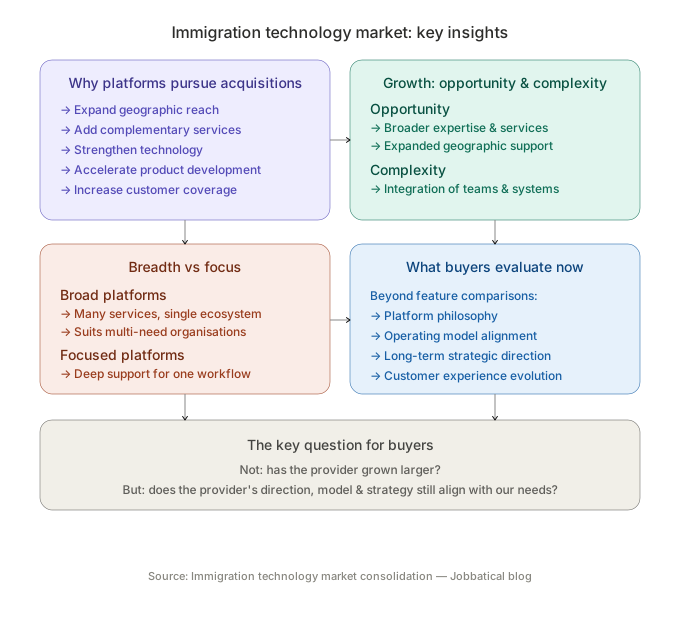
Acquérir une expertise en matière d'immigration européenne en partant de zéro, avec des équipes juridiques sur place, une expérience des démarches administratives auprès des autorités et une connaissance du terrain en Allemagne, en Espagne, au Royaume-Uni, au Portugal et au-delà, prend des années. Il est plus rapide d'acheter une entreprise qui dispose déjà de ces atouts.
Pour la société acquéreuse, la logique stratégique est claire :
- Se développer rapidement sur un nouveau marché géographique
- Se constituer une clientèle qu'ils n'avaient pas auparavant
- Proposer des offres groupées pour rivaliser avec les grands acteurs du marché
- Technologie d'accès ou infrastructure opérationnelle
Par exemple, Boundless est une société spécialisée dans l'immigration aux États-Unis ; l'acquisition de Localyze lui a permis de s'implanter en Europe sans avoir à partir de zéro. C'est une décision commerciale rationnelle. Mais qu'est-ce que cela signifie pour les entreprises qui font appel aux services de Localyze précisément en raison de son orientation européenne ?
Quels changements surviennent après une acquisition ?
Les premiers mois qui suivent une acquisition se passent généralement sans encombre. Les tarifs restent inchangés. Votre chargé de compte est toujours là. La plateforme semble identique. Le communiqué de presse annonce que « tout continue comme d'habitude ».
Ce qui évolue en réalité, souvent discrètement, sur une période de 12 à 24 mois, c'est l'orientation des priorités de la société issue de la fusion :
Feuille de route des produits
Les priorités de développement de la plateforme doivent désormais répondre aux besoins de deux clientèles réparties sur plusieurs zones géographiques. Les fonctionnalités qui revêtaient une importance capitale pour les entreprises axées sur le marché européen pourraient passer au second plan au profit des exigences du marché américain ou des efforts d'intégration à l'échelle mondiale.
Assistance et expertise
L'expertise en matière d'immigration sur place s'acquiert au fil des années et est étroitement liée à des personnes spécifiques. Une restructuration post-acquisition — même si elle part d'une bonne intention — peut perturber les équipes qui vous ont fourni la qualité de service pour laquelle vous aviez initialement choisi ce prestataire.
Orientation stratégique
Un spécialiste européen devient une division d'une plateforme mondiale. L'énergie qui était autrefois entièrement consacrée au marché européen est désormais répartie entre les Amériques, la région Asie-Pacifique et tous les nouveaux marchés que l'entité fusionnée cherche à conquérir. Ce n'est pas une critique, c'est simplement la réalité du fonctionnement des grandes organisations.
Rien ne garantit que ces changements vous porteront préjudice. Certaines entreprises sortent de ces acquisitions avec des produits réellement meilleurs. Mais vous ne devriez pas tenir pour acquise la continuité sans vous en assurer.
.svg)
Les questions que les équipes RH devraient se poser
Si votre prestataire actuel a fait l'objet d'une acquisition, ou si vous envisagez de faire appel à un prestataire qui a récemment changé de propriétaire, voici les questions à poser avant de vous engager :
Questions à poser à votre prestataire de soins
- Votre équipe d'assistance a-t-elle changé ?
- Qui s'occupera concrètement de vos dossiers au quotidien ?
- La feuille de route du produit porte-t-elle toujours principalement sur l'immigration en Europe ?
- Ou bien le développement s'oriente-t-il vers le marché principal de l'acquéreur ?
- Vos accords de niveau de service (SLA) sont-ils identiques ?
- Demandez une confirmation par écrit, et pas seulement par téléphone.
- À qui appartiennent vos données ?
- La localisation des données et la conformité au RGPD doivent être confirmées au sein de la nouvelle entité.
- Quel sera le modèle tarifaire à l'avenir ?
- Les acquisitions entraînent souvent une réorganisation des offres et une révision des tarifs dans les 18 mois qui suivent.
Si vous n'obtenez pas de réponses claires, cela vous apprend quelque chose d'important.
Élargissement ou spécialisation : le dilemme fondamental
Il existe un véritable débat sur ce marché entre deux modèles :
La plateforme mondiale tout-en-un
- Un seul prestataire s'occupe de tout : visas américains, autorisations européennes, conformité aux normes de la région Asie-Pacifique, installation à l'étranger, gestion des dépenses. L'intérêt réside dans la centralisation : moins de relations, un seul contrat, un seul tableau de bord.
- Le risque, c'est la dilution. Lorsqu'une plateforme tente de couvrir toutes les zones géographiques et tous les cas d'utilisation avec le même niveau de détail, elle parvient rarement à exceller dans chacune d'entre elles.
Le spécialiste européen
- Une plateforme spécialement conçue pour l'immigration européenne, dotée d'équipes juridiques sur place, d'une connaissance approfondie des procédures de visa en Allemagne, en Espagne, au Royaume-Uni et au Portugal, ainsi que d'une structure d'accompagnement adaptée aux processus RH européens, privilégie la profondeur plutôt que l'étendue.
- En contrepartie, vous devrez peut-être faire appel à un prestataire distinct pour les autres régions. Mais si c'est en Europe que se concentre l'essentiel de vos recrutements à l'international, cette expertise approfondie dans la région prime généralement sur une couverture mondiale.
- Dans la pratique, la plupart des équipes RH chargées du recrutement en Europe ont besoin du deuxième modèle. La complexité des règles européennes en matière d’immigration (qui varient d’un pays à l’autre), les exigences linguistiques, les délais variables, le regroupement familial et les renouvellements de titres de séjour justifient une spécialisation.
Ce que cela signifie si vous comparez Localyze et Jobbatical
Pour un aperçu complet et comparatif des fonctionnalités, des tarifs et des modèles de service, consultez la comparaison entreJobbatical et Localyze.
Un cadre pratique pour évaluer tout prestataire de services d'immigration
Que vous procédiez à une réévaluation après une acquisition ou à une première évaluation de fournisseurs, ces quatre critères sont plus importants que n'importe quelle liste de fonctionnalités :
Critères d'évaluation des prestataires
Conclusion
Les acquisitions font partie intégrante du processus de maturation des marchés technologiques. Elles ne sont pas en soi néfastes pour les clients. Mais elles entraînent des changements, et les équipes RH qui se retrouvent prises au dépourvu sont celles qui ont présumé de la continuité sans la vérifier.
Si votre prestataire de services d'immigration a fait l'objet d'une acquisition, gérez la situation comme vous le feriez pour tout changement majeur de fournisseur : relisez votre contrat, posez les questions qui fâchent et assurez-vous que le service pour lequel vous payez existe toujours sous la forme dont vous avez besoin.
Si vous partez de zéro, recherchez un prestataire dont les priorités correspondent aux vôtres. Dans le domaine de l'immigration européenne, cela signifie quelqu'un dont l'offre, l'équipe et la stratégie sont entièrement axées sur le problème précis que vous cherchez à résoudre.
C'est l'une des raisons pour lesquelles les comparaisons telles que « Localyze vs Jobbatical » prennent de plus en plus d'importance. Le débat porte souvent moins sur les fonctionnalités individuelles que sur la manière dont les différents prestataires abordent la croissance, la spécialisation, l'expérience client et l'exécution opérationnelle. Comprendre ces différences aide les organisations à évaluer les prestataires à l'aune de leurs propres priorités plutôt qu'en se basant uniquement sur les tendances du marché.
Foire aux questions : Acquisition d'une plateforme dédiée à l'immigration
Pourquoi y a-t-il autant d'acquisitions sur le marché des technologies liées à l'immigration ?
Le marché des technologies liées à l'immigration entre dans une phase de maturité. Les prestataires procèdent à des regroupements afin d'accélérer leur croissance, d'étendre leur couverture géographique, de renforcer leur position sur le marché et de proposer de nouveaux services plus rapidement qu'en les développant en interne. Les acquisitions permettent aux entreprises de se développer plus rapidement et d'offrir des solutions plus complètes à leurs clients.
En quoi ces acquisitions ont-elles un impact sur l'expérience utilisateur au quotidien ?
Les acquisitions sont à la fois source d'opportunités et de défis. Les clients peuvent ainsi bénéficier d'une gamme de services plus étendue, d'une infrastructure plus solide et d'équipes d'assistance plus importantes. Dans le même temps, ils peuvent être confrontés à des intégrations de plateformes, à l'évolution des feuilles de route des produits, à des changements dans les processus de travail ou à des ajustements des processus d'assistance client à mesure que les entreprises fusionnent.
Quelle est la différence entre l'étendue d'une plateforme et sa spécialisation ?
L'étendue d'une plateforme désigne un écosystème « tout-en-un » couvrant un large éventail de services liés à l'immigration, à la mobilité internationale, à la conformité et à la relocalisation. L'orientation d'une plateforme désigne quant à elle une solution spécialisée conçue pour optimiser en profondeur un flux de travail ou un processus opérationnel spécifique. Ces deux approches présentent chacune des avantages en fonction des priorités de votre organisation.
Faut-il opter pour une plateforme généraliste ou pour un spécialiste ciblé ?
Le choix qui s'impose dépend de votre objectif principal. Une plateforme polyvalente peut s'avérer plus adaptée si vous souhaitez regrouper plusieurs prestataires et gérer les services liés à l'immigration, à la relocalisation et à la mobilité à partir d'un seul et même endroit. Un prestataire spécialisé peut être préférable si votre priorité est d'atteindre un niveau maximal d'efficacité et d'expertise dans un domaine opérationnel spécifique.
Pourquoi les listes de contrôle des fonctionnalités logicielles perdent-elles de leur utilité ?
La plupart des plateformes dédiées à l'immigration et à la mobilité proposent désormais des fonctionnalités de base similaires, ce qui rend les listes de fonctionnalités moins efficaces en tant qu'outil d'aide à la décision. Les acheteurs évaluent de plus en plus les prestataires en fonction de leur stratégie à long terme, de leur modèle de prestation de services, de la qualité de leur service client, de leur feuille de route en matière d'innovation et de leur capacité à s'adapter aux besoins futurs de l'entreprise, plutôt qu'en se basant sur des fonctionnalités individuelles.
Que signifient réellement des comparaisons telles que « Localyze vs Jobbatical » ?
Les comparaisons telles que celle entre Localyze et Jobbatical vont au-delà des fonctionnalités individuelles. Elles reflètent souvent des philosophies d’entreprise, des stratégies de croissance, des atouts géographiques, des modèles de service et des approches en matière d’assistance client différents. L’évaluation de ces différences peut aider les organisations à identifier le prestataire qui correspond le mieux à leurs priorités opérationnelles et à leurs objectifs à long terme.

.svg)
.svg)