.svg)


.avif)
- Short-Stay Visas: Working holiday visa allows a one-year stay, with some agreements permitting extensions.
- Long-Stay (National) Visas: Covers work visas (Highly Qualified Professional, Cuenta Ajena, EU Blue Card, ICT, Digital Nomad, Freelancer), plus student, job search, family reunion, non-lucrative, and temporary residence permits (Arraigo, asylum).
- Duration & Nationality: Ranges from 3 months to 5 years by visa type; primarily for non-EU/EEA/Swiss nationals, with provisions for EU family members.
- Application Process: Filed at Spanish consulates in the home country or immigration offices in Spain, depending on visa type and legal status.
When relocating international talent to Spain, grasping the numerous Spain visa options is a vital first step. Securing the appropriate visa ensures your employees can legally live and work in the country, but navigating the diverse Spanish visa categories can be complex. This guide breaks down what employers need to comprehend about the most frequent Spanish visas, assisting HR and Global Mobility teams in making the best decisions to support their international hires.
Selecting the appropriate visa for global employees allows them to legally reside and work in Spain while preventing unnecessary delays. The ideal choice hinges on variables such as the job description, the applicant's qualifications, and the intended duration of stay. For employers, understanding these pathways streamlines recruitment and guarantees adherence to Spanish immigration regulations. Furthermore, the chosen visa can affect an employee's capability to bring family members, access public services, and eventually pursue permanent residency or citizenship.
Related Read:
Read how the permanent residence step works in our Spain permanent residence requirements guide.
Spanish Visas Comparison Table
Work Visas in Spain
For non-EEA nationals with a job offer, Spain offers several Spain work visa options. These permits generally have a maximum duration of three years.
Work Visas with a Spanish Work Contract
When a non-EEA national secures an employment offer from a Spanish company, they are eligible to pursue a work visa. The primary options include:
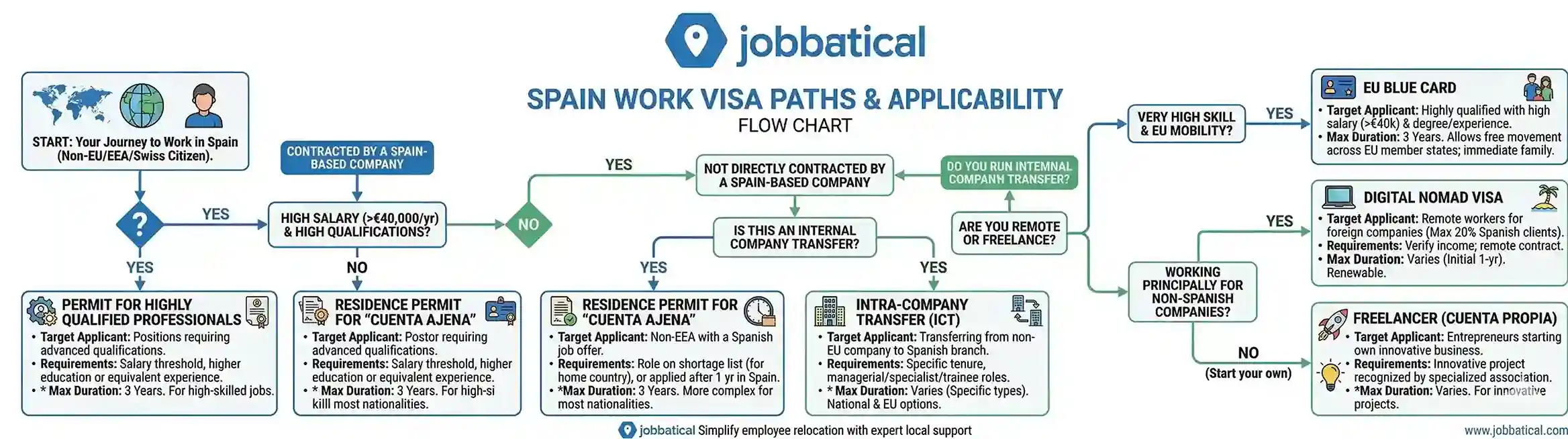
Permit for Highly Qualified Professionals:
Tailored for positions needing advanced expertise, generally mandating a salary above €40,000 annually. Salary thresholds may be lowered for applicants under 30. A university degree or comparable professional experience is typically required.
Read complete guide on Permit for Highly Qualified Professionals, designed for qualifying non-EU professionals.
Residence Permit for "Cuenta Ajena"
This permit is available to individuals who have legally resided in Spain for one year. Citizens of Peru or Chile can apply directly from their home countries. For other nationalities, applying from abroad is usually restricted to roles listed on Spain's shortage occupation list, making it a much more rigorous process.
If the role does not qualify for a specialised immigration route, the Spain Cuenta Ajena General Employment Permit may be the appropriate option for hiring non-EU employees.
EU Blue Card
To be eligible for an EU Blue Card, candidates must hold a higher professional qualification (like a three-year bachelor's degree) or possess at least five years of relevant work experience. The base salary normally must exceed €40,000. Unlike standard Spanish work visas, this permit eventually grants free movement across other EU member states without additional bureaucratic hurdles. It also allows immediate relatives, such as spouses and children, to reside in the EU for the applicant's full term.
For employers considering alternative routes for highly skilled talent, the Spain EU Blue Card offers a dedicated pathway for qualifying non-EU professionals.
Employment Contract in the Country of Origin
For employees who have an employment contract with a company outside Spain, specific Spanish visa types allow them to work remotely or transfer:
1) The Company Has an Entity in Spain - Intra-Company Transfer
A company or group with establishments in both Spain and a non-EU country can request a residence visa for intra-company transfer for foreign professionals over 18 years old who are not EU or Schengen state nationals. This applies within the context of employment, professional relationships, or previous professional training. The employee must have been employed by the company for a specific period. The roles are typically managerial, specialist or trainee roles.
There are two types of intra-company transfer residence authorizations:
- National Residence Authorization: For foreigners transferring exclusively to a company within Spanish territory.
- ICT-EU Residence Authorization: For foreigners who will be subject to an intra-company transfer that implies mobility within the European Union. This type of authorization only applies to temporary relocations for roles as a manager, specialist, or trainee.
For a detailed overview of relocating employees within the same corporate group, read our complete guide to the Spain Intra-Company Transfer (ICT) Permit.
2) The Company Has No Entity in Spain - Digital Nomads (Teletrabajadores de carácter internacional)
Non-EU nationals may apply for a residence permit for international teleworking, commonly known as the Spanish Digital Nomad Visa. This permit allows them to work remotely for companies outside Spain using exclusively digital means.
Regarding work requirements:
- In the case of labor activity, the permit holder can only work for companies located outside Spain. This framework clarifies the requirements for Spanish Digital Nomad Visa for remote work.
- In the case of professional activity, the permit holder can work for a company in Spain, provided this does not exceed 20% of their total professional activity.
The Digital Nomad Visa typically allows spouses to work remotely for non-Spanish companies. However, if they wish to pursue local employment in Spain, a separate work permit might be required.
For professionals looking to work remotely from Spain, read our complete guide to the Spain Digital Nomad Visa to understand the eligibility requirements, application process, and key benefits.
Family Reunion Visa in Spain (Visado de Reagrupación Familiar)
The family reunion visa allows family members of legal residents in Spain to join them. The applicant must have been a legal resident of Spain for at least one year.
Eligible family members for a family reunion visa include:
- A spouse or registered partner
- Children under 18 or dependent children
- Parents over 65 who are dependent on the applicant
Foreigners residing in Spain who do not have permits for family members or dependents included in their residence status can bring their relatives if they have been living in Spain legally for at least one year. Note that the Spain family reunion visa processing time can vary. The Spain family reunion visa requirements ensure genuine family ties.
EU Family Member Visa in Spain (Visado de Residencia de Familiar de Ciudadano de la UE)
Non-EU, non-EEA, or non-Swiss family members of EU, EEA, or Swiss citizens residing in Spain who plan to stay in Spain for more than three months to visit or accompany their family member need to apply for an EU family member Visa.
Eligibility for this Visa includes:
- Spouse or Registered Partner: Must be married or in a registered partnership.
- Direct Children and Ancestors: Includes dependent children under 21 and parents under the care of the EU citizen.
- Dependent and Cohabiting Family Members: Those dependent on the EU citizen or living with them for at least 24 months.
- Unregistered Partners: Stable relationships proven by cohabitation or common offspring.
The residence card for a family member visa in Spain of an EU citizen is valid for five years from the date of issuance or for the duration of the EU citizen's expected stay, if it is less than five years. After five years, the card can be renewed and converted into permanent residence.
For employees relocating to Spain with their families, read our complete guide to family reunification for non-EU residents in Spain to understand eligibility, requirements, and the application process.
Non-Lucrative Residence Visa in Spain (Permiso de Residencia No Lucrativa)
A non-lucrative residence visa in Spain allows non-EU nationals to live in Spain without engaging in any work activities. It is initially valid for one year and can be renewed annually, provided the holder has not exceeded the maximum allowed absences from Spain.
The requirements include:
- Financial Means: Proof of sufficient financial resources to support oneself without working in Spain.
- Health Insurance: Demonstrated health coverage through a private health insurance.
The Spanish non-lucrative residence Visa can also be applied for if the applicant is already legally residing in Spain. In these cases, obtaining a visa is not necessary, and the application for the residence permit can be done directly. This Visa is a form of a temporary residence permit in Spain.
Work and Residence Permit (Permiso de residencia y trabajo por Cuenta Propia)
There is an entrepreneur residence permit, provided that they are willing to start their own business in Spain, and that it is innovative. This project must be recognized as innovative by a specialized association.
Temporary Residence Authorization for Exceptional Circumstances: Arraigo
The residency based on arraigo is a type of temporary residence permit by which legal residency can be granted to foreigners who are in Spain in an irregular situation. There are three types (Family, Labor and Social). All of them require having resided in Spain for a certain period of time. This is a specific temporary residence permit aimed at regularization.
Related Read:
The 2026 rules cut the arraigo residence requirement from three years to two: Spain immigration updates for employers
Internships (Permiso de residencia para Prácticas Profesionales)
Applicants who have obtained a higher education diploma within the last two years can apply for this type of permit, which is valid for up to one year and is non-renewable. The key requirement is a higher education diploma related to the internship position at the host company.
Applications can be made either from within Spain if the applicant holds a stay permit, or from their home country. There are two ways to apply:
- University Agreement (Convenio Universitario): This option allows for a maximum duration of six months, with the possibility of extending for an additional six months.
- Internship Contract: This option permits a direct one-year internship contract.
Spanish Student Visa (Estancia por Estudios)
The student visa is intended for those who want to study or conduct research in Spain. It applies to university degrees, master's degrees, doctorates, and other regulated and permitted short-term courses. With this permit, it’s possible to enroll in studies at accredited institutions, participate in research or training programs, join student exchange programs, perform non-work placements, and engage in volunteer services as a student.
The student visa requirements include:
- Admission to an accredited educational institution or recognized research/training center.
- A signed agreement with a relevant organization if volunteering.
The duration of the student visa matches the length of the studies, ranging from 3 to 9 months or even 2 to 4 years. In most cases, depending on the type of studies, the permit allows the holder to work in Spain for up to 30 hours per week without needing additional work authorization. After completing their studies, students can convert the visa into a work permit directly.
Job Search Visa in Spain (Búsqueda de Empleo)
The job search visa, also known as the Employment Seeking Residence Permit, allows non-EU students to stay in Spain for a maximum period of 2 years after completing their studies to look for a job or start a business project. This permit can be requested by foreigners who have previously held a stay permit for studies and have completed their studies at an accredited higher education institution in Spain, achieving at least Level 6 according to the European Qualifications Framework, equivalent to a university degree. If family members have accompanied the student during their studies, they are also covered by this permit while the student searches for work.
Working Holiday Visa in Spain
The working holiday visa allows young people from selected countries to live and work in Spain for a limited period. Spain currently has Visa agreements with five countries: Australia, New Zealand, Canada, South Korea, and Japan.
This working holiday visa typically allows for a one-year stay, but some agreements provide the possibility of extending the stay from 3 months up to 24 months, provided certain requirements are met during the stay. Visa holders are allowed to work during their stay. If they wish to extend their stay, Jobbatical recommends the employer use this period to formally apply for a residence and work permit.
Spain work visa paths and applicability flow chart
How Can Employers Support Employees Through the Visa Process?
Employers can play an important role in helping employees through the visa application process. By identifying the right types of visas, sharing clear guidance on required documents, and assisting with appointments, employers can make the process easier for their teams. Connecting employees with local resources, such as specialized Spanish visa options assistance, is a great way to offer dedicated support and ensure a successful application.
Conclusion
Navigating the diverse Visa options for Spain can be challenging, but understanding the types of Spanish Visas available is vital for successful international hiring. From various work visa requirements to options for temporary residence permit or family reunification, each path has specific criteria.
Jobbatical specializes in end-to-end global mobility, providing full support for the relocation of skilled professionals to Spain for employers and their employees. Our expert team takes care of all the time-consuming immigration and settling-in procedures, for complete peace of mind through the entire relocation process. Learn more about our services here.
Disclaimer: Immigration rules change quite frequently; please verify with official sources or contact us for the latest info before making any decisions.
Frequently Asked Questions About Spain Visa Options and Requirements
What distinguishes work visas like the EU Blue Card from the Digital Nomad Visa?
Work visas require a Spanish employer and local salary, while the Digital Nomad Visa is for remote workers serving foreign employers or clients.
What is the duration of the Non-Lucrative Residence Visa?
It is valid for 1 year initially, renewable, and does not allow any work activity.
Who qualifies for an EU Family Member Visa?
Non-EU family members of EU, EEA, or Swiss citizens, with residence cards typically valid up to 5 years.
How long is the post-study Job Search Visa?
It is valid for up to 2 years for non-EU graduates of Level 6+ studies in Spain.
What is required for the Freelancer Residence Permit?
Applicants must submit a business plan for an innovative project recognized by a specialized Spanish association.
What work rights does the Student Visa provide?
Students can work up to 30 hours per week alongside their studies.

.svg)
.svg)