.svg)



POINTS CLÉS
- La règle des 180 jours correspond à une période de référence glissante de 12 mois, et non à une limite fixée par l'année civile. Une période de déplacements intensifs survenant en milieu de cycle peut compromettre l'éligibilité au titre de l'ILR plusieurs années avant le dépôt de la demande.
- Les déplacements professionnels sont considérés comme des absences dans le cadre du statut de résident permanent (ILR) pour les travailleurs qualifiés, sauf s'ils relèvent d'une exception très limitée prévue par le Home Office (recherche approuvée, action humanitaire ou raisons humanitaires impérieuses).
- Le ministère de l'Intérieur examine toutes les périodes de 12 mois possibles au cours de la période de référence de 5 ans ; deux voyages effectués à 11 mois d'intervalle peuvent tous deux se situer dans la même période glissante.
- Les alertes « Amber » déclenchées à 130 jours avant le départ (sur une période glissante) laissent aux RH le temps de modifier l'itinéraire ; les alertes « rouges » déclenchées à 150 jours ou plus nécessitent l'avis du service de l'immigration avant la réservation du prochain voyage.
Déplacements professionnels : le risque lié à l'ILR qui se cache dans les carnets de route de vos salariés
La demande est rejetée. Les frais sont perdus, le maintien du statut est compromis et le délai de parrainage est remis à zéro. Ce guide explique le fonctionnement de la règle, précise quels types de déplacements professionnels entraînent la perte d'éligibilité et indique comment mettre en place un système de suivi des absences. Pour consulter l'ensemble de la documentation relative à l'établissement définitif, reportez-vous à notre guide à l'intention des employeurs concernant le statut ILR au Royaume-Uni.
Comment fonctionne concrètement la règle des 180 jours ?
Cette règle est énoncée dans les directives du ministère de l'Intérieur relatives à la résidence continue et s'applique aux voies d'accès au statut de résident permanent (ILR) suivantes : « Travailleur qualifié », « Professionnel de la santé et des soins », « Talents internationaux », « Scale-up », ainsi qu'à la plupart des autres voies d'accès au statut de résident permanent fondées sur l'emploi.
Mécaniques de base :
- Votre salarié ne doit pas avoir passé plus de 180 jours entiers hors du Royaume-Uni au cours d'une période de 12 mois consécutifs pendant les années de référence.
- La période de 12 mois est une période glissante, et non une année civile fixe.
- Les absences antérieures à l'entrée physique du salarié au Royaume-Uni (la période comprise entre la date de début de validité du visa et son arrivée) sont également prises en compte dans la première période glissante.
- Une seule interruption au cours d'une période glissante suffit à rompre la continuité de la résidence.
- Les absences d'une partie de la journée, d'une durée inférieure à 24 heures, ne sont pas prises en compte ; toute absence s'étendant au-delà de minuit est comptabilisée comme une journée entière.
Deux voyages effectués à 11 mois d'intervalle peuvent se situer dans la même période glissante de 12 mois. Si chaque voyage dure 100 jours, tout semble correct dans la vue calendrier, mais la vérification de la période glissante indique 200 jours et l'application renvoie une erreur.
Vérifiez votre calendrier de régularisation au Royaume-Uni à l'aide du calculateur d'éligibilité à l'ILR et déterminez la date la plus proche à laquelle vous pouvez déposer votre demande.
Affichage glissant ou affichage calendrier
Les quatre types de déplacements professionnels qui entraînent la perte du droit aux prestations
Si l'une de ces situations vous semble familière, votre risque lié à l'absentéisme est déjà en train d'augmenter.
- Accompagnement de produit ou de lancement à l'étranger. Un ingénieur senior ou un chef de projet est détaché au sein d'une équipe à l'étranger pendant 3 à 4 mois. En interne, cela s'apparente à un travail de projet classique ; du point de vue de l'immigration, il s'agit d'un pic d'activité ponctuel.
- Interventions sur site chez le client. Les postes dans les domaines du conseil, de l’informatique et des services impliquant une forte composante opérationnelle nécessitent l’envoi de personnel sur les sites des clients pendant plusieurs semaines d’affilée. Les déplacements répétés au cours d’une période donnée s’accumulent rapidement.
- Missions liées aux TIC effectuées avec un visa inadapté. Des titulaires d’un visa « Travailleur qualifié » envoyés dans le cadre de détachements temporaires informels plutôt que via le programme « Global Business Mobility ». Les déplacements ont bien lieu, mais leur suivi fait souvent défaut. Consultez notre guide sur la distinction entre les activités de visiteur et les activités professionnelles au Royaume-Uni.
- Des conférences et des salons professionnels qui s'enchaînent. De courte durée pris individuellement, mais qui, cumulés, représentent un volume important. Un commercial expérimenté qui participe à huit événements régionaux sur deux continents peut facilement totaliser entre 60 et 80 jours par an, sans compter ses déplacements personnels.
Qu'est-ce qui est considéré comme une absence, et qu'est-ce qui ne l'est pas ?
Le ministère de l'Intérieur considère la plupart des déplacements professionnels comme des absences ordinaires. Il n'existe pas d'exemption automatique pour les voyages d'affaires. Un nombre restreint d'exceptions est défini dans le règlement sur l'immigration.
Absences qui ne sont pas prises en compte dans le calcul de la limite des 180 jours
Les voyages d'affaires courants n'entrent dans aucune de ces catégories. Partons du principe qu'ils sont pris en compte.
Outil de suivi des absences ILR : suivez les absences de vos employés
La plupart des équipes RH ne commencent à suivre sérieusement les absences qu’à partir de la quatrième année, lorsque les démarches d’ILR sont engagées. À ce stade, le préjudice est déjà constaté. Le suivi doit débuter dès le premier jour du visa de travailleur qualifié et se poursuivre jusqu’au jour du dépôt de la demande d’ILR. Consultez notre outil de suivi des absences pour l’ILR.
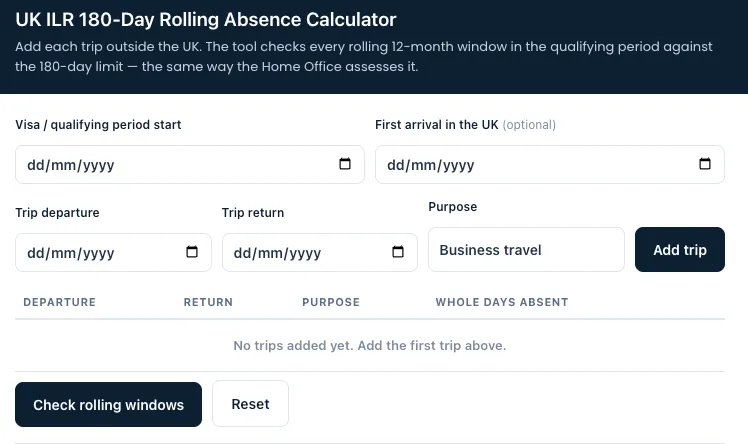
Consultez également notre calculateur gratuit d'éligibilité au statut ILR au Royaume-Uni, qui effectue d'autres vérifications.
Seuils d'alerte justifiant une intervention des RH
Si votre salarié a déjà dépassé les 180 jours
Ne partez pas du principe que la demande est caduque. Il existe trois pistes qu'il vaut la peine d'explorer avant de considérer que le délai de validité est écoulé.
- Vérifiez les motifs d'exception. Si une absence était liée à des travaux de recherche approuvés par le parrain, à un deuil familial ou à une situation de crise reconnue par le Home Office, rassemblez les pièces justificatives et préparez une demande de dérogation.
- Recalculez à partir de la date de début la plus favorable. Le Home Office autorise les demandeurs à compter la période de référence à rebours à partir de la date de dépôt de la demande, jusqu’à 28 jours après celle-ci, ou à partir de la date de la décision, selon ce qui leur est le plus favorable. Ce délai de 28 jours peut parfois faire en sorte qu’un manquement ne soit plus du tout pris en compte dans la période de référence.
- Prévoyez un « redémarrage ». Si aucune exception ne s'applique, le parrainage est prolongé. Prévoyez dans votre budget un nouveau cycle de la « Immigration Skills Charge », un certificat de parrainage mis à jour et un nouveau délai de cinq ans. La période d'éligibilité pouvant passer à 10 ans dans le cadre du modèle de régularisation au mérite, le coût d'un « redémarrage » ne fera qu'augmenter.
Et n'oubliez pas que les salariés amenés à voyager fréquemment ne peuvent pas quitter le Royaume-Uni tant que leur demande d'ILR est en cours d'examen — les services « prioritaires » et « super prioritaires » permettent de réduire ce délai d'interdiction de voyage de plusieurs mois à quelques jours.
Avertissement : les règles en matière d'immigration changent assez fréquemment ; veuillez vous renseigner auprès de sources officielles ou nous contacter pour obtenir les dernières informations avant de prendre toute décision.
Foire aux questions : Règle des 180 jours pour le statut de résident permanent (ILR) au Royaume-Uni et voyages d'affaires

.svg)
.svg)