.svg)


POINTS CLÉS
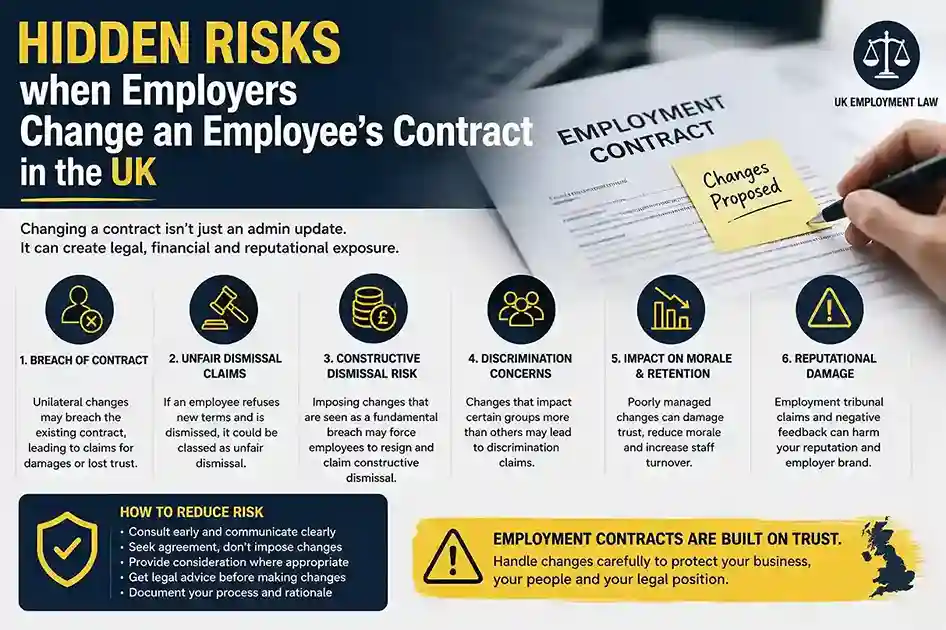
- Règles britanniques relatives à la modification des contrats : tout changement ne peut prendre effet qu'avec l'accord du salarié ou en présence d'une clause de flexibilité valide.
- Les modifications unilatérales peuvent entraîner une rupture de contrat, un licenciement déguisé et un risque de recours devant le tribunal du travail, notamment en matière de rémunération, d'horaires ou de lieu de travail.
- Une notification écrite doit être envoyée dans un délai d'un mois à compter de toute modification des conditions essentielles, conformément à l'article 4 de la loi sur les droits du travail.
- Un simple changement de intitulé de poste comporte généralement peu de risques, mais les modifications des attributions peuvent nécessiter une consultation et une mise à jour de la documentation
- Les travailleurs parrainés titulaires d'un visa impliquent une obligation supplémentaire : le ministère de l'Intérieur doit être informé par SMS dans un délai de 10 jours ouvrables.
Les risques cachés liés aux modifications de contrat au Royaume-Uni
- Le piège de la restructuration. Un responsable hiérarchique modifie trois descriptions de poste en plein processus de restructuration, envoie un e-mail aux collaborateurs concernés et fait l'impasse sur la consultation : une erreur courante qui peut entraîner des problèmes immédiats de conformité, en particulier pour les salariés internationaux pris en charge par l'entreprise.
- Les répercussions d'un licenciement déguisé. Six semaines plus tard, l'un des salariés concernés dépose une plainte pour licenciement déguisé. C'est à ce moment précis que la plupart des équipes RH se rendent compte que les règles britanniques en matière de modification de contrat sont bien plus strictes qu'elles ne le pensaient, ce qui risque de compromettre votre licence de sponsor britannique.
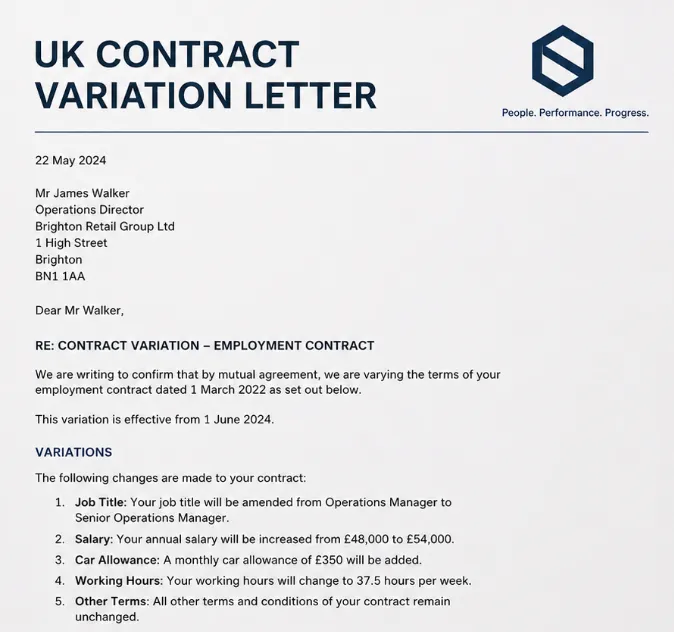
- Tout savoir sur les règles applicables aux employeurs en 2026. Voici précisément ce que les employeurs peuvent et ne peuvent pas faire en 2026, ainsi qu'un modèle de avenant contractuel que vous pouvez adapter. Pour garantir un suivi fiable de chaque modification, vous pouvez centraliser vos dossiers à l'aide de notre plateforme de gestion des dossiers.
┈┈┈┈┈┈┈┈┈┈┈┈┈┈┈┈┈┈┈┈┈┈┈┈┈┈┈┈┈┈┈┈┈┈┈┈┈┈┈┈┈┈┈┈┈┈┈
Un employeur peut-il modifier votre contrat au Royaume-Uni ?
Uniquement en cas d'accord, de clause valide ou de procédure légale. L'employeur ne dispose d'aucun droit automatique de modifier les conditions.
- D'un commun accord. La solution la plus simple : vous faites une proposition, le salarié signe, puis vous rédigez une lettre de modification du contrat.
- Clause de flexibilité. Elle ne s'applique que si la clause est précise et si la modification est raisonnable.
- Convention collective. Lorsqu'un syndicat reconnu a négocié des dispositions qui sont reprises dans les contrats.
- Droit légal. Les salariés peuvent exiger certaines modifications (horaires flexibles, interdiction de travailler le dimanche dans le secteur du commerce de détail).
- Licenciement et réembauche. Mesure de dernier recours, strictement encadrée par le Code de bonnes pratiques de 2024.
┈┈┈┈┈┈┈┈┈┈┈┈┈┈┈┈┈┈┈┈┈┈┈┈┈┈┈┈┈┈┈┈┈┈┈┈┈┈┈┈┈┈┈┈┈┈┈
Modification des conditions d'emploi : ce qui est pris en compte
Toutes les modifications ne constituent pas nécessairement une adaptation légale. Certaines relèvent des clauses de flexibilité ; d'autres modifient fondamentalement l'accord.
- Conditions matérielles. Le salaire, les horaires, les congés, le délai de préavis, le lieu de travail et les missions principales doivent tous faire l'objet d'un accord.
- Modifications administratives mineures. En général, le changement de supérieur hiérarchique ou de ligne hiérarchique ne nécessite pas de modification signée.
- Règlement interne vs contrat. Les dispositions du règlement interne qui ne relèvent pas du contrat peuvent souvent être mises à jour sans modification formelle.
- Clauses implicites. Une pratique de longue date (par exemple, une prime annuelle versée depuis 15 ans) peut acquérir force de contrat ; il convient de la traiter avec prudence.
- Changements défavorables. Toute mesure entraînant une réduction du salaire, du temps de travail ou du statut doit faire l'objet d'une consultation formelle.
┈┈┈┈┈┈┈┈┈┈┈┈┈┈┈┈┈┈┈┈┈┈┈┈┈┈┈┈┈┈┈┈┈┈┈┈┈┈┈┈┈┈┈┈┈┈┈
Quel est le délai de préavis requis pour modifier les clauses d'un contrat au Royaume-Uni ?
Il y a un minimum légal et un minimum pratique. Ce ne sont pas la même chose.
- Disposition réglementaire. Les informations écrites doivent être mises à jour par écrit dans un délai d'un mois à compter de la modification (ERA 1996, art. 4).
- Période de consultation. 30 à 45 jours de consultation effective pour les modifications substantielles.
- Consultation collective. Se déclenche dès que 20 personnes ou plus sont concernées ; durée minimale de 30 jours, 45 jours si l'entreprise compte 100 salariés ou plus.
- Modifications du délai de préavis. Le délai de préavis en vigueur s'applique à la mise en œuvre.
- Une marge de manœuvre raisonnable. Honnêtement, six semaines, c'est le minimum pour tout ce qui touche au salaire ou au lieu de travail.
┈┈┈┈┈┈┈┈┈┈┈┈┈┈┈┈┈┈┈┈┈┈┈┈┈┈┈┈┈┈┈┈┈┈┈┈┈┈┈┈┈┈┈┈┈┈┈
Changement de fonction : règles britanniques en matière de droit du travail
Les changements de intitulé de poste peuvent sembler anodins. Mais ce n'est pas toujours le cas.
Un employeur peut-il modifier l'intitulé d'un poste sans le consentement de l'employé ?
Uniquement si cela reste purement symbolique. Les fonctions, la rémunération, l'ancienneté et la hiérarchie doivent rester inchangées. Tout changement vers le bas est considéré comme une rétrogradation, et les rétrogradations nécessitent un accord préalable.
- Un changement de dénomination, ça va. Passer de « Responsable du service client » à « Spécialiste de la réussite client » : c'est le même poste, aucun accord n'est nécessaire.
- Toute extension des fonctions doit être approuvée. L'ajout de responsabilités en matière de gestion hiérarchique ou de compte de résultat change la donne.
- Les rétrogradations comportent des risques. Au Royaume-Uni, les recours intentés contre les employeurs qui modifient l'intitulé d'un poste sans le consentement de l'employé aboutissent régulièrement lorsque cela entraîne une baisse d'ancienneté.
- Les travailleurs parrainés nécessitent une attention particulière. La création d'un nouveau poste associé à un code SOC différent déclenche l'obligation de déclaration auprès du Home Office. Passez notre évaluation de conformité relative à la licence de parrainage au Royaume-Uni afin de vous assurer que vous êtes prêt à faire face à un audit.
- Consignez tout par écrit. Même les modifications anodines doivent faire l'objet d'une brève lettre de modification.
┈┈┈┈┈┈┈┈┈┈┈┈┈┈┈┈┈┈┈┈┈┈┈┈┈┈┈┈┈┈┈┈┈┈┈┈┈┈┈┈┈┈┈┈┈┈┈
Modification unilatérale d'un contrat au Royaume-Uni : les risques
Une modification unilatérale du contrat de travail imposée par les employeurs britanniques sans le consentement du salarié constitue une violation. Point final.
- Action en rupture de contrat. Le salarié intente une action en dommages-intérêts, dont le montant correspond généralement à la valeur de la clause modifiée.
- Licenciement déguisé. Un salarié démissionne et affirme que votre manquement l'a contraint à partir ; s'il justifie d'au moins deux ans d'ancienneté, cela constitue un licenciement abusif.
- Prélèvement illégal sur le salaire. Toute réduction de salaire sans accord préalable donne lieu à une plainte devant le tribunal du travail pour obtenir le paiement du montant manquant, majoré des intérêts.
- Travailler sous réserve. Les salariés qui formulent une objection formelle tout en continuant à travailler conservent leur droit de saisir la justice.
- Majoration par le tribunal. Le non-respect du code de bonnes pratiques entraîne une majoration de 25 % du montant de toute indemnité accordée.
┈┈┈┈┈┈┈┈┈┈┈┈┈┈┈┈┈┈┈┈┈┈┈┈┈┈┈┈┈┈┈┈┈┈┈┈┈┈┈┈┈┈┈┈┈┈┈
Modèle de lettre de modification de contrat (Royaume-Uni)
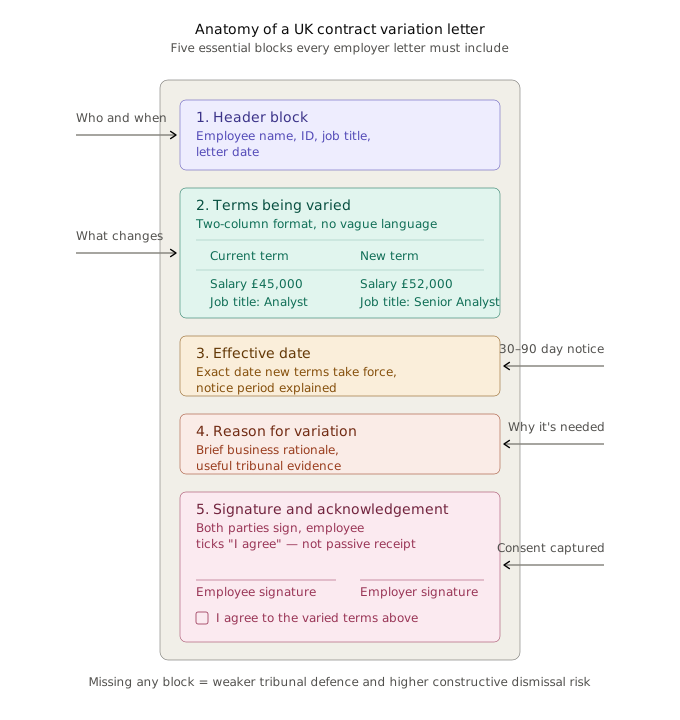
Un modèle de lettre de modification de contrat adapté, que les équipes britanniques peuvent adapter à leurs besoins, doit comporter des clauses spécifiques, des dates et un bloc de signature.
- En-tête. Nom de l'employé, numéro d'identification, poste actuel, date de la lettre.
- Modification des conditions. Chaque condition (ancienne et nouvelle) est présentée sur deux colonnes ; pas de formulation ambiguë.
- Date d'entrée en vigueur. Date exacte à laquelle les nouvelles conditions prennent effet, avec indication du délai de préavis.
- Motif de la variation. Brève justification commerciale ; élément de preuve utile en cas de contestation ultérieure.
- Signature et acceptation. Les deux parties signent ; l'employé coche la case « J'accepte » plutôt que d'accepter passivement.
Vous gérez les modifications apportées aux contrats de vos employés internationaux parrainés ? Réservez une démonstration pour découvrir comment Jobbatical automatise la déclaration par SMS, protège votre licence de parrainage britannique et propose des solutions fiables en matière de conformité aux réglementations sur les visas et l'immigration. Découvrez l'ensemble de nos services d'immigration professionnelle ou notre page dédiée au visa britannique pour travailleurs qualifiés.
┈┈┈┈┈┈┈┈┈┈┈┈┈┈┈┈┈┈┈┈┈┈┈┈┈┈┈┈┈┈┈┈┈┈┈┈┈┈┈┈┈┈┈┈┈┈┈
Licenciement puis réembauche après l'entrée en vigueur de la loi de 2025 sur les droits du travail
La pratique consistant à licencier puis réembaucher un salarié restera légale en 2026, mais elle ne sera plus aussi simple. La loi de 2025 sur les droits du travail (Employment Rights Act 2025) durcit considérablement les règles à compter du 1er janvier 2027 ; toute stratégie de flexibilité que vous mettez en place dès maintenant doit donc tenir compte de ces changements à venir.
- Les modifications soumises à des restrictions deviennent à haut risque. À partir de 2027, le licenciement d'un salarié pour avoir refusé des changements concernant la rémunération, la retraite, les horaires, les congés ou les rotations de service sera généralement considéré comme abusif de plein droit.
- Les nouvelles clauses de modification sont également concernées. L'insertion, dans un contrat existant, d'une clause vous permettant de modifier unilatéralement les conditions est en soi considérée comme une modification soumise à restriction.
- Le principe du « dernier recours » devient plus strict. Le Code de 2024 en vigueur exige déjà une véritable consultation et la saisine de l’Acas ; les réformes de 2025 restreignent encore davantage la marge de manœuvre en matière de licenciement et de réintégration.
- Passez dès maintenant vos dispositifs en revue. Procédez à un audit des clauses de flexibilité existantes et des lettres types de modification avant 2027 afin de vous assurer qu’elles restent valables dans le cadre du nouveau régime.
┈┈┈┈┈┈┈┈┈┈┈┈┈┈┈┈┈┈┈┈┈┈┈┈┈┈┈┈┈┈┈┈┈┈┈┈┈┈┈┈┈┈┈┈┈┈┈
Modification du contrat à la suite d'un transfert au titre du TUPE
Lorsque des salariés vous sont transférés dans le cadre du TUPE, leurs conditions de travail existantes sont transférées avec eux et bénéficient d'une protection très stricte. C'est en essayant d'« harmoniser » ces conditions avec celles de leur propre personnel que les employeurs commettent le plus souvent des erreurs.
- Les modifications liées à un transfert sont généralement nulles. Une modification est généralement inopposable si elle est motivée uniquement ou principalement par le transfert lui-même.
- L'harmonisation est un piège. Aligner les conditions de travail du personnel transféré sur votre contrat type peu après un transfert est exactement le genre de changement que les tribunaux rejettent.
- Certaines modifications restent possibles. Des modifications justifiées par des raisons économiques, techniques ou organisationnelles valables, ou qui n'ont véritablement aucun lien avec le transfert, peuvent être autorisées à condition de respecter la procédure appropriée.
- Les transferts de salariés parrainés compliquent un peu les choses. Si, dans le cadre d'un transfert TUPE, un salarié parrainé est affecté à une nouvelle entité ou à un nouveau site, ce changement doit également être signalé via le système de gestion des parrains.
┈┈┈┈┈┈┈┈┈┈┈┈┈┈┈┈┈┈┈┈┈┈┈┈┈┈┈┈┈┈┈┈┈┈┈┈┈┈┈┈┈┈┈┈┈┈┈
Respect des règles relatives à la période de paie pour les travailleurs pris en charge
Pour les travailleurs sous parrainage, il ne suffit plus de respecter le seuil salarial annuel. Depuis le 8 avril 2026, le ministère de l'Intérieur vérifie que le salaire requis est bien respecté à chaque période de paie, et non plus seulement en moyenne sur l'ensemble de l'année.
- À chaque période de paie, vous devez atteindre le seuil requis. Un seul mois en dessous du niveau requis, même temporairement, peut mettre en péril votre licence de parrainage.
- Les réductions salariales et les congés sans solde ont des conséquences. Une réduction de la cotisation de retraite, des retenues sur les avantages sociaux ou une période de congé sans solde peuvent, sans qu'on s'en rende compte, faire passer le salaire sous le seuil applicable pour cette période.
- Les structures reposant largement sur les primes doivent être réexaminées. Le salaire de base seul doit atteindre le seuil requis à chaque période ; les primes annuelles venant compléter le total ne suffiront pas à compenser un salaire de base trop faible.
- Vérifiez bien avant toute réduction. Avant de réduire les heures de travail ou de restructurer les rémunérations, assurez-vous que le nouveau montant respecte toujours à la fois le seuil général de 41 700 £ et le taux en vigueur pour chaque période de paie.
┈┈┈┈┈┈┈┈┈┈┈┈┈┈┈┈┈┈┈┈┈┈┈┈┈┈┈┈┈┈┈┈┈┈┈┈┈┈┈┈┈┈┈┈┈┈┈
Travailler malgré ses objections : ce que cela implique pour les employeurs
Lorsqu'un salarié continue à travailler après un changement auquel il n'a pas donné son accord, son silence peut être interprété comme un signe d'acceptation. « Travailler sous réserve » est le moyen pour les salariés de préserver leur droit de contester cette décision, mais cela peut aussi amener les employeurs à mal interpréter leur position.
- Le silence peut valoir accord. Si un salarié continue à exercer ses fonctions sans s'y opposer pendant un certain temps, un tribunal peut considérer que ce changement a été accepté par son comportement.
- Une réclamation officielle remet les compteurs à zéro. Un salarié qui fait valoir son opposition par écrit tout en continuant à travailler préserve ainsi ses droits en matière de rupture de contrat ou de licenciement déguisé.
- Les modifications ayant un effet immédiat sont plus évidentes. Lorsqu'une modification n'a pas d'impact immédiat, les tribunaux sont plus réticents à déduire une acceptation du fait que le travail se poursuit.
- Dans tous les cas, consignez par écrit votre position. Conservez une trace claire de toute objection et de votre réponse, afin que le statut de la modification ne fasse jamais l'objet d'aucune ambiguïté devant le tribunal.
┈┈┈┈┈┈┈┈┈┈┈┈┈┈┈┈┈┈┈┈┈┈┈┈┈┈┈┈┈┈┈┈┈┈┈┈┈┈┈┈┈┈┈┈┈┈┈
Cas particulier : modifications apportées aux contrats des salariés parrainés
Pour les travailleurs titulaires d'un visa « Skilled Worker » (travailleur qualifié) ou « Global Business Mobility » (mobilité professionnelle internationale) au Royaume-Uni, la modification du contrat relève également du droit de l'immigration.
- Modifications salariales. Une baisse en dessous de 41 700 £ (ou du salaire habituel pour le poste) peut entraîner l'annulation du visa ; veuillez le signaler par SMS dans un délai de 10 jours ouvrés.
- Modifications du code SOC. Un changement de poste implique l'obtention d'un nouveau certificat de parrainage, parfois avant même l'entrée en fonction du salarié.
- Changements d'emplacement. Les changements de site doivent être signalés et ont une incidence sur les registres de l'annexe D.
- Réduction du temps de travail. Le travail à temps partiel peut faire passer le salaire en dessous du seuil ; vérifiez d'abord ces deux éléments.
- Fonctions ou intitulé ? Le Home Office s'intéresse aux fonctions, pas aux intitulés. Consultez notre guide sur la conformité des licences des sponsors.
Pour mieux comprendre le contexte général de 2026, consultez les modifications réglementaires de l’ILR qui entreront en vigueur en avril 2026 et découvrez comment les renouvellements de visa s’articulent avec les modifications de contrat. Notre plateforme de gestion des dossiers regroupe en un seul endroit toutes les modifications, toutes les étapes liées aux visas et toutes les échéances de conformité. Commencez chaque modification par une lettre signée et une trace écrite claire, sinon vous devrez justifier vos décisions devant le tribunal.
Avertissement : les règles en matière d'immigration changent assez fréquemment ; veuillez vous renseigner auprès de sources officielles ou nous contacter pour obtenir les dernières informations avant de prendre toute décision.
┈┈┈┈┈┈┈┈┈┈┈┈┈┈┈┈┈┈┈┈┈┈┈┈┈┈┈┈┈┈┈┈┈┈┈┈┈┈┈┈┈┈┈┈┈┈┈
Foire aux questions : modification de contrat au Royaume-Uni

.svg)
.svg)