.svg)



KEY TAKEAWAYS
- The Historical Employment Chain: The Senior or Specialist Worker visa (formerly the UK ICT visa) requires 12 months of prior overseas employment; Chinese employers must document this carefully.
- The Corporate Sponsorship Chain: Your UK entity must hold an A-rated sponsor licence and issue a Certificate of Sponsorship before the Chinese employee applies.
- The Talent Deployment Chain: No English language requirement makes this route uniquely accessible for Chinese specialists.
- The Long-Term Settlement Chain: This route does not lead to ILR; for long-term UK presence, Chinese employees must switch to the Skilled Worker route.
Transferring Chinese Staff to Your UK Entity: What the GBM Route Actually Requires
If your Chinese company has a UK subsidiary and needs to send senior managers or technical specialists to London, Manchester, or any UK office, the Global Business Mobility (GBM) Senior or Specialist Worker visa is the right route.
Read below information for what Chinese companies specifically need to get right, from corporate linkage evidence to salary thresholds and post-July 2025 compliance changes. Explore Jobbatical's UK Global Business Mobility (GBM), Senior or Specialist Worker visa visa service for end-to-end support on the route.
Who Qualifies: The Route-Specific Criteria for China to UK
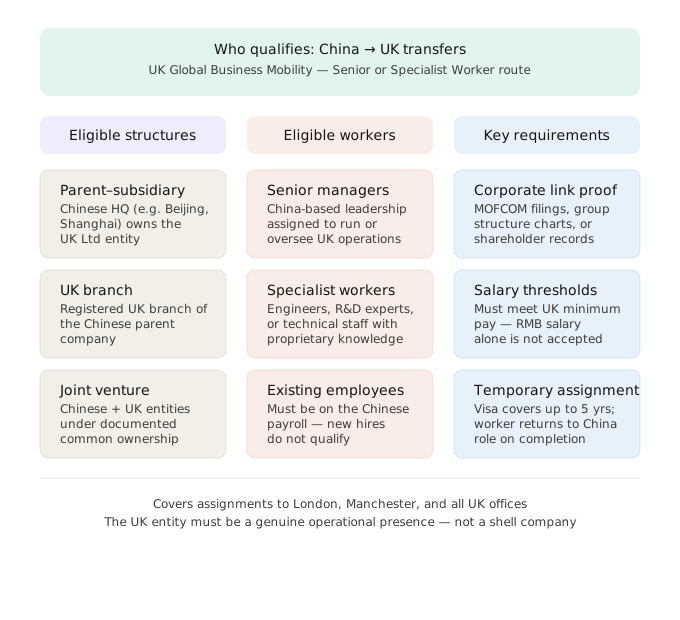
The Senior or Specialist Worker route is for employees being temporarily assigned to a UK entity that is genuinely linked to their overseas employer.
For Chinese companies, this means one of three structures:
✅ A parent-subsidiary relationship
✅ A UK branch of the Chinese parent
✅ A documented joint venture where both entities are under common ownership
A Common China-UK Corporate Link Issue
- The Scenario: A Shenzhen tech company sets up a new UK branch in London to expand its European market presence.
- The Complication: To navigate Chinese foreign exchange controls, the Shenzhen parent doesn't own the UK branch directly. Instead, an intermediary holding company in Hong Kong owns the UK entity.
- The UKVI Roadblock: When London attempts to sponsor an engineer from Shenzhen, UKVI caseworkers flag the discrepancy. On paper, the UK entity belongs to the Hong Kong intermediary, while the employee's history is tied to the mainland Chinese parent.
- The Consequence: The Home Office rejects the application due to a "broken" corporate link. Because direct China-to-UK ownership is obscured, the company faces massive delays trying to retroactively prove that the Shenzhen headquarters controls the entire chain.
2026 Compliance: Essential Updates for Chinese Employers
For Chinese multinationals managing UK workforce transfers, maintaining compliance requires seamless coordination between your headquarters in China and your UK entity. Two critical changes require your immediate attention:
- The Transition to Digital eVisas: Your Chinese assignees must navigate the UKVI system to set up their online accounts. It is crucial that your cross-border HR teams establish a clear protocol for verifying right-to-work via digital eVisa "share codes," as legacy paper BRPs will no longer be valid past December 2026.
- Strict 10-Day SMS Reporting Deadlines: When HQ in China initiates an internal promotion or adjusts a salary (even if managed in RMB), this information is often delayed in reaching the UK. You must establish a direct, rapid communication line so your UK branch can report the change in time.
The Focus of 2026 Home Office Visits: UKVI compliance checks this year are heavily targeting record-keeping gaps. While the assignee might report directly to managers in China, the compliance burden sits entirely with your UK entity. They must hold current, compliant Appendix D documentation on-site.
Chinese Overseas Employment Law: Compliance Risks for HR
When managing Chinese expats transferred to the UK, HR teams must ensure strict compliance with Chinese domestic regulations. Managing cross-border mobility requires navigating several complex legal obligations to protect both the business and the employee:
- Global Taxation (IIT): Under China's Individual Income Tax (IIT) law, Chinese citizens remain taxable on their worldwide income. HR must ensure UK earnings are accurately reported to China's State Taxation Administration, utilizing the China-UK Double Taxation Agreement to claim tax credits and prevent double taxation.
- Social Security Contributions: HR must strategize how to maintain the employee's Chinese domestic pension and benefits while navigating UK National Insurance obligations to avoid double-contribution pitfalls.
- Hukou and Status Reporting: Any prolonged overseas assignment or change in legal immigration status must be managed in accordance with Chinese Exit and Entry rules. HR should proactively advise employees on how working abroad long-term may impact their domestic household registration (Hukou).
- Family and Dependent Accompaniment: HR must coordinate these joint visa applications while advising families on the cross-border implications such as how a dependent spouse's employment in the UK might trigger additional Chinese Individual Income Tax (IIT) reporting obligations.
Plan your global mobility strategy early. Read our complete guide to managing UK transfers compliantly.
Disclaimer: Immigration rules change quite frequently; please verify with official sources or contact us for the latest info before making any decisions.
Frequently Asked Questions for UK Senior or Specialist Worker Visa for Chinese Companies

.svg)
.svg)