.svg)


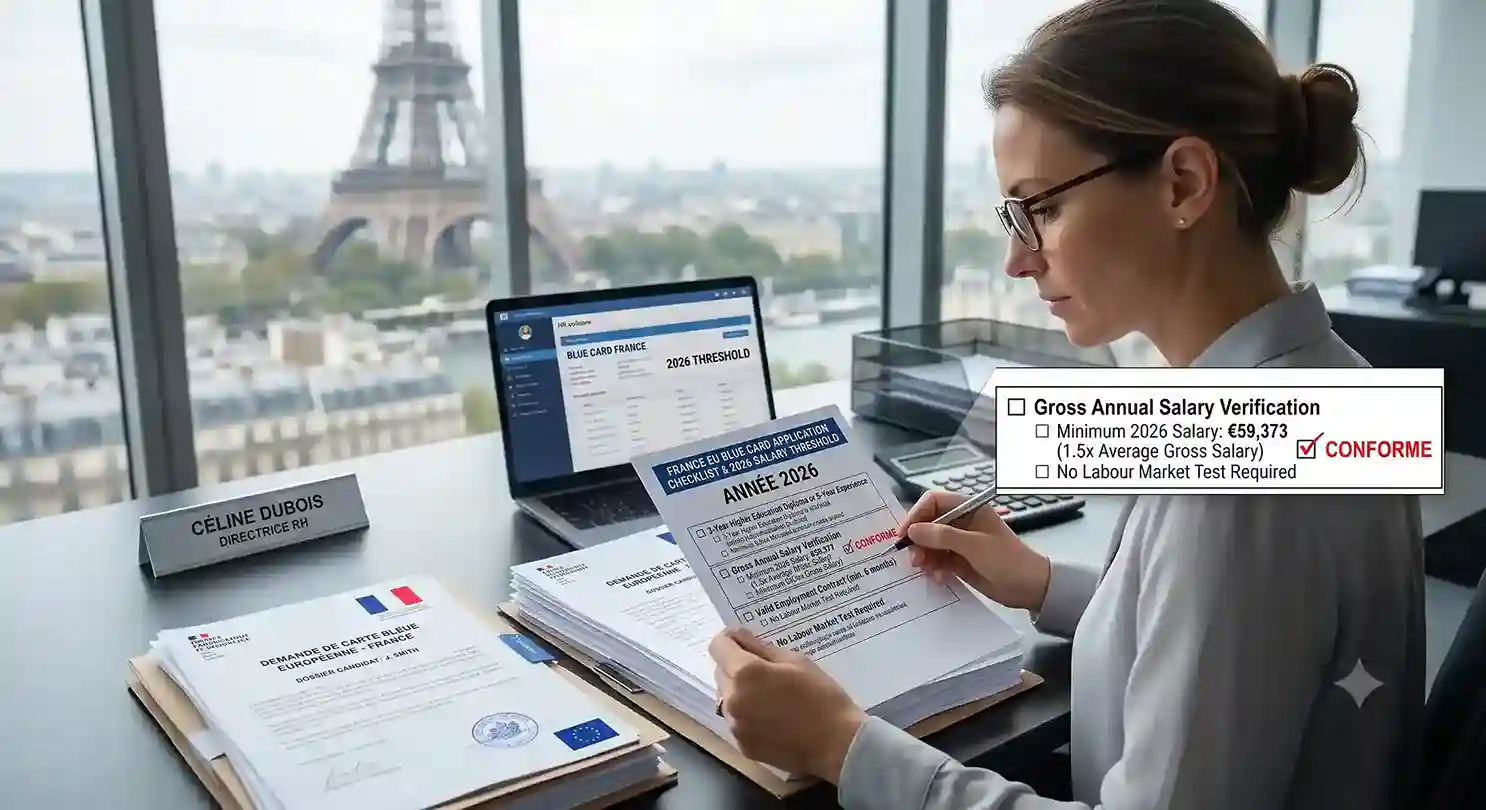
Das Wichtigste in Kürze: Die EU-Blaue Karte in Frankreich
- Die Gehaltsschwelle für die EU-Blue-Card für Frankreich im Jahr 2026 beträgt 59.373 € brutto jährlich. Dies muss in Ihrem Arbeitsvertrag ausgewiesen sein, bevor Sie den Antrag einreichen.
- Es ist keine Arbeitsmarktprüfung erforderlich, was diesen Weg zu einem der schnellsten Verfahren macht, um Fachkräfte aus Nicht-EU-Ländern nach Frankreich zu holen.
- Das gesamte Antragsverfahren läuft in zwei Schritten ab: zunächst die Beantragung eines Visums für einen längerfristigen Aufenthalt beim französischen Konsulat, anschließend die Beantragung einer Aufenthaltserlaubnis über die ANEF-Plattform innerhalb von drei Monaten nach der Einreise.
- Die staatlichen Gebühren belaufen sich insgesamt auf etwa 449 Euro: 99 Euro für das Konsularvisum und 350 Euro für die Aufenthaltserlaubnis (Steuern und Stempelgebühren zusammen).
- Inhaber einer Blue Card können nach 12 Monaten in einen anderen EU-Mitgliedstaat umziehen, was von Bedeutung ist, wenn Ihr Unternehmen grenzüberschreitend tätig ist.
- Jobbatical Das Team bearbeitet Anträge auf die EU-Blue-Card für Frankreich von Anfang bis Ende unter Einhaltung aller Vorschriften.
Was ist die französische EU-Blue-Card?
Die EU-Blue-Card für Frankreich ist eine kombinierte Arbeits- und Aufenthaltserlaubnis für hochqualifizierte Fachkräfte aus Ländern außerhalb der EU, des EWR und der Schweiz.
Sie wird offiziell als „Talent – Carte Bleue Européenne“ ausgestellt und ist Teil des umfassenderen französischen „Passeport Talent“-Programms, bietet jedoch einen entscheidenden Vorteil: Mobilität innerhalb der EU. Nach 12 Monaten rechtmäßigem Aufenthalt in Frankreich kann Ihr Mitarbeiter in einen anderen EU-Mitgliedstaat wechseln, ohne das Einwanderungsverfahren von Grund auf neu beginnen zu müssen.
Keine Arbeitsmarktprüfung. Keine Arbeitserlaubnis. Nur ein qualifizierter Bewerber, ein den Vorschriften entsprechender Arbeitsvertrag und die richtigen Unterlagen. Für Unternehmen, die in großem Umfang international Personal einstellen, ist diese Kombination von großer Bedeutung.
┈┈┈┈┈┈┈┈┈┈┈┈┈┈┈┈┈┈┈┈┈┈┈┈┈┈┈┈┈┈┈┈┈┈┈┈┈┈┈┈┈┈┈┈┈┈┈
Welche Voraussetzungen gelten 2026 für die EU-Blue-Card in Frankreich?
Bevor Sie etwas einreichen, vergewissern Sie sich bitte, dass Ihr Kandidat alle unten aufgeführten Anforderungen erfüllt. Schon eine einzige Lücke führt zu einer Ablehnung oder Verzögerung.
Die Zulassungskriterien auf einen Blick: Französische EU-Blue-Card
Profi-Tipp für Personalabteilungen: Zwar gibt es auf dem Papier eine niedrigere Gehaltsschwelle für Mangelberufe im MINT- und IKT-Bereich, doch verzögert sich die endgültige Veröffentlichung der ministeriellen Liste der förderfähigen Berufe in den einzelnen Regionen weiterhin. Um einen reibungslosen Antragsprozess zu gewährleisten und Bearbeitungsrückstände zu vermeiden, ist es am sichersten, bei allen technischen Stellen die Standardschwelle von 59.373 € einzuhalten.
┈┈┈┈┈┈┈┈┈┈┈┈┈┈┈┈┈┈┈┈┈┈┈┈┈┈┈┈┈┈┈┈┈┈┈┈┈┈┈┈┈┈┈┈┈┈┈
Welche Unterlagen benötigen Sie für den Antrag auf die EU-Blue-Card in Frankreich?
Ihr Mitarbeiter sammelt die meisten Unterlagen ein; Ihr Unternehmen stellt die arbeitsgeberseitigen Unterlagen bereit. Hier finden Sie die vollständige Liste.
Dokumente für Mitarbeiter
- Gültiger Reisepass (muss während der gesamten Gültigkeitsdauer der Genehmigung gültig bleiben)
- Zwei aktuelle Passfotos
- Ausgefülltes Antragsformular für ein Visum für den längerfristigen Aufenthalt
- In Frankreich oder der EU anerkanntes Hochschulabschlusszeugnis bzw. Nachweis über 5 Jahre einschlägige Berufserfahrung
- Führungszeugnis ohne Einträge
- Nachweis über den Krankenversicherungsschutz
- Bei einer Statusänderung in Frankreich: Nachweis einer derzeit gültigen Aufenthaltserlaubnis
Eine Schritt-für-Schritt-Übersicht zur Arbeitserlaubnis in Frankreich finden Sie in unserem Leitfaden „France Passeport Talent“, der die wichtigsten Voraussetzungen und den Ablauf behandelt, die Arbeitgeber kennen sollten.
Dokumente des Arbeitgebers
- Unterzeichneter Arbeitsvertrag, in dem die Position, das Gehalt (mindestens 59.373 €) und die Vertragsdauer (mindestens 6 Monate) festgelegt sind
- Formular für die Arbeitgebererklärung (vom Unternehmen auszufüllen und zusammen mit dem Visumantrag einzureichen)
- Unternehmensregisterauszug (Kbis-Auszug oder gleichwertiges Dokument)
- Bestätigung, dass das Unternehmen keine offenen Verbindlichkeiten in Bezug auf Sozialversicherung, Steuern oder arbeitsrechtliche Angelegenheiten hat – die Präfekturen können Anträge nun aus diesem Grund ablehnen
Übersetzungsfehler zwischen dem Arbeitsvertrag und den Qualifikationsnachweisen gehören zu den häufigsten Gründen für eine Ablehnung. Achten Sie darauf, dass die Berufsbezeichnung und die Stellenbeschreibung in allen Dokumenten einheitlich sind, bevor Sie diese einreichen.
┈┈┈┈┈┈┈┈┈┈┈┈┈┈┈┈┈┈┈┈┈┈┈┈┈┈┈┈┈┈┈┈┈┈┈┈┈┈┈┈┈┈┈┈┈┈┈
Wie beantragt man die EU-Blue-Card für Frankreich – Schritt für Schritt?
Das Antragsverfahren für die EU-Blue-Card in Frankreich umfasst für Arbeitnehmer, die ihren Antrag aus dem Ausland stellen, in der Regel zwei Schritte: die Beantragung des entsprechenden Visums für einen längerfristigen Aufenthalt vor der Einreise nach Frankreich und, falls erforderlich, die Beantragung der mehrjährigen Aufenthaltserlaubnis nach der Ankunft.
Stufe 1: Visum für einen längeren Aufenthalt für Arbeitnehmer, die ihren Antrag aus dem Ausland stellen
- Füllen Sie den Antrag bei France-Visas aus: Der Arbeitnehmer beantragt das entsprechende Visum für einen längerfristigen Aufenthalt im Rahmen des französischen Visumverfahrens in seinem Wohnsitzland. Für Antragsteller einer EU-Blue-Card wird das Visum unter der Kategorie „passeport talent – carte bleue européenne“ ausgestellt.
- Reichen Sie die erforderlichen Unterlagen ein: Der Arbeitnehmer legt die für den Antrag erforderlichen persönlichen, beruflichen und vom Arbeitgeber ausgestellten Unterlagen vor. Der Arbeitgeber muss die entsprechenden Beschäftigungsunterlagen ausfüllen, einschließlich des für den Antrag auf die Blaue Karte EU erforderlichen Formulars.
- Bezahlen Sie die Visumgebühr: Die Standardgebühr für ein Visum für einen längeren Aufenthalt beträgt 99 €.
- Erhalt des Visums und Einreise nach Frankreich: Sobald das Visum erteilt wurde, kann der Mitarbeiter nach Frankreich reisen.
- Gegebenenfalls ein VLS-TS validieren: Wenn die Beschäftigungsvereinbarung eine Laufzeit von weniger als 12 Monaten hat, wird laut France-Visas ein Langzeitvisum, das als Aufenthaltsgenehmigung dient (VLS-TS) und die Bezeichnung „passeport talent“ trägt, ausgestellt. Dieses muss innerhalb von 3 Monaten nach der Einreise online validiert werden.
Schritt 2: Beantragung einer Aufenthaltsgenehmigung in Frankreich
Bei einer EU-Blue-Card-Regelung, die eine mehrjährige Aufenthaltsgenehmigung voraussetzt, muss der Arbeitnehmer den Antrag nach seiner Ankunft in Frankreich stellen.
- Antrag innerhalb von zwei Monaten nach der Einreise stellen: Der Arbeitnehmer reicht den Antrag auf die mehrjährige Talent-Aufenthaltserlaubnis über die Online-Plattform der ANEF ein. France-Visas weist darauf hin, dass Inhaber einer EU-Blue-Card die mehrjährige Aufenthaltserlaubnis innerhalb von zwei Monaten nach ihrer Einreise beantragen können.
- Reichen Sie die erforderlichen Unterlagen ein: Der Antrag umfasst die Identitäts- und Aufenthaltsdokumente des Arbeitnehmers, Unterlagen zum Arbeitsverhältnis sowie Nachweise über die für die EU-Blue-Card erforderlichen Qualifikationen.
- Bezahlen Sie die Aufenthaltsgenehmigungssteuer: Laut den aktuellen Leitlinien von Service-Public kostet die Talent-Aufenthaltskarte 225 €, bestehend aus einer Steuer in Höhe von 200 € und einer Stempelsteuer in Höhe von 25 €.
- Erhalt der Aufenthaltserlaubnis: Die Blaue Karte EU wird in der Regel für die Dauer des Arbeitsvertrags ausgestellt, wobei die Gültigkeitsdauer auf höchstens vier Jahre begrenzt ist.
Nutzen Sie unsere OFII-Checkliste zur Überprüfung nach der Einreise, um sich über die wichtigsten Schritte, Fristen und behördlichen Auflagen nach der Einreise in Frankreich zu informieren.
Statusänderung (für Mitarbeiter, die sich bereits in Frankreich befinden)
Befindet sich Ihr Mitarbeiter bereits mit einer anderen Aufenthaltsgenehmigung in Frankreich, beantragt er die Änderung seines Aufenthaltsstatus direkt über die ANEF-Plattform. Der Antrag sollte 4 bis 2 Monate vor Ablauf der aktuellen Aufenthaltsgenehmigung gestellt werden. Für diesen Weg ist kein Visumantrag erforderlich.
Jobbatical verwaltet beide Phasen von Anfang bis Ende – von der Prüfung der Anspruchsberechtigung über die Vorbereitung der Unterlagen bis hin zur Einreichung bei der ANEF und der Echtzeit-Verfolgung über den gesamten Mitarbeiter-Prozess hinweg. Buchen Sie eine Demo, um zu sehen, wie es funktioniert.
┈┈┈┈┈┈┈┈┈┈┈┈┈┈┈┈┈┈┈┈┈┈┈┈┈┈┈┈┈┈┈┈┈┈┈┈┈┈┈┈┈┈┈┈┈┈┈
Wie viel kostet die EU-Blue-Card in Frankreich im Jahr 2026?
Die behördlichen Gebühren sind festgesetzt und relativ überschaubar. Hier erfahren Sie, was Sie einplanen sollten.
Aufschlüsselung der offiziellen staatlichen Gebühren: Französische EU-Blue-Card
Hierbei handelt es sich ausschließlich um staatliche Gebühren. Die Kosten für die professionelle Abwicklung des Einwanderungsverfahrens, die Übersetzung von Dokumenten, die Beglaubigung sowie etwaige Integrationspflichten gegenüber der OFII fallen separat an. Planen Sie entsprechend ein, wenn Sie mehrere Umzüge organisieren.
┈┈┈┈┈┈┈┈┈┈┈┈┈┈┈┈┈┈┈┈┈┈┈┈┈┈┈┈┈┈┈┈┈┈┈┈┈┈┈┈┈┈┈┈┈┈┈
Wie lange ist die französische EU-Blue-Card gültig und wie verlängert man sie?
Frankreich – EU-Blaue Karte – Gültigkeitsdauer
- Die Gültigkeitsdauer der Blue Card entspricht der Laufzeit Ihres Arbeitsvertrags, höchstens jedoch 4 Jahre.
- Bei kurzen Verträgen gibt es einen kleinen Spielraum: Bei einem Vertrag mit einer Laufzeit von weniger als zwei Jahren ist die Karte für die Vertragsdauer plus drei Monate gültig.
Verlängerung der EU-Blue-Card in Frankreich
- Der Verlängerungsantrag muss über ANEF frühestens 4 Monate und spätestens 2 Monate vor Ablauf eingereicht werden.
- Bei einer Verlängerung gilt die aktuelle Gehaltsschwelle und nicht die Schwelle zum Zeitpunkt der ursprünglichen Antragstellung. Sollte der Betrag gestiegen sein, muss das Gehalt zunächst angepasst werden.
- Unternehmen mit mehreren Inhabern einer Blue Card sollten spätestens sechs Monate vor dem frühestmöglichen Verlängerungstermin eine Compliance-Prüfung durchführen.
- Bitte beachten Sie, dass unter den derzeitigen steuerlichen Rahmenbedingungen die bei der Verlängerung fällige Gesamtgebühr auf 250 € gestiegen ist (200 € Verlängerungsgebühr + 50 € Verwaltungsstempelsteuer).
┈┈┈┈┈┈┈┈┈┈┈┈┈┈┈┈┈┈┈┈┈┈┈┈┈┈┈┈┈┈┈┈┈┈┈┈┈┈┈┈┈┈┈┈┈┈┈
Welche Compliance-Verpflichtungen hat der Arbeitgeber im Zusammenhang mit der EU-Blue-Card für Frankreich?
Die Förderung eines Fachkräften im Rahmen des Programms „Talent – Carte Bleue Européenne“ erfordert die strikte Einhaltung der operativen Vorschriften. Nach den geltenden Bestimmungen können die Präfekturen Erstanträge und Verlängerungsanträge ablehnen, wenn bei einem Arbeitgeber ausstehende Zahlungen im Bereich der Sozialversicherung, Steuern oder arbeitsrechtliche Unregelmäßigkeiten vorliegen.
Um Ihre Genehmigungsfristen einzuhalten, müssen Global-Mobility-Manager fünf Kernbereiche im Blick behalten:
- Die Pflicht zur Eintragung in das Personalregister: Die Arbeitserlaubnis jedes ausländischen Staatsangehörigen muss unverzüglich im „registre unique du personnel“ Ihres Unternehmens eingetragen und eine Kopie beigefügt werden. Unstimmigkeiten bei Funktionsbezeichnungen, Kategorien oder Standorten können zu Bußgeldern zwischen 4.000 € und 8.000 € pro Mitarbeiter führen.
- Laufende Gehaltsüberwachung: Die Vergütung wird kontinuierlich überwacht. Falls das Gehalt eines Inhabers einer Blue Card länger als drei aufeinanderfolgende Monate unter die vorgeschriebene Schwelle von 59.373 € fällt, werden anstehende Verlängerungen abgelehnt.
- Strengere Integrationsanforderungen: Mehrjährige Verlängerungen der Aufenthaltsgenehmigung unterliegen strengen Integrationskriterien, darunter das Bestehen einer standardisierten Prüfung zu staatsbürgerlichem Wissen und das Erreichen bestimmter Schwellenwerte für Französischkenntnisse. Personalabteilungen müssen frühzeitig auf diese Prüfungstermine hinweisen.
- Ankunftsbestätigung: Stellen Sie sicher, dass der Arbeitnehmer sein Langzeitvisum innerhalb von drei Monaten nach der Einreise nach Frankreich online über das OFII-Portal validiert und sich innerhalb von 90 Tagen bei der französischen Sozialversicherung (CPAM) anmeldet.
- Benachrichtigungen über Statusänderungen: Alle unmittelbaren Änderungen des Vertragsstatus eines Mitarbeiters – wie beispielsweise Kündigungen, Entlassungen oder wesentliche Änderungen der Aufgabenbereiche – müssen über das ANEF-Portal direkt an die Präfektur gemeldet werden.
┈┈┈┈┈┈┈┈┈┈┈┈┈┈┈┈┈┈┈┈┈┈┈┈┈┈┈┈┈┈┈┈┈┈┈┈┈┈┈┈┈┈┈┈┈┈┈
Die französische EU-Blue-Card vs. „Talent Salarié Qualifié“: Welcher Weg passt zu Ihrer Neueinstellung?
Die EU-Blue-Card ist nicht immer die optimale Aufenthaltsgenehmigung für eine Anstellung in Frankreich. Die Aufenthaltsgenehmigung „Talent Salarié Qualifié“ eignet sich für bestimmte Profile besser, und die richtige Wahl von Anfang an verhindert kostspielige erneute Anträge.
- Unterschied bei der Gehaltsschwelle: Für den „Talent – Salarié Qualifié“-Weg gilt das Referenzgehalt von 39.582 €, während für die Blue Card das 1,5-Fache dieses Betrags, also 59.373 €, erforderlich ist. Daher fallen Stellen mit einem Gehalt unter 59.373 € stattdessen unter den „Salarié Qualifié“-Weg.
- Qualifikations- und Anforderungsprofil: Das Programm „Talent – Salarié Qualifié“ richtet sich allgemein an qualifizierte Arbeitnehmer, während die „Blue Card“ nicht an eine bestimmte Branche gebunden ist, sondern durch höhere Anforderungen an Qualifikation und Gehalt definiert wird, was in der Praxis vor allem für leitende technische und hochbezahlte Positionen geeignet ist.
- Familienzusammenführung: Beide Wege ermöglichen Familien den Erhalt der vereinfachten Aufenthaltskarte „Talent – Famille“ mit uneingeschränkten Arbeitsrechten und ohne die übliche Wartezeit für die Familienzusammenführung, sodass die Möglichkeiten für Familienangehörige bei beiden Genehmigungen weitgehend gleich sind.
- EU-weite Übertragbarkeit: Die Blaue Karte ermöglicht nach 12 Monaten eine strukturierte Mobilität innerhalb der EU sowie die kumulative Anrechnungszeit der Aufenthaltsdauer in verschiedenen Mitgliedstaaten, was das Programm „Talent – Salarié Qualifié“ für länderübergreifende Strategien nicht vorsieht.
- Zusammenfassung der besten Lösung: Wählen Sie das Programm „Talent – Salarié Qualifié“ für Einstellungen mit Schwerpunkt auf Frankreich oder für Gehälter unter 59.373 €; wählen Sie die Blue Card für besser bezahlte Positionen, bei denen die Mobilität innerhalb der EU und die grenzüberschreitende Niederlassung einen umfassenderen europäischen Expansionsplan unterstützen.
Wenn Sie umfassende Unterstützung bei der Auswahl und Beantragung des richtigen Einwanderungswegs für Fachkräfte nach Frankreich benötigen, informieren Sie sich über unseren „France Talent Passport“-Service – die von Experten betreute Lösung von Jobbatical für Personalabteilungen, die Fachkräfte nach Frankreich versetzen.
┈┈┈┈┈┈┈┈┈┈┈┈┈┈┈┈┈┈┈┈┈┈┈┈┈┈┈┈┈┈┈┈┈┈┈┈┈┈┈┈┈┈┈┈┈┈┈
Warum liegt die Gehaltsschwelle für die EU-Blue-Card in Frankreich bei 59.373 Euro?
Der in der „Blue Card“ angegebene Gehaltsbetrag ist nicht willkürlich; er ist in einer bestimmten Ministerialverordnung verankert, die Personalabteilungen kennen sollten, wenn sie die Vergütung gegenüber internen Interessengruppen begründen.
- Die maßgebliche Verordnung: Eine im Journal Officiel veröffentlichte Ministerialverordnung vom 29. August 2025 legt den Referenzgehaltsrahmen sowohl für die „Talent“- als auch für die „Blue Card“-Genehmigungen fest.
- Das Referenzgehalt: Der Erlass legt ein jährliches Brutto-Referenzgehalt in Höhe von 39.582 € fest, das als 1×-Grundlage für die Aufenthaltsgenehmigung für talentqualifizierte Arbeitnehmer dient.
- Der „Blue Card“-Multiplikator: Der Schwellenwert von 59.373 € ergibt sich gemäß den Artikeln R. 421-16 A und R. 421-21 A des CESEDA direkt als das 1,5-Fache dieses Referenzgehalts.
- Geografischer Geltungsbereich: Die Schwellenwerte gelten für das französische Festland und erstrecken sich speziell im Falle der Europäischen Blauen Karte auch auf Saint-Barthélemy und Saint-Martin.
- Aufhebung früherer Vorschriften: Mit diesem Erlass werden die früheren Schwellenwerte aus dem Jahr 2016 aufgehoben und der veraltete Betrag von 53.837 Euro ersetzt, der bis August 2025 für Anträge galt.
Wenn Sie praktische Unterstützung benötigen, um sicherzustellen, dass Ihre Arbeitsverträge die französischen Compliance-Anforderungen erfüllen, informieren Sie sich über unseren Service zur französischen EU-Blue-Card: Jobbatical bietet Ihnen einen vollständig betreuten Weg zur Anwerbung hochqualifizierter Fachkräfte in Frankreich.
┈┈┈┈┈┈┈┈┈┈┈┈┈┈┈┈┈┈┈┈┈┈┈┈┈┈┈┈┈┈┈┈┈┈┈┈┈┈┈┈┈┈┈┈┈┈┈
Was hat sich bei der Reform der EU-Blauen Karte in Frankreich im Jahr 2026 geändert?
Mit den jüngsten Verordnungen in Frankreich wurden mehrere strukturelle Lockerungen eingeführt, durch die die „Blue Card“ flexibler ist als unter den bisherigen Rahmenbedingungen. Wenn Arbeitgeber verstehen, was sich geändert hat, können sie die nun verfügbaren Einstellungsmöglichkeiten besser nutzen.
- Kürzere Mindestvertragslaufzeit: Die vorgeschriebene Vertragslaufzeit wurde von 12 Monaten auf 6 Monate verkürzt; dies gilt sowohl für befristete (CDD) als auch für unbefristete (CDI) Arbeitsverträge.
- Qualifikation durch Berufserfahrung: Bewerber können nun einen Hochschulabschluss durch fünf Jahre einschlägige Berufserfahrung ersetzen, in bestimmten, besonders gefragten Branchen durch drei Jahre, vorbehaltlich der ministeriellen Berufsliste.
- Visumfreie Einreise innerhalb der EU: Inhaber einer Blauen Karte aus einem anderen Mitgliedstaat können visumfrei nach Frankreich einreisen und ihren Antrag auf eine französische Blaue Karte innerhalb von 30 Tagen nach ihrer Ankunft stellen, anstatt das Verfahren von Neuem zu durchlaufen.
- Angepasste Gültigkeitspuffer: Bei Verträgen mit einer Laufzeit von weniger als zwei Jahren wird nun eine Karte ausgestellt, die für die Vertragsdauer zuzüglich eines dreimonatigen Puffers gültig ist, wobei die maximale Gültigkeitsdauer auf 24 Monate begrenzt ist.
- Verstärkte Compliance-Prüfungen: Die Behörden haben die Überprüfung der Steuer- und Arbeitsunterlagen der Arbeitgeber, einschließlich des URSSAF-Status, während des Antragsverfahrens intensiviert.
┈┈┈┈┈┈┈┈┈┈┈┈┈┈┈┈┈┈┈┈┈┈┈┈┈┈┈┈┈┈┈┈┈┈┈┈┈┈┈┈┈┈┈┈┈┈┈
Was passiert, wenn Sie die Vorschriften zur EU-Blauen Karte in Frankreich nicht einhalten?
Die Beschäftigung eines Ausländers ohne ordnungsgemäße, gültige Genehmigung oder die Beschäftigung außerhalb des zugelassenen Berufsfelds oder der zugelassenen Region zieht schwere Strafen nach sich:
- Verwaltungsstrafen: Bis zu 20.750 € pro Arbeitnehmer bei einem erstmaligen Verstoß, bei Wiederholungsfällen steigen die Strafen auf 62.250 €.
- Strafrechtliche Sanktionen: Die Geldbußen wurden auf bis zu 30.000 € pro Arbeitnehmer verdoppelt.
Die Automatisierung der Compliance-Überwachung verhindert Überraschungen bei Vertragsverlängerungen in letzter Minute und ermöglicht es Ihrem HR-Team, sich vom reaktiven Krisenmanagement hin zu einer reibungslosen Talentmobilität zu verlagern.
┈┈┈┈┈┈┈┈┈┈┈┈┈┈┈┈┈┈┈┈┈┈┈┈┈┈┈┈┈┈┈┈┈┈┈┈┈┈┈┈┈┈┈┈┈┈┈
Wie funktioniert die Mobilität innerhalb der EU im Rahmen der französischen Blue Card?
Der entscheidende Vorteil der EU-Blue-Card (Talent – Carte Bleue Européenne) gegenüber herkömmlichen Programmen für qualifizierte Arbeitskräfte liegt in ihrer beispiellosen regionalen Flexibilität. Für multinationale Konzerne oder Unternehmen, die regionale Projekte auf dem gesamten Kontinent durchführen, hilft diese Aufenthaltsgenehmigung auf zwei verschiedene Arten dabei, lokale bürokratische Hürden zu überwinden:
1. Befreiung bei kurzfristigen Projekten und Tätigkeiten (Neu ab 2026)
Nach den jüngsten Änderungen im Einwanderungsrecht können Inhaber einer von einem anderen EU-Mitgliedstaat ausgestellten EU-Blue-Card nun nach Frankreich einreisen, um dort innerhalb eines Zeitraums von 180 Tagen bis zu 90 Tage lang einer tatsächlichen bezahlten Beschäftigung nachzugehen, ohne dass eine französische Arbeitserlaubnis erforderlich ist. Dies erleichtert den Einsatz grenzüberschreitender Projektteams oder die Abwicklung vorübergehender interner Versetzungen erheblich, ohne dass man sich mit separaten Einwanderungsanträgen herumschlagen muss.
2. Langfristige Versetzung innerhalb der EU
Nach 12 Monaten rechtmäßigem Aufenthalt in Frankreich kann Ihr Mitarbeiter über ein stark beschleunigtes, vereinfachtes Verfahren dauerhaft in einen anderen teilnehmenden EU-Mitgliedstaat (wie Deutschland, Spanien oder die Niederlande) wechseln, ohne das ursprüngliche Einwanderungsverfahren von Grund auf neu beginnen zu müssen.
┈┈┈┈┈┈┈┈┈┈┈┈┈┈┈┈┈┈┈┈┈┈┈┈┈┈┈┈┈┈┈┈┈┈┈┈┈┈┈┈┈┈┈┈┈┈┈
Wie funktioniert das beschleunigte Verfahren zur Erlangung einer dauerhaften Aufenthaltsgenehmigung im Rahmen der französischen „Blue Card“?
Wenn Ihr Unternehmen einen Fachkräfteeinstellung vornimmt, der bereits Inhaber einer EU-Blue-Card aus einem anderen Mitgliedstaat ist, ergibt sich daraus ein oft unterschätzter struktureller Vorteil: Die Zeit, die diese Person bereits im Rahmen dieser früheren Aufenthaltsgenehmigung verbracht hat, wird auf die in Frankreich geltende fünfjährige Aufenthaltsdauer angerechnet. In der Praxis bedeutet dies, dass erfahrene internationale Mitarbeiter wesentlich schneller den Status eines Daueraufenthaltsberechtigten erhalten, was als wirksames Mittel zur langfristigen Bindung von Fachkräften dient.
Hinweis zur Einhaltung der Vorschriften: Bei einem regulären französischen „Talent Passport“ müssen für einen Umzug in ein anderes EU-Land entweder die vor Ort geltenden Fristen abgewartet oder separate Erstvisa beantragt werden. Wenn Ihr Geschäftsmodell auf dem flexiblen Austausch von Fachkräften zwischen europäischen Niederlassungen basiert, ist die Blaue Karte langfristig die mit Abstand bessere Lösung.
┈┈┈┈┈┈┈┈┈┈┈┈┈┈┈┈┈┈┈┈┈┈┈┈┈┈┈┈┈┈┈┈┈┈┈┈┈┈┈┈┈┈┈┈┈┈┈
Haftungsausschluss: Die Einreisebestimmungen ändern sich häufig; bitte informieren Sie sich bei offiziellen Stellen oder kontaktieren Sie uns, um die aktuellsten Informationen zu erhalten, bevor Sie Entscheidungen treffen.

.svg)
.svg)