.svg)


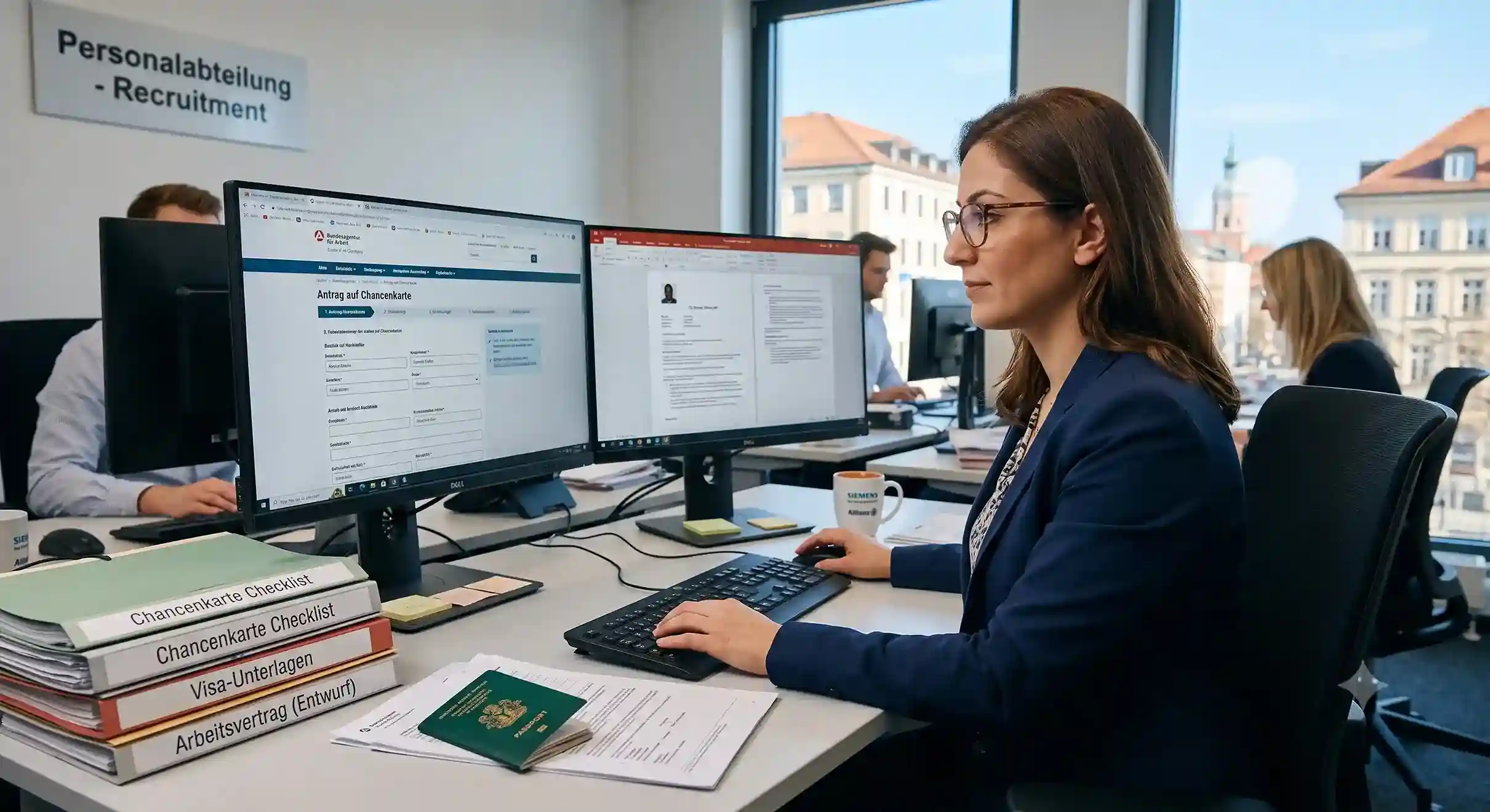
Points clés à retenir concernant la « Chancekarte » (Carte des opportunités) 2026 en Allemagne
- Parrainage sans frais initiaux : la « carte d’opportunité » (Chancenkarte) permet aux talents qualifiés non ressortissants de l’UE de s’installer en Allemagne pour une durée maximale d’un an sans offre d’emploi préalable, ce qui réduit considérablement les obstacles à l’installation et le risque lié au parrainage par l’employeur.
- Règles de recrutement souples : les titulaires de la carte peuvent travailler à temps partiel jusqu'à 20 heures par semaine et effectuer une période d'essai de deux semaines (Probearbeit) par entreprise, ce qui offre aux équipes RH une période d'évaluation « essayer avant d'embaucher » sans risque.
- Des choix stratégiques clairs : utilisez la « carte opportunité » pour repérer et constituer un vivier de talents flexible ; optez pour le visa de travailleur qualifié ou la Carte bleue européenne pour les embauches directes et immédiates accompagnées d’offres d’emploi confirmées.
En tant que professionnel des ressources humaines ou responsable du recrutement, pour faire face à la pénurie chronique de main-d’œuvre en Allemagne — estimée à environ 400 000 professionnels qualifiés par an —, il est nécessaire de mettre en place des stratégies de mobilité internationale modernes et flexibles. La nouvelle loi allemande sur l’immigration des travailleurs qualifiés offre des voies efficaces pour recruter des talents hors UE.
La principale d'entre elles est la « carte d'opportunité » (Chancenkarte), prévue à l'article 20a de la loi sur le séjour (AufenthG). Conçue pour faciliter le recrutement international, la Chancenkarte permet aux travailleurs qualifiés de s'installer en Allemagne avant d'avoir obtenu un contrat à temps plein. Ce guide présente une analyse détaillée du fonctionnement de la carte d'opportunité, des conditions d'éligibilité des candidats, des exigences de conformité en matière de ressources humaines, ainsi qu'une comparaison directe des visas, afin de vous aider à recruter efficacement.
Qu'est-ce que la « Chancekarte » (carte d'opportunité) allemande et pourquoi les employeurs devraient-ils s'y intéresser ?
La « Opportunity Card » est un titre de séjour attribué selon un système de points qui permet aux professionnels non ressortissants de l'UE remplissant les conditions requises d'entrer en Allemagne pour une durée maximale de 12 mois, dans le but spécifique de trouver un emploi.
Pour les équipes RH et les responsables du recrutement, le principal avantage réside dans la suppression des formalités administratives. Les visas de travail traditionnels obligent l'employeur à parrainer un candidat, à obtenir les autorisations locales et à patienter pendant de longs délais de rendez-vous à l'ambassade avant même que le candidat ne puisse mettre les pieds dans le pays.
En revanche, la « Opportunity Card » ne nécessite aucun parrainage initial de la part d'un employeur. Les candidats gèrent eux-mêmes leurs visas, doivent prouver leur autonomie financière et s'installent en Allemagne de leur propre initiative.
Présentation détaillée du service, expliquant notamment comment Jobbatical gère la demande de A à Z : page du service « Carte des opportunités » (Chancenkarte) en Allemagne
Principaux avantages de la « Chancekarte » (carte d'opportunité) pour les employeurs
- Disponibilité des candidats locaux : au moment où vous menez un entretien avec un titulaire de la « Chancenkarte », celui-ci réside déjà en Allemagne, s'est adapté au fuseau horaire local et est disponible pour des entretiens en présentiel ou des essais immédiats sur site.
- Évaluation sans risque (« Essayer avant d'embaucher ») : les titulaires de la carte sont légalement autorisés à travailler jusqu'à 20 heures par semaine et à effectuer des missions d'essai de courte durée (Probearbeit) d'une durée maximale de deux semaines par employeur.
- Processus d'intégration simplifié : la conversion du statut d'un candidat résidant déjà en Allemagne en un permis de travail permanent est nettement plus rapide que le lancement d'une procédure de relocation internationale depuis une ambassade étrangère.
- Large champ d'application sectoriel : cette carte attire des talents issus des secteurs de l'informatique, de l'ingénierie, de la santé, de la logistique, du bâtiment et des métiers spécialisés.
Qui postule via une « Chancenkarte » ? Le profil du candidat
La « Chancenkarte » n’est pas un visa délivré sans condition ; elle fait office de filtre sélectif destiné aux professionnels non européens répondant à certains critères. Pour y prétendre, les candidats doivent soit être titulaires d’un diplôme étranger pleinement reconnu, soit obtenir au moins six points selon une grille d’évaluation portant sur la formation, les compétences linguistiques, l’expérience professionnelle, l’âge et les liens avec l’Allemagne.
Principales informations sur les candidats
- Principaux pays d'origine : un nombre important de candidats provient des principaux pôles de talents, notamment l'Inde (qui représente plus de 31 % des premiers titulaires de la carte), la Chine, la Turquie, le Pakistan, le Nigeria, la Tunisie et le Népal.
- Secteurs à forte densité : Vous y trouverez un vivier abondant de candidats spécialisés dans le développement logiciel, les infrastructures informatiques, les disciplines d'ingénierie, la santé (soins infirmiers et technologies médicales), la logistique et les métiers manuels qualifiés.
- Ce que les candidats peuvent faire dès maintenant : tout en recherchant un poste en CDI, les candidats peuvent subvenir à leurs besoins grâce à un emploi à temps partiel (jusqu'à 20 heures par semaine) ou participer à des périodes d'essai de courte durée, ce qui permet aux équipes RH de vérifier leurs compétences techniques et leur adéquation avec la culture d'entreprise avant de leur proposer un poste à temps plein.
En ce qui concerne plus particulièrement les métiers manuels, la logistique et les métiers du secteur des soins, consultez l'ensemble des voies d'accès disponibles : Visas allemands pour les travailleurs manuels
Conditions d'éligibilité et système de points « Chancenkarte » 2026
Pour obtenir une « Opportunity Card », les candidats non ressortissants de l'UE doivent remplir des critères fondamentaux ou satisfaire aux exigences de la grille d'évaluation allemande en 6 points.
1. Conditions d'éligibilité de base
- Diplômes et qualifications professionnelles : soit un diplôme universitaire reconnu par l'État dans le pays d'origine ou en Allemagne, soit au moins deux ans de formation professionnelle reconnue par l'État qui l'a délivrée. Les qualifications peuvent être vérifiées via la base de données officielle Anabin ou les portails IHK/ZAB.
- Compétences linguistiques : maîtrise minimale de base de l'allemand (niveau A1) OU de l'anglais (niveau B2) selon le Cadre européen commun de référence pour les langues (CECR). Des niveaux de compétence plus élevés donnent droit à des points supplémentaires dans la grille d'évaluation.
- Justificatifs financiers : preuve d'une autonomie financière d'au moins 13 092 € par an (soit environ 1 091 € par mois sur un compte bloqué), une déclaration d'engagement officielle (Verpflichtungserklärung) ou un contrat de travail à temps partiel éligible en Allemagne.
- Assurance maladie : couverture complète équivalente aux normes de l'assurance maladie publique allemande (aucune franchise supérieure à 300 € par an).
À lire également :
Avant de vous fier au diplôme d'un candidat, vérifiez comment il est classé : ce que signifient les notes H+ et H− d'Anabin pour le recrutement d'un employé en Allemagne
Si la qualification n'est reconnue que partiellement, un « partenariat de reconnaissance » peut vous permettre d'embaucher dans un premier temps : le « partenariat de reconnaissance » expliqué aux employeurs
2. Présentation détaillée du système de points 2026
Les candidats qui ne sont pas titulaires d'un diplôme ou d'une qualification allemande pleinement reconnu doivent obtenir au moins 6 points dans les catégories suivantes :
Évaluez un candidat spécifique à l'aide de cette matrice en moins de trois minutes : auto-évaluation de l'éligibilité à la « Opportunity Card »
Le guide RH : Intégration et parrainage d'un titulaire de la « Chancenkarte »
Bien que le recrutement d'un titulaire de la « Opportunity Card » soit simple, les équipes des ressources humaines doivent suivre des étapes de conformité bien définies afin de garantir des transitions de statut sans heurts et d'éviter toute infraction à la législation.
Étape 1 : Liste de contrôle pour l'intégration et vérifications préalables à l'embauche
- Vérification de la carte physique et de sa validité : conservez une copie de la carte « Opportunity Card » physique de l'employé ainsi que de son passeport pour les dossiers de conformité des ressources humaines.
- Inscription à la mairie (Bürgeramt) : Vérifiez que le salarié a bien procédé à son inscription sur la liste d'habitation (Anmeldung) dans les 14 jours suivant l'obtention d'un logement en Allemagne.
- Respecter les limites horaires : appliquer strictement la limite hebdomadaire de 20 heures de travail si la personne travaille à temps partiel avant l'obtention définitive de son permis.
Les formalités administratives qui prennent le plus de temps aux équipes RH dans le cadre des permis de travail allemands : 7 erreurs coûteuses commises par les équipes RH au titre de la loi sur les travailleurs qualifiés
Étape 2 : Gestion de la paie et respect du salaire minimum
- Exigences en matière de salaire minimum : le salaire minimum légal (13,90 €/heure en 2026) s'applique dès le premier jour de tout emploi à temps partiel ou de toute période d'essai rémunérée.
- Déclaration fiscale et sociale : la demande de numéro d'identification fiscale (Steueridentifikationsnummer) et la déclaration à la sécurité sociale doivent être effectuées dès la prise d'effet d'un contrat à temps partiel.
- Documentation relative à la période d'essai : un emploi à l'essai non rémunéré (Probearbeit) d'une durée maximale de deux semaines par employeur ne nécessite pas de contrat de travail officiel, mais doit faire l'objet d'un document écrit précisant le champ d'activité, la durée et les critères d'évaluation objectifs.
Étape 3 : Conversion en permis de travail permanent
Pour transformer un titulaire d'une « Opportunity Card » en salarié à temps plein, suivez la procédure suivante :
- Formuler une offre de contrat contraignante : rédiger un contrat de travail à temps plein précisant le titre du poste, la description de poste, les horaires de travail et le salaire annuel.
- Veiller à l'adéquation des qualifications : le poste doit correspondre étroitement au parcours scolaire ou à la formation professionnelle du candidat afin de satisfaire aux exigences de l'Office des étrangers (Ausländerbehörde) et de l'Agence fédérale pour l'emploi (Bundesagentur für Arbeit - BA).
- Dépôt d'une demande de conversion : le candidat dépose son contrat et sa fiche de poste directement auprès de l'Ausländerbehörde de sa localité en Allemagne. Il n'a pas besoin de retourner dans son pays d'origine.
- Obtenir une autorisation écrite avant de commencer à travailler à temps plein : le candidat doit obtenir une autorisation écrite (ou un permis temporaire / « Fiktionsbescheinigung ») de la part des services de l'immigration avant de commencer à exercer ses fonctions à temps plein.
Avertissement des RH : ne laissez jamais un candidat prendre ses fonctions à temps plein avant d’avoir reçu l’accord écrit officiel de l’Ausländerbehörde. Si un rendez-vous est prévu le 30 octobre et que la date de prise de fonction demandée est le 1er novembre, subordonnez la date officielle de prise de fonction à la confirmation écrite délivrée lors de ce rendez-vous ou après celui-ci.
À lire également :
Guide complet de la procédure de conversion : documents, rendez-vous, barèmes salariaux et frais : conversion d'une « Chancenkarte » en visa de travail allemand (Arbeitsvisum)
Règles relatives au travail : les titulaires d'une « Chancenkarte » peuvent-ils travailler à temps plein ?
Une question qui prête souvent à confusion chez les recruteurs est de savoir si une « Opportunity Card » fait office de permis de travail à temps plein. Ce n'est pas le cas.
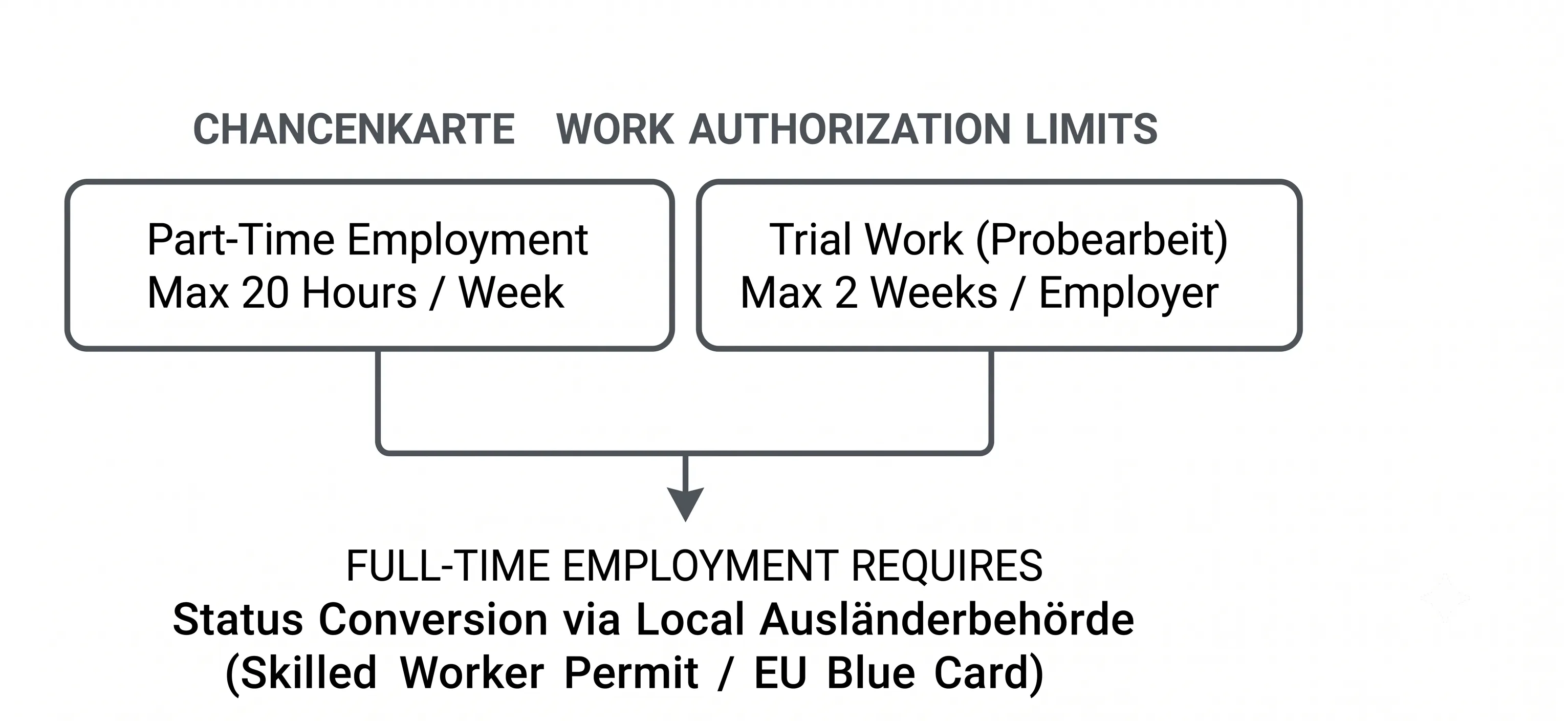
- Limite de 20 heures par semaine : lorsqu'ils recherchent un emploi à durée indéterminée, les titulaires de la carte ne peuvent exercer qu'un maximum de 20 heures par semaine dans le cadre d'un emploi standard.
- Conditions du stage d'essai : Le stage d'essai (Probearbeit) est limité à deux semaines consécutives au maximum par employeur potentiel. Il doit avoir pour objectif d'évaluer l'aptitude du candidat à occuper un poste qualifié, et non de répondre à des besoins généraux en main-d'œuvre.
- Passage à un emploi à temps plein : pour passer à un emploi à temps plein, il faut transformer la carte en un permis de séjour standard pour travailleur qualifié (en vertu des articles 18a et 18b de la loi sur le séjour [AufenthG]) ou en une « carte bleue européenne ».
Un cas concret survenu à Hambourg illustrant les mesures que les RH ont dû mettre en place concernant l'enregistrement de l'adresse lors du changement : le passage de la « Chancenkarte » à la « Carte bleue européenne » en Allemagne
Comparaison des visas : la « Chancenkarte » par rapport aux autres voies d'accès à l'Allemagne
Le choix de la procédure d'immigration la plus adaptée dépend de l'urgence du recrutement, de la localisation du candidat, du niveau de rémunération et de la complexité du poste.
1. Carte « Opportunity Card » ou visa pour travailleurs qualifiés (ouvriers et métiers techniques)
Les responsables des ressources humaines chargés du recrutement d'ouvriers, de spécialistes de la logistique, d'ouvriers du bâtiment ou d'aides-soignants comparent souvent la « Opportunity Card » (section 20a) au visa traditionnel pour travailleurs qualifiés (sections 18a/18b).
- Carte « Opportunité » (article 20a) :
- Idéal pour : repérer des talents polyvalents, constituer des viviers de candidats et tester ces derniers sur place dans le cadre de missions à l'essai avant de leur proposer un contrat à durée indéterminée.
- Offre d'emploi : non requise à l'entrée sur le territoire allemand.
- Charge financière : supportée principalement par le candidat via des comptes bloqués (13 092 €).
- Avantage pour l'employeur : aucun frais de parrainage initial ; disponibilité immédiate sur place.
- Visa de travailleur qualifié (articles 18a et 18b) :
- Idéal pour : le recrutement immédiat et direct pour des postes vacants confirmés dans les métiers en pénurie (par exemple, électriciens, mécaniciens, plombiers, aides-soignants).
- Offre d'emploi : obligatoire avant toute demande de visa.
- Seuils salariaux (2026) : salaire annuel brut minimum de 45 934,20 € (3 828 € par mois) pour les métiers en pénurie ; 50 700 € pour les métiers ne faisant pas l'objet d'une pénurie.
- Avantage pour l'employeur : intégration à temps plein dès l'arrivée ; parcours direct vers la pérennisation de l'emploi (éligibilité au permis de séjour définitif dès 21 à 36 mois avec un niveau B1 en allemand).
À lire également :
Pour les candidats disposant d'une solide expérience mais ne possédant pas de diplôme officiellement reconnu, il existe une troisième voie : le permis de travail allemand fondé sur l'expérience, prévu à l'article 19c.
2. Tableau comparatif : « Chancenkarte » vs. visa de formation vs. Carte bleue européenne
À lire également :
Référence complète des seuils pour 2026, incluant les taux applicables aux métiers en pénurie et aux jeunes diplômés : seuils salariaux de la Carte bleue européenne pour l'Allemagne en 2026
Procédure de candidature, coûts et délais
Accompagnez vos candidats potentiels non ressortissants de l'UE tout au long des principales étapes opérationnelles nécessaires à l'obtention de leur carte.
1. Documents requis pour le dossier de candidature
- Passeport en cours de validité : délivré au cours des 10 dernières années et dont la durée de validité restante est d'au moins 6 mois.
- Formulaires de candidature : à remplir via le portail officiel VIDEX.
- Photos d'identité : deux photos récentes au format passeport.
- Justificatifs de qualification : diplômes universitaires, diplômes professionnels ou attestation de reconnaissance Anabin.
- Certificats de langue : certificats officiels de niveau A1 en allemand (par exemple, Goethe-Institut, Telc) ou de niveau B2 en anglais (par exemple, IELTS, TOEFL).
- Justificatifs financiers : relevé de compte bloqué (13 092 €), contrat de travail à temps partiel ou déclaration de prise en charge officielle (Verpflichtungserklärung).
- CV : présentant de manière détaillée le parcours professionnel chronologique et la formation.
Pour la procédure relative au titre de séjour en Allemagne, veuillez vous reporter à la liste des documents requis : Liste des documents requis pour la demande et le renouvellement d'un titre de séjour en Allemagne
2. Où postuler et informations sur la nomination
- Depuis l'étranger : les candidats doivent déposer leur dossier à l'ambassade, au consulat d'Allemagne ou dans un centre VFS Global de leur pays d'origine (ou en ligne via le portail des services consulaires, lorsqu'il est disponible). Les rendez-vous pour la collecte des données biométriques doivent être honorés en personne.
- En Allemagne : les ressortissants de pays tiers titulaires d'un titre de séjour valide autorisant un changement de statut peuvent déposer leur demande directement auprès du service des étrangers (Ausländerbehörde) de leur lieu de résidence.
- Délais de prise de rendez-vous : les candidats sont invités à prendre rendez-vous à l'ambassade 2 à 3 mois à l'avance en raison de la forte demande dans certaines régions, telles que l'Asie du Sud et l'Afrique de l'Ouest.
Vérifiez les délais d'attente actuels des consulats avant de fixer une date de début : outil d'estimation des délais d'attente pour les rendez-vous de visa en Allemagne
3. Coûts et délais de traitement
- Frais de visa/titre de séjour : 75 € pour le visa national délivré à l'étranger ; 100 € pour le titre de séjour délivré sur place par l'Ausländerbehörde.
- Délai de traitement : le délai de traitement standard est compris entre 3 et 5 mois, depuis le dépôt de la demande jusqu'à la délivrance du visa.
Tous les frais de visa et de titre de séjour pour l'Allemagne réunis en un seul endroit, mis à jour pour 2026 : tout ce qu'il faut savoir sur les frais de visa pour l'Allemagne – visas de long séjour, de court séjour et titres de séjour
4. Attentes salariales lors du passage à un contrat à durée indéterminée
Une fois qu'un candidat accède à un emploi à durée indéterminée, les barèmes salariaux s'alignent sur les taux du marché et les seuils légaux en matière d'immigration :
- Spécialistes en informatique : peuvent prétendre à une Carte bleue européenne avec un seuil salarial réduit fixé à 45 934,20 € par an (2026). L'exigence d'un diplôme universitaire n'est pas applicable aux professionnels de l'informatique justifiant d'au moins 3 ans d'expérience professionnelle pertinente au cours des 7 dernières années.
- Autres professions qualifiées : les conditions standard applicables aux travailleurs qualifiés s'appliquent, sous réserve des contrôles de parité salariale effectués par l'Agence fédérale pour l'emploi (BA) afin de garantir le respect des normes du marché du travail local.
Vérifiez que l'offre respecte le seuil requis avant la signature du contrat : outil de vérification du salaire pour la Carte bleue européenne de l'employeur
Statistiques récentes et actualités du marché
- Croissance du nombre de cartes délivrées : rien qu’entre juin et octobre 2024, plus de 2 500 cartes « Opportunity » ont été délivrées par les représentations diplomatiques allemandes.
- Principaux groupes démographiques : les professionnels indiens constituent le groupe le plus important de titulaires de carte (environ 31 %), suivis par les candidats éligibles originaires de Chine, de Turquie, du Pakistan et du Nigeria.
- Centralisation des procédures : L'Allemagne s'emploie activement à centraliser la gestion de l'immigration au sein d'autorités fédérales spécialisées afin de réduire les délais moyens de traitement des demandes de visa jusqu'à 40 %.
Quelle orientation la politique allemande va-t-elle prendre concernant les filières destinées aux travailleurs peu qualifiés par rapport à celles destinées aux travailleurs qualifiés ? En juin 2026, l’Allemagne passera d’une politique axée sur les travailleurs immigrés à une politique axée sur l’élite qualifiée.
Comment Jobbatical simplifie la procédure de la « Chancenkarte » pour les employeurs
La gestion des changements de statut, des retards dans les formalités d'enregistrement locales et des démarches auprès des services d'immigration peut mettre à rude épreuve les équipes RH internes. Jobbatical propose une gestion complète de la relocalisation et de la conformité afin de rationaliser votre processus de recrutement international :
- Conversion sans heurts du statut : nous prenons en charge l'ensemble des démarches nécessaires pour transformer la « Chancenkarte » de votre collaborateur en permis de travail à temps plein pour travailleur qualifié ou en Carte bleue européenne.
- Conformité et immatriculation locales : notre équipe locale aide les nouveaux collaborateurs à s'immatriculer (Anmeldung), à souscrire une assurance maladie et à faire vérifier leurs documents.
- Accélération de la mise en production : l'allègement des charges administratives réduit les délais d'intégration et élimine les risques liés à la conformité pour votre entreprise.
Avertissement : les règles en matière d'immigration changent assez fréquemment ; veuillez vous renseigner auprès de sources officielles ou nous contacter pour obtenir les dernières informations avant de prendre toute décision.
Foire aux questions sur la « Chancenkarte » (carte des opportunités) allemande à l'intention des équipes RH

.svg)

.svg)